Ubud Monkey Forest Buffer Zone Permits Costs Bali
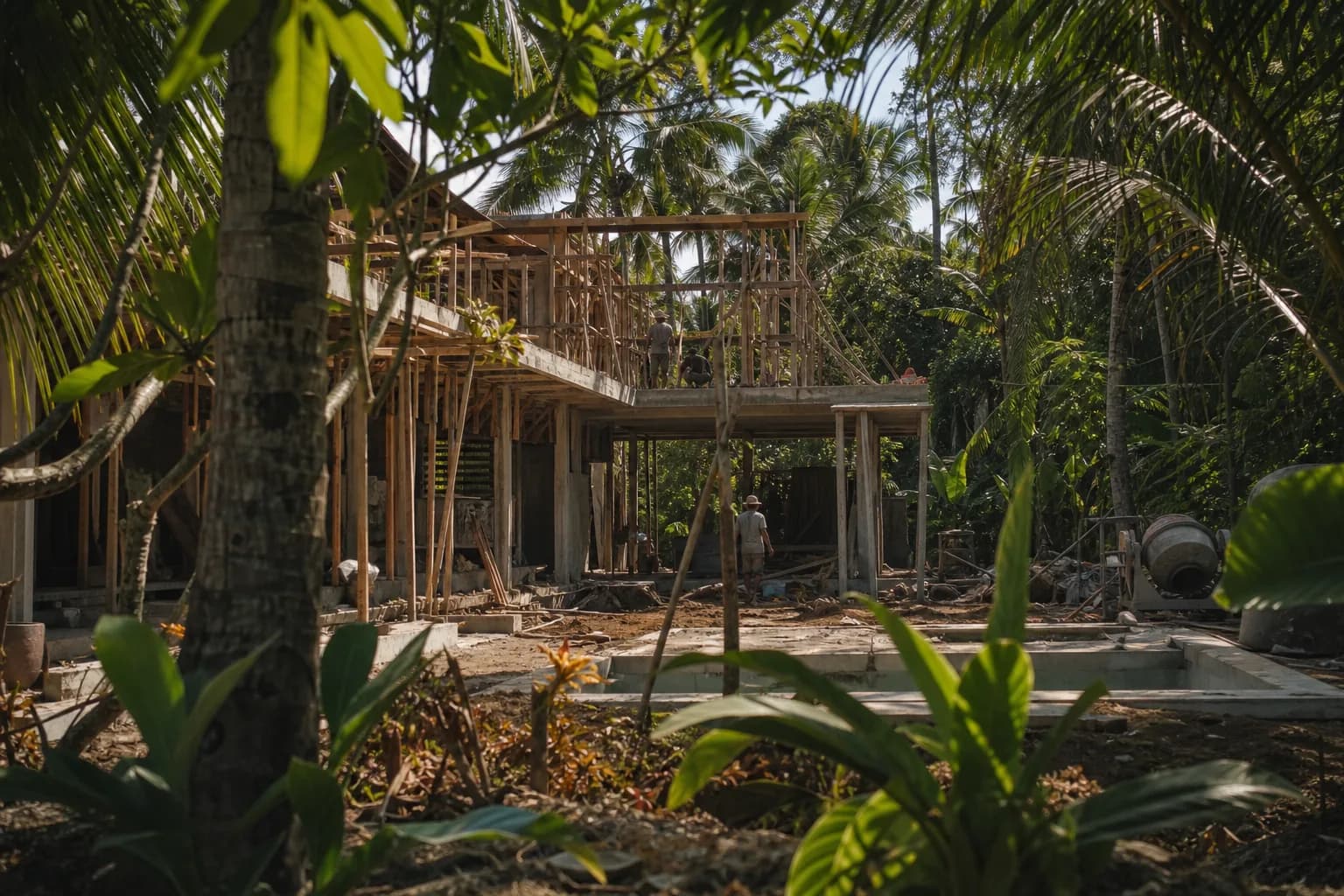
The Ubud Monkey Forest Buffer Zone Construction Challenge
Properties within 500 meters of the Sacred Monkey Forest Sanctuary in Ubud face unique construction constraints that most foreign buyers discover only after land purchase. While Bali’s Gianyar Regency doesn’t enforce formal “wildlife setback permits” as a separate regulatory category, properties in this culturally sensitive zone encounter layered restrictions through traditional village (adat) regulations, environmental impact assessments, and heightened scrutiny during IMB (building permit) applications. The construction engineering challenge isn’t wildlife corridors in the Western conservation sense—it’s navigating the intersection of sacred forest boundaries, macaque territorial behavior, traditional Balinese spatial codes, and modern structural requirements. Developers who treat this as standard residential zoning face permit delays averaging 4-7 months beyond typical timelines and unexpected design modifications costing $12,000-$28,000 in architectural revisions and structural adaptations.
Technical Framework: Sacred Forest Proximity and Construction Regulations
The Ubud Monkey Forest operates under the management of Padangtegal village’s customary council (desa adat), creating a regulatory environment where traditional law (awig-awig) intersects with national building codes. Properties within the 500-meter radius don’t require separate “wildlife permits,” but construction applications trigger three distinct review layers that function as de facto buffer zone controls.
Adat Village Construction Protocols
The Padangtegal customary council maintains unwritten but strictly enforced spatial guidelines for properties bordering the 12.5-hectare sanctuary. New construction within 200 meters of forest boundaries requires formal presentation to the banjar (neighborhood council) before provincial permit applications begin. These presentations assess structural height relative to sacred tree canopies, building orientation concerning temple sight lines, and potential disruption to macaque movement patterns between forest zones and surrounding compounds.
Engineering teams must document that foundation excavation won’t destabilize root systems of heritage trees extending beyond property lines—a geotechnical consideration absent from standard soil reports. Properties at 150-300 meters typically face height restrictions of 12 meters maximum (approximately three stories), compared to 15-meter allowances in central Ubud areas. This isn’t codified in written regulations but enforced through permit approval discretion.
Environmental Impact Assessment Triggers
Gianyar Regency’s environmental office (Dinas Lingkungan Hidup) applies heightened AMDAL (environmental impact analysis) requirements to construction projects within culturally significant zones. While residential villas under 5,000 square meters normally qualify for simplified UKL-UPL environmental management plans, properties within 400 meters of the Monkey Forest frequently require full AMDAL documentation—a process adding 3-5 months and $8,000-$15,000 in consultant fees.
The assessment focuses on waste management systems (macaques accessing construction debris), noise pollution during sacred ceremony periods, and water runoff affecting forest hydrology. Structural engineers must specify closed waste systems, sound-dampening construction schedules, and drainage designs that don’t redirect runoff toward sanctuary boundaries. These aren’t standard villa construction specifications—they require specialized tropical engineering adaptations.
IMB Application Complications
Building permit applications for buffer zone properties undergo additional technical review by the Gianyar Cultural Heritage Office (Dinas Kebudayaan). Reviewers assess architectural compatibility with Padangtegal’s traditional aesthetic guidelines—not merely the standard Bali Governor Regulation No. 9/2009 on spatial planning, but village-specific interpretations emphasizing natural material ratios, roof pitch angles matching temple architecture, and wall permeability allowing visual connection to surrounding landscape.
Concrete-dominant modern designs face rejection or mandatory revision. Successful applications typically demonstrate 40-60% natural material usage (local stone, bamboo structural elements, alang-alang roofing), even when these materials increase construction costs by 18-25% compared to standard cement-block construction. The engineering challenge involves achieving tropical durability standards while meeting aesthetic requirements that weren’t designed for structural longevity.
Hidden Risks Foreign Developers Consistently Miss
The primary risk isn’t regulatory—it’s the assumption that proximity to Ubud’s premier tourist attraction adds property value without corresponding construction complexity. Three critical oversights emerge repeatedly in buffer zone projects:
Macaque Territorial Behavior and Building Damage
Properties within 300 meters experience regular macaque incursions, particularly during fruiting seasons (October-March). Standard villa designs with open pavilions, accessible rooflines, and decorative water features become maintenance liabilities. Monkeys damage roof tiles searching for nesting materials, compromise waterproofing membranes, and destroy landscaping. Effective mitigation requires engineering solutions: reinforced roof edge details, enclosed utility areas, and strategic barrier planting—additions costing $6,000-$11,000 beyond standard construction budgets.
Ceremony Schedule Construction Blackouts
Padangtegal village observes 18-22 major ceremony days annually when construction noise is prohibited within 500 meters of temple complexes surrounding the forest. Unlike negotiable work stoppages, these are absolute—violations result in work-stop orders and banjar fines of Rp 5-15 million ($320-$960). Construction schedules must build in 25-30 additional days, extending typical 8-month villa builds to 10-11 months. Contractors unfamiliar with local ceremony calendars consistently underestimate timelines, creating cash flow problems for owners paying extended accommodation costs.
Land Title Complications in Transitional Zones
Several parcels marketed as “near Monkey Forest” occupy transitional areas where customary forest boundaries (marked by sacred shrines) don’t align with modern cadastral surveys. Due diligence must verify that land certificates don’t overlap with forest expansion zones claimed by adat councils. This requires engaging local land consultants who understand traditional boundary markers—not merely reviewing SHM (freehold) or leasehold documents. Properties with boundary disputes face construction permit denials regardless of title validity, a risk standard legal reviews miss.
Step-by-Step Process for Buffer Zone Construction Approval
Phase 1: Pre-Purchase Due Diligence (4-6 Weeks)
Before land acquisition, commission a specialized site assessment covering three areas beyond standard surveys. First, engage a local land consultant to verify customary boundary recognition—confirm the banjar acknowledges cadastral boundaries and no sacred tree claims extend into the parcel. Second, obtain written confirmation from Padangtegal village office regarding construction height limits and material requirements for the specific location. Third, conduct macaque activity monitoring during early morning hours (6-8 AM) for seven consecutive days to assess territorial patterns—properties with daily troop movements require significantly different design approaches.
Request that sellers provide documentation of neighboring properties’ IMB approvals, revealing actual (not theoretical) restrictions applied to similar parcels. This due diligence costs $1,200-$2,400 but prevents discovering deal-breaking restrictions post-purchase.
Phase 2: Banjar Presentation and Preliminary Approval (3-5 Weeks)
Before engaging architects, present construction intentions to the banjar council through a formal meeting arranged by your land consultant. Prepare a simple site plan showing proposed building footprint, approximate height, and material concepts. This isn’t a technical review—it’s relationship-building and gauging receptivity to your project scale. Banjar feedback at this stage is advisory but practically binding; proceeding against expressed concerns guarantees permit complications later.
Expect requests for ceremonial contributions (typically Rp 3-8 million / $190-$510) and agreement to employ minimum percentages of local labor (usually 40-60% of construction crew). Document these commitments in writing through your consultant—they become conditions of subsequent permit approvals.
Phase 3: Architectural Design with Buffer Zone Specifications (8-12 Weeks)
Brief your architect specifically on buffer zone requirements: height restrictions confirmed during banjar consultation, natural material ratios, macaque-resistant detailing, and ceremony-compatible construction phasing. Request two design iterations—one meeting minimum compliance, one optimized for approval speed. The optimized version typically incorporates 15-20% more natural materials, lower profile structures, and traditional Balinese spatial organization, adding $22,000-$38,000 to construction costs but reducing permit timeline by 6-10 weeks.
Structural engineering must address foundation designs that avoid sacred tree root zones (requiring soil testing at 8-12 points rather than standard 4-6 points) and drainage systems directing runoff away from forest boundaries. These specifications should appear in construction drawings submitted for permits—retrofitting after approval requires amendment applications adding 4-8 weeks.
Phase 4: Environmental Documentation and IMB Application (12-20 Weeks)
Commission UKL-UPL or full AMDAL documentation from environmental consultants experienced with Gianyar cultural zone projects. Standard Bali environmental consultants often lack familiarity with Monkey Forest-specific requirements, causing revision cycles. Specify that documentation must address macaque interaction mitigation, ceremony schedule construction phasing, and forest hydrology protection—elements absent from template environmental plans.
Submit IMB applications through the Gianyar One-Stop Service (DPMPTSP) with complete environmental documentation, banjar approval letters, and structural drawings showing buffer zone adaptations. Applications missing any element face automatic rejection, restarting the 12-20 week review clock. Engage a permit expeditor familiar with Gianyar cultural heritage reviewers—their relationships reduce revision requests that extend timelines.
Phase 5: Construction Execution with Ongoing Compliance (8-14 Months)
Provide your construction manager with the village ceremony calendar and enforce absolute compliance with noise restrictions. Install macaque deterrent systems (reinforced roof edges, enclosed waste areas) during structural phase—retrofitting after finishing work costs 40-60% more. Schedule monthly check-ins with banjar representatives to address any community concerns before they escalate to formal complaints. Budget for ceremonial contributions at foundation laying, roof completion, and occupancy—typically Rp 1.5-3 million ($95-$190) per ceremony, but essential for maintaining community goodwill that prevents work stoppages.
Realistic Cost and Timeline Implications
Buffer zone construction carries premium costs across multiple categories. Environmental documentation adds $8,000-$15,000 for full AMDAL versus $2,500-$4,500 for standard UKL-UPL. Architectural designs meeting natural material requirements increase construction costs by $35,000-$65,000 for a typical 250-square-meter villa compared to modern concrete designs. Macaque-resistant detailing and barrier landscaping add $6,000-$11,000. Permit expeditor fees for cultural zone projects run $3,500-$6,500 versus $1,800-$3,200 for standard Ubud areas.
Timeline extensions are significant: permit approval averages 16-24 weeks versus 10-14 weeks for non-buffer properties. Construction duration extends from typical 8-9 months to 10-13 months due to ceremony blackout days and material sourcing for natural elements. Total project timeline from land purchase to occupancy averages 22-28 months for buffer zone properties versus 16-20 months for standard Ubud construction.
These aren’t optional premium features—they’re minimum requirements for permit approval and long-term operational viability. Properties attempting to minimize these costs face permit rejections, construction delays, and ongoing maintenance problems that ultimately cost more than upfront compliance investments.
Frequently Asked Questions: Monkey Forest Buffer Zone Construction
Do I need special permits to build within 500 meters of the Monkey Forest?
There’s no separate “wildlife setback permit,” but properties in this zone require enhanced environmental documentation (often full AMDAL instead of simplified UKL-UPL), formal banjar approval before IMB application, and Cultural Heritage Office review of architectural designs. These function as layered approval requirements that effectively regulate buffer zone construction more strictly than standard residential areas. Expect 6-10 additional weeks in the permit process and $12,000-$22,000 in extra documentation and consultant fees compared to properties outside the 500-meter radius.
What construction restrictions apply to properties near the Sacred Monkey Forest?
Height limits typically cap at 12 meters (versus 15 meters in other Ubud areas), architectural designs must incorporate 40-60% natural materials (local stone, bamboo, traditional roofing), and structural plans must demonstrate forest hydrology protection and macaque deterrent features. Construction schedules must accommodate 18-22 annual ceremony blackout days when noise is prohibited. These restrictions aren’t published in formal regulations but enforced through permit approval discretion by Gianyar cultural heritage reviewers and Padangtegal village councils.
How do I protect my property from macaque damage during and after construction?
Engineering solutions include reinforced roof edge details preventing tile displacement, enclosed utility and waste areas eliminating food access, strategic barrier planting with species macaques avoid (citrus, bougainvillea), and eliminating open food sources like accessible fruit trees. Install these systems during construction—retrofitting costs 40-60% more. Budget $6,000-$11,000 for
 3104 m²11 month(s)from 99.000 USD
TALA 100

Want to calculate?
 164 m²7 month(s)from 79.000 USD
TALA TWO
 3180 m²7 month(s)from 142.000 USD
Vasudeva
 2144 m²11 month(s)from 104.000 USD
Narayana
 4344 m²16 month(s)from 290.000 USD
Radha
164 m²7 month(s)from 79.000 USDPrivate: Haridas Villas, Tegallalang
 1from 198.000 USD
Private: Haridas Villas
 3173 m²6 month(s)from 125.000 USD
TALA FOUR
 3127 m²9 month(s)from 177.000 USD
Mukunda
 3124 m²6 month(s)from 123.000 USD
TALA 8
 172 m²8 month(s)from 120.000 USD
Keshava
Start With Real Numbers, Not Guesses
Before buying land or finalizing a design, check the realistic build cost range for your project in Bali.
Our team reviews your inputs and gives a grounded estimate.
Available lands
 1720 m²2 min$ 241478Bali, Tabanan
 3100 m²15 min$ 257697Bali, Tegallalang
 29000 m²6 min$ 3857143Bali, Tabanan
 3100 m²20 min$ 272968Bali, Tabanan
 220 m²2 min$ 66565Bali, Cemagi
 550 m²15 min$ 164594Bali, Mengwi
 1350 m²5 min$ 283467Bali, Pecatu
 6000 m²30 min$ 55419Bali, Tabanan
 1430 m²5 min$ 209862Bali, Klungkung
 1660 m²10 min$ 343448Bali, Kerobokan
 2200 m²3 min$ 183842Bali, Berawa
 3300 m²15 min$ 449889Bali, Tabanan
 3254 m²5 min$ 631800Bali, All
 325 m²15 min$ 44472Bali, Ungasan
 2800 m²2 min$ 713793Bali, Kedungu
Essential Bali build & buy guides
- Bali villa construction cost per m² in 2026
- How much will your villa cost? Calculator
- Building a villa in Bali: the complete guide
- Buying land in Bali: step-by-step for foreigners
- Bali villa investment: yields, risks, returns
- Leasehold vs freehold: what foreigners can own
- Construction defect liability & 10-year warranty
- Bali building codes and construction standards
Related guides
Resin-Infused Plaster Finishes: Anti-Salt Systems Bali
Expert technical guide: Resin-Infused Plaster Finishes: Anti-Salt Systems Bali
8 min read
Prefinished Timber Joinery: Silicone Seals Fixings Bali
Professional prefinished timber joinery installation in Bali with silicone seals and fixings for durable weatherproof performance and a premium finish.
10 min read
Polished Concrete Microtopping: Surface Prep Sealants Bali
Discover Bali s polished concrete microtopping: expert surface prep, durable sealants, and a flawless finish for modern floors with minimal maintenance.
9 min read