Tabanan Rice Field Conversion Permits Rezoning Costs Bali
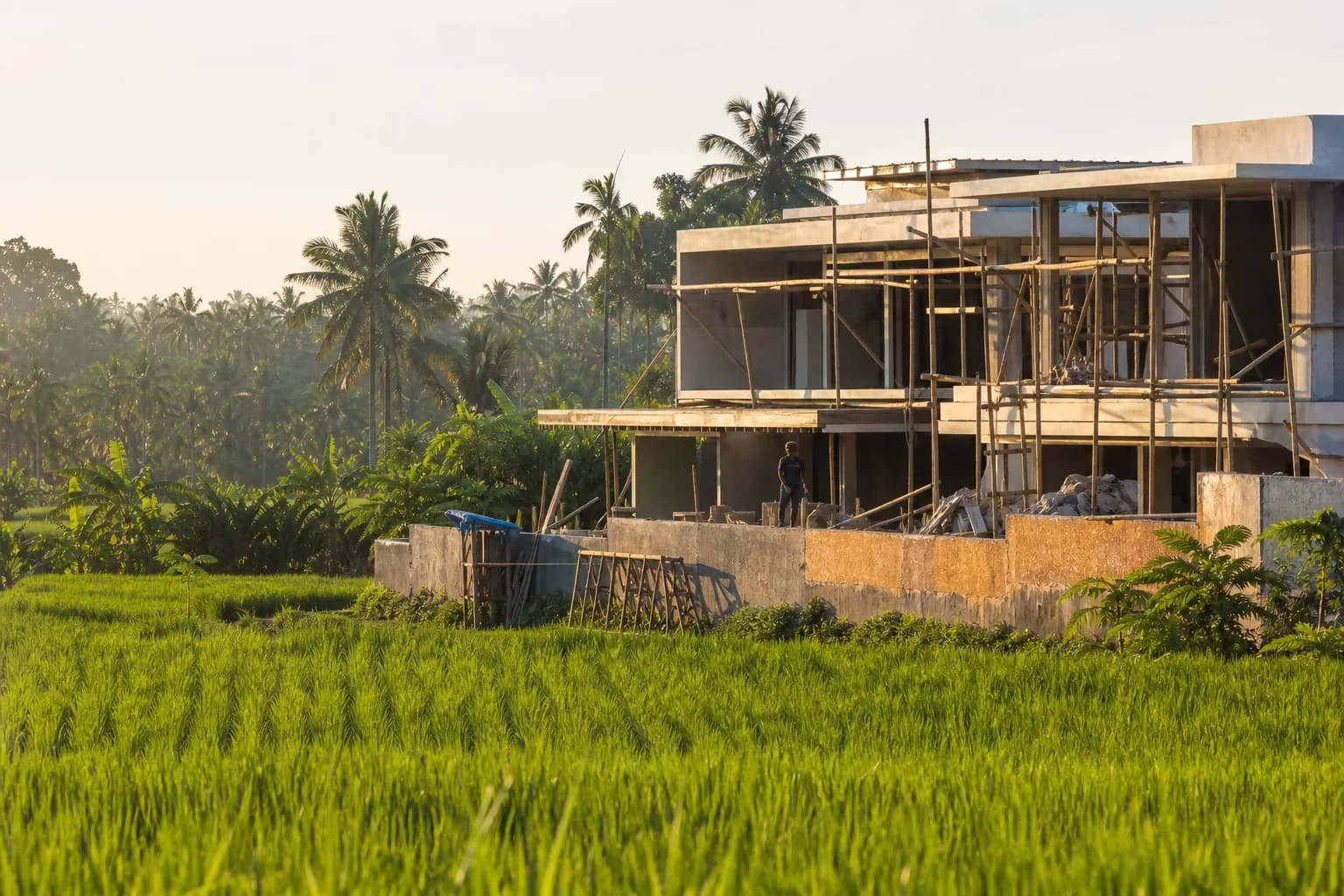
Why Tabanan Rice Field Conversion Has Become Bali’s Most Complex Land Development Challenge
Tabanan regency holds approximately 40% of Bali’s remaining productive rice terraces, making it the island’s agricultural heartland. Since 2024, the provincial government has implemented strict moratoriums on converting productive sawah (rice fields) to commercial development, creating a regulatory maze for anyone considering land acquisition in this region. The technical challenge isn’t just obtaining permits—it’s understanding whether conversion is legally possible at all, what rezoning pathways exist under current spatial planning laws, and how soil engineering requirements differ dramatically from standard Bali villa construction on stable ground.
The Technical Reality of Tabanan Agricultural Land Rezoning Under Current Regulations
Tabanan’s rice field parcels fall under three distinct zoning classifications in Bali’s 2021-2041 Spatial Planning Regulation (RTRW): Lahan Pertanian Pangan Berkelanjutan (LP2B – Sustainable Food Agricultural Land), Lahan Pertanian Non-LP2B, and Kawasan Pertanian with conditional development allowances. Each classification carries fundamentally different conversion possibilities and cost structures.
LP2B-designated rice fields—which comprise roughly 65% of Tabanan’s sawah—are legally protected under Presidential Regulation No. 59/2019. Conversion permits for commercial villa construction are effectively prohibited. The only legal pathway involves demonstrating the land serves “strategic national interest” (infrastructure, government facilities), a threshold impossible for private residential development. Attempting to purchase LP2B land for villa construction represents the single most common legal failure we observe in Tabanan projects.
Non-LP2B agricultural land in Tabanan can theoretically undergo rezoning, but requires navigating a multi-agency approval process involving the Tabanan Land Office (BPN), Provincial Spatial Planning Agency (DPMPTSP), Environmental Impact Assessment (AMDAL/UKL-UPL), and village-level adat approval. The technical process involves:
- Spatial conformity verification: Confirming the parcel falls within zones permitting residential development under the district’s Rencana Detail Tata Ruang (RDTR). Many Tabanan subdistricts lack updated RDTR documents, creating legal ambiguity.
- Land use change permit (Izin Perubahan Penggunaan Tanah): Requires soil analysis, hydrology impact studies, and proof the conversion won’t disrupt irrigation systems (subak) serving neighboring parcels.
- Environmental clearance: Rice fields are classified as water-dependent ecosystems. Converting parcels larger than 5,000m² typically triggers full AMDAL requirements, adding 8-12 months to approval timelines.
- Subak system compensation: Tabanan’s traditional irrigation cooperatives (subak) hold legal standing to block conversions that compromise water distribution. Compensation agreements—often involving infrastructure contributions or alternative water source development—are legally binding prerequisites.
The engineering reality compounds these regulatory challenges. Active rice fields in Tabanan sit 40-80cm below surrounding berm levels, with saturated clay soils (bearing capacity typically 0.8-1.2 kg/cm²) unsuitable for standard villa foundations. Successful tropical construction engineering on converted sawah requires:
Soil stabilization and compaction: Minimum 12-month drying period after final harvest, followed by staged filling with select granular material. Attempting to build within 18 months of active rice cultivation almost guarantees differential settlement and structural cracking.
Deep foundation systems: Standard umpak (pad) foundations fail on former rice fields. Projects require either bored pile foundations (15-20m depth to reach stable strata) or ground improvement through stone columns and geotextile reinforcement—adding USD $45-75/m² to foundation costs compared to stable land construction.
Drainage engineering: Former rice fields retain high water tables year-round. Perimeter drainage systems, sump pumps, and elevated floor slabs (minimum 60cm above natural grade) are non-negotiable for preventing chronic moisture infiltration.
Hidden Risks Buyers Miss When Evaluating Tabanan Rice Field Parcels
The “agricultural land” pricing trap: Brokers market Tabanan rice fields at IDR 15-35 million/are (USD $950-2,200/100m²), significantly below standard villa land prices. Buyers calculate apparent savings without accounting for conversion costs, extended timelines, and permit failure risk. When rezoning proves impossible, the land remains locked in agricultural use—resaleable only to farmers at agricultural valuations.
Subak water rights complications: Rice field parcels carry legal obligations to maintain irrigation flow to downstream parcels. Even after successful rezoning, subak organizations can enforce water easements across your property, limiting building placement and requiring permanent drainage channels. These obligations rarely appear in land certificates but carry legal enforceability through adat (customary) law systems.
The LP2B verification gap: Land certificates (SHM/HGB) don’t indicate LP2B status. Sellers and brokers frequently misrepresent protected farmland as “convertible.” The only authoritative verification comes from requesting the parcel’s LP2B status directly from Tabanan’s Agriculture Office (Dinas Pertanian)—a step fewer than 30% of buyers complete before purchase.
Soil contamination from agricultural chemicals: Decades of pesticide and fertilizer application leave residual contamination in rice field soils. While not typically hazardous for construction, these residues can leach into groundwater wells, requiring deeper bore wells (80-120m vs. standard 40-60m) and water treatment systems—adding USD $8,000-15,000 to site development costs.
Step-by-Step Process for Tabanan Rice Field Conversion Feasibility Assessment
Step 1: LP2B Status Verification (Week 1-2)
Before any purchase commitment, obtain written confirmation from Tabanan Agriculture Office (Jl. Gajah Mada No. 4, Tabanan) regarding the parcel’s LP2B designation. Request the official LP2B map overlay for the specific land certificate number. If designated LP2B, halt the process—conversion is legally prohibited regardless of broker claims.
Step 2: RTRW Zoning Confirmation (Week 2-3)
Visit Tabanan DPMPTSP office to verify the parcel’s zoning classification under the district’s spatial plan. Request written confirmation whether the location falls within zones permitting residential development (typically coded as “Perumahan” or “Permukiman”). Obtain the relevant RDTR map section if available for the subdistrict.
Step 3: Subak Consultation (Week 3-4)
Identify the subak organization managing irrigation for the parcel (information available from the village head/kelian dinas). Meet with subak leadership to discuss conversion intentions and assess potential objections. Document any water easement requirements or compensation expectations in writing.
Step 4: Geotechnical Investigation (Week 4-6)
Commission soil boring tests (minimum 3 test pits to 4m depth for parcels under 2,000m²) to determine bearing capacity, water table depth, and soil composition. This data is essential for both permit applications and accurate construction cost estimation. Expect costs of USD $1,200-2,500 depending on parcel size.
Step 5: Environmental Screening (Week 6-8)
Engage an environmental consultant to determine whether the project requires full AMDAL or simplified UKL-UPL documentation. This assessment considers parcel size, proximity to protected areas, and potential impacts on surrounding agricultural operations. Budget USD $2,500-4,000 for this preliminary screening.
Step 6: Formal Rezoning Application (Month 3-12)
If Steps 1-5 indicate feasibility, submit formal land use change application to Tabanan BPN, including: spatial conformity letter, environmental clearance, subak agreement, geotechnical report, and site development plan. Processing time ranges 6-14 months for straightforward cases, longer if appeals or additional studies are required.
Step 7: IMB Application with Modified Requirements (Month 12-16)
After successful rezoning, apply for building permit (IMB) through standard channels, but expect additional scrutiny on foundation design and drainage systems. Tabanan building officials typically require sealed engineer certifications for any construction on former agricultural land, adding USD $1,500-3,000 in professional fees.
Realistic Cost Ranges and Timeline Expectations for Tabanan Conversions
Permit and professional fees: USD $12,000-28,000 total, including rezoning application fees (USD $3,000-6,000), environmental documentation (USD $4,000-9,000), legal representation (USD $3,000-7,000), and geotechnical studies (USD $2,000-6,000). Costs scale with parcel size and complexity.
Subak compensation: Highly variable, ranging from token payments (USD $2,000-5,000) to substantial infrastructure contributions (USD $15,000-40,000) for parcels that significantly impact irrigation systems. Negotiated case-by-case with no standard formulas.
Site preparation premium: Former rice fields require USD $35-85/m² additional site work compared to standard land—including extended drying time, soil replacement, compaction, and drainage infrastructure. For a typical 1,000m² villa plot, budget USD $35,000-85,000 beyond standard site costs.
Foundation cost premium: Pile foundations or ground improvement add USD $45-75/m² to building footprint costs. A 300m² villa requires approximately USD $13,500-22,500 additional foundation investment compared to construction on stable ground.
Timeline reality: From initial feasibility assessment to IMB issuance: 18-28 months for successful conversions. This assumes no major complications. Projects encountering subak disputes, environmental appeals, or spatial plan ambiguities can extend to 36+ months.
Frequently Asked Questions: Tabanan Rice Field Development
Can I build a private villa on LP2B-designated rice fields in Tabanan if I maintain some rice cultivation on the property?
No. LP2B designation under Presidential Regulation 59/2019 prohibits any permanent structures on protected farmland, regardless of maintaining partial agricultural use. The regulation exists specifically to prevent incremental conversion of food-producing land. Some brokers suggest “agricultural villa” concepts, but these violate spatial planning law and risk demolition orders. The only legal construction on LP2B land involves temporary agricultural support structures (storage sheds under 50m²) that don’t require concrete foundations.
What’s the actual success rate for rezoning applications on non-LP2B rice fields in Tabanan?
Based on Tabanan DPMPTSP data from 2023-2025, approximately 40-45% of agricultural land rezoning applications receive approval, with significant variation by subdistrict. Kediri and Tabanan town areas show higher approval rates (55-60%) due to existing residential development patterns, while Penebel and Pupuan subdistricts see rejection rates above 70% due to provincial priorities maintaining agricultural zones. Applications fail most commonly due to LP2B misclassification (35% of rejections), subak objections (25%), and spatial plan non-conformity (30%).
How do Tabanan conversion costs compare to purchasing already-zoned residential land?
The total cost equation typically favors purchasing residential-zoned land. Example comparison for equivalent 1,500m² parcels: Rice field purchase (IDR 25 million/are) = USD $23,500 + conversion costs (USD $60,000-120,000) + extended timeline risk = USD $83,500-143,500 total. Residential-zoned land in similar Tabanan locations: USD $95,000-140,000 with immediate building capability. The rice field “discount” disappears once true conversion costs are included, while carrying substantially higher risk and 18-24 month delays. Review verified residential parcels for risk-comparison.
What happens if I purchase rice field land and the rezoning application gets rejected?
You own agricultural land with agricultural-use restrictions, resaleable only at agricultural land valuations (typically 40-60% below your purchase price if you paid “development potential” premiums). The land can be leased to farmers for rice cultivation (generating IDR 8-15 million/hectare/year), but cannot be developed for residential use. No legal mechanism exists to reverse the purchase or compel approval. This scenario affects approximately 15-20% of foreign buyers who purchase Tabanan rice fields through nominee arrangements without proper feasibility assessment.
Are there specific Tabanan subdistricts where rice field conversion is more feasible?
Yes. Kediri and Marga subdistricts, particularly areas within 3km of major roads (Jl. Raya Kediri, Jl. Denpasar-Gilimanuk), show higher conversion feasibility due to existing mixed-use development patterns and lower LP2B designation rates (35-45% of agricultural land vs. 70-80% in interior subdistricts). Coastal Tabanan areas (Kelating, Yeh Gangga) also permit easier conversion but face different challenges including coastal setback regulations and high water tables. Penebel, Pupuan, and Baturiti subdistricts maintain strict agricultural preservation policies with conversion approval rates below 25%.
Engineering-Driven Approach to Tabanan Agricultural Land Evaluation
Tabanan rice field conversion represents Bali’s most complex intersection of regulatory compliance, traditional water rights, and tropical soil engineering challenges. The romantic appeal of terraced sawah views must be balanced against 18-28 month approval timelines, USD $60,000-120,000 conversion cost premiums, and 40-55% application rejection rates. For buyers committed to Tabanan locations, purchasing residential-zoned land eliminates regulatory risk while providing immediate construction capabi
 4344 m²16 month(s)from 290.000 USD
Radha
 3173 m²6 month(s)from 125.000 USD
TALA FOUR
 3104 m²11 month(s)from 99.000 USD
TALA 100
 1from 198.000 USD
Private: Haridas Villas
 3127 m²9 month(s)from 177.000 USD
Mukunda
 3124 m²6 month(s)from 123.000 USD
TALA 8
 2144 m²11 month(s)from 104.000 USD
Narayana
 164 m²7 month(s)from 79.000 USD
Private: Haridas Villas, Tegallalang
164 m²7 month(s)from 79.000 USDTALA TWO

Want to calculate?
 3180 m²7 month(s)from 142.000 USD
Vasudeva
 172 m²8 month(s)from 120.000 USD
Keshava
Start With Real Numbers, Not Guesses
Before buying land or finalizing a design, check the realistic build cost range for your project in Bali.
Our team reviews your inputs and gives a grounded estimate.
Available lands
 700 m²20 min$ 90517Bali, Cepaka
 2500 m²5 min$ 609606Bali, Kedungu
 1200 m²2 min$ 155172Bali, Klungkung
 1300 m²10 min$ 312192Bali, Kutuh South Bali
 1375 m²10 min$ 447044Bali, Canggu
 610 m²10 min$ 165271Bali, Seminyak
 3900 m²10 min$ 432266Bali, Tabanan
 1430 m²5 min$ 209862Bali, Klungkung
 660 m²10 min$ 175567Bali, Mengwi
 4270 m²10 min$ 394397Bali, Ubud
 3000 m²15 min$ 738916Bali, Cepaka
 3300 m²15 min$ 449889Bali, Tabanan
 18900 m²2 min$ 6912931Bali, Pecatu
 1000 m²10 min$ 123154Bali, Jimbaran
 1700 m²10 min$ 632257Bali, Kuta
Essential Bali build & buy guides
- Bali villa construction cost per m² in 2026
- How much will your villa cost? Calculator
- Building a villa in Bali: the complete guide
- Buying land in Bali: step-by-step for foreigners
- Bali villa investment: yields, risks, returns
- Leasehold vs freehold: what foreigners can own
- Construction defect liability & 10-year warranty
- Bali building codes and construction standards
Related guides
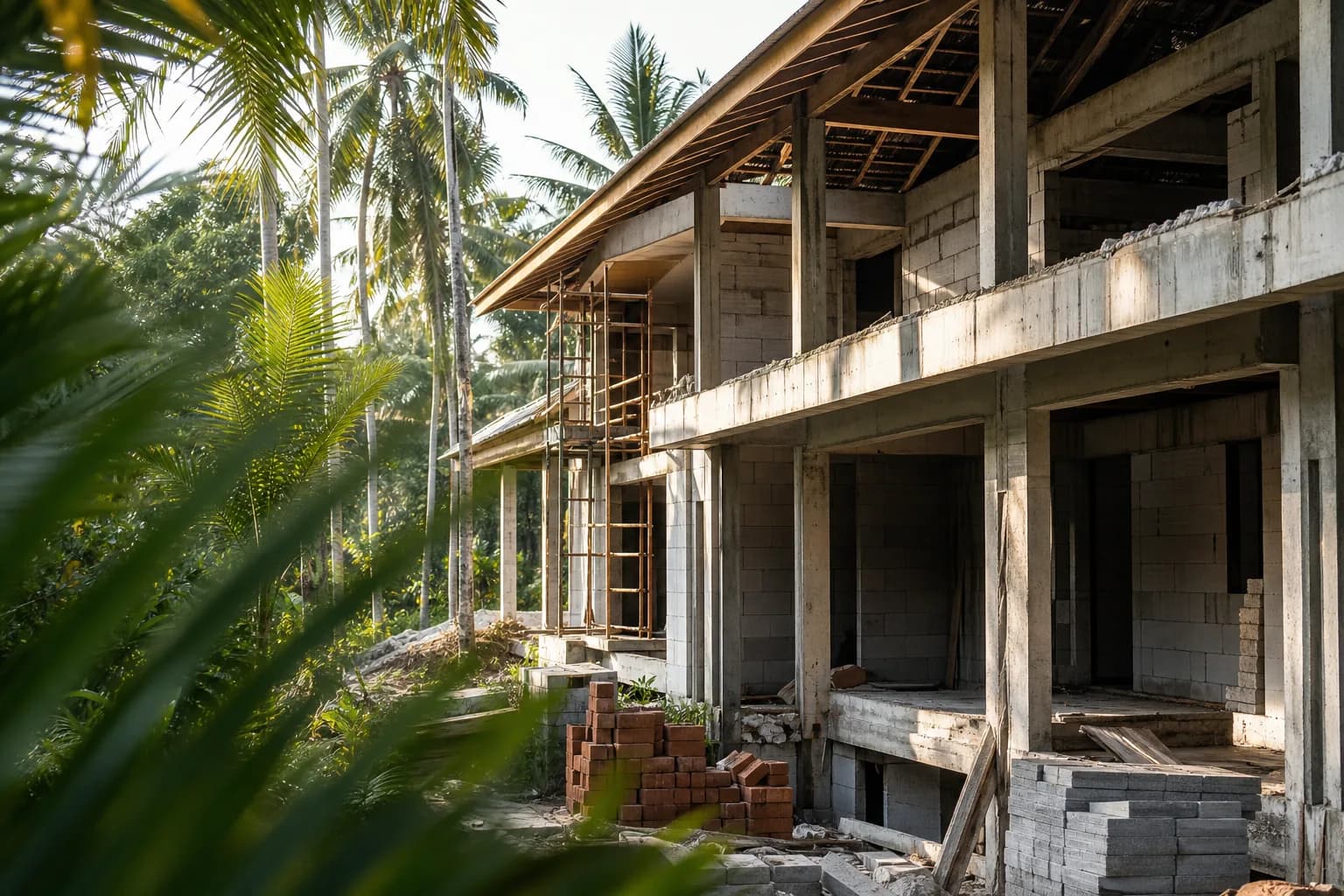
Sanur and Nusa Dua vs Canggu: Stability Plays vs Hype
Canggu gets the headlines; Sanur and Nusa Dua quietly deliver steadier returns to a different kind of buyer. An honest 2026 comparison of the stability markets against the hype market — prices, demand drivers, oversupply risk, and who should buy where.
7 min read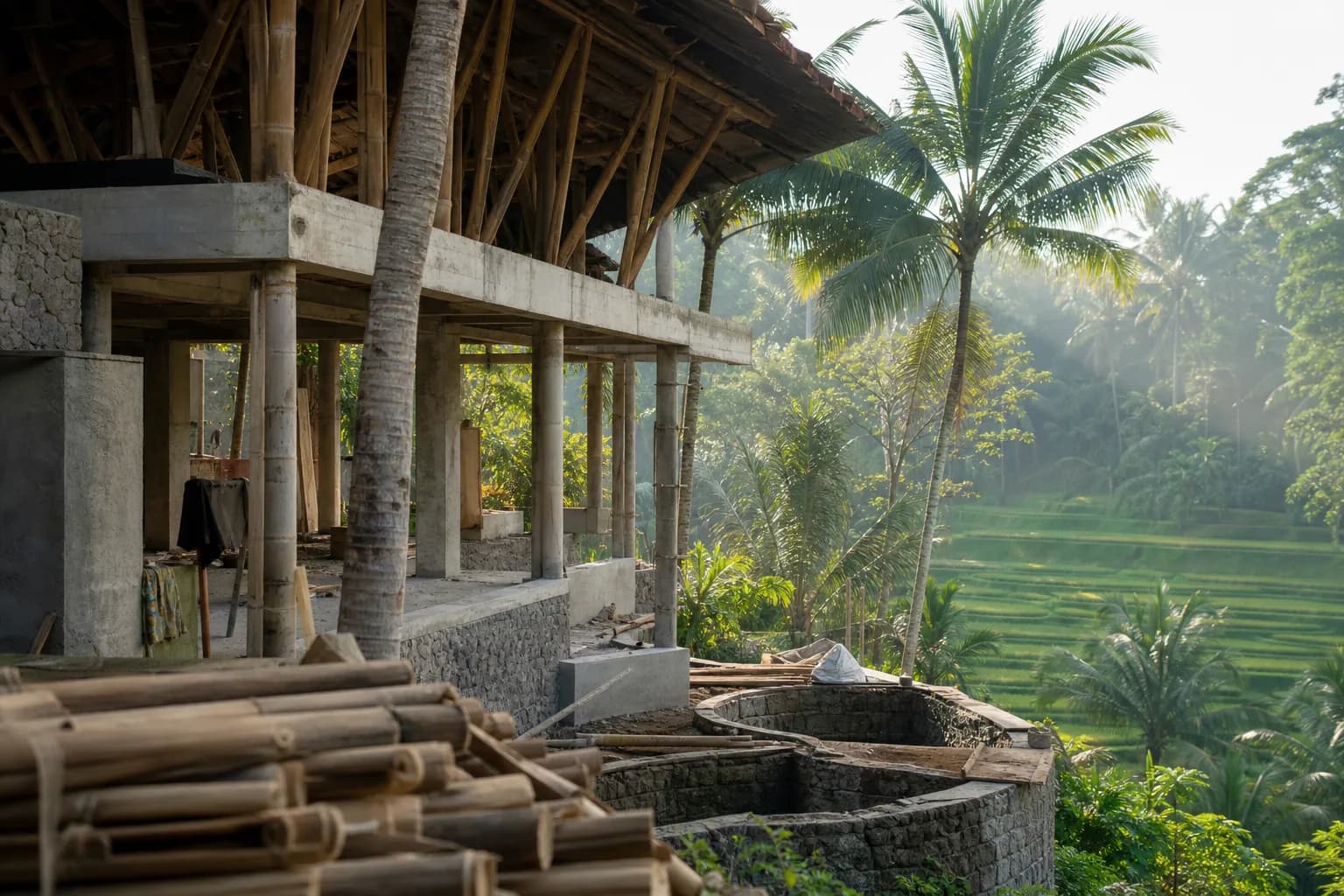
Ubud and the Wellness Market: Buying or Building for Retreats
Ubud is Bali's wellness capital, and retreat-focused property behaves differently from beach villas: longer stays, group bookings, lower volatility. Here is what the market rewards, what zoning allows, and what it costs to buy or build a retreat property in 2026.
8 min read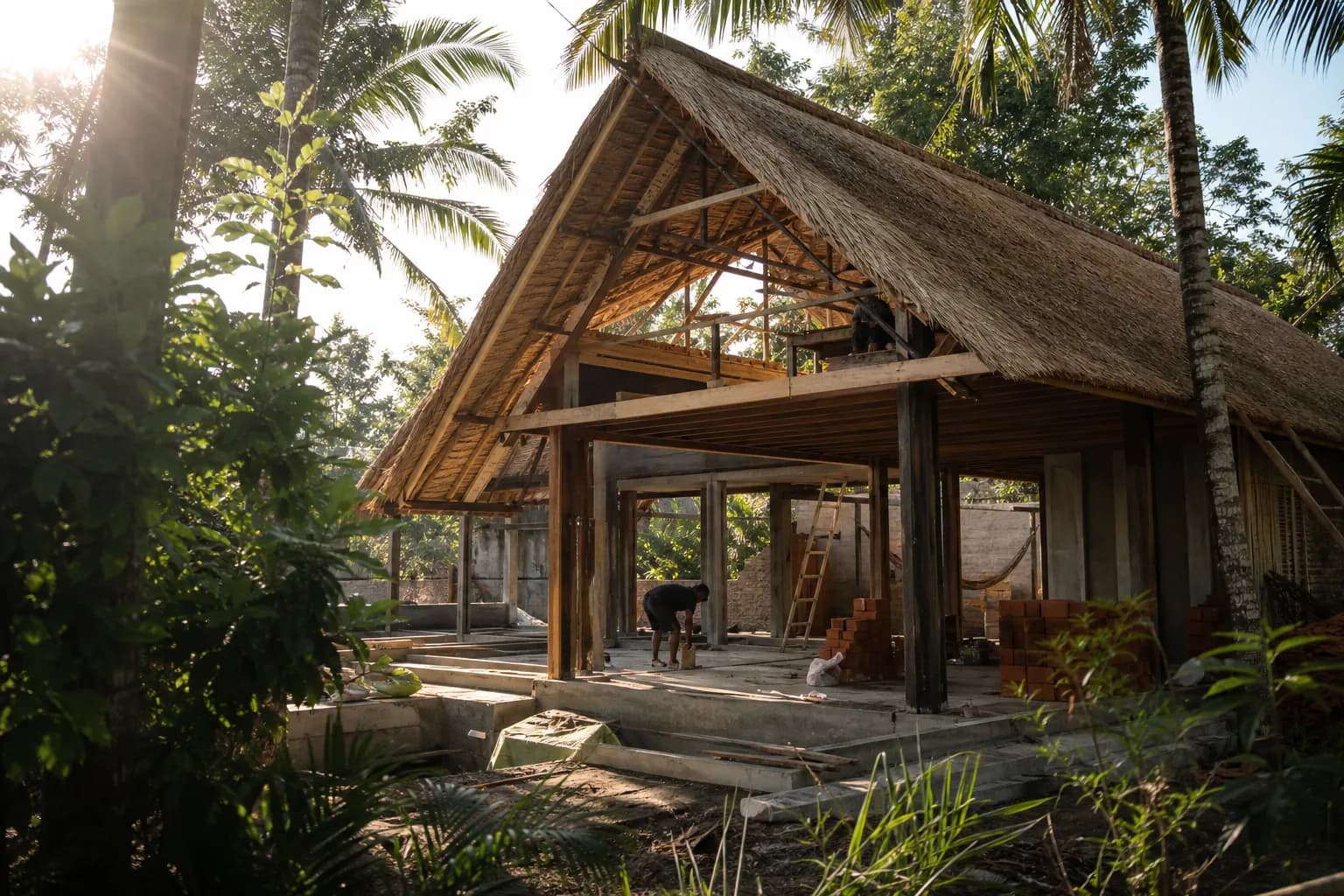
Buying and Building on the Bukit: Uluwatu, Bingin and Balangan from a Buyer's Seat
A buyer's-seat 2026 guide to the Bukit peninsula — Uluwatu, Bingin and Balangan land prices, the water problem nobody budgets, cliff setbacks after the 2025 Bingin demolitions, and how to build there properly.
7 min read