Sidemen Valley Retaining Wall Costs Permits Bali
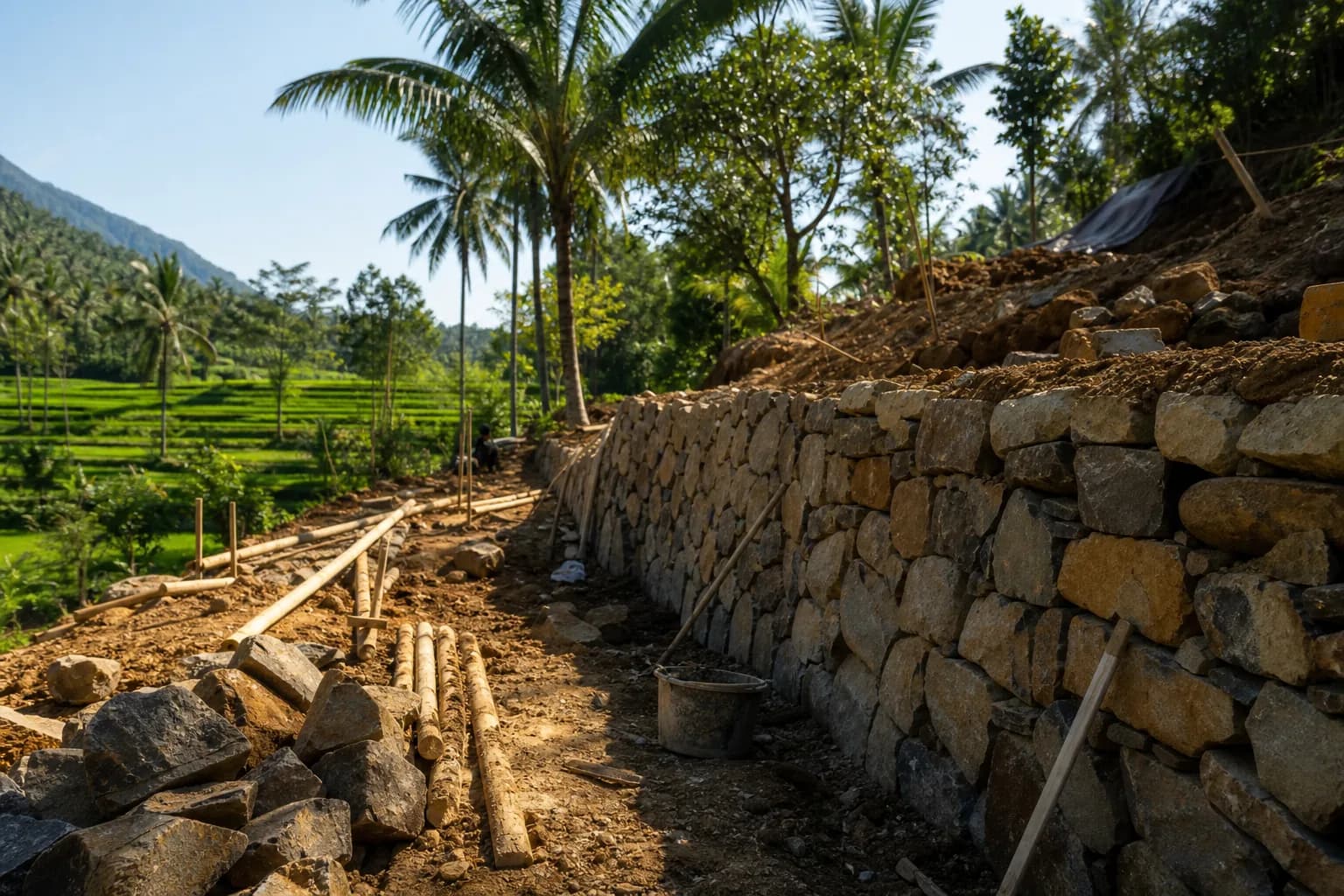
Why Sidemen Valley’s Steep Terrain Demands Specialized Retaining Wall Engineering
Sidemen Valley’s dramatic terraced rice paddies and steep volcanic slopes create one of Bali’s most visually stunning landscapes—but these same topographical features present significant structural challenges for villa construction. Property buyers attracted to Sidemen’s elevation and panoramic views often underestimate the engineering complexity and permit requirements for building on slopes exceeding 15-25 degrees. Unlike flat coastal plots in Canggu or Seminyak, Sidemen’s terrain requires multi-level terraced retaining walls that must withstand tropical rainfall exceeding 2,500mm annually, volcanic soil composition with variable bearing capacity, and seismic activity from Bali’s position on the Pacific Ring of Fire. The question isn’t whether you need retaining walls—it’s whether your budget accounts for the geotechnical surveys, structural engineering, drainage systems, and multi-agency permit coordination that Sidemen’s unique geology demands.
Engineering Requirements for Sidemen Valley Slope Stabilization
Sidemen Valley sits at 400-700 meters elevation on the southern slopes of Mount Agung, where volcanic ash deposits create layered soil profiles with dramatically different load-bearing characteristics. A proper terraced retaining wall system here requires understanding three critical engineering factors that don’t apply to flat-site construction elsewhere in Bali.
Geotechnical Soil Analysis for Volcanic Terrain
Sidemen’s soil composition typically consists of weathered volcanic tuff overlaying older andesite bedrock, with seasonal water tables that rise 2-4 meters during monsoon periods. Before any retaining wall design begins, geotechnical boring tests must reach minimum 6-meter depth to identify soil stratification, bearing capacity (typically 80-150 kN/m² in upper layers), and groundwater behavior. The volcanic ash layers common in Sidemen exhibit cohesion values between 15-35 kPa—significantly lower than the consolidated clay found in southern Bali—meaning retaining walls require deeper foundations and more robust drainage systems. Soil reports cost $800-1,500 in Sidemen but prevent catastrophic failures that occur when walls are designed using generic assumptions rather than site-specific data.
Terraced Wall Height and Setback Calculations
Bali’s building regulations (Peraturan Daerah) limit single retaining wall heights to 2 meters without special engineering certification. On Sidemen’s steep slopes, this means villa sites require 3-5 terraced levels with horizontal setbacks between walls. The engineering rule: each terrace setback must equal at least 0.7 times the wall height below it to prevent progressive failure. For a site with 8 meters total elevation change, you’re looking at four 2-meter walls with 1.4-meter setbacks between levels—consuming 5.6 meters of horizontal space before construction even begins. This terracing requirement directly impacts usable building area and must be calculated during land evaluation, not after purchase. Properties advertised as “1,000m² with valley views” may yield only 600-700m² of buildable flat area after terracing.
Drainage Engineering for 2,500mm Annual Rainfall
Sidemen receives 60% more rainfall than Seminyak, with monsoon events delivering 150-200mm in 24 hours. Retaining walls without proper drainage systems experience hydrostatic pressure buildup that can generate lateral forces exceeding 50 kN/m²—enough to topple walls designed only for soil retention. Proper Sidemen retaining wall systems require: perforated drainage pipes (minimum 100mm diameter) behind each wall connected to gravel backfill zones, weep holes every 2 meters at wall base level, surface water diversion channels above each terrace, and discharge systems that prevent erosion at wall toes. Drainage materials and installation add $45-65 per linear meter but are non-negotiable in Sidemen’s hydrological conditions. Walls built without these systems typically show distress within 2-3 monsoon seasons.
Structural Design for Seismic Loads
Bali’s location in a seismically active zone requires retaining walls to resist both static soil pressure and dynamic earthquake loads. Sidemen’s proximity to Mount Agung (18km) places it in Zone 4 seismic classification, requiring walls to withstand peak ground acceleration of 0.25-0.30g. This necessitates reinforced concrete construction with minimum 12mm rebar at 200mm spacing, tied to foundation footings extending 800mm-1,200mm below grade. Cyclopean stone walls—traditional in Bali—cannot meet seismic requirements for walls exceeding 1.5 meters height in Sidemen. The structural engineering calculations and certification required for seismic compliance add $600-1,200 to project costs but are mandatory for IMB (building permit) approval in slope construction zones.
Hidden Risks Buyers Miss in Sidemen Slope Properties
Three critical issues consistently surprise foreign buyers purchasing Sidemen land without construction-focused due diligence, often discovered only when retaining wall engineering begins.
Customary Land Boundaries on Terraced Rice Paddies
Many Sidemen properties include active or former rice terraces where traditional subak (irrigation cooperative) boundaries don’t align with legal certificates. The terraced walls you see may be communal irrigation structures, not property boundaries. Modifying these for villa construction can trigger disputes with neighboring farmers or subak leadership, even when your certificate appears clear. Always verify: does your land survey show terrace walls as internal features or boundary markers? Are there existing water rights or irrigation easements? Teville’s land verification process specifically checks subak status because retaining wall placement that blocks traditional water flow can halt construction mid-project while disputes resolve—a delay we’ve seen extend 6-12 months on Sidemen sites.
Access Road Grade Limitations
Sidemen’s steep terrain means access roads often exceed 15-20% grades—the maximum most concrete trucks can navigate. If your property requires retaining walls but sits above accessible concrete delivery points, you face either: pumping concrete uphill (adding $180-250 per cubic meter), hand-mixing on-site (reducing quality control and extending timelines 300%), or building temporary access ramps (costing $3,000-6,000 that don’t add property value). This access constraint should be evaluated during land selection, not during construction planning. Properties with existing vehicle access to the building envelope save $8,000-15,000 in retaining wall construction logistics.
Permit Jurisdiction Complexity
Sidemen spans multiple desa adat (customary villages) and desa dinas (administrative villages) with overlapping authority. Retaining wall permits require approval from: the Karangasem Regency building department (IMB), local banjar for construction activity, desa adat for land modification affecting views or water, and potentially forestry department if your land borders protected zones above 700m elevation. Each agency has different fee structures ($50-450 range) and timelines (2-8 weeks). The mistake: assuming a single IMB covers all requirements. Teville’s permit coordination service exists specifically because Sidemen projects require 4-6 separate approvals that must be sequenced correctly—starting construction with incomplete permits results in stop-work orders and penalty fees of $500-2,000.
Step-by-Step Process for Sidemen Retaining Wall Projects
Phase 1: Pre-Purchase Site Assessment (2-3 Weeks)
Before committing to land purchase, commission a topographical survey with 0.5-meter contour intervals showing existing slope angles, drainage patterns, and access points. Cost: $400-700 for typical 1,000-1,500m² Sidemen plots. This survey reveals the total elevation change across your site and allows preliminary terracing calculations. Simultaneously, verify with the local banjar whether the land has any customary restrictions on slope modification—some areas near sacred sites or water sources have traditional prohibitions that aren’t documented in legal certificates. Teville’s verified land consultation includes this customary verification because it cannot be reversed after purchase.
Phase 2: Geotechnical Investigation (1-2 Weeks)
Hire a certified soil testing laboratory to perform minimum three boring tests across your site, reaching 6-8 meter depth. The report must specify: soil classification at each stratum, bearing capacity values, groundwater depth and seasonal variation, and recommendations for foundation types. In Sidemen, expect to find volcanic ash layers requiring special attention. Cost: $800-1,500 depending on site accessibility. This report is required for structural engineering and IMB permit applications—attempting to skip it results in permit rejection or, worse, designing walls that fail within 3-5 years.
Phase 3: Structural Engineering Design (3-4 Weeks)
Engage a licensed Indonesian structural engineer (SIPIL certification required) to design your terraced retaining wall system based on the geotechnical report. The design package must include: wall cross-sections showing reinforcement details, foundation depth and width calculations, drainage system specifications, seismic load calculations, and construction sequencing to prevent slope instability during building. Engineering fees for Sidemen retaining wall systems: $1,200-2,400 depending on complexity. The engineer stamps drawings for permit submission—foreign architects cannot provide this certification, and unstamped drawings are rejected by Karangasem building department.
Phase 4: Multi-Agency Permit Applications (6-10 Weeks)
Submit permit applications in this sequence: (1) Desa adat approval for land modification—requires site plan showing how terracing preserves water flow and views, fee $50-150, timeline 2-3 weeks. (2) Banjar construction notification—fee $30-80, immediate approval but must be done before equipment arrives. (3) IMB application to Karangasem Regency—requires stamped engineering drawings, geotechnical report, land certificate, fee $200-450 based on wall volume, timeline 4-6 weeks. (4) Environmental impact assessment if total earth movement exceeds 500 cubic meters—fee $300-600, timeline 3-4 weeks. Attempting to process these simultaneously without understanding dependencies causes rejections and restarts.
Phase 5: Construction Execution (8-14 Weeks)
Retaining wall construction in Sidemen must follow dry season scheduling (April-October) to prevent monsoon complications. Sequence: excavation and foundation pouring for lowest terrace first, working uphill to prevent undermining completed walls. Each wall requires 7-10 days for formwork, rebar installation, concrete pouring, and 14-day curing before backfilling. Drainage installation happens during backfill, not after. The critical mistake: rushing backfill before concrete reaches 70% strength (14 days minimum)—this causes wall deflection and cracking that’s expensive to repair. Total construction timeline for a typical 3-terrace system: 10-12 weeks in dry season, 14-18 weeks if monsoon delays occur.
Realistic Cost Breakdown for Sidemen Terraced Retaining Walls
Based on 2026 construction costs in Karangasem Regency, here are specific budget ranges for Sidemen Valley projects. These figures assume standard 2-meter height reinforced concrete walls with proper drainage systems.
Pre-Construction Costs:
- Topographical survey: $400-700
- Geotechnical soil testing: $800-1,500
- Structural engineering design: $1,200-2,400
- Permit fees (all agencies): $330-680
- Total pre-construction: $2,730-5,280
Construction Costs Per Linear Meter (2m height wall):
- Excavation and foundation: $85-120/m
- Reinforced concrete wall: $180-260/m
- Drainage system (pipes, gravel, weep holes): $45-65/m
- Backfill and compaction: $35-50/m
- Total per linear meter: $345-495/m
Complete Project Examples:
- Small site (30 linear meters, 2 terraces): $13,080-20,130 total
- Medium site (60 linear meters, 3 terraces): $23,430-35,010 total
- Large site (100 linear meters, 4 terraces): $37,230-54,780 total
These ranges reflect Sidemen-specific factors: limited concrete truck access (requiring pumping), volcanic soil requiring deeper foundations, and higher drainage requirements than coastal Bali. Projects attempting to reduce costs by eliminating drainage systems or using unengineered designs save $8,000-12,000 initially but face $25,000-45,000 in remedial work within 3-5 years when walls fail. For detailed cost estimation based on your specific Sidemen site conditions, Teville’s build cost assessment provides engineered quotes after topographical review.
Frequently Asked Questions: Sidemen Retaining Walls
Can I use traditional Balinese stone walls instead of reinforced concrete in Sidemen?
Traditional cyclopean stone walls (stacked volcanic rock) are culturally appropriate and visually appealing, but Karangasem building regulations prohibit them for structural retaining walls exceeding 1.5 meters height in seismic zones. Sidemen’s Zone 4 classification and steep slopes require engineered reinforced concrete for walls supporting building loads or retaining more than 2 meters of soil. You can use stone as decorative facing over a reinforced concrete structural core—this approach costs $85-120 per linear meter additional but achieves traditional aesthetics while meeting seismic safety requirements. Purely decorative garden walls under 1 meter height can be traditional stone without engineering certification.
How do monsoon delays affect retaining wall construction timelines in Sidemen?
Sidemen’s monsoon season (November-March) brings 150-200mm rainfall events that halt concrete work for 3-7 days per event and make excavation dangerous on steep slopes. Concrete cannot be poured during rain or within 24 hours of forecasted heavy rain—moisture compromises strength and bonding. If your project timeline extends into monsoon months, expect 40-60% longer construction duration and 15-25% higher costs due to: temporary weather protection structures, dewatering pumps for excavations, extended equipment rental, and labor inefficiency. Teville’s project scheduling specifically ta
 3173 m²6 month(s)from 125.000 USD
TALA FOUR
 164 m²7 month(s)from 79.000 USD
Private: Haridas Villas, Tegallalang
 3127 m²9 month(s)from 177.000 USD
Mukunda
 3104 m²11 month(s)from 99.000 USD
TALA 100
 172 m²8 month(s)from 120.000 USD
Keshava
 4344 m²16 month(s)from 290.000 USD
Radha
 3180 m²7 month(s)from 142.000 USD
Vasudeva
 2144 m²11 month(s)from 104.000 USD
Narayana

Want to calculate?
164 m²7 month(s)from 79.000 USDTALA TWO
 3124 m²6 month(s)from 123.000 USD
TALA 8
 1from 198.000 USD
Private: Haridas Villas
Start With Real Numbers, Not Guesses
Before buying land or finalizing a design, check the realistic build cost range for your project in Bali.
Our team reviews your inputs and gives a grounded estimate.
Available lands
 204 m²5 min$ 40899Bali, Kedungu
 2230 m²15 min$ 410573Bali, Padonan
 700 m²7 min$ 400000Bali, Canggu
 1700 m²10 min$ 632257Bali, Kuta
 3300 m²15 min$ 449889Bali, Tabanan
 7250 m²56 min$ 235714Bali, Tabanan
 325 m²15 min$ 44472Bali, Ungasan
 500 m²2 min$ 175862Bali, Cemagi
 1000 m²10 min$ 123154Bali, Jimbaran
 1375 m²10 min$ 447044Bali, Canggu
 1000 m²5 min$ 350431Bali, Drupadi
 1000 m²10 min$ 384852Bali, Canggu
 1000 m²8 min$ 134544Bali, Bukit
 2000 m²10 min$ 243842Bali, Mengwi
 928 m²15 min$ 910123Bali, Pererenan
Essential Bali build & buy guides
- Bali villa construction cost per m² in 2026
- How much will your villa cost? Calculator
- Building a villa in Bali: the complete guide
- Buying land in Bali: step-by-step for foreigners
- Bali villa investment: yields, risks, returns
- Leasehold vs freehold: what foreigners can own
- Construction defect liability & 10-year warranty
- Bali building codes and construction standards
Related guides
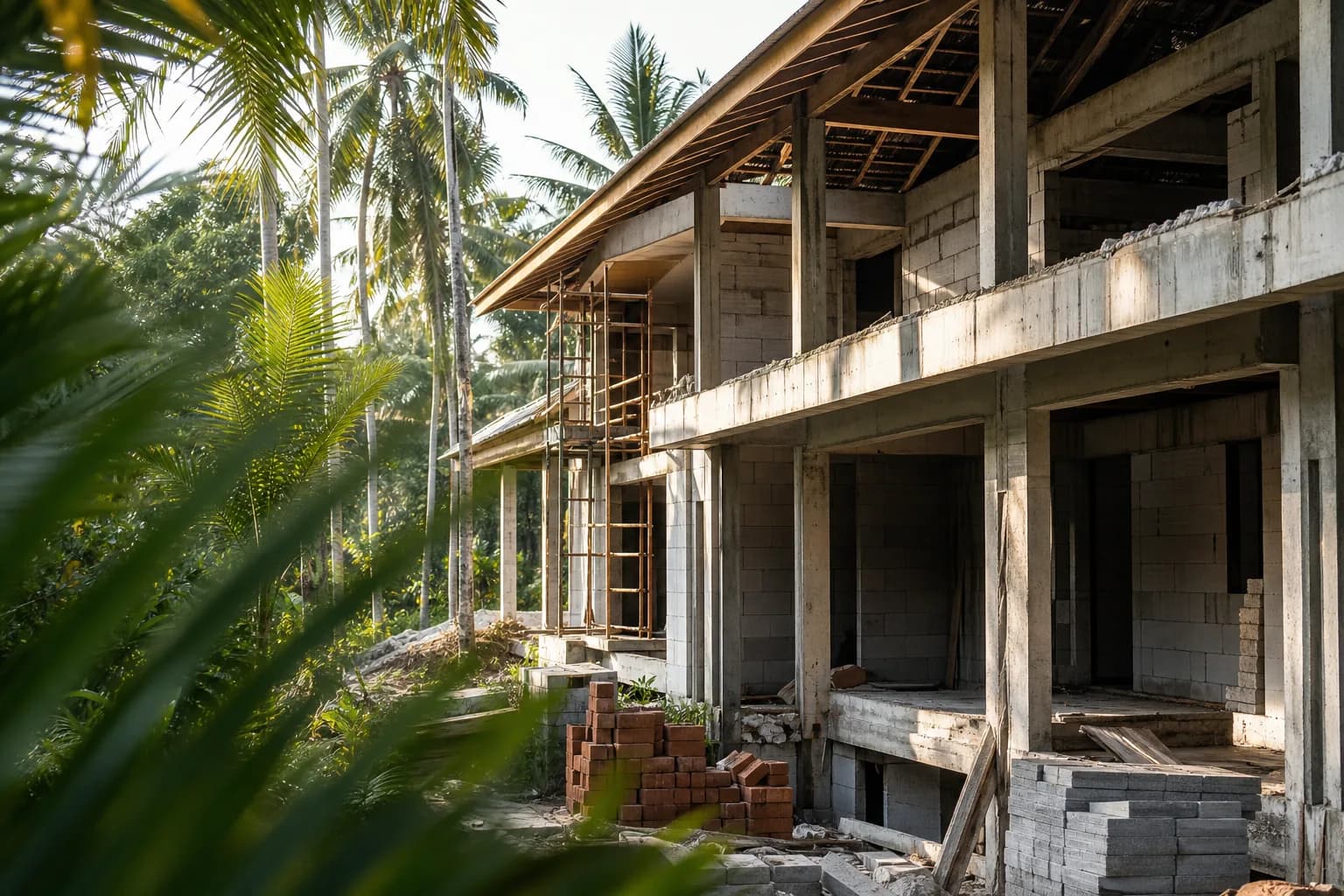
Sanur and Nusa Dua vs Canggu: Stability Plays vs Hype
Canggu gets the headlines; Sanur and Nusa Dua quietly deliver steadier returns to a different kind of buyer. An honest 2026 comparison of the stability markets against the hype market — prices, demand drivers, oversupply risk, and who should buy where.
7 min read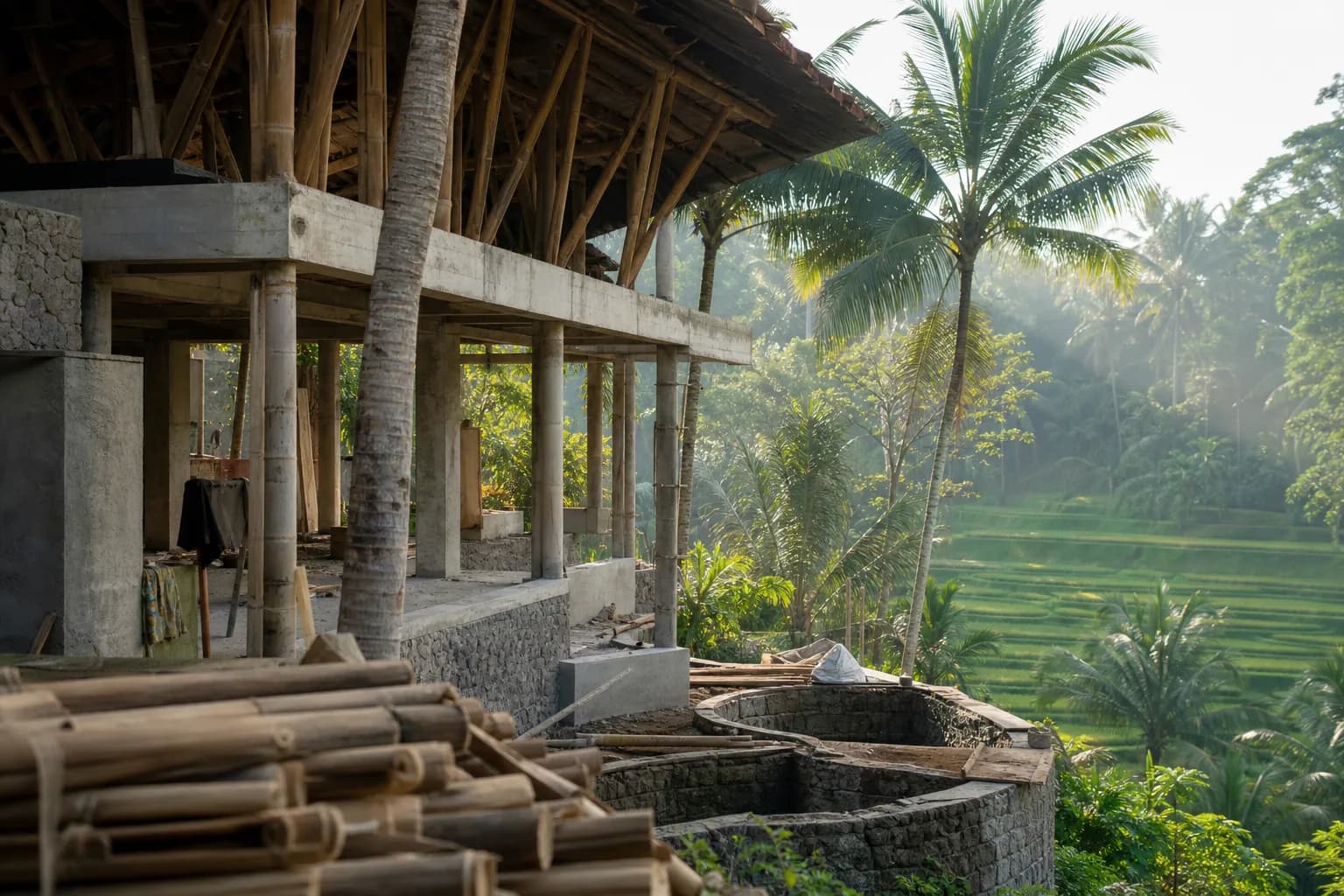
Ubud and the Wellness Market: Buying or Building for Retreats
Ubud is Bali's wellness capital, and retreat-focused property behaves differently from beach villas: longer stays, group bookings, lower volatility. Here is what the market rewards, what zoning allows, and what it costs to buy or build a retreat property in 2026.
8 min read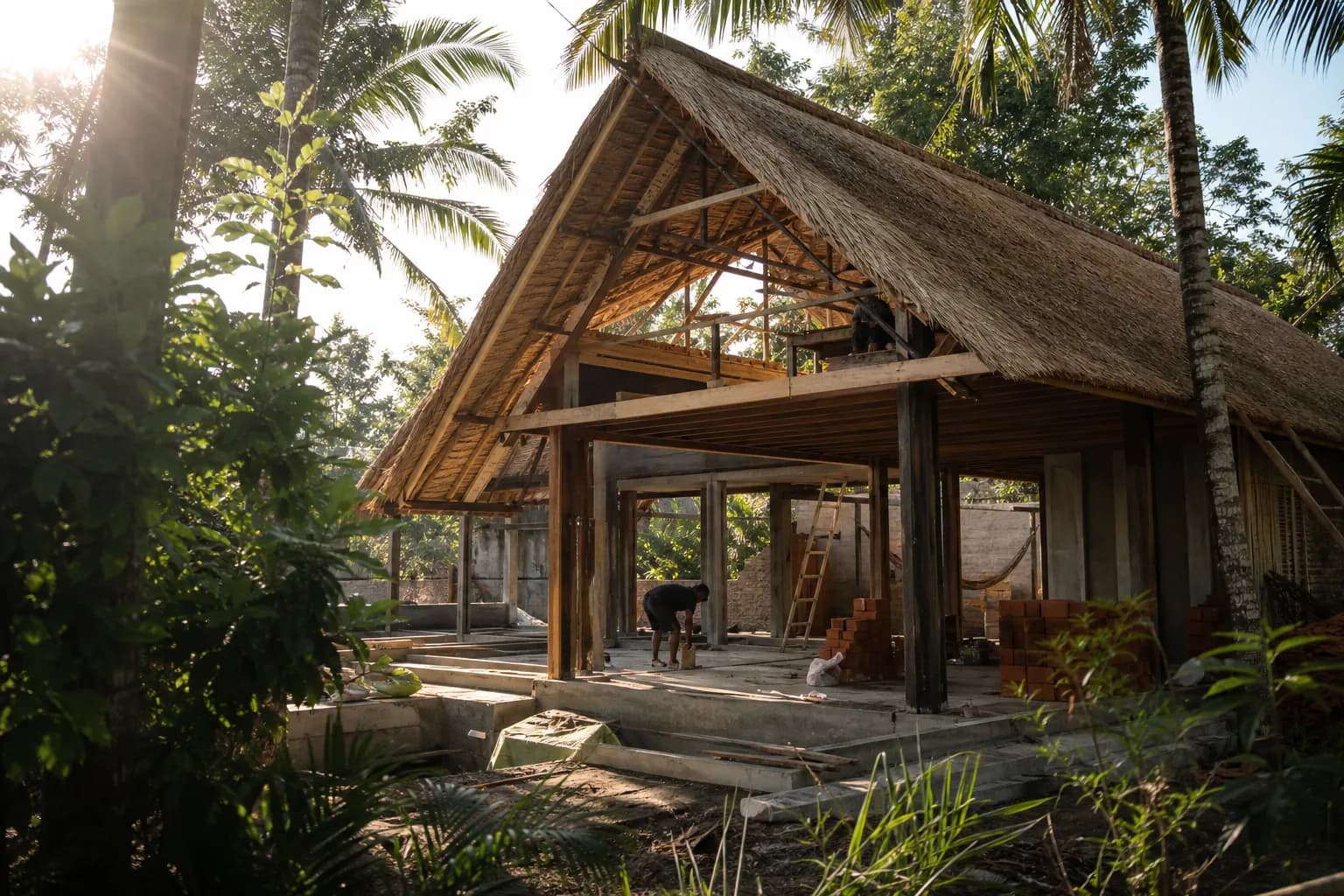
Buying and Building on the Bukit: Uluwatu, Bingin and Balangan from a Buyer's Seat
A buyer's-seat 2026 guide to the Bukit peninsula — Uluwatu, Bingin and Balangan land prices, the water problem nobody budgets, cliff setbacks after the 2025 Bingin demolitions, and how to build there properly.
7 min read