Septic Tank Soakaway Pit Sizing Standards for Bali Villas
# Septic Tank Soakaway Pit Sizing Standards for Bali Villa Renovations
The Hidden Infrastructure Challenge in Bali Villa Renovations
When renovating luxury villas in Bali, most property owners focus on visible finishing works—polished terrazzo floors, custom teak furniture, and infinity pool installations. Yet beneath these aesthetic elements lies a critical utility system that determines whether your renovation meets Indonesian building standards: the septic tank soakaway pit. Undersized or improperly constructed soakaway systems lead to sewage backup, soil contamination, and expensive remediation work that disrupts your villa’s operations. For Bali villa construction projects, understanding precise soakaway pit sizing standards isn’t optional—it’s fundamental to creating durable, compliant infrastructure that withstands tropical monsoon conditions and high water table challenges unique to the island.
Technical Specifications for Soakaway Pit Sizing in Bali’s Tropical Environment
The 2026 Indonesian building code mandates a minimum soakaway area of 30 square meters for residential septic systems, but this baseline figure requires significant adjustment based on soil percolation rates, villa occupancy, and seasonal groundwater fluctuations. At Teville, our renovation Bali projects begin with comprehensive percolation testing—a non-negotiable step that determines actual drainage capacity of your specific site.
Percolation testing involves excavating test holes to the proposed drainage field depth (typically 1.2-1.5 meters below finished grade), saturating the soil, then measuring how quickly water drains. Bali’s volcanic soils exhibit percolation rates ranging from 12 seconds per millimeter in sandy coastal areas to 100+ seconds in clay-heavy regions like Canggu and Pererenan. This dramatic variation directly impacts soakaway sizing calculations.
For a standard 4-bedroom villa with 8-10 occupants generating approximately 1,200 liters of wastewater daily, the calculation follows this formula: Daily wastewater volume (liters) × Percolation time (seconds) ÷ 150 = Required soakaway area (square meters). A site with 50-second percolation requires: 1,200 × 50 ÷ 150 = 400 square meters of drainage field—significantly exceeding the 30-square-meter minimum.
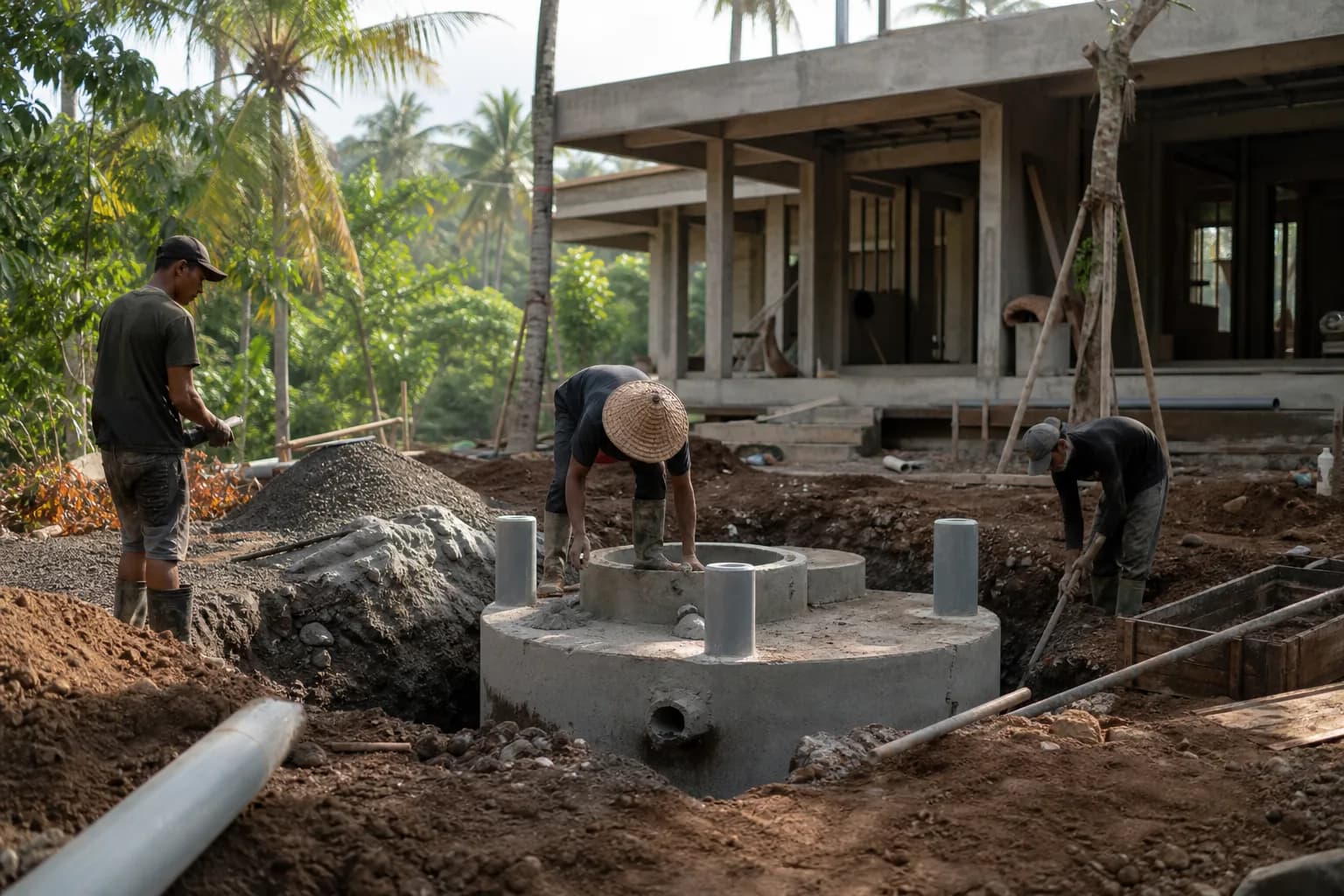
The soakaway pit construction itself utilizes perforated PVC pipes (110mm diameter minimum) laid in gravel-filled trenches. Each trench measures 600mm wide and extends 1,200-1,500mm deep, with pipes positioned at the trench bottom surrounded by 300mm of 20-40mm washed aggregate. This aggregate layer serves dual purposes: providing structural support and creating void space for effluent distribution. The pipes connect in parallel runs spaced 2 meters apart, creating a grid pattern that maximizes soil contact area.
Bali’s high water table presents unique challenges for villa utilities installation. During monsoon season (November-March), groundwater levels rise 500-800mm, potentially flooding improperly positioned soakaway systems. Our construction teams install soakaway fields with minimum 1-meter clearance above seasonal high water marks, often requiring raised drainage fields with imported engineered fill—a specification rarely needed in temperate climates but essential for tropical durability.
The septic tank itself must be positioned 5 meters minimum from the villa structure and 1.5 meters above the soakaway field to ensure gravity flow. For hillside renovations common in Ubud and Uluwatu, this vertical separation becomes challenging, sometimes requiring pump-assisted systems with dual-chamber dosing tanks that release effluent in controlled intervals rather than continuous flow.
Geotextile fabric installation represents another critical specification. We wrap all aggregate-filled trenches with non-woven geotextile (minimum 140gsm) before backfilling, preventing fine soil particles from migrating into void spaces and reducing drainage capacity over time. This fabric barrier extends the soakaway’s functional lifespan from 8-10 years to 15-20 years—a significant improvement that justifies the additional material cost in long-term renovation Bali projects.
Materials Standards for Tropical Climate Durability
Material selection for soakaway pit construction in Bali differs substantially from temperate climate specifications due to accelerated degradation from heat, humidity, and aggressive soil chemistry. Standard PVC pipes must meet SNI 06-0084-2002 Indonesian standards with minimum 3.2mm wall thickness for structural pipes and 2.7mm for non-pressure drainage applications.
The perforated drainage pipes require specific hole patterns: 10mm diameter perforations arranged in rows of 3-4 holes spaced 100mm apart longitudinally. Holes face downward at 4 and 8 o’clock positions (not directly bottom) to prevent sediment entry while maximizing effluent distribution. Pre-perforated pipes from reputable manufacturers like Rucika or Wavin ensure consistent hole sizing—hand-drilled perforations often create stress fractures that fail within 2-3 years.
Aggregate specifications demand particular attention. We source 20-40mm washed river stone rather than crushed limestone, as limestone dissolves in Bali’s slightly acidic soils (pH 5.5-6.5), creating fines that clog the drainage field. The aggregate must be washed to remove particles smaller than 5mm—unwashed material reduces void space by 30-40%, severely compromising drainage capacity.
Geotextile fabric selection requires UV-stabilized, non-woven polypropylene rated for continuous soil contact. Woven fabrics, while stronger, have insufficient permeability for soakaway applications. The fabric must maintain minimum 120 liters/m²/second flow rate while filtering particles larger than 75 microns. We specify Polyfelt TS-series or equivalent products with documented tropical climate performance data.
For interior finishing Bali projects that include bathroom additions or kitchen expansions, the connection between new fixtures and existing septic systems requires careful material matching. Incompatible pipe materials (mixing PVC with ABS, for example) create weak joints that fail during soil settlement, causing leaks that undermine villa foundations—a finishing disaster that requires extensive remediation.
Step-by-Step Soakaway Pit Installation Process
Phase 1: Site Assessment and Testing (Days 1-3)
Our construction teams begin with comprehensive site surveying, identifying existing utilities, property boundaries, and setback requirements. We excavate 4-6 percolation test holes across the proposed drainage field area, conducting tests at different depths to map soil stratification. Each test hole receives 300mm of water, and we measure drainage time over 24-hour periods, repeating tests three times to establish reliable averages. This data feeds directly into engineering calculations that determine final soakaway dimensions—a process that cannot be shortcut without risking system failure.
Phase 2: Excavation and Ground Preparation (Days 4-6)
Mechanical excavation removes soil to design depth, typically 1.5 meters below finished grade. For Bali’s compact volcanic soils, we use rubber-tracked excavators that minimize site disturbance—critical when working within established villa compounds where existing landscaping and furniture installation areas must be preserved. The excavation bottom receives laser-level grading to ensure uniform 1:200 slope toward the drainage field perimeter, preventing effluent pooling. We compact the base with plate compactors, achieving 95% modified Proctor density before aggregate placement.
Phase 3: Aggregate Base and Pipe Installation (Days 7-9)
A 150mm base layer of washed aggregate creates the foundation for pipe placement. We install perforated pipes in parallel runs, maintaining precise 2-meter spacing using temporary wooden spacers. Each pipe section connects with solvent-welded joints—mechanical couplings are prohibited due to failure risk from soil movement. The pipe network connects to a central distribution box positioned at the septic tank outlet, ensuring equal flow distribution across all drainage runs. We test the system by flooding pipes with water, verifying no low spots where effluent could accumulate.
Phase 4: Aggregate Surround and Geotextile Wrapping (Days 10-11)
Additional aggregate fills trenches to 300mm above pipe crowns, creating the critical void space for effluent distribution. Workers hand-place aggregate around pipes to prevent displacement, then use mechanical spreaders for upper layers. Once aggregate placement is complete, we drape geotextile fabric over the entire drainage field, overlapping edges by minimum 300mm and securing with landscape staples every 500mm. This fabric envelope completely encases the aggregate, creating a protected drainage zone isolated from surrounding soil.
Phase 5: Backfilling and Surface Restoration (Days 12-14)
Backfill material consists of excavated soil screened to remove rocks larger than 75mm, placed in 200mm lifts and compacted to 90% density. The final 300mm receives topsoil suitable for landscaping, though we prohibit deep-rooted trees within 5 meters of the drainage field—root intrusion represents the primary long-term failure mode for soakaway systems. For Bali villa construction projects with extensive landscaping plans, we coordinate with landscape architects to specify appropriate shallow-rooted ground covers that won’t compromise the drainage infrastructure.
Cost Factors and Project Timeline for Villa Renovations
Soakaway pit installation costs for Bali villa renovations vary significantly based on soil conditions, site accessibility, and system complexity. A standard 30-square-meter soakaway serving a 3-bedroom villa typically ranges from IDR 35-50 million (USD 2,200-3,200), including materials, labor, and percolation testing. Larger systems for 5+ bedroom properties with poor soil percolation can exceed IDR 100 million when pump-assisted drainage and extensive aggregate fields are required.
Material costs represent 40-45% of total project expense: perforated PVC pipes (IDR 180,000-250,000 per 4-meter section), washed aggregate (IDR 350,000-450,000 per cubic meter delivered), geotextile fabric (IDR 25,000-35,000 per square meter), and distribution boxes (IDR 1.5-2.5 million for commercial-grade units). Labor costs in Bali’s construction market currently run IDR 350,000-500,000 per worker daily, with soakaway installation requiring 4-6 skilled workers for 10-14 days.
Timeline considerations extend beyond installation duration. Percolation testing requires 3-5 days including soil saturation periods, and results may necessitate design modifications that add 2-3 days for engineering revisions. Monsoon season work requires weather contingencies—excavations left open during heavy rain can flood, requiring re-excavation and adding 3-5 days to schedules. We recommend scheduling soakaway work during Bali’s dry season (April-October) when soil conditions remain stable and weather delays are minimal.
For comprehensive renovation Bali projects, soakaway installation typically occurs during early construction phases, before finishing works and furniture installation commence. This sequencing prevents heavy equipment from damaging completed interior spaces and allows the drainage field to settle before final landscaping. Property owners can explore detailed cost estimation through Teville’s project planning tools, which account for site-specific variables that impact final pricing.
Frequently Asked Questions About Soakaway Pit Sizing
How do I determine if my existing villa’s soakaway system is adequately sized?
Signs of undersized soakaway systems include slow-draining fixtures, sewage odors near the drainage field, unusually lush vegetation patches, or standing water during dry season. Professional assessment involves dye testing (introducing colored tracer into the septic system and monitoring drainage field surface for emergence) and soil probing to check for saturated conditions. If your villa was constructed before 2015, the soakaway likely doesn’t meet current 30-square-meter minimum standards and should be evaluated during any major renovation. Teville’s technical teams conduct complimentary soakaway assessments for clients planning comprehensive villa upgrades—contact us through our project portfolio page to schedule evaluation.
Can soakaway pits be installed on sloped properties common in Ubud and Uluwatu?
Sloped sites require modified soakaway designs with terraced drainage fields that follow contour lines rather than traditional grid patterns. Each terrace maintains level pipe runs, with drop boxes connecting elevation changes. The minimum slope for effective soakaway function is 1:200 (5mm per meter), while maximum slope before terracing becomes necessary is 1:20 (50mm per meter). Hillside installations cost 30-40% more than flat-site systems due to additional excavation, retaining structures, and complex pipe routing. However, sloped sites often provide excellent natural drainage, potentially reducing required soakaway area by 15-20% compared to flat coastal properties with high water tables.
What maintenance does a properly sized soakaway system require?
Soakaway pits themselves require minimal maintenance when correctly sized and installed—the system operates passively through gravity and soil absorption. However, the septic tank requires pumping every 2-3 years to remove accumulated solids that would otherwise migrate to the drainage field and cause clogging. We recommend annual inspections of distribution boxes to verify equal flow across all drainage runs and check for root intrusion at pipe connections. Avoid using harsh chemical drain cleaners that kill beneficial bacteria in septic systems, and never dispose of cooking oils, feminine hygiene products, or non-biodegradable materials through villa plumbing. These practices extend soakaway functional life from 15 to 25+ years, eliminating costly premature replacement.
Do Bali building permits require specific soakaway documentation?
Indonesian building permits (IMB – Izin Mendirikan Bangunan) for villa construction and major renovations require engineered septic sy
 172 m²8 month(s)from 120.000 USD
Keshava
 3180 m²7 month(s)from 142.000 USD
Vasudeva
 164 m²7 month(s)from 79.000 USD
TALA TWO
 3127 m²9 month(s)from 177.000 USD
Mukunda
 3173 m²6 month(s)from 125.000 USD
TALA FOUR
 4344 m²16 month(s)from 290.000 USD
Radha
 3104 m²11 month(s)from 99.000 USD
TALA 100
 1from 198.000 USD
Private: Haridas Villas
 3124 m²6 month(s)from 123.000 USD
TALA 8
164 m²7 month(s)from 79.000 USDPrivate: Haridas Villas, Tegallalang
 2144 m²11 month(s)from 104.000 USD
Narayana

Want to calculate?
Start With Real Numbers, Not Guesses
Before finalizing your finishing works plan, check realistic cost ranges for your Bali villa project.
Available lands
 2200 m²15 min$ 508005Bali, Canggu
 928 m²15 min$ 910123Bali, Pererenan
 1350 m²5 min$ 283467Bali, Pecatu
 600 m²12 min$ 101970Bali, Mengwi
 1700 m²10 min$ 632257Bali, Kuta
 2000 m²5 min$ 1440887Bali, Pecatu
 1700 m²10 min$ 392549Bali, Nusadua
 444 m²10 min$ 111000Bali, Tabanan
 515 m²7 min$ 570813Bali, Canggu
 550 m²5 min$ 217629Bali, Tabanan
 13000 m²1 min$ 920567Bali, Pekutatan
 2800 m²2 min$ 713793Bali, Kedungu
 1000 m²5 min$ 350431Bali, Drupadi
 3700 m²15 min$ 738177Bali, Tabanan
 1410 m²15 min$ 390702Bali, Tabanan
Essential Bali build & buy guides
- Bali villa construction cost per m² in 2026
- How much will your villa cost? Calculator
- Building a villa in Bali: the complete guide
- Buying land in Bali: step-by-step for foreigners
- Bali villa investment: yields, risks, returns
- Leasehold vs freehold: what foreigners can own
- Construction defect liability & 10-year warranty
- Bali building codes and construction standards
Related guides
Sanur and Nusa Dua vs Canggu: Stability Plays vs Hype
Canggu gets the headlines; Sanur and Nusa Dua quietly deliver steadier returns to a different kind of buyer. An honest 2026 comparison of the stability markets against the hype market — prices, demand drivers, oversupply risk, and who should buy where.
7 min read
Ubud and the Wellness Market: Buying or Building for Retreats
Ubud is Bali's wellness capital, and retreat-focused property behaves differently from beach villas: longer stays, group bookings, lower volatility. Here is what the market rewards, what zoning allows, and what it costs to buy or build a retreat property in 2026.
8 min read
Buying and Building on the Bukit: Uluwatu, Bingin and Balangan from a Buyer's Seat
A buyer's-seat 2026 guide to the Bukit peninsula — Uluwatu, Bingin and Balangan land prices, the water problem nobody budgets, cliff setbacks after the 2025 Bingin demolitions, and how to build there properly.
7 min read