Septic Biofilter vs Conventional Systems: Bali Clay Soil Percolat
The Clay Soil Percolation Crisis: Why Your Conventional Septic System May Fail in Bali
When planning Bali villa construction, most developers focus on architectural design and permits, overlooking a critical underground challenge: clay soil percolation rates that can render conventional septic systems ineffective within months. Bali’s volcanic clay soils, particularly in areas like Canggu, Seminyak, and parts of Ubud, exhibit percolation rates as slow as 120+ minutes per inch—far exceeding the 60-minute threshold where conventional absorption fields begin failing. This isn’t a minor inconvenience; it’s a structural engineering problem that affects wastewater treatment efficiency, environmental compliance, and long-term operational costs. The choice between biofilter and conventional septic systems in Bali’s clay-dominant terrain directly impacts your project’s viability, requiring soil-specific engineering analysis before any excavation begins.
Engineering Analysis: Percolation Mechanics in Bali’s Clay Soil Matrix
Percolation rate—the speed at which water moves through soil—determines whether a septic system can effectively disperse treated effluent. In Bali’s clay soils, the microscopic particle structure creates a dense matrix with minimal void space, typically 35-45% porosity compared to 50-60% in sandy loam. This translates to hydraulic conductivity values of 0.01-0.5 cm/hour in clay versus 5-20 cm/hour in suitable septic soils.
Conventional septic systems operate on a simple principle: anaerobic bacterial digestion in the tank, followed by soil infiltration through perforated pipes in gravel-filled trenches. The soil itself becomes the final treatment medium, with aerobic bacteria in the upper soil layers breaking down remaining pathogens and nutrients. This process requires adequate percolation—water must move through soil fast enough to prevent surface pooling but slow enough for biological treatment. Clay soils violate this balance.
In field testing across Bali construction sites, we consistently observe percolation rates of 90-150 minutes per inch in undisturbed clay layers at 60-120cm depth—precisely where absorption fields are installed. At these rates, a conventional system designed for a 4-bedroom villa (approximately 1,500 liters daily flow) cannot discharge effluent fast enough. The result: hydraulic overload, where wastewater backs up into the tank, floods the absorption field, and eventually surfaces or seeps laterally toward foundations.
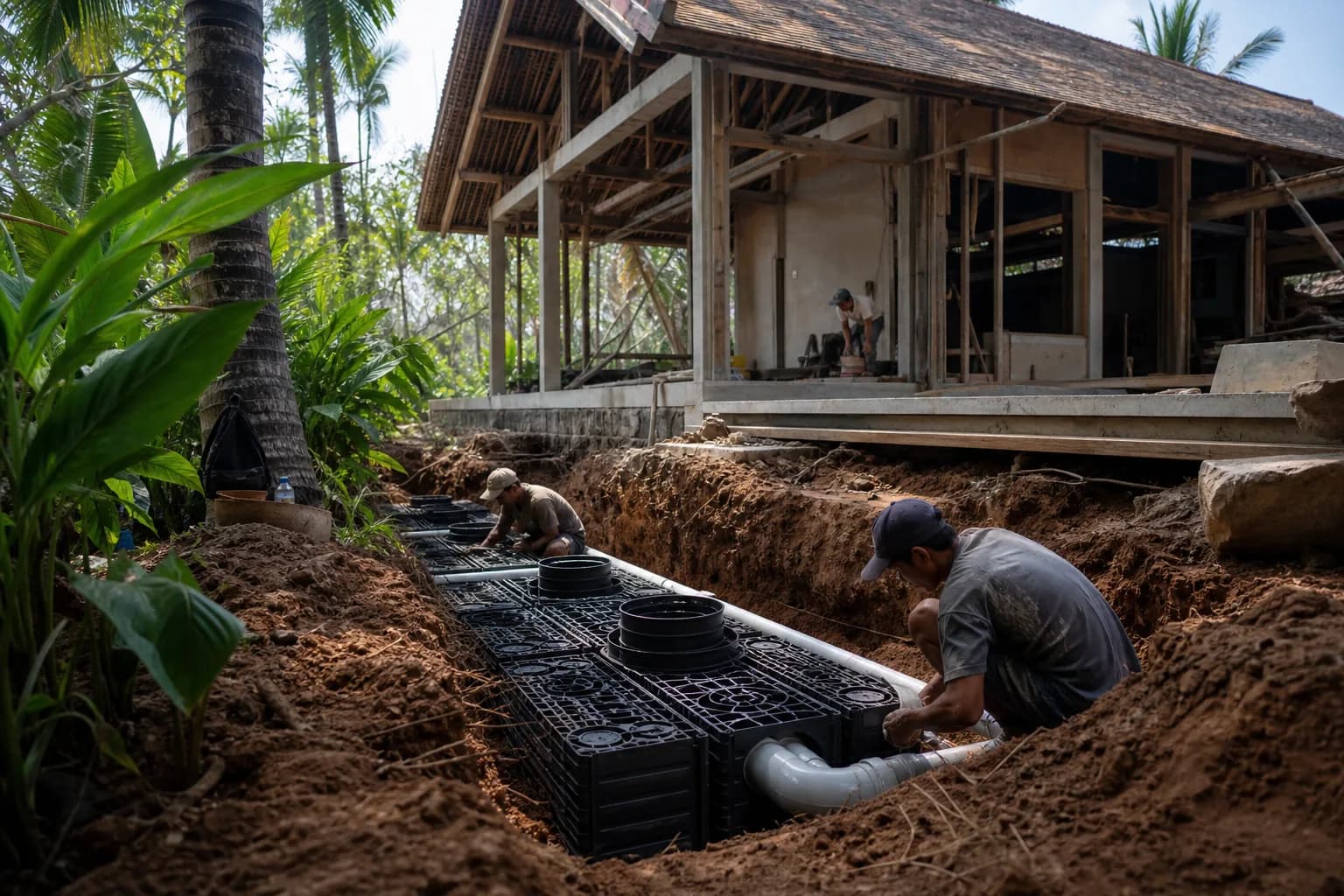
Biofilter septic systems fundamentally alter this equation by decoupling treatment from soil percolation. Systems like Enviro-Septic, BioCoir, or engineered sand filter variants incorporate synthetic or organic media with controlled porosity and massive surface area for bacterial colonization. A typical biofilter module contains 40-60 square meters of treatment surface per cubic meter of media—exponentially more than soil provides. The biological treatment occurs within the engineered system, not in the ground.
The critical advantage in clay soils: biofilters reduce effluent strength (BOD, TSS, fecal coliforms) by 85-95% before discharge, compared to 40-60% reduction in conventional tanks. This means the soil receives pre-treated water requiring minimal additional filtration. Even with slow clay percolation, the reduced organic load prevents biomat formation—the impermeable bacterial layer that clogs conventional absorption fields within 2-3 years in clay conditions.
Hydraulic loading rates differ dramatically. Conventional systems in suitable soil require 0.6-1.2 square meters of absorption area per person. In clay, engineers must increase this to 2-4 square meters per person to compensate for slow percolation—often impossible on constrained Bali villa plots. Biofilter systems, treating effluent to higher standards, can operate at 0.4-0.8 square meters per person even in clay, reducing land requirements by 60-75%.
Temperature effects compound the challenge. Bali’s 26-32°C soil temperatures accelerate bacterial activity, increasing oxygen demand in the treatment zone. Clay’s poor aeration means anaerobic conditions develop quickly, reducing treatment efficiency and producing hydrogen sulfide odors. Biofilters maintain aerobic conditions through engineered air exchange, independent of soil characteristics.
From a tropical construction engineering perspective, the soil-system interface requires specific design. Clay’s shrink-swell behavior during wet-dry cycles can crack rigid piping, while its low bearing capacity when saturated threatens system stability. Biofilter installations typically use flexible connections and modular designs that accommodate soil movement, whereas conventional systems with rigid PVC distribution networks frequently fail at joints when clay shifts seasonally.
Hidden Risks: What Soil Reports Don’t Reveal About Septic Performance
Most building permits Bali applications include basic soil boring logs identifying clay presence, but rarely include percolation testing at the specific depth and location of proposed absorption fields. This omission creates a critical knowledge gap. Clay layers in Bali are rarely uniform—volcanic deposition creates lenses of clay interbedded with ash or sand. A test hole 5 meters from your actual installation site may show acceptable percolation, while the construction location has impermeable clay.
Seasonal water table fluctuation represents another hidden risk. During Bali’s wet season (November-March), water tables can rise 1-2 meters, saturating clay layers that appear dry during dry-season soil testing. A conventional absorption field installed 1 meter above the dry-season water table may be submerged for 4-5 months annually, rendering it completely non-functional. Biofilter systems with elevated discharge points or pump-assisted distribution can adapt to these conditions.
The “percolation test timing trap” catches many developers. Tests conducted during dry season (June-September) show artificially fast rates as desiccated clay contains cracks and fissures. Once wet season saturates the soil, these cracks close, and actual percolation drops by 60-80%. Engineers experienced in Bali villa construction conduct wet-season verification testing or apply safety factors of 2-3x to dry-season results.
Regulatory compliance presents a moving target. While Indonesia’s Ministry of Environment regulation (PermenLH No. 68/2016) sets effluent standards, local Bali environmental agencies increasingly require advanced treatment for properties near water bodies or in high-density areas. Conventional systems rarely meet these standards in clay soils; biofilters provide documented compliance, protecting your investment from future retrofit mandates.
Implementation Protocol: Clay Soil Septic System Selection and Installation
Phase 1: Site-Specific Percolation Assessment (Week 1-2)
Conduct minimum three percolation tests at proposed absorption field locations, at installation depth (typically 60-100cm below finished grade). Standard procedure: dig test holes 30cm diameter, pre-soak for 24 hours, then measure water level drop over 60 minutes. Calculate percolation rate in minutes per inch. In clay soils, extend observation to 120+ minutes for accurate measurement. Test during wet season or saturate soil artificially for 72 hours to simulate worst-case conditions. Document water table depth via observation wells left open for 2-week monitoring period.
Phase 2: System Selection Engineering (Week 3)
If percolation rates exceed 60 minutes per inch, conventional systems require engineered modifications: oversized absorption fields (3-4x standard area), mounded systems raising the field above clay layers, or at-grade installations with imported sand media. Each adds 40-120 million IDR to baseline costs. Alternative: specify biofilter system matched to daily flow calculations (150 liters per bedroom plus 200 liters for common areas). For a 4-bedroom villa, this totals 800-1,000 liters daily design flow. Select biofilter capacity at 1.5x design flow for safety margin.
Phase 3: Regulatory Approval Integration (Week 4-5)
Submit system specifications with building permit applications, including percolation test results, system sizing calculations, and effluent quality projections. Biofilter systems typically require manufacturer’s technical documentation proving compliance with Indonesian standards (SNI 03-2398-2002 for wastewater treatment). Coordinate with environmental consultant (AMDAL or UKL-UPL preparer) to ensure septic design aligns with environmental permit requirements—critical for properties over 500 square meters built area.
Phase 4: Installation Execution (Week 8-10 of construction)
Excavate absorption field area, maintaining 3-meter minimum setback from structures, 5-meter from water sources. In clay soils, avoid over-excavation which smears clay surfaces, further reducing percolation. For biofilter systems, prepare level gravel base (10cm crushed stone), install modules per manufacturer specifications with proper slope (0.5-1% grade), connect to septic tank outlet via 100mm PVC with flexible couplings. Install observation ports at system inlet/outlet for monitoring. For conventional systems in marginal clay, import 60-80cm of sand media above clay layer, install distribution piping in gravel envelope, cover with geotextile before backfilling.
Phase 5: Verification and Commissioning (Week 11)
Conduct hydraulic testing: fill system with clean water, verify flow distribution, check for leaks. For biofilters, follow manufacturer’s bacterial inoculation protocol (some systems ship pre-colonized, others require 2-4 week startup period). Install effluent sampling port for future water quality testing. Document installation with as-built drawings showing exact locations, depths, and distances—essential for future maintenance or property transfer.
Cost and Timeline Realities: Biofilter vs Conventional in Clay Conditions
For a standard 4-bedroom villa (200-300 square meters) on clay soil, villa construction cost Bali for septic systems breaks down as follows:
Conventional system (engineered for clay): 45-75 million IDR including oversized 3,000-liter concrete tank (15-22 million IDR), expanded absorption field with imported sand media (25-40 million IDR for excavation, sand, piping, and gravel), and installation labor. Timeline: 8-12 days. Maintenance: pumping every 12-18 months at 2-3 million IDR per service, potential field replacement at year 5-8 (20-35 million IDR).
Biofilter system: 65-95 million IDR including 2,500-liter primary tank (12-18 million IDR), biofilter modules (35-55 million IDR depending on brand—imported systems cost more but offer better warranties), compact absorption area (8-15 million IDR), and installation. Timeline: 6-9 days. Maintenance: annual inspection and pumping (2.5-3.5 million IDR), biofilter media replacement at year 10-15 (15-25 million IDR).
Initial cost premium for biofilters: 20-30%. However, lifecycle analysis over 15 years shows biofilters cost 15-25% less when accounting for reduced maintenance, no premature field replacement, and lower risk of system failure requiring emergency repairs. For properties requiring environmental permits or located in sensitive areas, biofilters eliminate the risk of non-compliance penalties (50-500 million IDR under environmental regulations).
Timeline advantages matter during construction. Biofilter systems’ smaller footprint means less excavation in Bali’s challenging clay—reducing earthwork costs by 30-40% and avoiding delays when excavation encounters unexpected groundwater or rock layers common in volcanic soils.
Frequently Asked Questions: Septic Systems in Bali Clay Soil
Can I install a conventional septic system if my percolation test shows 90 minutes per inch in clay soil?
Technically yes, but it requires significant engineering modifications that often double the absorption field area and add 30-50 million IDR to costs. You’ll need either a mounded system (building the absorption field above grade with imported soil), an at-grade system with 60-80cm of sand media, or a pressurized distribution system with dosing chamber. Even with modifications, conventional systems in clay soils above 80 minutes per inch percolation rate have 40-60% failure rates within 5 years based on field data from Bali installations. A biofilter system designed for clay conditions provides more reliable long-term performance and typically costs less than an engineered conventional system when lifecycle costs are considered.
How do I know if my Bali property has clay soil before purchasing land?
Request a geotechnical investigation as part of your land purchase Bali due diligence. This should include soil boring to 3-meter depth with samples analyzed for texture, percolation testing at proposed septic system depth, and water table monitoring. Clay soils are prevalent in coastal areas (Canggu, Seminyak, Sanur) and some inland valleys, while volcanic slopes often have better-draining ash and pumice soils. Visual indicators include: water pooling after rain, cracking during dry season, sticky texture when wet, and difficulty digging when dry. However, only laboratory testing provides definitive classification. Budget 8-15 million IDR for comprehensive soil investigation—essential data that influences not just septic design but also foundation engineering and drainage systems.
What maintenance differences exist between biofilter and conventional systems in clay soil conditions?
Conventional systems in clay require more frequent pumping (every 12-18 months vs 24-36 months in suitable soil) because slow percolation causes solids to accumulate faster. You’ll also need periodic inspection of the absorption field for surface wetness or odors indicating failure—common in clay after 3-5 years. Biofilter systems require annual inspection of the biological media and cleaning of distribution components, but the treatment process is more stable. The critical difference: conventional system failure in clay often requires complete absorption field replacement (20-40 million IDR), while biofilter maintenance is predictable and less costly. Both systems benefit from bacterial additives in Bali’s tropical conditions,
 164 m²7 month(s)from 79.000 USD
TALA TWO
 3127 m²9 month(s)from 177.000 USD
Mukunda
 3124 m²6 month(s)from 123.000 USD
TALA 8
164 m²7 month(s)from 79.000 USDPrivate: Haridas Villas, Tegallalang
 4344 m²16 month(s)from 290.000 USD
Radha
 3173 m²6 month(s)from 125.000 USD
TALA FOUR
 3180 m²7 month(s)from 142.000 USD
Vasudeva

Want to calculate?
 2144 m²11 month(s)from 104.000 USD
Narayana
 1from 198.000 USD
Private: Haridas Villas
 3104 m²11 month(s)from 99.000 USD
TALA 100
 172 m²8 month(s)from 120.000 USD
Keshava
Start With Real Numbers, Not Guesses
Before buying land or finalizing a design, check the realistic build cost range for your project in Bali.
Our team reviews your inputs and gives a grounded estimate.
Available lands
 911 m²15 min$ 248217Bali, Pererenan
 300 m²55 min$ 32475Bali, Tegelalang
 700 m²15 min$ 90517Bali, Central Bali
 1000 m²5 min$ 350431Bali, Drupadi
 2500 m²5 min$ 609606Bali, Kedungu
 204 m²5 min$ 40899Bali, Kedungu
 2400 m²7 min$ 496552Bali, Canggu
 515 m²7 min$ 570813Bali, Canggu
 325 m²15 min$ 44472Bali, Ungasan
 2850 m²15 min$ 315887Bali, Tabanan
 928 m²15 min$ 910123Bali, Pererenan
 1375 m²10 min$ 447044Bali, Canggu
 600 m²12 min$ 101970Bali, Mengwi
 2000 m²10 min$ 243842Bali, Mengwi
 3100 m²20 min$ 272968Bali, Tabanan
Essential Bali build & buy guides
- Bali villa construction cost per m² in 2026
- How much will your villa cost? Calculator
- Building a villa in Bali: the complete guide
- Buying land in Bali: step-by-step for foreigners
- Bali villa investment: yields, risks, returns
- Leasehold vs freehold: what foreigners can own
- Construction defect liability & 10-year warranty
- Bali building codes and construction standards
Related guides
Resin-Infused Plaster Finishes: Anti-Salt Systems Bali
Expert technical guide: Resin-Infused Plaster Finishes: Anti-Salt Systems Bali
8 min read
Prefinished Timber Joinery: Silicone Seals Fixings Bali
Professional prefinished timber joinery installation in Bali with silicone seals and fixings for durable weatherproof performance and a premium finish.
10 min read
Polished Concrete Microtopping: Surface Prep Sealants Bali
Discover Bali s polished concrete microtopping: expert surface prep, durable sealants, and a flawless finish for modern floors with minimal maintenance.
9 min read