Seminyak Basement Waterproofing Costs: High Water Table Bali
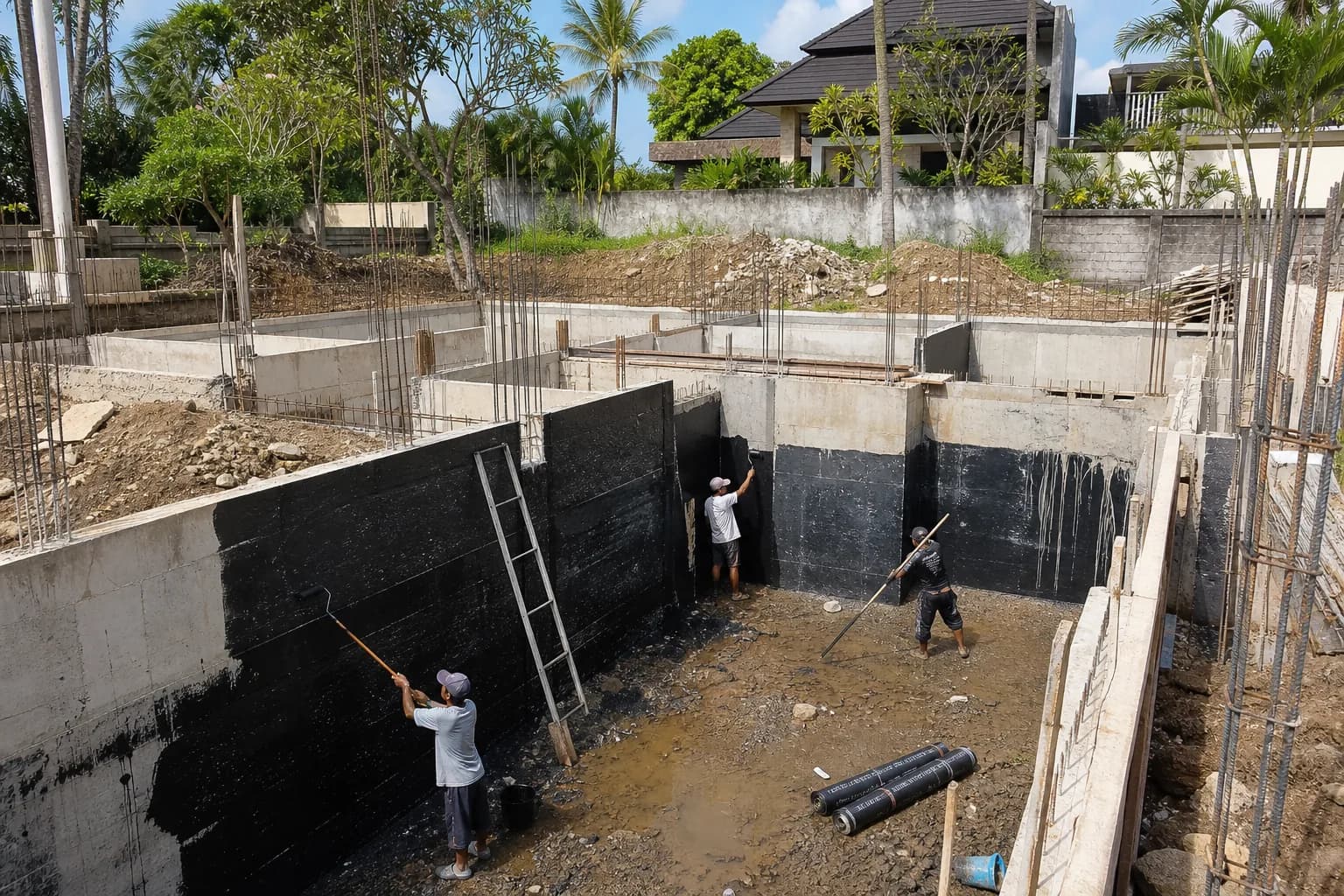
Why Seminyak’s High Water Table Makes Basement Construction a Critical Engineering Decision
Seminyak’s coastal proximity creates one of Bali’s most challenging construction environments for below-grade spaces. The water table in central Seminyak typically sits between 1.5 to 3 meters below ground level, rising to less than 1 meter during peak rainy season in beachfront zones. This hydrostatic pressure creates continuous upward force against basement structures, making waterproofing not just a protective measure but a fundamental structural requirement. Property developers often underestimate that basement waterproofing in Seminyak represents 18-25% of total below-grade construction costs, with failure rates exceeding 40% when tropical engineering protocols aren’t followed. The question isn’t whether to waterproof—it’s whether your site conditions, budget, and long-term maintenance capacity can support a basement at all in this high-water-table environment.
The Engineering Reality of Building Below Seminyak’s Water Table
Seminyak’s geological profile consists of sandy loam topsoil (0.5-1m depth) over clay-sand mixtures with high permeability, sitting above a shallow aquifer system connected to the ocean. During dry season (April-October), the water table in inland Seminyak areas (Jalan Raya Seminyak, Oberoi) stabilizes at 2-2.5 meters depth. In beachfront zones (Petitenget, Dhyana Pura), it remains at 1-1.5 meters year-round. Monsoon season (November-March) raises these levels by 0.5-1 meter, creating hydrostatic pressure exceeding 10 kPa against basement walls.
This creates three critical engineering challenges. First, continuous hydrostatic pressure requires tanked waterproofing systems rather than simple damp-proofing membranes. The pressure differential between groundwater and interior basement space creates constant moisture migration through concrete micropores, requiring multi-layer barrier systems with hydrophilic crystalline additives. Second, tidal influence in coastal Seminyak means water table fluctuations occur twice daily, creating expansion-contraction cycles that stress waterproofing joints and penetrations. Third, saltwater intrusion from ocean proximity introduces chloride ions that accelerate concrete degradation and corrode steel reinforcement, requiring specialized concrete mixes with supplementary cementitious materials.
Indonesian building code SNI 03-2847-2019 requires basement structures in high-water-table zones to demonstrate waterproofing capacity against hydrostatic pressure at 1.5x maximum anticipated water level. For Seminyak, this means designing for water table at ground level—a worst-case scenario that occurs during king tides combined with heavy rainfall. The structural slab must resist uplift forces (buoyancy) when the basement is empty, requiring either sufficient dead load from the structure above or ground anchors tied into deeper soil strata.
Waterproofing system selection depends on basement depth and water table relationship. For basements where the floor slab sits above seasonal high water table (rare in Seminyak), external membrane systems with drainage boards may suffice. For basements extending below water table (most Seminyak cases), you need tanked systems: external bituminous membranes combined with internal crystalline waterproofing admixtures in concrete, plus cavity drain membrane systems as tertiary protection. The concrete itself becomes part of the waterproofing strategy, requiring minimum 350 kg/m³ cement content, maximum 0.45 water-cement ratio, and 50mm minimum cover to reinforcement.
Dewatering during construction presents another complexity. Excavating 3-4 meters for a basement in Seminyak requires continuous pumping to lower the water table temporarily. This costs $800-1,200 per week for wellpoint systems, with construction timelines extending 2-3 weeks longer than equivalent above-grade work. More critically, dewatering can cause ground settlement in adjacent properties if not properly managed with recharge wells, creating legal liability under Indonesian civil code regarding construction-induced damage.
The legal framework adds constraints. Bali Governor Regulation No. 99/2018 requires groundwater impact assessments for excavations exceeding 2 meters depth in coastal zones. Seminyak falls under this jurisdiction, meaning basement projects need hydrogeological studies documenting pre-construction water table levels, predicted drawdown during construction, and mitigation measures. These studies cost $2,500-4,000 and take 3-4 weeks, but failure to obtain approval can halt construction and trigger fines up to Rp 50 million.
Hidden Risks Property Developers Miss in Seminyak Basement Projects
The most expensive mistake is treating waterproofing as a post-structural addition rather than integrated design. Developers who build the basement structure first, then apply waterproofing membranes, face 60% higher failure rates because they can’t address the critical junction between footing and wall—where 70% of water ingress occurs. Proper sequencing requires waterproofing membranes installed on blinding concrete before structural slab pour, with continuous lapping up basement walls before wall formwork.
Second critical error: inadequate drainage system design. Seminyak’s high water table means you cannot rely on gravity drainage for basement sumps. Power failures during storms (common in Bali) cause sump pump failures, and without backup systems, basements can flood within 2-3 hours. Investment-grade installations require dual sump pumps with battery backup and high-water alarms, adding $3,500-5,000 to costs that developers often omit from initial budgets.
Third oversight: ignoring long-term maintenance requirements. Waterproofing systems in high-water-table environments require annual inspections of drainage systems, sump pump testing, and monitoring of interior humidity levels. Crystalline waterproofing systems need 28 days minimum curing before water exposure—rushing this process to meet construction deadlines compromises the entire system. Developers who don’t budget for 5-year waterproofing warranties with maintenance protocols face repair costs averaging $15,000-25,000 when systems fail after 3-4 years.
The fourth hidden risk involves property resale and disclosure. Under Indonesian consumer protection law, structural defects including waterproofing failures must be disclosed to buyers. Basement moisture problems reduce property values by 15-30% and create legal liability. Proper documentation—waterproofing system specifications, installation photos, testing certificates—becomes essential for future transactions, yet 80% of Seminyak basement projects lack this documentation.
Step-by-Step Process for Basement Waterproofing in High Water Table Conditions
Phase 1: Site Investigation and Feasibility (Weeks 1-3)
Commission geotechnical investigation with minimum three boreholes to 8-meter depth. The report must document soil stratification, water table depth across seasons, permeability coefficients, and soil bearing capacity. Request specific testing for chloride content and pH levels to determine concrete mix requirements. Simultaneously, engage hydrogeological consultant for groundwater impact assessment required under Governor Regulation 99/2018. This phase costs $4,500-6,500 total but determines whether basement construction is technically and economically viable.
Phase 2: Waterproofing System Design (Weeks 4-5)
Work with structural engineer to integrate waterproofing into structural design, not as afterthought. Specify concrete mix design: minimum C30/37 grade, crystalline waterproofing admixture (Xypex, Penetron, or equivalent), supplementary cementitious materials (10-15% fly ash or slag) for chloride resistance. Design external membrane system: 4mm APP-modified bituminous membrane with polyester reinforcement, applied in two layers with staggered joints. Include cavity drain membrane as tertiary protection on internal walls. Detail all penetrations (pipes, cables) with hydrophilic waterstops and mechanical seals.
Phase 3: Dewatering and Excavation (Weeks 6-8)
Install wellpoint dewatering system around excavation perimeter before digging begins. Monitor water table drawdown daily and install recharge wells if settlement risk exists for adjacent properties. Excavate to formation level, then pour 100mm blinding concrete within 24 hours to prevent base heave. This rapid sequencing is critical in Seminyak’s high-water-table conditions where exposed soil can become unstable quickly.
Phase 4: Waterproofing Installation (Weeks 9-11)
Apply first layer of bituminous membrane to blinding concrete, lapping 150mm at joints. Install second layer with staggered joints. Lap membrane 500mm up excavation sides where basement walls will be cast. Install protection board over membrane before reinforcement placement. Pour basement slab with crystalline-admixed concrete in single continuous pour to avoid cold joints. After 7-day curing, construct basement walls with same concrete specification. Apply external membrane to walls after formwork removal, protecting with drainage board and filter fabric.
Phase 5: Drainage and Backup Systems (Weeks 12-13)
Install perimeter drainage pipes at footing level, sloped to sump pit locations. Specify dual submersible sump pumps (primary and backup) with separate power circuits. Install battery backup system rated for 8-hour runtime. Connect high-water alarm to property management system. Install cavity drain membrane on internal walls, channeling any seepage to sump system. This redundancy is non-negotiable in Seminyak’s conditions.
Phase 6: Testing and Documentation (Week 14)
Conduct flood testing if possible (fill basement with water to test waterproofing integrity) or electronic leak detection testing. Document all waterproofing installations with photographs before covering. Obtain manufacturer’s warranty certificates for membranes and crystalline systems. Create maintenance manual specifying inspection schedules and pump testing protocols. This documentation protects your investment and facilitates future property transactions.
Realistic Cost Breakdown for Seminyak Basement Waterproofing
For a typical 80-square-meter basement (common size for 3-4 bedroom villa), comprehensive waterproofing costs in Seminyak break down as follows:
- Geotechnical investigation and hydrogeological study: $5,000-6,500 (one-time, pre-construction)
- Dewatering during construction: $6,400-9,600 (8-week installation period at $800-1,200/week)
- Crystalline waterproofing admixture for concrete: $2,400-3,200 (added to all basement concrete)
- External bituminous membrane system: $4,800-6,400 (two-layer application, walls and slab)
- Cavity drain membrane system: $3,200-4,000 (internal tertiary protection)
- Drainage system and dual sump pumps: $4,500-6,000 (including battery backup)
- Specialized concrete mix design: $1,600-2,400 (premium over standard concrete)
- Waterproofing labor premium: $3,200-4,800 (specialized installation requirements)
Total waterproofing-specific costs: $31,100-42,900 for 80m² basement, equating to $389-536 per square meter purely for waterproofing systems. When combined with structural costs ($600-800/m²), finishes ($400-600/m²), and MEP systems ($200-300/m²), total basement construction reaches $1,589-2,236 per square meter—aligning with the $1,000-1,800/m² range for finished investment-grade basements, with Seminyak’s high-water-table conditions pushing costs toward the upper end.
Timeline reality: basement construction in Seminyak requires 14-16 weeks from excavation to weatherproof completion, versus 10-12 weeks for equivalent above-grade construction. The waterproofing curing requirements and dewatering logistics cannot be compressed without compromising system integrity.
Frequently Asked Questions: Seminyak Basement Waterproofing
Can I build a basement in beachfront Seminyak where water table is less than 1 meter deep?
Technically possible but economically questionable. When water table sits within 1 meter of surface, you’re building a permanent underwater structure requiring submarine-grade waterproofing. Costs increase 40-60% over standard basement construction, and you’ll need continuous dewatering during construction (12+ weeks at $1,200/week = $14,400+). The structural slab must resist buoyancy forces when basement is empty, requiring either massive dead loads or ground anchors adding $8,000-12,000. More critically, maintenance becomes perpetual—sump pumps run continuously, power failures create immediate flooding risk, and system lifespan reduces to 15-20 years versus 30-40 years for basements above water table. For beachfront Seminyak sites, elevated construction with ground-floor parking typically delivers better value and lower risk than basement excavation.
What’s the difference between waterproofing costs in Seminyak versus inland Bali areas like Ubud?
Seminyak waterproofing costs run 35-50% higher than inland areas due to three factors. First, higher water table requires more robust tanked systems versus simple damp-proofing sufficient in Ubud where water table sits 6-8 meters deep. Second, saltwater intrusion in coastal Seminyak demands specialized concrete mixes with supplementary cementitious materials, adding $20-30/m³ to concrete costs. Third, tidal fluctuations create dynamic loading on waterproofing systems, requiring cavity drain membranes as tertiary protection—unnecessary in stable inland conditions. A basement in Ubud might need $250-320/m² for waterproofing; the same basement in Seminyak requires $389-536/m². The engineering complexity and material specifications simply differ based on hydrogeological conditions.
How long do waterproofing systems last in Seminyak’s high-water-table environment?
Properly installed systems using crystalline-admixed concrete with external bituminous membranes and cavity drain backup should provide 25-30 years of effective protection in Seminyak conditions, assuming annual maintenance. However, this assumes correct installation—membrane laps sealed properly, concrete cured for full 28 days, drainage systems functioning. In practice, 40% of Seminyak basements show waterproofing issues within 5-7 years du
 164 m²7 month(s)from 79.000 USD
TALA TWO
 3180 m²7 month(s)from 142.000 USD
Vasudeva
 2144 m²11 month(s)from 104.000 USD
Narayana
 3124 m²6 month(s)from 123.000 USD
TALA 8
 3104 m²11 month(s)from 99.000 USD
TALA 100

Want to calculate?
 1from 198.000 USD
Private: Haridas Villas
 172 m²8 month(s)from 120.000 USD
Keshava
164 m²7 month(s)from 79.000 USDPrivate: Haridas Villas, Tegallalang
 3127 m²9 month(s)from 177.000 USD
Mukunda
 3173 m²6 month(s)from 125.000 USD
TALA FOUR
 4344 m²16 month(s)from 290.000 USD
Radha
Start With Real Numbers, Not Guesses
Before buying land or finalizing a design, check the realistic build cost range for your project in Bali.
Our team reviews your inputs and gives a grounded estimate.
Available lands
 700 m²15 min$ 162500Bali, Tabanan
 1533 m²5 min$ 165666Bali, Cepaka
 700 m²15 min$ 90517Bali, Central Bali
 928 m²15 min$ 910123Bali, Pererenan
 800 m²10 min$ 307882Bali, Tibubeneng
 800 m²8 min$ 113300Bali, Ungasan
 500 m²2 min$ 175862Bali, Cemagi
 2000 m²15 min$ 523000Bali, Canggu
 1300 m²10 min$ 348214Bali, Tabanan
 300 m²55 min$ 32475Bali, Tegelalang
 500 m²10 min$ 107143Bali, Tabanan
 444 m²10 min$ 111000Bali, Tabanan
 204 m²5 min$ 40899Bali, Kedungu
 3000 m²15 min$ 1246921Bali, Tabanan
 2000 m²10 min$ 243842Bali, Mengwi
Essential Bali build & buy guides
- Bali villa construction cost per m² in 2026
- How much will your villa cost? Calculator
- Building a villa in Bali: the complete guide
- Buying land in Bali: step-by-step for foreigners
- Bali villa investment: yields, risks, returns
- Leasehold vs freehold: what foreigners can own
- Construction defect liability & 10-year warranty
- Bali building codes and construction standards
Related guides
Sanur and Nusa Dua vs Canggu: Stability Plays vs Hype
Canggu gets the headlines; Sanur and Nusa Dua quietly deliver steadier returns to a different kind of buyer. An honest 2026 comparison of the stability markets against the hype market — prices, demand drivers, oversupply risk, and who should buy where.
7 min read
Ubud and the Wellness Market: Buying or Building for Retreats
Ubud is Bali's wellness capital, and retreat-focused property behaves differently from beach villas: longer stays, group bookings, lower volatility. Here is what the market rewards, what zoning allows, and what it costs to buy or build a retreat property in 2026.
8 min read
Buying and Building on the Bukit: Uluwatu, Bingin and Balangan from a Buyer's Seat
A buyer's-seat 2026 guide to the Bukit peninsula — Uluwatu, Bingin and Balangan land prices, the water problem nobody budgets, cliff setbacks after the 2025 Bingin demolitions, and how to build there properly.
7 min read