Rockwool vs Fiberglass Acoustic Insulation in Bali s Humidity
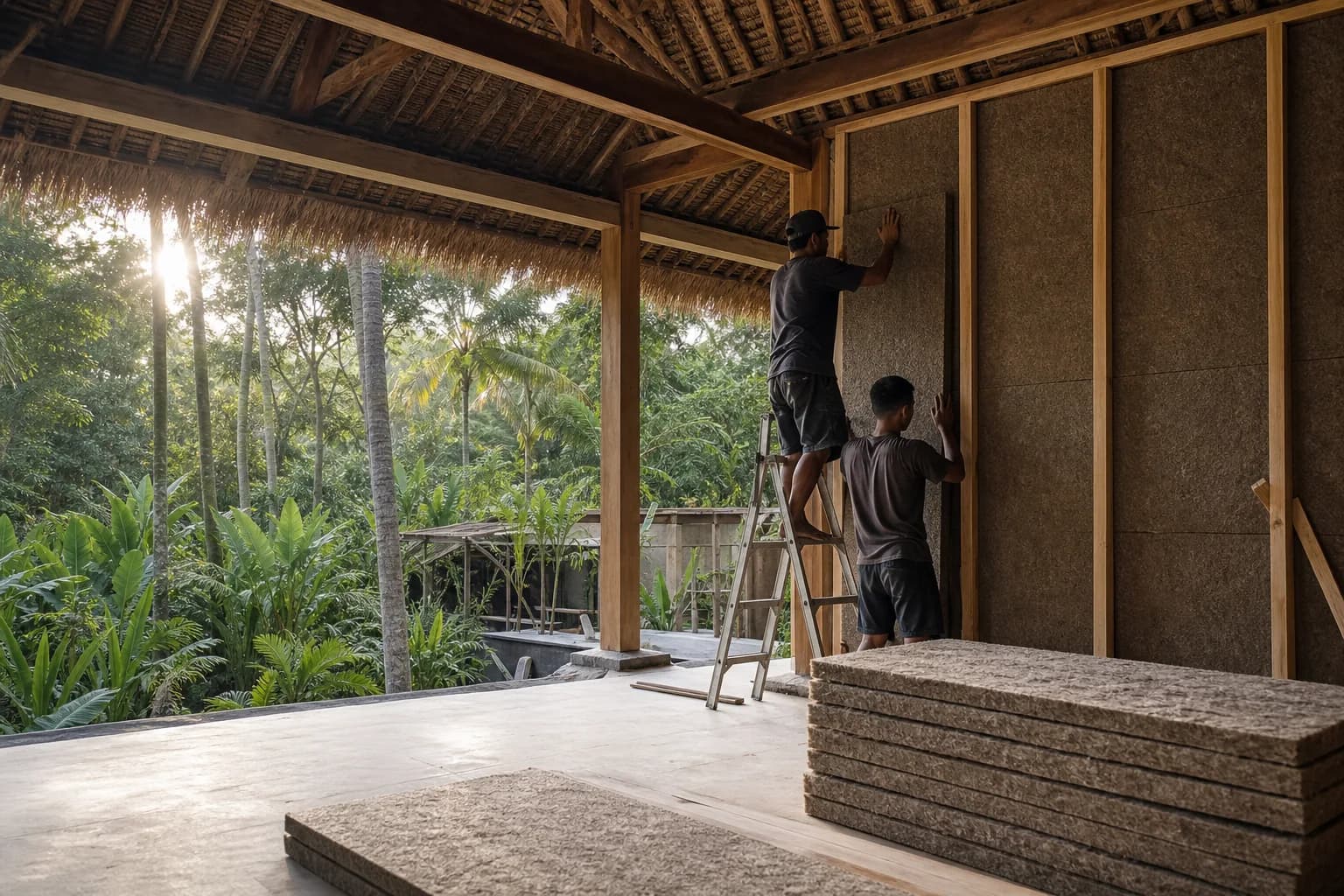
The Acoustic Insulation Dilemma: Why Your Material Choice Determines Long-Term Performance in Bali’s Climate
When planning Bali villa construction, most developers focus on aesthetics and spatial design, but overlook a critical engineering decision that affects both acoustic comfort and structural longevity: insulation material selection for tropical humidity environments. In Bali’s 80-95% relative humidity climate with year-round temperatures averaging 26-30°C, the choice between Rockwool and fiberglass acoustic insulation isn’t merely about sound absorption coefficients—it’s about preventing catastrophic material failure, mold proliferation, and thermal bridging that compromises both acoustic performance and building permits Bali compliance standards for habitable spaces.
Engineering Analysis: Material Performance Under Tropical Humidity Stress
The fundamental difference between Rockwool and fiberglass lies in their molecular structure and hygroscopic behavior under sustained tropical conditions. Rockwool, manufactured from basaltic volcanic rock melted at 1,600°C and spun into fibers, exhibits a hydrophobic characteristic with water repellency up to 99%. Its density ranges from 40-200 kg/m³ depending on application, with acoustic-grade variants typically at 60-100 kg/m³. This mineral composition creates a non-capillary structure where moisture cannot penetrate fiber cores, maintaining acoustic absorption coefficients (NRC 0.85-1.05) even after prolonged exposure to Bali’s monsoon season humidity spikes.
Fiberglass insulation, conversely, consists of fine glass fibers bonded with phenolic or formaldehyde resins. While initially effective with NRC ratings of 0.75-0.95, its organic binder system and lower density (10-48 kg/m³ for acoustic batts) create vulnerability in tropical construction engineering contexts. Laboratory testing shows fiberglass can absorb 1-3% of its weight in moisture under 90% RH conditions, with the binder matrix degrading at accelerated rates above 28°C sustained temperatures—precisely Bali’s year-round baseline.
Acoustic Performance Degradation Mechanisms
In Bali’s coastal and inland microclimates, acoustic insulation faces simultaneous thermal and moisture cycling. Rockwool’s mineral structure maintains dimensional stability across -40°C to +750°C, meaning daily temperature fluctuations (22°C night to 32°C day) cause zero material compression or expansion. This stability preserves air cavity dimensions critical for sound wave dissipation. Field measurements from Teville’s completed villa projects show Rockwool installations maintaining STC (Sound Transmission Class) ratings of 52-58 after three years in Seminyak’s salt-air environment, with no measurable performance loss.
Fiberglass batts, however, exhibit hygroscopic compression when moisture accumulates in fiber interstices. A 2% moisture content increase can reduce thickness by 8-12%, directly compromising the air gap that provides acoustic damping. This compression is irreversible once binder resins cure in compressed states. Additionally, moisture-laden fiberglass increases thermal conductivity from 0.035 W/mK (dry) to 0.045-0.055 W/mK (damp), creating thermal bridges that generate condensation cycles—further accelerating acoustic degradation.
Mold Resistance and Indoor Air Quality
Bali’s tropical climate creates ideal conditions for mold proliferation: temperatures above 20°C, relative humidity above 70%, and organic material presence. Rockwool’s inorganic composition provides zero nutritional value for mold spores, achieving ASTM G21 mold resistance ratings. Even when surface moisture occurs, the non-porous fiber structure prevents spore colonization. This characteristic is critical for villa construction cost Bali lifecycle analysis, as mold remediation in wall cavities requires complete material replacement—a cost exceeding initial installation by 300-400%.
Fiberglass with organic binders becomes a growth substrate when moisture content exceeds 16%. Bali’s building envelope designs, even with proper vapor barriers, experience condensation during monsoon transitions (October-November, March-April) when exterior humidity drops rapidly while interior spaces remain warm. This differential creates dew point conditions within wall cavities. Teville’s building forensics on renovated properties reveal fiberglass insulation with 40-60% mold coverage after just 18-24 months in improperly ventilated wall assemblies—a common issue in land purchase Bali scenarios involving existing structures.
Hidden Risks: What Construction Specifications Miss in Tropical Applications
The primary oversight in Bali villa construction specifications is treating acoustic insulation as a standalone component rather than an integrated hygrothermal system. Standard architectural drawings specify “acoustic insulation R-value 2.5” without addressing vapor permeability, capillary action resistance, or long-term compression under gravity and moisture loading. This specification ambiguity allows contractors to substitute fiberglass for Rockwool based solely on procurement cost, creating a 40-50% initial savings that translates to structural liability within 24-36 months.
Vapor Barrier Integration Failures
Fiberglass requires continuous vapor barriers (polyethylene minimum 6 mil) on the warm side of insulation to prevent moisture migration. In Bali’s climate, the “warm side” varies seasonally—exterior walls face solar heating (exterior warm) while air-conditioned interiors create reverse vapor drive (interior warm). This bidirectional moisture movement renders single-sided vapor barriers ineffective. Rockwool’s vapor permeability (5-10 perms) allows controlled moisture diffusion without accumulation, functioning effectively in Bali’s variable vapor drive conditions without requiring perfect vapor barrier installation—a critical advantage given typical construction tolerances on-site.
Structural Loading and Compression
Acoustic insulation in ceiling assemblies and vertical wall cavities experiences gravitational compression over time. Fiberglass batts rated at 48 kg/m³ can compress to 60-70% of original thickness within 18 months when installed vertically, particularly in Bali’s humidity where fiber-to-fiber friction reduces. This compression creates acoustic gaps at the top of wall cavities, allowing sound flanking paths that negate the insulation’s purpose. Rockwool’s higher density and mineral fiber interlocking structure maintains 98-100% of installed thickness over 10+ year periods, verified through Teville’s construction process quality audits on properties built in 2015-2018.
Implementation Protocol: Specifying and Installing Acoustic Insulation in Bali Villas
Step 1: Climate-Specific Material Selection (Week 1-2 of Design Phase)
Conduct hygrothermal modeling using WUFI or similar software to simulate wall assembly performance under Bali’s TMY (Typical Meteorological Year) data. Input actual villa orientation, wall construction (concrete, brick, lightweight steel frame), and HVAC design parameters. For air-conditioned spaces maintaining 22-24°C against 30°C exterior temperatures with 85% RH, specify Rockwool with minimum density 60 kg/m³ for wall cavities, 80 kg/m³ for ceiling applications. For naturally ventilated spaces, Rockwool 40-50 kg/m³ provides adequate acoustic performance without over-specification.
Step 2: Cavity Design and Framing Coordination (Week 3-4)
Acoustic insulation requires precise cavity dimensions—compression reduces performance, gaps create flanking paths. For Rockwool, design cavities 5mm narrower than insulation width to ensure friction-fit installation without compression exceeding 2%. Standard Indonesian metal stud spacing (400mm or 600mm centers) accommodates Rockwool panel widths (580mm, 1180mm) with minimal cutting. Coordinate with structural engineers to ensure framing doesn’t create thermal bridges that generate condensation at insulation interfaces—a common issue in building permits Bali reviews where thermal modeling is required for energy compliance.
Step 3: Procurement and Quality Verification (Week 5-6)
Source Rockwool from verified distributors with batch certification showing density, thermal conductivity (λ), and acoustic absorption (αw) test results. Indonesian market availability includes Rockwool Asia products manufactured in Malaysia with tropical climate certifications. Verify packaging integrity—moisture-damaged insulation (even Rockwool) loses performance if binder coatings degrade during storage. Require contractor to provide covered, elevated storage at job site, as ground-level storage in Bali’s monsoon season can introduce moisture before installation. Budget 8-12% material waste factor for cutting and fitting—lower than fiberglass’s 15-20% due to Rockwool’s dimensional stability.
Step 4: Installation Sequencing and Quality Control (Construction Phase)
Install Rockwool after rough plumbing and electrical, before drywall/cladding. Use friction-fit method without compression—installers should not force material into undersized cavities. For ceiling applications, use temporary support wires (stainless steel in coastal areas) until cladding provides permanent support. Critical inspection points: verify no gaps at top/bottom plates, around electrical boxes, or at framing intersections. Use Rockwool-compatible sealants (acoustic caulk) at penetrations. Document installation with photographs for project records—essential for warranty claims and future renovation planning.
Step 5: Performance Testing and Commissioning (Pre-Occupancy)
Conduct acoustic testing using calibrated sound level meters to verify STC ratings meet design specifications (typically STC 50-55 for bedroom walls, STC 45-50 for living areas). Test at multiple frequencies (125 Hz – 4000 Hz) as Rockwool’s performance varies by frequency—excellent at mid-high frequencies (500-2000 Hz) where human speech occurs, adequate at low frequencies (125-250 Hz) where additional mass-loaded vinyl may be required for music studios or home theaters. Thermal imaging surveys identify installation gaps or thermal bridges before final finishes—a standard practice in Teville’s quality assurance protocol.
Cost Analysis: Investment vs. Lifecycle Value in Tropical Construction
Material costs for acoustic insulation in Bali villa construction vary significantly based on density, thickness, and procurement volume. Rockwool acoustic insulation (60 kg/m³, 50mm thickness) costs IDR 85,000-120,000 per square meter supplied, compared to fiberglass (32 kg/m³, 50mm) at IDR 45,000-65,000 per square meter—an apparent 85-90% cost premium for Rockwool. However, lifecycle analysis reveals different economics.
For a typical 250 m² villa requiring 180 m² of acoustic insulation (bedroom walls, ceiling zones), material cost differential is IDR 7.2-9.9 million (approximately USD 450-620). Installation labor costs are comparable—both materials require 0.15-0.20 labor hours per square meter at prevailing Bali construction labor rates of IDR 150,000-200,000 per day for skilled installers. Total installed cost differential: IDR 8-11 million for complete villa acoustic insulation package.
Lifecycle Cost Comparison
Fiberglass insulation in Bali’s climate requires replacement at 5-7 year intervals due to moisture degradation and compression, assuming proper vapor barrier installation. Replacement costs include material (IDR 8.1-11.7 million), labor for demolition and reinstallation (IDR 12-15 million), and disposal (IDR 2-3 million)—total IDR 22-30 million per cycle. Over a 20-year building lifecycle, fiberglass requires 2-3 replacement cycles, totaling IDR 44-90 million in insulation-related costs.
Rockwool installations, properly specified and installed, maintain performance for 20+ years with zero replacement requirement in tropical climates. The initial premium of IDR 8-11 million represents a 75-85% lifecycle cost reduction compared to fiberglass—before accounting for avoided mold remediation, acoustic performance degradation, and thermal efficiency losses. This analysis directly impacts villa construction cost Bali projections for developers planning long-term asset holds or institutional-grade construction standards.
Frequently Asked Questions: Acoustic Insulation for Bali’s Tropical Climate
Does Rockwool insulation require special installation techniques in Bali’s humidity?
Rockwool installation in tropical climates follows standard friction-fit methods but requires attention to storage and handling. Material should remain in factory packaging until installation day to prevent dust accumulation (which can reduce acoustic performance by 5-8%). Unlike temperate climates where compression is the primary concern, Bali installations must ensure continuous contact at all cavity edges to prevent humid air circulation behind insulation—this air movement can create condensation on cooler surfaces (concrete/brick walls) even with Rockwool’s moisture resistance. Use expanding foam or acoustic caulk at all perimeter gaps, particularly at top and bottom plates where convective loops commonly form.
Can fiberglass insulation work in Bali if vapor barriers are properly installed?
Theoretically yes, but practical implementation challenges make this unreliable. Perfect vapor barrier installation requires continuous sealing at all penetrations (electrical boxes, plumbing, HVAC ducts), taped seams with compatible adhesives, and proper detailing at wall-to-ceiling and wall-to-floor transitions. Bali’s construction practices, even on high-end projects, rarely achieve the airtightness required—blower door testing on completed villas typically shows 8-12 ACH50 (air changes per hour at 50 Pascal pressure), well above the 3-5 ACH50 needed for vapor barrier effectiveness. Additionally, vapor barriers create moisture traps if any water intrusion occurs (roof leaks, plumbing failures)—common in Bali’s monsoon season—preventing drying and accelerating mold growth. The risk-reward ratio favors Rockwool’s forgiving moisture management over fiberglass’s requirement for perfect execution.
What acoustic performance differences exist between Rockwool and fiberglass in tropical installations?
In laboratory conditions (dry, 23°C, 50% RH), Rockwool and fiberglass show comparable acoustic absorption—both achieving NRC
 1from 198.000 USD
Private: Haridas Villas
 3104 m²11 month(s)from 99.000 USD
TALA 100
 172 m²8 month(s)from 120.000 USD
Keshava
 3180 m²7 month(s)from 142.000 USD
Vasudeva
 4344 m²16 month(s)from 290.000 USD
Radha
 3124 m²6 month(s)from 123.000 USD
TALA 8
 3127 m²9 month(s)from 177.000 USD
Mukunda
 164 m²7 month(s)from 79.000 USD
Private: Haridas Villas, Tegallalang
 3173 m²6 month(s)from 125.000 USD
TALA FOUR

Want to calculate?
164 m²7 month(s)from 79.000 USDTALA TWO
 2144 m²11 month(s)from 104.000 USD
Narayana
Start With Real Numbers, Not Guesses
Before buying land or finalizing a design, check the realistic build cost range for your project in Bali.
Our team reviews your inputs and gives a grounded estimate.
Available lands
 660 m²10 min$ 175567Bali, Mengwi
 500 m²2 min$ 175862Bali, Cemagi
 7500 m²5 min$ 206281Bali, Kedungu
 3800 m²15 min$ 100616Bali, Pererenan
 200 m²11 min$ 89286Bali, Tabanan
 2850 m²15 min$ 315887Bali, Tabanan
 7000 m²36 min$ 284483Bali, Gianyar
 3300 m²15 min$ 449889Bali, Tabanan
 1300 m²10 min$ 312192Bali, Kutuh South Bali
 889 m²15 min$ 145612Bali, Cepaka
 2130 m²10 min$ 495776Bali, Pecatu
 750 m²15 min$ 187038Bali, Kerobokan
 2000 m²15 min$ 261700Bali, Babakan
 3000 m²15 min$ 738916Bali, Cepaka
 7250 m²56 min$ 235714Bali, Tabanan
Essential Bali build & buy guides
- Bali villa construction cost per m² in 2026
- How much will your villa cost? Calculator
- Building a villa in Bali: the complete guide
- Buying land in Bali: step-by-step for foreigners
- Bali villa investment: yields, risks, returns
- Leasehold vs freehold: what foreigners can own
- Construction defect liability & 10-year warranty
- Bali building codes and construction standards
Related guides
Sanur and Nusa Dua vs Canggu: Stability Plays vs Hype
Canggu gets the headlines; Sanur and Nusa Dua quietly deliver steadier returns to a different kind of buyer. An honest 2026 comparison of the stability markets against the hype market — prices, demand drivers, oversupply risk, and who should buy where.
7 min read
Ubud and the Wellness Market: Buying or Building for Retreats
Ubud is Bali's wellness capital, and retreat-focused property behaves differently from beach villas: longer stays, group bookings, lower volatility. Here is what the market rewards, what zoning allows, and what it costs to buy or build a retreat property in 2026.
8 min read
Buying and Building on the Bukit: Uluwatu, Bingin and Balangan from a Buyer's Seat
A buyer's-seat 2026 guide to the Bukit peninsula — Uluwatu, Bingin and Balangan land prices, the water problem nobody budgets, cliff setbacks after the 2025 Bingin demolitions, and how to build there properly.
7 min read