Rainwater Tank Sizing Canggu Dry Season | Bali Guide
The Critical Calculation Most Canggu Villa Builders Get Wrong
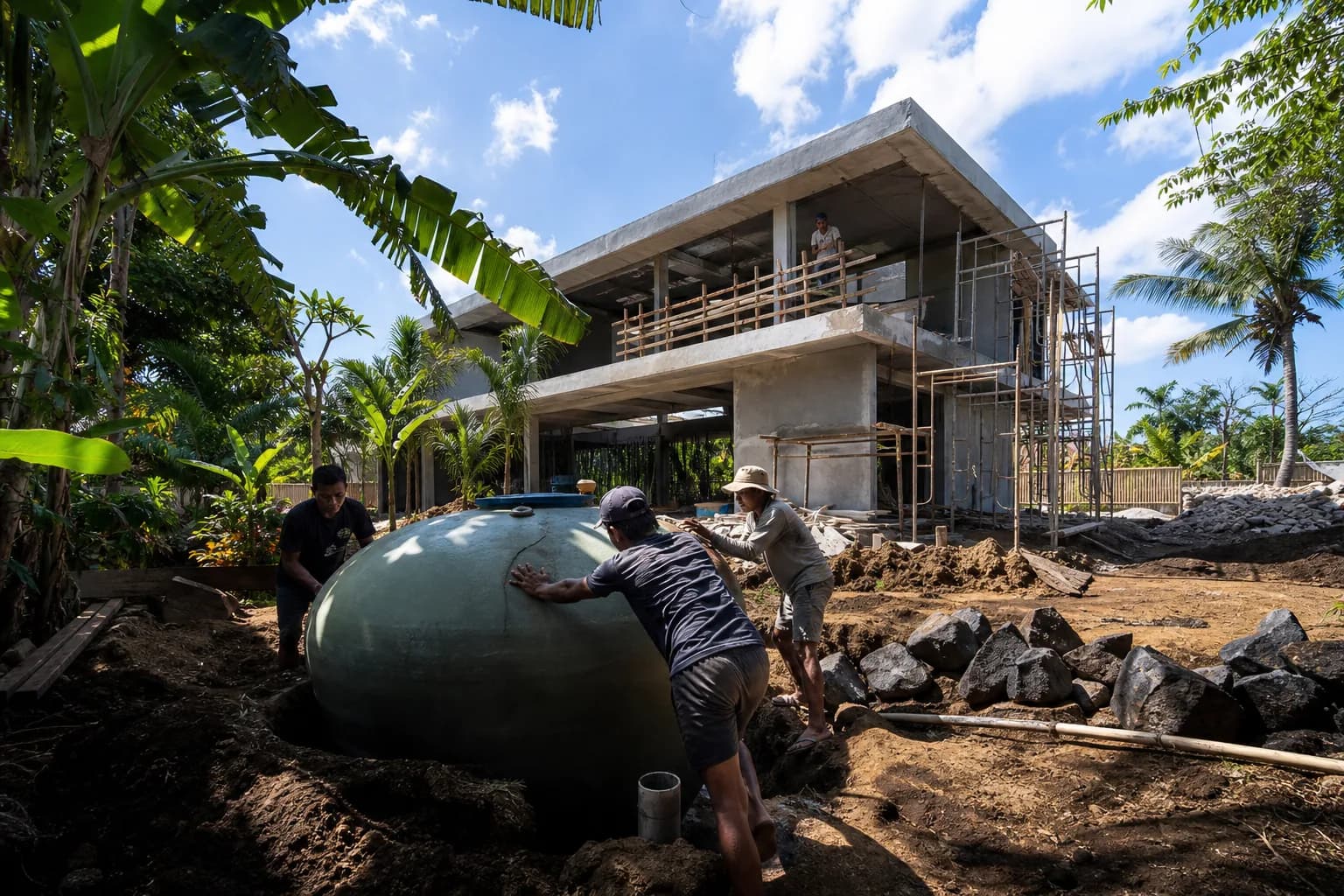
When designing a villa in Canggu, most developers focus on infinity pools and ocean views while overlooking a fundamental engineering question: how large should your rainwater harvesting tank be to survive Bali’s four-month dry season without municipal water dependency? The difference between a 10,000-liter tank and a properly calculated 25,000-liter system isn’t just storage capacity—it’s the difference between water security and emergency tanker deliveries at 800,000 IDR per load during peak dry season. For villa construction cost Bali planning, this calculation directly impacts both initial infrastructure investment and long-term operational resilience. Canggu’s specific microclimate, with its coastal exposure and increasingly unpredictable rainfall patterns, demands precise engineering rather than generic tropical assumptions. The four-month buffer isn’t arbitrary—it represents the typical duration from June through September when Canggu receives less than 50mm monthly rainfall, yet villa water demand remains constant or increases due to tourist season occupancy.
Engineering the Four-Month Buffer: Canggu-Specific Calculation Methodology
Calculating rainwater harvesting tank sizing for Canggu requires three critical data inputs: catchment area, local rainfall patterns, and realistic daily water consumption. Unlike generic Bali villa construction guidelines, Canggu’s coastal position creates specific variables that dramatically affect system performance.
Catchment Area Calculation for Tropical Roof Systems
Your effective catchment area isn’t simply roof square meterage. For tropical construction engineering, we calculate: Effective Catchment = Roof Area (m²) × Runoff Coefficient × Collection Efficiency. A typical 200m² villa roof in Canggu with concrete tile roofing has a runoff coefficient of 0.85 (15% loss to evaporation and absorption). Collection efficiency depends on gutter design—poorly installed systems lose another 10-15% to overflow during Bali’s intense rainfall events. A 200m² roof realistically yields 170m² of effective catchment area after accounting for these losses. This matters significantly: that 30m² difference represents approximately 3,000 liters of lost collection during a 100mm rainfall event.
Canggu’s Rainfall Reality: Beyond Annual Averages
While Bali’s annual rainfall averages 1,500-2,000mm, Canggu’s coastal microclimate shows distinct patterns. Our construction data from projects along Jalan Batu Bolong and Jalan Pantai Berawa reveals wet season concentration: approximately 1,400mm falls between November and March (five months), leaving just 400-600mm distributed across the remaining seven months. During the critical four-month dry season buffer period (June-September), Canggu typically receives only 150-200mm total rainfall—roughly 40-50mm monthly. This isn’t enough to sustain even minimal villa operations without substantial storage reserves. For building permits Bali compliance, understanding these patterns is essential as newer developments face increasing scrutiny on water self-sufficiency.
Daily Water Demand: Realistic Villa Consumption Patterns
Generic calculations assume 150 liters per person daily. Canggu villa reality differs substantially. A three-bedroom villa with pool requires: domestic use (4 occupants × 150L = 600L), garden irrigation for 100m² tropical landscaping (200L daily during dry season), pool evaporation replacement (6m × 3m pool loses approximately 150L daily in Canggu’s coastal wind conditions), and cleaning/maintenance (100L). Total realistic daily demand: 1,050 liters. This figure increases 20-30% during peak tourist season when villas operate at full occupancy with additional laundry and outdoor shower usage.
The Four-Month Buffer Calculation
For a 200m² catchment villa with 1,050L daily demand, the four-month (120-day) buffer calculation works as follows: Total dry season demand = 1,050L × 120 days = 126,000 liters. Expected dry season collection (200mm rainfall × 170m² effective catchment × 0.001 conversion) = 34,000 liters. Required storage capacity = 126,000L – 34,000L = 92,000 liters minimum. However, this assumes perfect timing and distribution of dry season rainfall. Engineering best practice for tropical construction engineering adds a 20% safety margin, bringing the recommended tank capacity to approximately 110,000 liters—or roughly 110 cubic meters of storage infrastructure.
Modular Tank Configuration Strategy
Rather than single massive tanks, Teville’s engineering approach for Canggu projects utilizes modular systems: three to four interconnected tanks of 25,000-30,000 liters each. This configuration provides maintenance flexibility, allows phased installation to match construction budgets, and creates redundancy if one tank requires servicing. The modular approach also simplifies land purchase Bali site planning, as multiple smaller tanks can be positioned to optimize space utilization around villa footprints and pool equipment areas.
Hidden Risks in Undersized Rainwater Systems
The most expensive mistake in Canggu rainwater harvesting isn’t the initial tank investment—it’s the cascading operational costs of inadequate capacity. When developers install generic 20,000-liter systems based on outdated rainfall assumptions, they create permanent operational vulnerabilities that affect property value and guest satisfaction.
Emergency Water Delivery Economics
During September 2024’s extended dry period, Canggu villa operators reported emergency water tanker costs reaching 1,200,000 IDR per 8,000-liter delivery due to demand surge. A villa requiring three deliveries monthly during dry season peaks faces 3,600,000 IDR in avoidable costs—money that could have funded proper storage infrastructure. Over a five-year period, inadequate tank sizing costs more than the initial investment in properly calculated capacity.
Structural Integration Timing
Rainwater tanks exceeding 30,000 liters require foundation engineering integration during initial villa construction cost Bali planning. Retrofitting large-capacity systems after construction completion often requires structural modifications, landscaping disruption, and pool equipment relocation. We’ve documented retrofit projects costing 40-60% more than integrated installation during initial construction phases. The construction process must account for tank positioning, foundation loading, and plumbing integration from preliminary design stages.
Permit Compliance Evolution
Badung Regency’s evolving water management regulations increasingly scrutinize new villa developments’ water self-sufficiency. While current building permits Bali don’t mandate specific tank capacities, projects demonstrating inadequate water infrastructure face longer approval timelines and additional technical review requirements. Forward-thinking developers incorporate oversized systems to future-proof against regulatory tightening—a strategy that also enhances property marketability to environmentally conscious buyers.
Step-by-Step Implementation for Canggu Villa Projects
Phase 1: Site-Specific Assessment (Weeks 1-2)
Begin with precise roof catchment measurement using architectural plans. For villa projects in Canggu, account for multi-level roofing, pergola coverage, and any planned expansions. Conduct soil percolation testing to determine if supplementary groundwater recharge systems can reduce storage requirements. Evaluate site topography for gravity-fed distribution potential—properties with natural elevation changes can reduce pump energy requirements by 30-40%. Document existing water infrastructure and PDAM connection capacity, as hybrid systems often provide optimal resilience.
Phase 2: Demand Modeling and System Sizing (Weeks 3-4)
Calculate realistic water demand using actual occupancy projections rather than theoretical minimums. For rental villas, analyze comparable properties’ consumption data—Canggu villa managers report 15-25% higher usage than owner-occupied residences due to guest behavior patterns. Model three scenarios: minimum occupancy (caretaker only), typical occupancy (60% annual average), and peak occupancy (100% during July-August). Size your system for the peak scenario with 20% margin. This conservative approach prevents the operational disruptions that damage rental reputation and revenue.
Phase 3: Tank Configuration and Positioning (Weeks 5-6)
Work with structural engineers to determine optimal tank placement. Underground installation in Canggu requires careful consideration of water table depth—typically 3-5 meters in coastal areas—and seasonal fluctuation. Tanks positioned too deep risk groundwater infiltration during wet season, while shallow installation may face structural stress from landscaping loads. For tropical construction engineering compliance, ensure minimum 1.5-meter clearance from property boundaries and 3-meter separation from septic systems. Coordinate tank positioning with pool equipment, electrical panels, and future expansion zones identified in master planning.
Phase 4: Filtration and Distribution Integration (Weeks 7-10)
Rainwater harvesting systems require multi-stage filtration: first-flush diverters (removing initial roof runoff containing debris), pre-tank screening (200-micron mesh minimum), and post-storage filtration before distribution. For potable use applications, UV sterilization and activated carbon filtration add 15,000,000-25,000,000 IDR to system costs but enable complete PDAM independence. Distribution plumbing should separate irrigation circuits from domestic supply, allowing prioritization during low-storage periods. Install monitoring systems with tank level sensors and automated PDAM backup switching—technology that costs 8,000,000 IDR but prevents dry-tank scenarios.
Phase 5: Testing and Commissioning (Weeks 11-12)
Conduct full-system pressure testing at 1.5× operating pressure for 24 hours minimum. Verify all overflow routing directs to appropriate drainage or recharge systems rather than creating erosion issues. Test automated switching between rainwater and backup supplies under simulated depletion conditions. For portfolio documentation, photograph all underground infrastructure before backfilling—critical for future maintenance and property transfer documentation.
Investment Reality: Canggu Rainwater System Costs
A properly engineered 110,000-liter modular rainwater harvesting system for a Canggu villa involves the following investment ranges based on 2024-2025 construction data:
Tank Infrastructure: Four 30,000-liter underground concrete tanks with waterproofing: 85,000,000-110,000,000 IDR. Fiberglass alternatives reduce costs by 20-25% but have shorter service life in Bali’s tropical conditions. Excavation and foundation preparation for coastal soil conditions: 25,000,000-35,000,000 IDR, varying significantly based on water table depth and soil composition.
Collection and Filtration: Gutter systems, first-flush diverters, and pre-filtration for 200m² catchment: 15,000,000-22,000,000 IDR. Post-storage filtration and UV treatment for potable quality: 18,000,000-28,000,000 IDR. Pump systems with automated controls and backup switching: 12,000,000-18,000,000 IDR.
Total System Investment: 155,000,000-213,000,000 IDR for complete installation. This represents approximately 4-6% of total villa construction cost Bali for a mid-range three-bedroom project. However, this investment eliminates 90-95% of ongoing water purchase costs and significantly enhances property value in Canggu’s increasingly water-conscious market. For detailed project costing including rainwater infrastructure, Teville’s cost estimation process provides site-specific analysis.
Timeline Considerations: Tank installation and integration requires 10-12 weeks when properly sequenced within overall construction scheduling. Attempting to compress this timeline risks inadequate curing of concrete tanks and incomplete system testing—issues that create expensive remediation requirements post-occupancy.
Frequently Asked Questions: Canggu Rainwater Tank Sizing
Can I start with smaller tanks and expand later if needed?
While modular systems allow phased installation, the foundation and plumbing infrastructure must be designed for full capacity from the beginning. Installing 60,000 liters initially with provisions for expanding to 110,000 liters is feasible, but retrofitting additional capacity without initial planning typically costs 50-70% more than integrated installation. The structural foundations, overflow routing, and distribution manifolds should accommodate ultimate capacity even if tanks are added progressively. For verified lands with space constraints, this phased approach balances initial budget limitations with long-term water security requirements.
How does Canggu’s coastal location affect tank material selection?
Canggu’s proximity to ocean (most villa sites within 2km of coastline) creates elevated chloride exposure that accelerates corrosion of metal components and degrades certain plastics. Reinforced concrete tanks with proper waterproofing and corrosion-resistant rebar (epoxy-coated or stainless steel) provide 30-40 year service life in coastal conditions. Fiberglass tanks offer corrosion immunity but may degrade under UV exposure if any portion remains above-ground. For tropical construction engineering durability, concrete remains the preferred solution for large-capacity installations, while fiberglass works well for smaller supplementary tanks in shaded locations.
What maintenance requirements should I budget for rainwater systems?
Annual maintenance for a 110,000-liter system includes: gutter cleaning and first-flush diverter inspection (quarterly during wet season, 500,000 IDR annually if outsourced), filter replacement (pre-filters every 6 months, UV bulbs annually, total 3,500,000 IDR), tank interior inspection and cleaning (every 3-5 years, 8,000,000-12,000,000 IDR including pump-out and disinfection), and pump system servicing (annually, 2,000,000 IDR). Total annual maintenance averages 6,000,000-8,000,000 IDR—substantially less t
 1from 198.000 USD
Private: Haridas Villas
 3104 m²11 month(s)from 99.000 USD
TALA 100
 3127 m²9 month(s)from 177.000 USD
Mukunda

Want to calculate?
 3124 m²6 month(s)from 123.000 USD
TALA 8
 164 m²7 month(s)from 79.000 USD
Private: Haridas Villas, Tegallalang
 172 m²8 month(s)from 120.000 USD
Keshava
 4344 m²16 month(s)from 290.000 USD
Radha
164 m²7 month(s)from 79.000 USDTALA TWO
 2144 m²11 month(s)from 104.000 USD
Narayana
 3173 m²6 month(s)from 125.000 USD
TALA FOUR
 3180 m²7 month(s)from 142.000 USD
Vasudeva
Start With Real Numbers, Not Guesses
Before buying land or finalizing a design, check the realistic build cost range for your project in Bali.
Our team reviews your inputs and gives a grounded estimate.
Available lands
 2000 m²15 min$ 523000Bali, Canggu
 2680 m²10 min$ 1732759Bali, Pererenan
 1600 m²32 min$ 266010Bali, Tabanan
 800 m²8 min$ 113300Bali, Ungasan
 1700 m²10 min$ 392549Bali, Nusadua
 3900 m²10 min$ 432266Bali, Tabanan
 2130 m²10 min$ 495776Bali, Pecatu
 660 m²10 min$ 175567Bali, Mengwi
 770 m²5 min$ 163578Bali, Kedungu
 2200 m²15 min$ 508005Bali, Canggu
 1375 m²10 min$ 447044Bali, Canggu
 585 m²8 min$ 165702Bali, Mengwi
 1000 m²5 min$ 350431Bali, Drupadi
 1230 m²15 min$ 132543Bali, Tegallalang
 2000 m²5 min$ 738916Bali, Ungasan
Essential Bali build & buy guides
- Bali villa construction cost per m² in 2026
- How much will your villa cost? Calculator
- Building a villa in Bali: the complete guide
- Buying land in Bali: step-by-step for foreigners
- Bali villa investment: yields, risks, returns
- Leasehold vs freehold: what foreigners can own
- Construction defect liability & 10-year warranty
- Bali building codes and construction standards
Related guides
Resin-Infused Plaster Finishes: Anti-Salt Systems Bali
Expert technical guide: Resin-Infused Plaster Finishes: Anti-Salt Systems Bali
8 min read
Prefinished Timber Joinery: Silicone Seals Fixings Bali
Professional prefinished timber joinery installation in Bali with silicone seals and fixings for durable weatherproof performance and a premium finish.
10 min read
Polished Concrete Microtopping: Surface Prep Sealants Bali
Discover Bali s polished concrete microtopping: expert surface prep, durable sealants, and a flawless finish for modern floors with minimal maintenance.
9 min read