Pecatu Limestone Cliff Foundation Engineering Load-Bearing Limi
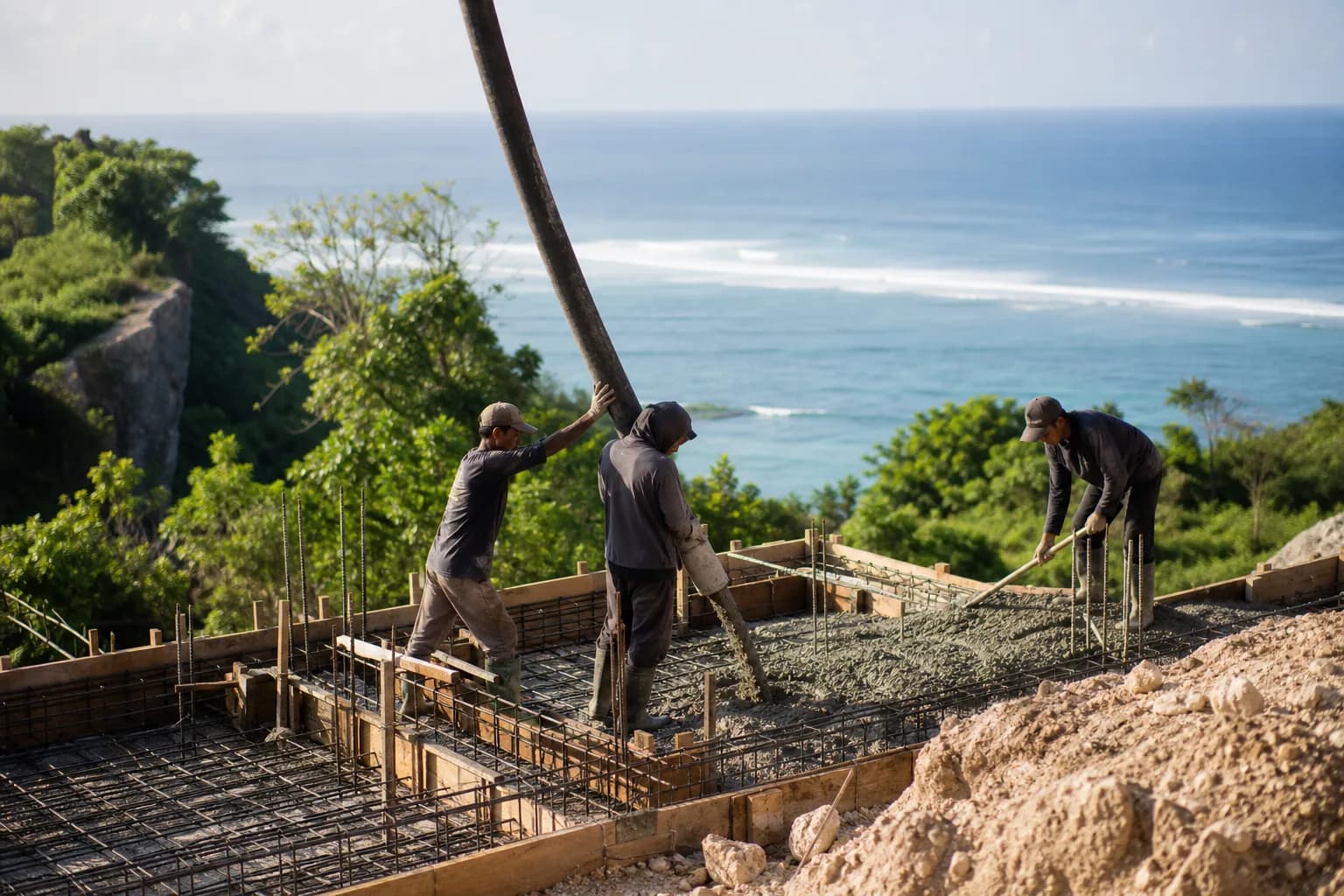
The Critical Challenge of Building on Pecatu’s Limestone Cliff Edges
Pecatu’s dramatic clifftop locations offer unparalleled ocean views, but the underlying limestone geology presents a complex engineering challenge that many developers underestimate. The porous, karstic nature of Pecatu limestone creates variable load-bearing capacity across even small building plots, with foundation strength potentially varying by 300-500% within a 20-meter span. Unlike stable volcanic bedrock found in Ubud or compacted alluvial soils in Canggu, Pecatu’s coralline limestone contains hidden voids, dissolution channels, and differential weathering patterns that can compromise structural integrity if not properly assessed. The question isn’t whether limestone can support construction—it’s understanding the specific load-bearing limits of your exact site, identifying subsurface anomalies, and engineering foundations that account for both vertical loads and the unique lateral pressures created by cliff-edge proximity and seismic activity in this coastal zone.
Understanding Pecatu Limestone Geology and Load-Bearing Characteristics
Pecatu limestone, technically classified as Miocene-age reef limestone, differs fundamentally from the igneous rock formations dominating northern and central Bali. This sedimentary rock formed from ancient coral reef deposits, creating a porous matrix with compressive strengths ranging from 15-45 MPa (megapascals) depending on weathering grade, porosity percentage, and proximity to dissolution features. Fresh, unweathered Pecatu limestone can exhibit bearing capacities of 800-1,200 kN/m² (kilonewtons per square meter), comparable to medium-density sandstone. However, weathered zones—common within 3-8 meters of the surface—may drop to 200-400 kN/m², requiring significantly different foundation approaches.
The karstic nature of this limestone creates the primary engineering challenge. Subsurface dissolution has formed cavities ranging from fist-sized voids to chambers exceeding 2 meters in diameter. These features are unpredictable in distribution and often undetectable through surface inspection. A geotechnical investigation conducted by Teville on a 1,500 m² Pecatu clifftop site revealed seven significant voids (0.4-1.8 meters diameter) within the building footprint, with cavity depths varying from 2.1 to 6.7 meters below grade. Standard bearing capacity calculations become meaningless when subsurface voids exist directly beneath proposed foundation elements.
Cliff-edge proximity introduces additional complexity through reduced lateral confinement. Limestone within 15 meters of a cliff face experiences different stress distributions than inland formations, with reduced passive earth pressure and increased susceptibility to block detachment along existing joint sets. The Bukit Peninsula’s predominant joint orientations (N-S and E-W trending) create natural planes of weakness that must be mapped during site investigation. Foundation elements placed too close to cliff edges may experience progressive failure as weathering and wave action gradually undermine lateral support.
Seismic considerations further complicate load-bearing calculations. Bali sits within a moderate seismic zone (Zone 3 per Indonesian SNI 1726:2019), with peak ground acceleration values of 0.3-0.4g expected for design-level earthquakes. Limestone’s brittle nature means it responds differently to seismic loading than ductile volcanic soils—sudden fracture propagation rather than gradual settlement. Foundation systems must account for both static dead loads and dynamic seismic amplification, particularly in structures exceeding two stories where overturning moments become significant.
Water interaction with limestone creates time-dependent strength degradation. Pecatu’s seasonal rainfall (averaging 1,200-1,500mm annually, concentrated November-March) infiltrates through the porous limestone matrix, gradually dissolving calcium carbonate and enlarging existing voids. Foundation elements in contact with limestone must be designed for progressive strength reduction over the building’s 50-year design life. This differs fundamentally from volcanic soil foundations where bearing capacity typically increases with consolidation over time.
Professional geotechnical investigation for Pecatu clifftop sites requires specialized techniques beyond standard soil boring. Ground-penetrating radar (GPR) surveys can detect subsurface voids to depths of 8-12 meters in limestone, while seismic refraction testing maps variations in rock quality. Core drilling at 10-15 meter spacing provides direct samples for laboratory testing of compressive strength, porosity, and dissolution susceptibility. Teville’s construction process mandates comprehensive geotechnical investigation before foundation design, with investigation costs typically representing 1.5-2.5% of total foundation budget but preventing far costlier remediation later.
Hidden Risks Buyers and Developers Overlook
The most dangerous assumption is treating all Pecatu limestone as uniform. Developers often extrapolate geotechnical data from neighboring sites, failing to recognize that subsurface conditions can change dramatically within 50 meters. A villa project 200 meters inland may have encountered excellent bearing capacity, but your clifftop site could contain extensive voiding. Each site requires independent investigation—there are no shortcuts.
Inadequate investigation depth represents another critical oversight. Many developers conduct shallow borings to 5-6 meters, sufficient for single-story structures but inadequate for multi-level villas where foundation loads concentrate at greater depths. Voids at 8-10 meter depths may not affect shallow foundations but could cause catastrophic failure under deep pile foundations if not detected. Investigation depth should extend at least 1.5 times the maximum foundation element depth or until competent, void-free limestone is confirmed across the entire building footprint.
Cliff setback distances are frequently underestimated. Indonesian building codes require minimum setbacks, but these generic standards don’t account for site-specific geology. Limestone with closely-spaced joints parallel to the cliff face may require 20-25 meter setbacks for structural safety, while massive, unfractured limestone might safely accommodate 12-15 meter setbacks. The setback decision must be based on detailed joint mapping and stability analysis, not arbitrary code minimums or maximizing ocean views.
Seasonal groundwater fluctuations create hidden loading conditions. During dry season, the water table may sit 15-20 meters below grade, but monsoon infiltration can raise it to 6-8 meters depth. This fluctuation changes effective stress conditions in the limestone, potentially reducing bearing capacity by 15-25% during wet season. Foundations designed only for dry-season conditions may experience excessive settlement or even bearing failure during prolonged wet periods.
Long-term weathering progression is rarely factored into design life calculations. Exposed limestone weathers at approximately 0.3-0.8mm per year in Pecatu’s tropical marine environment. Over a 50-year building life, this represents 15-40mm of surface degradation—seemingly minor, but sufficient to expose previously confined voids or weaken foundation-rock interfaces. Conservative design must account for this progressive strength reduction through appropriate safety factors and periodic inspection protocols.
Engineering Process for Clifftop Limestone Foundations
Phase 1: Comprehensive Site Investigation (4-6 weeks)
Begin with desktop geological review using available geological maps and aerial imagery to identify major structural features, historical landslides, and regional joint patterns. Engage a qualified geotechnical engineer—not a general contractor—to design the investigation program. For typical 1,000-1,500 m² clifftop sites, this includes: 6-8 core borings to 12-15 meter depths at strategic locations across the building footprint; ground-penetrating radar survey covering 150% of the building area to detect shallow voids; seismic refraction lines to map rock quality variations; and detailed joint mapping within 30 meters of cliff edges to assess block stability.
Laboratory testing of core samples should determine: unconfined compressive strength (minimum 5 samples per distinct lithology); porosity and density measurements; point load index testing at 1-meter intervals; and dissolution susceptibility through acid immersion testing. Request the raw data, not just summary conclusions—understanding the variability is as important as the average values.
Phase 2: Foundation System Selection (2-3 weeks)
Based on investigation results, the geotechnical engineer recommends appropriate foundation types. For sites with competent limestone (>600 kN/m² bearing capacity) and minimal voiding, spread footings on prepared limestone surfaces may suffice for single-story structures. Two-story villas typically require deeper foundations: drilled piers extending 4-6 meters into sound limestone, or grade beams connecting isolated pad footings. Sites with extensive shallow voiding may necessitate deep pile foundations (8-12 meters) extending through weathered zones to competent rock, or ground improvement through void grouting before conventional foundation construction.
Cliff-edge structures require specialized lateral support systems. Tie-back anchors drilled 8-12 meters into limestone behind the building provide resistance against overturning moments. Reinforced grade beams create a rigid foundation mat distributing loads across multiple bearing points, preventing differential settlement if localized weakness develops. Seismic design must include base isolation or enhanced ductility detailing to accommodate ground motion without brittle limestone fracture.
Phase 3: Void Treatment and Ground Preparation (3-5 weeks)
Detected voids require treatment before foundation construction. Small voids (<0.5m diameter) can be filled with controlled low-strength material (CLSM)—a flowable cement-sand mixture that completely fills irregular cavities. Larger voids may require structural grouting using cement-based grouts injected under pressure to ensure complete filling. For extensive voiding, jet grouting creates columns of improved ground by mixing in-situ limestone with cementitious materials. Teville’s villa projects in Pecatu have successfully employed all three techniques depending on site-specific conditions.
Surface preparation involves removing all weathered limestone from bearing surfaces—typically 0.3-0.8 meters of excavation. Bearing surfaces must be level, clean, and slightly roughened to ensure proper concrete-rock bonding. Proof testing through plate load tests verifies actual bearing capacity matches design assumptions before proceeding with permanent foundation construction.
Phase 4: Foundation Construction and Monitoring (6-10 weeks)
Foundation construction in limestone requires specialized equipment and techniques. Rock drilling for piers uses rotary percussion methods with temporary casing to prevent sidewall collapse in fractured zones. Concrete placement must occur within 24 hours of drilling completion to prevent water infiltration and bearing surface degradation. High-strength concrete (minimum K-350, equivalent to 29 MPa) ensures adequate load transfer into limestone.
Real-time monitoring during construction includes: settlement monitoring points established before foundation loading; inclinometers near cliff edges to detect any lateral movement; and periodic GPR scanning between foundation elements to verify no new voids have developed. This monitoring continues through structural frame construction, the period of maximum loading when any foundation inadequacies will manifest.
Phase 5: Long-Term Performance Verification (ongoing)
Post-construction monitoring should continue at 6-month intervals for the first two years, then annually. Survey-grade measurements detect settlement exceeding 5mm, triggering investigation of potential foundation distress. Visual inspection of cliff faces identifies progressive weathering or block detachment requiring remedial anchoring. This proactive approach prevents minor issues from becoming structural failures.
Realistic Cost and Timeline Expectations
Geotechnical investigation for Pecatu clifftop sites ranges from IDR 85-150 million (USD $5,400-9,500) depending on site size and complexity. This includes 6-8 borings, GPR survey, laboratory testing, and comprehensive engineering report with foundation recommendations. Attempting to save costs through inadequate investigation typically results in foundation redesign during construction, costing 3-5 times the initial investigation savings.
Foundation costs for clifftop limestone sites run 40-75% higher than comparable inland volcanic soil sites. A two-story villa requiring spread footings on volcanic soil might have foundation costs of IDR 450-600 million, while the same structure on Pecatu limestone with void treatment and drilled piers could reach IDR 750-1,100 million. Deep pile foundations for challenging sites can exceed IDR 1,400 million for a 300 m² building footprint. These costs include void grouting (IDR 3.5-6.5 million per cubic meter), specialized drilling equipment mobilization (IDR 45-75 million), and enhanced reinforcement for seismic resistance.
Timeline from investigation to completed foundation typically spans 16-24 weeks for clifftop sites, compared to 10-14 weeks for straightforward inland locations. Investigation requires 4-6 weeks, design and permitting 3-4 weeks, void treatment 3-5 weeks, and foundation construction 6-10 weeks. Monsoon season (November-March) can extend timelines by 20-30% due to drilling difficulties in saturated limestone and concrete curing challenges in high humidity.
Contingency budgets for limestone foundation projects should be 15-20% of foundation cost, compared to 10% for typical projects. Unexpected void discovery during construction, encountering weaker limestone than investigation suggested, or required design modifications based on actual conditions all necessitate this higher contingency. Experienced developers budget conservatively and celebrate when contingencies aren’t needed, rather than optimistically budgeting and facing project delays when reality differs from assumptions.
Frequently Asked 1from 198.000 USD
Private: Haridas Villas

Want to calculate?
 4344 m²16 month(s)from 290.000 USD
Radha
 2144 m²11 month(s)from 104.000 USD
Narayana
 3124 m²6 month(s)from 123.000 USD
TALA 8
 3104 m²11 month(s)from 99.000 USD
TALA 100
 164 m²7 month(s)from 79.000 USD
TALA TWO
164 m²7 month(s)from 79.000 USDPrivate: Haridas Villas, Tegallalang
 172 m²8 month(s)from 120.000 USD
Keshava
 3180 m²7 month(s)from 142.000 USD
Vasudeva
 3173 m²6 month(s)from 125.000 USD
TALA FOUR
 3127 m²9 month(s)from 177.000 USD
Mukunda
Start With Real Numbers, Not Guesses
Before buying land or finalizing a design, check the realistic build cost range for your project in Bali.
Our team reviews your inputs and gives a grounded estimate.
Available lands
 800 m²8 min$ 113300Bali, Ungasan
 750 m²15 min$ 187038Bali, Kerobokan
 550 m²5 min$ 217629Bali, Tabanan
 1000 m²10 min$ 303571Bali, Tabanan
 300 m²55 min$ 32475Bali, Tegelalang
 3000 m²15 min$ 1246921Bali, Tabanan
 680 m²15 min$ 110751Bali, Pererenan
 1000 m²10 min$ 280788Bali, Pecatu
 911 m²15 min$ 248217Bali, Pererenan
 515 m²7 min$ 570813Bali, Canggu
 2115 m²5 min$ 1139547Bali, Pererenan
 29000 m²6 min$ 3857143Bali, Tabanan
 3700 m²15 min$ 738177Bali, Tabanan
 7500 m²5 min$ 206281Bali, Kedungu
 1950 m²7 min$ 150092Bali, Tabanan
Essential Bali build & buy guides
- Bali villa construction cost per m² in 2026
- How much will your villa cost? Calculator
- Building a villa in Bali: the complete guide
- Buying land in Bali: step-by-step for foreigners
- Bali villa investment: yields, risks, returns
- Leasehold vs freehold: what foreigners can own
- Construction defect liability & 10-year warranty
- Bali building codes and construction standards
Related guides
Sanur and Nusa Dua vs Canggu: Stability Plays vs Hype
Canggu gets the headlines; Sanur and Nusa Dua quietly deliver steadier returns to a different kind of buyer. An honest 2026 comparison of the stability markets against the hype market — prices, demand drivers, oversupply risk, and who should buy where.
7 min read
Ubud and the Wellness Market: Buying or Building for Retreats
Ubud is Bali's wellness capital, and retreat-focused property behaves differently from beach villas: longer stays, group bookings, lower volatility. Here is what the market rewards, what zoning allows, and what it costs to buy or build a retreat property in 2026.
8 min read
Buying and Building on the Bukit: Uluwatu, Bingin and Balangan from a Buyer's Seat
A buyer's-seat 2026 guide to the Bukit peninsula — Uluwatu, Bingin and Balangan land prices, the water problem nobody budgets, cliff setbacks after the 2025 Bingin demolitions, and how to build there properly.
7 min read