Nusa Dua Hotel Wastewater Permits Treatment Costs Bali
{
“article”: “
Why Nusa Dua Hotel Zone Wastewater Compliance Determines Your Construction Budget
\n\n
If you’re planning hotel or villa construction in Bali’s Nusa Dua Hotel Zone, wastewater discharge permits and treatment infrastructure represent one of the most technically complex—and financially significant—regulatory requirements you’ll face. Unlike other Bali regions where decentralized septic systems might suffice, Nusa Dua operates under a centralized wastewater management framework with strict discharge standards enforced by BTDC (Bali Tourism Development Corporation) and the Bali Provincial Government. The 2025 introduction of Indonesia’s regulation No. 11/2025 has further tightened domestic wastewater quality standards, requiring advanced treatment technologies that can add 15-30% to your total utility infrastructure budget. Understanding these permit requirements and associated treatment costs before land acquisition isn’t optional—it’s the difference between a financially viable project and one that stalls during the permitting phase.
\n\n
Technical Framework: Nusa Dua’s Centralized Wastewater Infrastructure
\n\n
Nusa Dua operates as Bali’s only fully planned resort enclave with integrated utility infrastructure, including a centralized wastewater collection and treatment system managed by BTDC. This system was designed in the 1970s to prevent groundwater contamination and protect the peninsula’s pristine beaches—environmental concerns that have only intensified with stricter 2026 regulations.
\n\n
Regulatory Hierarchy and Permit Requirements
\n\n
Your wastewater discharge permit application must navigate three regulatory layers. First, compliance with national standards under Regulation No. 11/2025, which establishes maximum permissible limits for BOD (Biological Oxygen Demand), COD (Chemical Oxygen Demand), TSS (Total Suspended Solids), and pathogen levels. Second, BTDC’s zone-specific requirements, which often exceed national minimums due to the area’s environmental sensitivity and tourism importance. Third, the Bali Provincial Government’s 2026 implementation guidelines, which introduce quarterly monitoring requirements and penalties for non-compliance ranging from operational suspension to permit revocation.
\n\n
The permit application requires detailed engineering drawings of your on-site pre-treatment system, hydraulic calculations demonstrating adequate capacity for peak discharge periods, and a maintenance protocol approved by a certified wastewater engineer. BTDC mandates that all commercial properties install grease traps, solids separators, and equalization tanks before connecting to the centralized collection system. Hotels and multi-unit developments must also provide real-time monitoring equipment with data transmission capabilities to BTDC’s central management system.
\n\n
Treatment Technology Requirements
\n\n
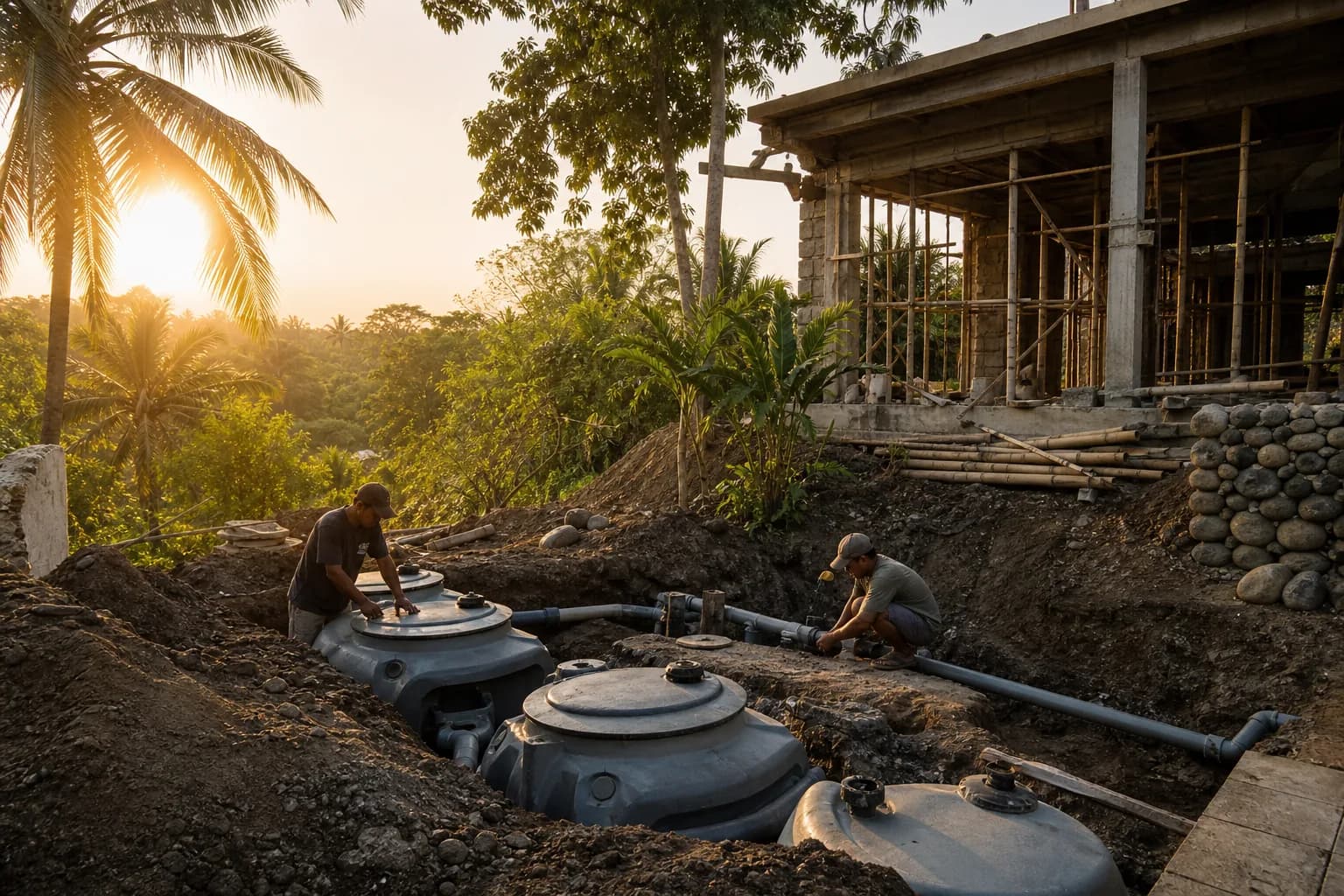
The 2025 regulation shift has effectively eliminated conventional septic tank systems for new commercial construction in Nusa Dua. Your project now requires either connection to the centralized system with compliant pre-treatment, or installation of an on-site advanced treatment plant meeting discharge standards for direct environmental release—a significantly more expensive option rarely approved in the Hotel Zone due to groundwater protection policies.
\n\n
Pre-treatment systems must achieve minimum 60% BOD reduction and 70% TSS removal before discharge to the collection network. This typically requires multi-stage treatment: primary settling, biological treatment using extended aeration or membrane bioreactor (MBR) technology, and tertiary filtration. For hotel properties with food service operations, additional grease removal capacity of 0.5-0.8 liters per meal served is mandatory, with interceptors sized for 2-3 day retention at peak occupancy.
\n\n
The centralized treatment plant in Nusa Dua has recently undergone upgrades as part of Bali’s “green utility” ecosystem, incorporating advanced oxidation processes and UV disinfection to enable treated water reuse for landscape irrigation—a requirement that affects your landscape design specifications and irrigation system engineering. Properties connecting to this system pay both capital connection fees and ongoing volumetric discharge charges calculated on metered flow.
\n\n
Engineering Challenges in Tropical Coastal Environments
\n\n
Nusa Dua’s coastal location and high water table (typically 1.5-3 meters below grade) create specific engineering challenges for wastewater infrastructure. Collection pipes and treatment tanks must be designed for buoyancy resistance, requiring concrete ballast or anchoring systems to prevent flotation during high groundwater periods. Corrosion protection is critical—all metallic components require marine-grade stainless steel or epoxy coating, as the saline groundwater environment accelerates deterioration of standard materials.
\n\n
Pump stations, required for properties below the gravity flow elevation of BTDC’s collection mains, must incorporate duplex or triplex configurations with emergency storage capacity for 24-hour peak flow. Power backup systems are mandatory, as wastewater overflow during Bali’s frequent power interruptions creates immediate environmental violations and substantial fines.
\n\n
Hidden Risks: What Development Teams Overlook Until Permitting
\n\n
The most expensive mistake we observe is land acquisition without verification of wastewater connection availability. BTDC’s collection system has finite capacity, and certain zones within Nusa Dua have reached allocation limits, requiring developers to fund off-site infrastructure upgrades—costs that can reach USD 150,000-300,000 for trunk line extensions or pump station capacity increases. This information isn’t readily available in standard due diligence; it requires direct coordination with BTDC’s engineering department and review of the zone’s hydraulic capacity model.
\n\n
Second, many teams underestimate the timeline for wastewater permit approval. While building permits (IMB) might be obtained in 3-4 months, wastewater discharge permits require separate technical review by BTDC, environmental impact assessment for properties over 5,000 m² built area, and coordination with the Provincial Environmental Agency (DLH). The complete approval chain typically requires 6-9 months, and construction cannot legally commence until wastewater permits are secured—a sequencing requirement that delays project timelines and increases carrying costs.
\n\n
Third, ongoing compliance costs are frequently omitted from operational budgets. The 2026 regulations mandate quarterly water quality testing by accredited laboratories, with sample collection, analysis, and reporting costs of approximately IDR 8-12 million per quarter. Properties that fail two consecutive tests face mandatory system audits by independent engineers, adding IDR 25-40 million in unplanned expenses. These aren’t one-time costs—they continue throughout the property’s operational life.
\n\n
Step-by-Step Process: Securing Wastewater Permits in Nusa Dua
\n\n
Phase 1: Pre-Acquisition Technical Assessment (Weeks 1-3)
\n\n
Before finalizing land purchase, request a wastewater connection feasibility letter from BTDC. This document confirms available capacity in the collection system serving your parcel and identifies any required off-site improvements. Simultaneously, commission a geotechnical investigation to determine groundwater elevation and soil permeability—data essential for treatment system design. Engage a wastewater engineer certified by the Indonesian Association of Sanitation and Environmental Engineering (IATPI) to review BTDC’s technical standards and prepare preliminary system sizing calculations based on your project’s planned occupancy and water consumption.
\n\n
Phase 2: Detailed Engineering and Permit Application (Weeks 4-16)
\n\n
Your engineer prepares detailed construction drawings showing all wastewater collection piping, pre-treatment equipment, pump stations, and monitoring systems. These drawings must demonstrate compliance with Indonesian National Standard (SNI) 03-7065-2005 for wastewater treatment plant design and BTDC’s supplementary technical specifications. The application package includes hydraulic calculations, equipment specifications with manufacturer certifications, maintenance protocols, and emergency response procedures.
\n\n
Submit the application to BTDC’s Technical Services Division along with the required review fee (typically 0.5-0.8% of estimated wastewater infrastructure construction cost). BTDC conducts a technical review within 30-45 days, often requesting clarifications or design modifications. Properties requiring environmental impact assessment (AMDAL) must complete this parallel process through DLH, adding 8-12 weeks to the timeline.
\n\n
Phase 3: Construction and Pre-Operational Inspection (Weeks 17-40)
\n\n
Once permits are approved, construction proceeds under supervision of your certified engineer, who must certify completion of each major milestone. BTDC requires notification 14 days before system commissioning to schedule pre-operational inspection. This inspection verifies that constructed systems match approved drawings, all equipment is properly installed and functional, and monitoring systems are operational and transmitting data correctly.
\n\n
Before final connection approval, you must demonstrate system performance through a 7-day operational test with water quality sampling at inlet and outlet points. Results must meet discharge standards with safety margin—BTDC typically requires performance 20% better than minimum standards to account for operational variability. Only after successful testing does BTDC issue the final discharge permit and authorize connection to the collection system.
\n\n
Phase 4: Ongoing Compliance and Monitoring (Operational Phase)
\n\n
Maintain detailed operational logs documenting daily flow volumes, equipment maintenance, and any system malfunctions. Quarterly sampling must be conducted by laboratories accredited by the National Accreditation Committee (KAN), with results submitted to BTDC within 14 days of sample collection. Annual permit renewal requires submission of compliance reports, updated maintenance records, and payment of volumetric discharge fees based on metered flow from the previous year.
\n\n
Realistic Cost Ranges: Budgeting for Wastewater Compliance
\n\n
For a boutique hotel or villa development of 10-15 keys in Nusa Dua, expect the following wastewater-related costs:
\n\n
- \n
- BTDC Connection Fee: USD 8,000-15,000 (one-time, based on projected peak daily flow)
- On-Site Pre-Treatment System: USD 35,000-65,000 (including grease traps, equalization tanks, biological treatment, and filtration)
- Pump Station (if required): USD 18,000-28,000 (duplex configuration with emergency storage and backup power)
- Monitoring Equipment: USD 6,000-10,000 (flow meters, sampling ports, data transmission system)
- Engineering and Permitting: USD 8,000-12,000 (design, calculations, application preparation, inspection support)
- Quarterly Compliance Testing: USD 280-400 per quarter (ongoing operational cost)
- Annual Discharge Fees: USD 1,200-2,500 (based on metered volume, approximately USD 0.15-0.25 per cubic meter)
\n
\n
\n
\n
\n
\n
\n
\n\n
Total first-year wastewater infrastructure investment typically ranges from USD 75,000-130,000 for a mid-scale development, with annual ongoing compliance costs of USD 6,000-12,000. These figures can increase by 40-60% for properties requiring off-site infrastructure upgrades or those with specialized discharge requirements such as spa facilities with treatment chemical discharge or commercial laundries.
\n\n
Timeline from permit application to operational approval averages 7-11 months, assuming no major design revisions or capacity constraints requiring off-site improvements.
\n\n
Frequently Asked Questions: Nusa Dua Wastewater Compliance
\n\n
Can I use a standard septic system instead of connecting to BTDC’s centralized wastewater system?
\n\n
No. BTDC regulations prohibit new septic tank installations for commercial properties in the Nusa Dua Hotel Zone. The area’s high water table, coral limestone geology, and proximity to sensitive coastal ecosystems make septic systems environmentally unsuitable. All new commercial construction must connect to the centralized collection and treatment system with compliant pre-treatment. Attempting to install a septic system will result in building permit denial and potential legal action for environmental violations. Existing properties with grandfathered septic systems face mandatory conversion to centralized connection during major renovations or ownership transfers.
\n\n
What happens if my property’s wastewater quality fails quarterly testing?
\n\n
First failure triggers a warning notice and mandatory retest within 30 days at your expense. If the retest also fails, BTDC requires a comprehensive system audit by an independent certified engineer to identify deficiencies and propose corrective actions. You must implement all required improvements within 90 days and demonstrate compliance through additional testing. Continued non-compliance can result in daily fines of IDR 5-10 million, operational suspension orders, and ultimately permit revocation. The 2026 regulations also introduce public disclosure requirements—properties with repeated violations are listed on BTDC’s compliance website, creating reputational risk that affects property values and guest bookings.
\n\n
How does the new Regulation No. 11/2025 affect existing properties with older treatment systems?
\n\n
Existing properties have a 24-month grace period (until February 2028) to upgrade systems to meet new discharge standards. However, properties undergoing major renovations, ownership changes, or permit renewals must achieve immediate compliance. The regulation’s stricter limits for BOD (maximum 30 mg/L, down from previous 50 mg/L) and introduction of pathogen standards (E. coli below 3,000 MPN/100mL) mean most older systems require significant upgrades—typically adding tertiary treatment stages and UV disinfection. Budget USD 25,000-45,000 for retrofit upgrades on existing 10-15 key properties. BTDC offers technical assistance programs to help existing operators navigate the upgrade process, but does not provide financial subsidies.
\n\n
Are there water reuse requirements that affect landscape design and irrigation systems?
\n\n
Yes. The 2026 sustainabil
 3180 m²7 month(s)from 142.000 USD
Vasudeva
 2144 m²11 month(s)from 104.000 USD
Narayana
 3127 m²9 month(s)from 177.000 USD
Mukunda
 164 m²7 month(s)from 79.000 USD
TALA TWO
 1from 198.000 USD
Private: Haridas Villas
 3104 m²11 month(s)from 99.000 USD
TALA 100
164 m²7 month(s)from 79.000 USDPrivate: Haridas Villas, Tegallalang
 172 m²8 month(s)from 120.000 USD
Keshava
 3173 m²6 month(s)from 125.000 USD
TALA FOUR
 3124 m²6 month(s)from 123.000 USD
TALA 8

Want to calculate?
 4344 m²16 month(s)from 290.000 USD
Radha
Start With Real Numbers, Not Guesses
Before buying land or finalizing a design, check the realistic build cost range for your project in Bali.
Our team reviews your inputs and gives a grounded estimate.
Available lands
 2130 m²10 min$ 495776Bali, Pecatu
 550 m²15 min$ 164594Bali, Mengwi
 889 m²15 min$ 145612Bali, Cepaka
 700 m²15 min$ 162500Bali, Tabanan
 1375 m²10 min$ 447044Bali, Canggu
 700 m²8 min$ 165517Bali, Umalas
 3254 m²5 min$ 631800Bali, All
 7000 m²36 min$ 284483Bali, Gianyar
 2200 m²3 min$ 183842Bali, Berawa
 750 m²15 min$ 187038Bali, Kerobokan
 770 m²5 min$ 163578Bali, Kedungu
 2800 m²15 min$ 310345Bali, Tabanan
 700 m²15 min$ 90517Bali, Central Bali
 1430 m²5 min$ 209862Bali, Klungkung
 6000 m²10 min$ 1330049Bali, Kutuh South Bali
Essential Bali build & buy guides
- Bali villa construction cost per m² in 2026
- How much will your villa cost? Calculator
- Building a villa in Bali: the complete guide
- Buying land in Bali: step-by-step for foreigners
- Bali villa investment: yields, risks, returns
- Leasehold vs freehold: what foreigners can own
- Construction defect liability & 10-year warranty
- Bali building codes and construction standards
Related guides
Sanur and Nusa Dua vs Canggu: Stability Plays vs Hype
Canggu gets the headlines; Sanur and Nusa Dua quietly deliver steadier returns to a different kind of buyer. An honest 2026 comparison of the stability markets against the hype market — prices, demand drivers, oversupply risk, and who should buy where.
7 min read
Ubud and the Wellness Market: Buying or Building for Retreats
Ubud is Bali's wellness capital, and retreat-focused property behaves differently from beach villas: longer stays, group bookings, lower volatility. Here is what the market rewards, what zoning allows, and what it costs to buy or build a retreat property in 2026.
8 min read
Buying and Building on the Bukit: Uluwatu, Bingin and Balangan from a Buyer's Seat
A buyer's-seat 2026 guide to the Bukit peninsula — Uluwatu, Bingin and Balangan land prices, the water problem nobody budgets, cliff setbacks after the 2025 Bingin demolitions, and how to build there properly.
7 min read