Moisture-Resistant Composite Cabinet Install for Bali Villas
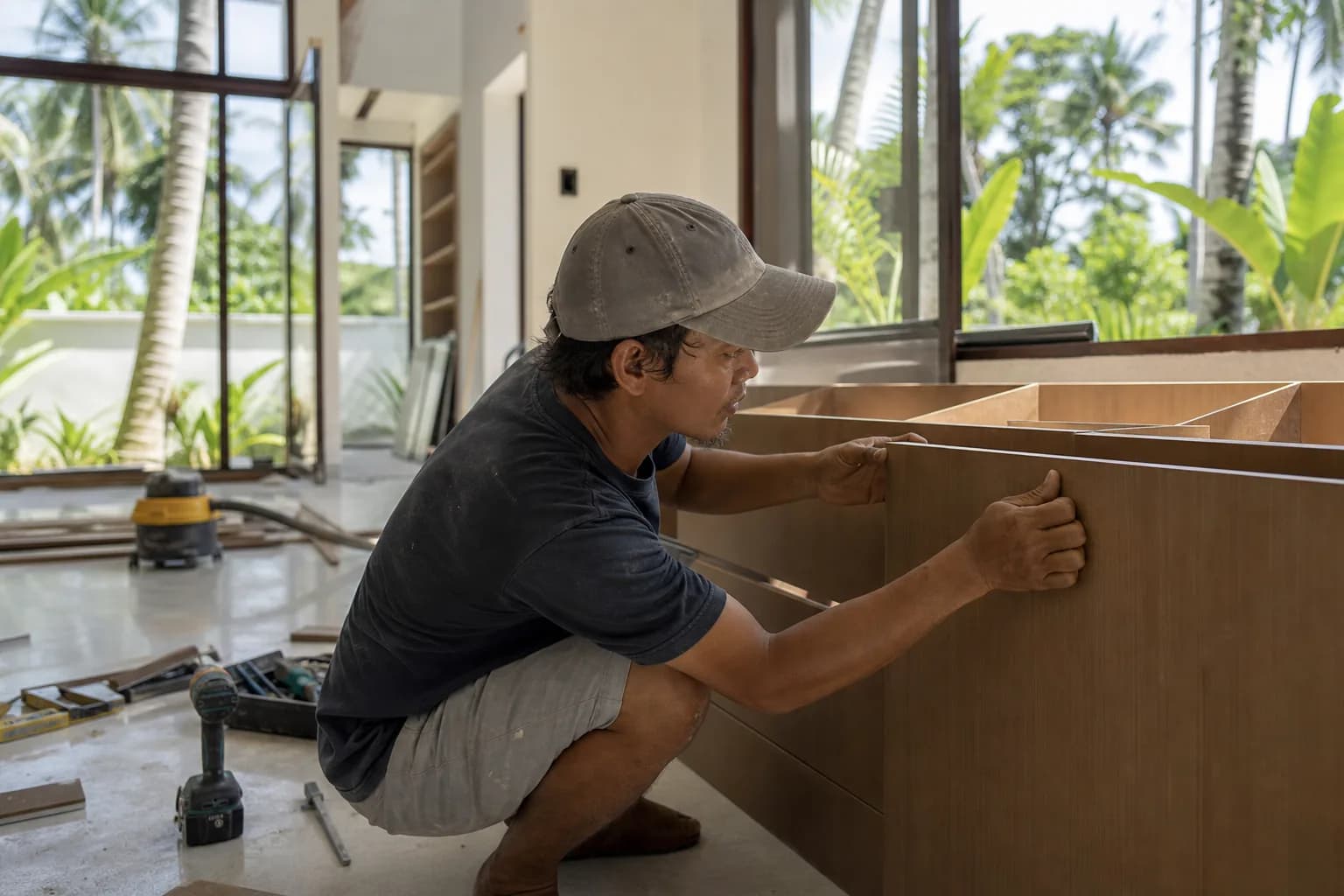
Moisture-Resistant Composite Cabinet Installation for Bali Villas: A Technical Guide
Specific Problem/Question
You’ve selected “moisture-resistant” cabinetry for a Bali villa, yet doors still twist, carcasses swell at plinths, hinges corrode, and musty odors creep in—especially near coastal spray or wet cores like kitchens and bathrooms. The question is not just which product to buy, but how to engineer, fabricate, and install composite cabinets so they remain dimensionally stable, hygienic, and serviceable in Bali’s high humidity, salt air, and monsoon seasons. This Bali area guide from Teville focuses on the finishing process and precise installation methods that make moisture-resistant composite cabinetry truly durable in real Bali conditions.
Technical Deep Dive: What “Moisture-Resistant” Must Mean in Bali
Moisture resistance in Bali villas is a system, not a sticker. It’s the sum of substrate selection, edge sealing, hardware specification, wall interface, ventilation strategy, and service access. Below are the key technical levers Teville designs into furniture installation for kitchens, pantries, vanities, and utility cabinetry in tropical conditions.
- Carcass substrates built for humidity: Prefer wood-plastic composite (WPC), compact laminate (phenolic/solid HPL), or PVC foam board for wet zones; high-grade moisture-resistant board with sealed edges for drier, air-conditioned spaces. Composite back panels should be minimum 6–8 mm to resist cupping and allow ventilated cavities.
- Fronts and finishes: Door/drawer fronts in compact laminate, WPC with HPL, or ABS-faced panels. High-pressure laminates with antimicrobial surfaces help in coastal kitchens. Avoid unsealed MDF in any wet adjacency.
- Edges are failure points: Use ABS edge banding with PUR reactive adhesive (preferred over EVA) to create water- and steam-resistant bonds. Band all four edges, including concealed carcass edges and shelf undersides. Seal exposed cuts with two-part epoxy primer where banding is not possible (e.g., complex scribe panels).
- Hardware that survives salt air: Specify stainless steel AISI 316 for coastal or semi-exposed locations; 304 or zinc-nickel coated only for well-ventilated interiors. Choose hinges with sealed cups and stainless screws; premium slides with stainless rails or marine coating. Use polymer adjustable legs for plinths to lift carcasses off potentially damp floors.
- Anchorage to Bali masonry: Villas often use AAC/lightweight block or brick. For upper cabinets, employ continuous wall rails (French cleats) with multiple fixings into structural points. Use stainless or hot-dip galvanized anchors; chemical anchors where base material is friable. Minimum two fixings per 600 mm of run, verified for pull-out in the actual wall type.
- Perimeter sealing without trapping moisture: Interface at countertops, backsplashes, and wall returns with MS polymer or neutral-cure silicone (non-acetoxy) to avoid corrosion. Leave micro-vent paths where appropriate; do not create continuous vapor barriers behind the whole run.
- Ventilated cavities and toe-kicks: Provide 10–20 mm service voids behind carcasses with discreet vent grilles at toe-kicks or side panels. Under-sink modules receive stainless or composite drip trays with replaceable liners and an air gap to the back.
- Thermal and moisture acclimatization: Deliver and store cabinets at the villa for 48–72 hours before installation, at 24–32°C and 60–85% RH. Use a moisture meter to check walls and floors: masonry under 5% mass moisture, wood finishes near 10–12% before fixing.
- Movement allowances: Maintain 2–3 mm reveals at doors/drawers; 3–5 mm expansion gaps at end panels to adjacent walls; 2 mm shadow gaps at scribe trims. Never hard-bond long end panels to walls—use mechanical clips and compressible tape.
- Wet-core protection: Under-mount sink bases get butyl or EPDM flashing at penetrations, sealed grommets at pipe entries, and a stainless or polymer tray. Dishwashers and heat sources need reflective/thermal barriers and ventilation slots per manufacturer clearances.
- Electrical and lighting integration: Use IP44 or better for under-cabinet lights near splashes; seal cable entries with grommets. Coordinate with RCD-protected villa circuits; keep junctions accessible via removable backs.
- Quality control tolerances: Plumb and level to ±1 mm/m; door alignment tolerance ±0.5 mm; worktop overhang uniformity ±1 mm; anchorage torque and pull-out verified on site. Record photos of each concealed seal and anchor as-built.
This is how Teville translates interior finishing Bali standards into lived durability—details that stop wicking, prevent hidden condensation, and keep hardware operable long after the first monsoon.
Materials & Standards That Withstand Bali’s Climate
- Preferred carcass materials:
- Compact laminate (phenolic/solid HPL) 10–13 mm for extreme wet zones.
- WPC boards 15–18 mm for carcasses and shelves.
- PVC foam board 15–18 mm for vanities and utility cabinets (lightweight, water-impervious).
- Moisture-resistant particleboard only in conditioned zones and always with sealed edges.
- Fronts and surfacing: HPL or CPL with antimicrobial topcoats; textured laminates for grip in humid kitchens; UV-coated composite for high-wear edges. Avoid natural veneers without robust sealing.
- Edge bonding: PUR hotmelt for all edgebands; EN 204 D4-rated adhesives where lamination or solid timber trims are used near wet exposure.
- Hardware and fasteners: AISI 316 stainless for hinges, screws, and handles within 2–3 km of the coast; AISI 304 inland. Drawer slides with stainless or zinc-nickel finish tested to ISO 9227 (salt spray) where possible.
- Seals and membranes: Neutral-cure silicone or MS polymer sealants; EPDM/butyl flashing tapes under sinks and at service penetrations; closed-cell foam gaskets for appliance interfaces.
- Emissions and indoor air quality: Prefer low-VOC and formaldehyde E0/E1-compliant composites (per EN 717-1) for closed, air-conditioned villas.
- Electrical and lighting: IP44/IP65 luminaires near splashes; RCD/GFCI protection per local electrical code and PLN requirements; accessible service panels for villa utilities.
- Local compliance and best practice: Follow Indonesian building and electrical regulations, manufacturer installation manuals, and recognized cabinet durability benchmarks (e.g., KCMA moisture exposure practices) adapted to Bali’s humidity profile.
Material selection aligns with Bali villa construction realities: high humidity, salt-laden air, and intermittent conditioning. Choosing marine-grade or durable composites and pairing them with corrosion-resistant hardware is non-negotiable for renovation Bali projects that must last.
Step-by-Step Process We Use in Bali Villas
- Site survey and substrate verification: Measure walls, plumb/level, and check moisture levels in masonry and floors. Identify wall type (AAC, brick, concrete) to match anchors. Confirm ventilation strategy and available villa utilities routes.
- Design for movement and service: Build 10–20 mm rear service voids, toe-kick vents, and removable backs behind sinks/appliances. Include 2–3 mm operational reveals and scoped scribe panels for uneven walls common in renovations.
- Material confirmation: Assign carcasses to WPC/PVC/compact laminate by wetness zone; specify 316 hardware and stainless fasteners for coastal sites. Confirm adhesives: PUR for edgebanding; D4/PUR for laminations.
- Fabrication and factory sealing: Edge-band all panels on four sides; factory-apply sealant to cutouts (sinks, mixers). Pre-fit stainless drip trays under sinks. Mark components for zones to streamline on-site assembly.
- Acclimatization on site: Store cabinets 48–72 hours in the install zone. Keep off floors with spacers; avoid direct sun. Verify RH and temperature are within acceptable ranges for the composite system.
- Layout, rails, and leveling: Mark datum lines with a laser. Fix continuous wall rails/French cleats with stainless/galvanized anchors appropriate to wall type. Shim base cabinets on polymer legs and laser-level the run to ±1 mm/m.
- Carcass assembly and fixation: Mechanically join carcasses with stainless confirmats or cam systems. Anchor to wall rails; tie adjacent units square. Maintain design reveals and expansion gaps at ends and wall returns.
- Countertop and wet-interface sealing: Fit counters; seal to backsplashes with neutral-cure silicone/MS polymer. At sinks, apply EPDM/butyl flashing around cutouts; seal penetrations with grommets and flexible sealant.
- Hardware and fronts installation: Install 316/304 hinges and slides; torque to spec. Hang doors/drawers; align to ±0.5 mm. Fit handles with stainless fasteners and anti-seize where needed.
- Ventilation and lighting: Install toe-kick or side vents; mount IP-rated task lights; route cabling through grommets. Confirm RCD-protected circuits and drip loops where cables descend.
- Commissioning and QC: Operate all fronts 50+ cycles; water-test under-sink trays; inspect every seal line. Document anchors and concealed protections. Train villa staff on cleaning and ventilation practices.
- Handover package: Provide maintenance schedule, hardware adjustment guide, and as-built documentation. For future furniture installation or renovation Bali works, retain drawings for seamless upgrades.
For examples of our finishing standards in practice, review Teville’s villa projects and portfolio. Our construction process details our quality control checkpoints.
Costs & Timeline (Indicative for Bali, 2026)
Cabinetry budgets vary by composite type, hardware grade, import content, and site complexity. Below are indicative bands for planning; request a tailored estimate via our cost estimation form.
- Supply and install, composite wet-zone cabinetry: Typically higher than standard MDF/HPL due to WPC/compact laminate and 316 hardware. Expect a premium for coastal locations and compact laminate doors/panels.
- Hardware choices: Upgrading from 304 to 316 stainless and marine-grade slides can add notable cost but dramatically improves service life in salt air.
- Site factors: Difficult access, uneven substrates, and integration with existing villa utilities influence labor.
Timeline (typical villa kitchen/vanity set):
- Design finalization and approvals: 1–2 weeks.
- Fabrication and finishing: 3–6 weeks (longer for imported compact laminate or custom finishes).
- On-site acclimatization: 2–3 days.
- Installation and commissioning: 3–7 days depending on scope and appliance integration.
These durations assume coordinated interior finishing Bali schedules, conditioned spaces at handover, and clear access. Teville sequences works to protect finishes from other trades and monsoon exposure.
FAQ: Moisture-Resistant Composite Cabinets in Bali Villas
No. Many MR boards resist humidity but will still fail with prolonged wetting or unsealed edges. In Bali wet zones, use WPC, PVC, or compact laminate with fully sealed edges and proper detailing.
Within a few kilometers of the coast or in wind-exposed areas, 316 is strongly recommended for hinges, screws, and handles. Inland, well-ventilated interiors can use 304. Mixed specs are common to balance cost and durability.
Provide vented toe-kicks or side vents, avoid continuous vapor barriers against cool walls, use low-VOC materials, and ensure a small service void at the back. Keep sinks and penetrations sealed, and maintain RH through natural or mechanical ventilation.
Often it’s more reliable to replace swollen MR boards with WPC/PVC modules while reusing fronts if compatible. We also add stainless trays, improve sealing, and upgrade hardware during renovation Bali projects.
Composites like WPC and PVC are inherently resistant. Where wood trims are present, we seal and, if required, treat them. Keep plinths raised on polymer legs to minimize hidden moisture that attracts pests.
Modern HPL/CPL and compact laminate finishes achieve premium textures. Edge detailing with PUR-bonded ABS and slim profiles present a refined aesthetic consistent with luxury Bali villa construction.
We coordinate early: service voids, sealed grommets, IP
 3173 m²6 month(s)from 125.000 USD
TALA FOUR
 3127 m²9 month(s)from 177.000 USD
Mukunda
 3124 m²6 month(s)from 123.000 USD
TALA 8
 4344 m²16 month(s)from 290.000 USD
Radha
 1from 198.000 USD
Private: Haridas Villas
 3104 m²11 month(s)from 99.000 USD
TALA 100

Want to calculate?
 164 m²7 month(s)from 79.000 USD
Private: Haridas Villas, Tegallalang
 3180 m²7 month(s)from 142.000 USD
Vasudeva
164 m²7 month(s)from 79.000 USDTALA TWO
 2144 m²11 month(s)from 104.000 USD
Narayana
 172 m²8 month(s)from 120.000 USD
Keshava
Start With Real Numbers, Not Guesses
Before finalizing your finishing works plan, check realistic cost ranges for your Bali villa project.
Available lands
 3000 m²15 min$ 1246921Bali, Tabanan
 4270 m²10 min$ 394397Bali, Ubud
 7500 m²5 min$ 206281Bali, Kedungu
 700 m²15 min$ 162500Bali, Tabanan
 3300 m²15 min$ 449889Bali, Tabanan
 1000 m²10 min$ 384852Bali, Canggu
 1300 m²10 min$ 348214Bali, Tabanan
 889 m²15 min$ 145612Bali, Cepaka
 700 m²15 min$ 109052Bali, Buduk
 3800 m²15 min$ 100616Bali, Pererenan
 608 m²15 min$ 310377Bali, Seminyak
 2000 m²5 min$ 1440887Bali, Pecatu
 1230 m²15 min$ 132543Bali, Tegallalang
 7900 m²25 min$ 413485Bali, Tabanan
 700 m²15 min$ 90517Bali, Central Bali
Essential Bali build & buy guides
- Bali villa construction cost per m² in 2026
- How much will your villa cost? Calculator
- Building a villa in Bali: the complete guide
- Buying land in Bali: step-by-step for foreigners
- Bali villa investment: yields, risks, returns
- Leasehold vs freehold: what foreigners can own
- Construction defect liability & 10-year warranty
- Bali building codes and construction standards
Related guides
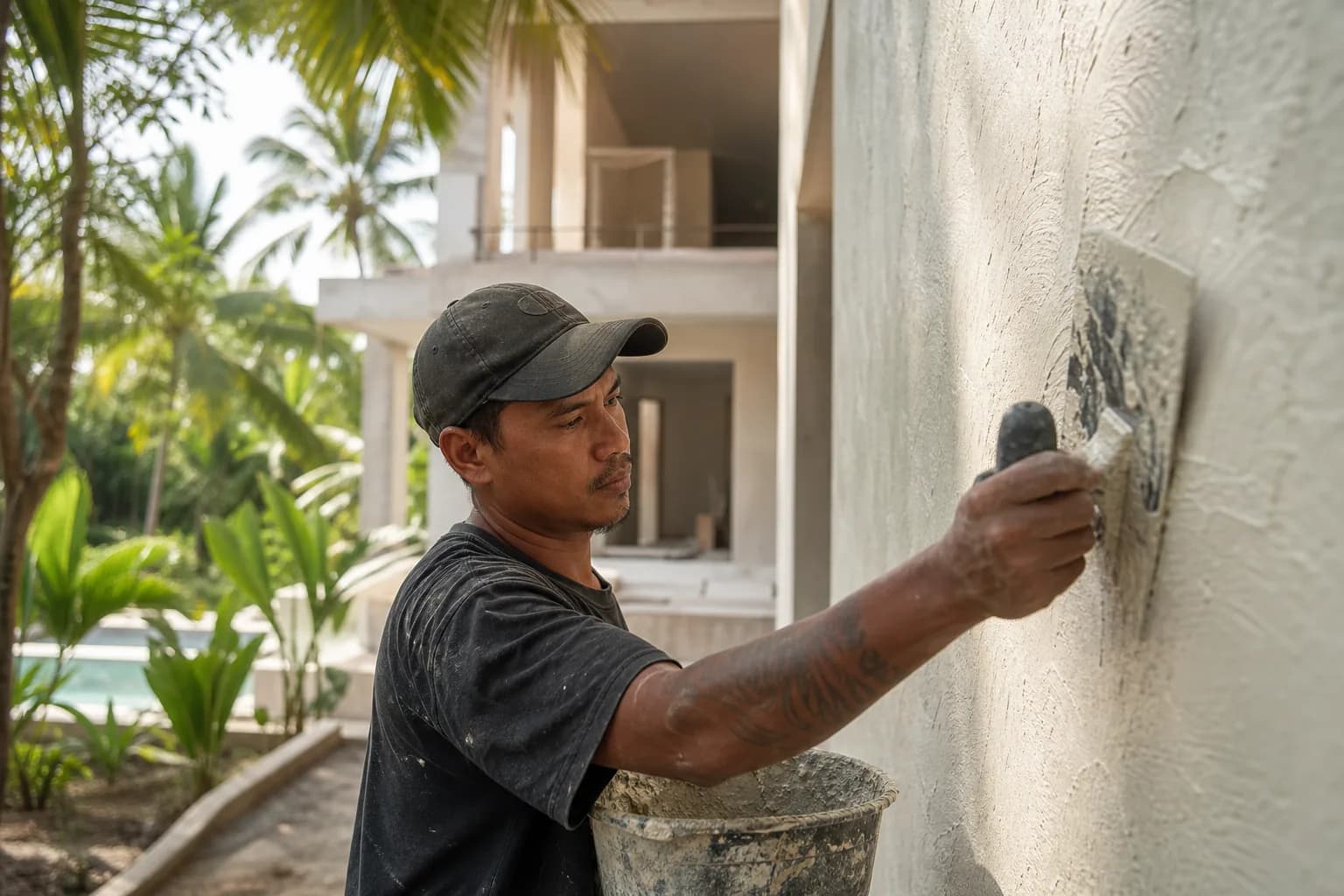
Resin-Infused Plaster Finishes: Anti-Salt Systems Bali
Expert technical guide: Resin-Infused Plaster Finishes: Anti-Salt Systems Bali
8 min read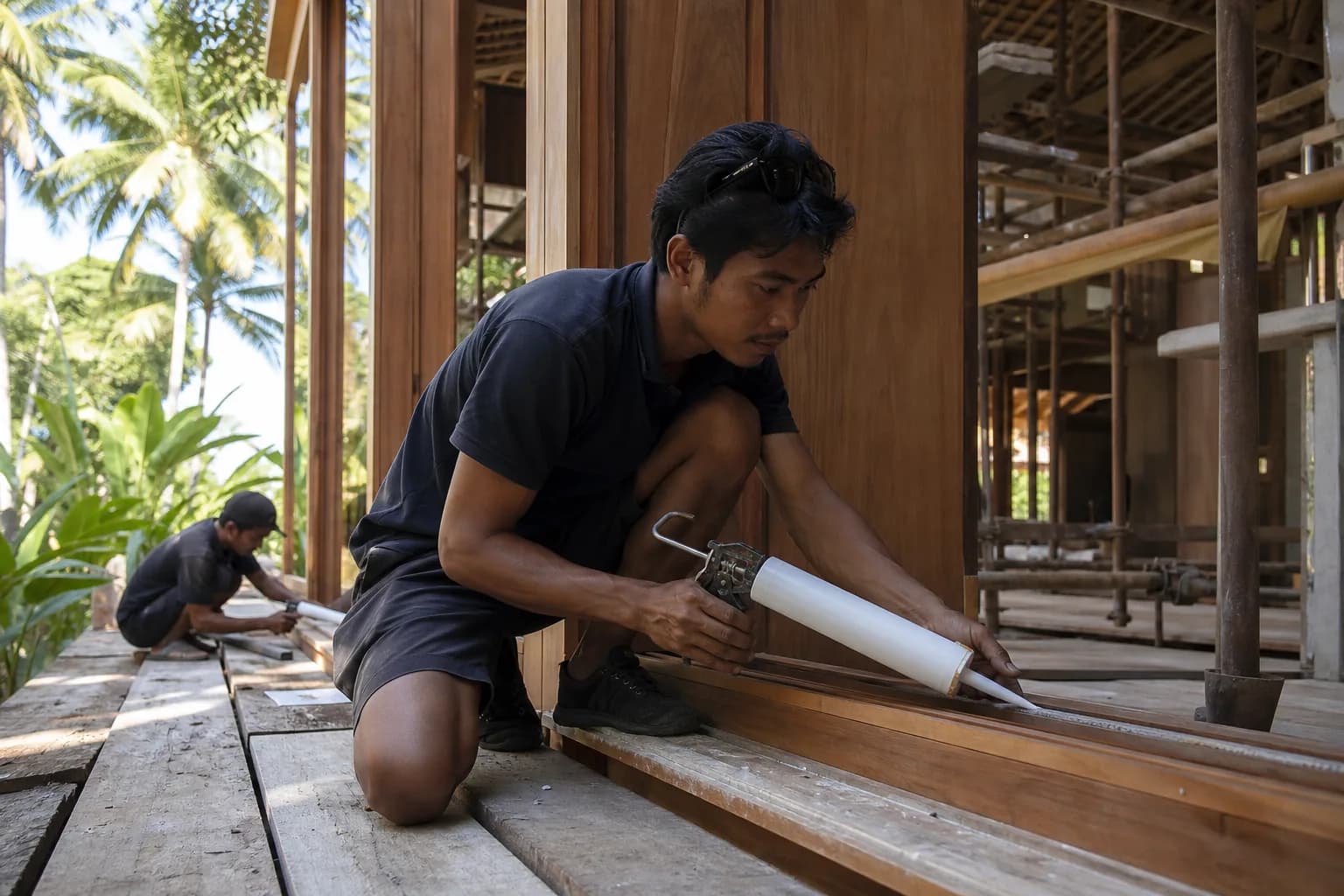
Prefinished Timber Joinery: Silicone Seals Fixings Bali
Professional prefinished timber joinery installation in Bali with silicone seals and fixings for durable weatherproof performance and a premium finish.
10 min read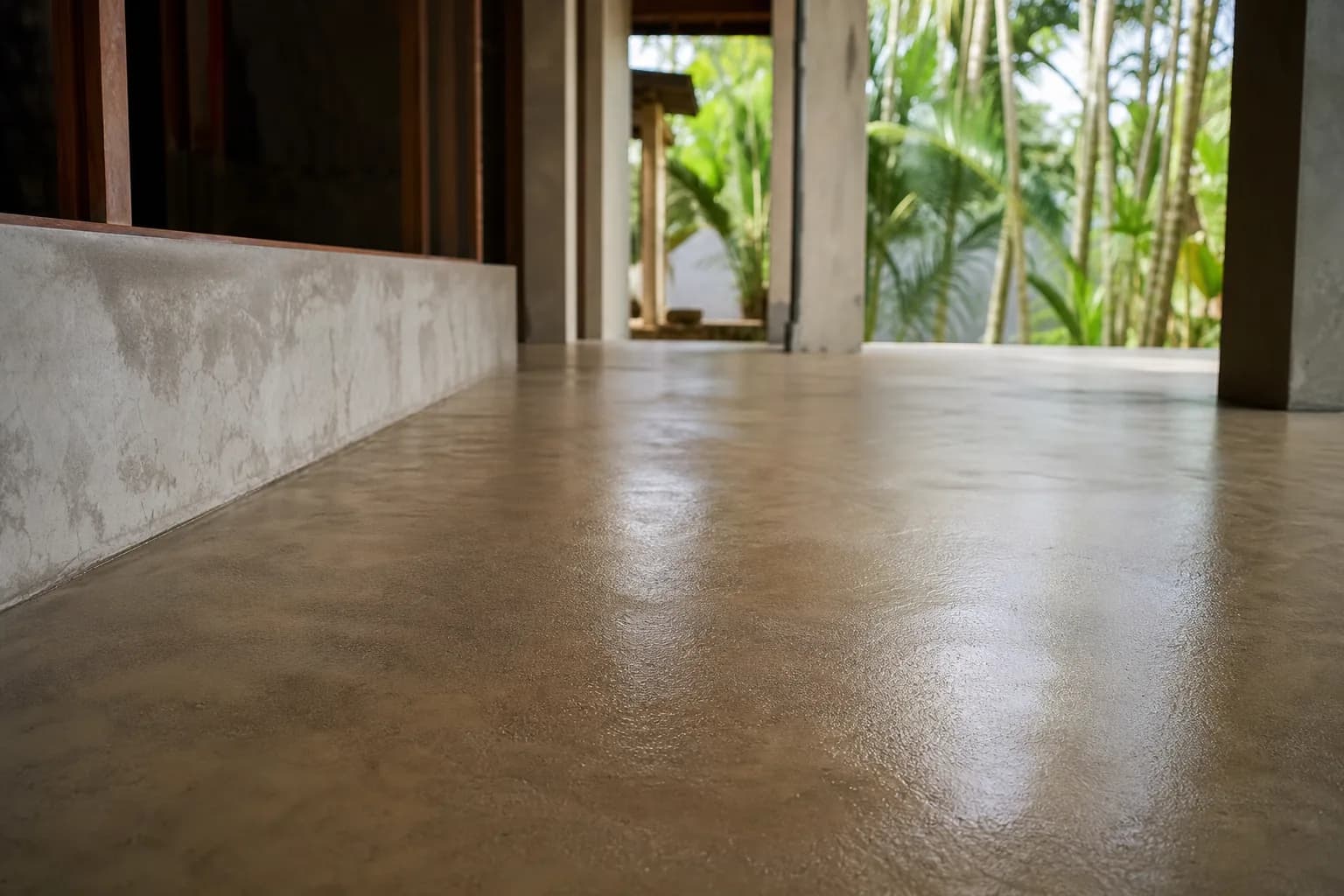
Polished Concrete Microtopping: Surface Prep Sealants Bali
Discover Bali s polished concrete microtopping: expert surface prep, durable sealants, and a flawless finish for modern floors with minimal maintenance.
9 min read