MDF vs Solid Wood Skirting Boards in Bali: Installation Guide
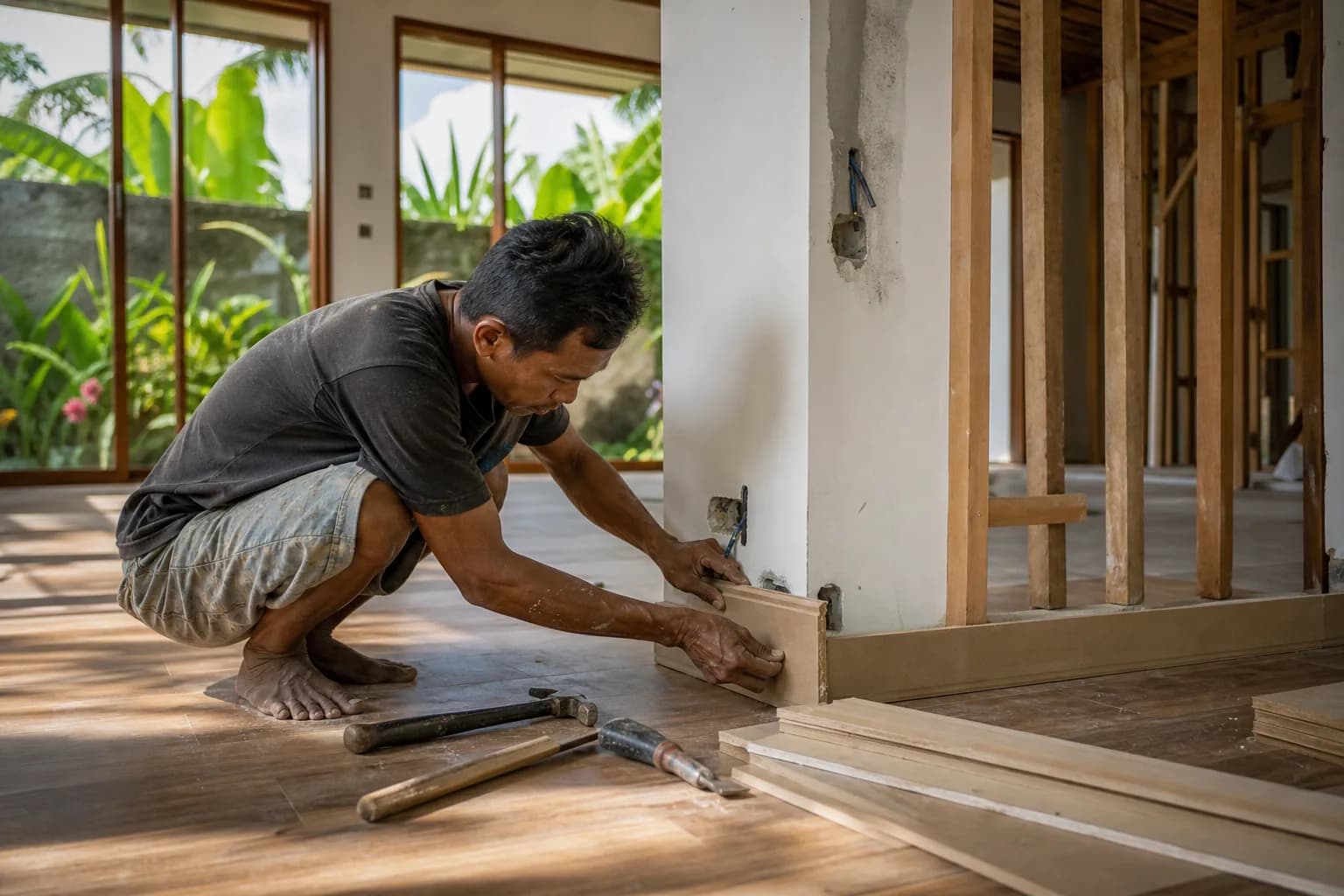
# Skirting Board Installation: MDF vs Solid Wood in Bali Humidity
The Critical Decision: Choosing Skirting Materials for Bali’s Tropical Climate
When completing interior finishing work in Bali villa construction, skirting board selection presents a unique challenge that directly impacts long-term durability and maintenance costs. With humidity levels consistently ranging between 70-85% throughout the year, the choice between MDF and solid wood skirting boards isn’t merely aesthetic—it’s a technical decision that affects structural integrity, moisture resistance, and finishing quality. Many renovation projects in Bali experience premature skirting failure due to improper material selection, leading to warping, swelling, and deterioration within 12-18 months of installation. Understanding the performance characteristics of each material in tropical conditions is essential for achieving professional-grade interior finishing that withstands Bali’s demanding climate.
Technical Performance Analysis: MDF vs Solid Wood in High Humidity Environments
The fundamental difference between MDF (Medium Density Fiberboard) and solid wood skirting boards lies in their cellular structure and moisture interaction mechanisms. Standard MDF consists of wood fibers bonded with resin under high pressure, creating a uniform, dense material without natural grain patterns. In Bali’s humidity, standard MDF absorbs moisture through its exposed edges and unfinished surfaces, causing fiber expansion that leads to irreversible swelling and structural compromise. The material’s engineered composition means it lacks the natural moisture-regulating properties found in solid wood.
Moisture-resistant MDF (MR-MDF), specifically engineered for humid environments, incorporates water-repellent additives and modified resin systems that significantly improve performance in tropical climates. This variant features a distinctive green or blue core color indicating its enhanced moisture resistance. When properly sealed with appropriate primers and finishing coats, MR-MDF can maintain dimensional stability in Bali’s conditions, with moisture absorption rates reduced by approximately 60-70% compared to standard MDF. However, even MR-MDF requires meticulous edge sealing during installation, as cut edges remain vulnerable entry points for moisture infiltration.
Solid wood skirting boards, particularly tropical hardwoods like teak, merbau, or bangkirai, possess natural oils and dense cellular structures that inherently resist moisture penetration. These species have evolved in tropical environments, developing natural defense mechanisms against humidity and fungal growth. The wood’s cellular structure allows for controlled moisture exchange—absorbing humidity when ambient levels rise and releasing it as conditions dry—without the catastrophic failure patterns seen in improperly sealed engineered materials. This hygroscopic behavior, when properly managed through finishing, provides superior long-term stability.
The critical performance factor in Bali villa construction involves understanding moisture equilibrium content (MEC). Solid wood naturally acclimates to ambient humidity levels, typically reaching 12-16% moisture content in Bali’s climate. Quality hardwoods can accommodate this fluctuation through minor dimensional changes (approximately 0.2-0.4% across the grain) without visible warping or structural failure. MDF, conversely, experiences more dramatic and often permanent deformation when moisture content exceeds 15%, particularly along exposed edges and joints.
From a furniture installation and interior finishing perspective, the substrate compatibility differs significantly between materials. MDF provides a perfectly smooth, uniform surface ideal for painted finishes, accepting primer and paint without grain telegraphing. This makes it advantageous for contemporary villa designs requiring crisp, clean lines with solid color applications. Solid wood, while offering natural grain beauty, requires more extensive surface preparation for painted finishes but excels in stained or clear-coated applications that showcase its organic character—a preference in many high-end Bali renovation projects.
Installation mechanics also differ substantially. MDF’s uniform density allows for clean cuts without splintering and accepts fixings reliably, though over-tightening can cause localized crushing. Solid wood requires pre-drilling to prevent splitting, particularly near board ends, and its natural grain direction influences cutting and fixing approaches. In Bali’s climate, solid wood’s natural movement necessitates strategic fixing patterns that accommodate expansion and contraction, while properly sealed MR-MDF remains more dimensionally stable, allowing for tighter fixing intervals.
Material Standards and Specifications for Tropical Applications
For Bali villa construction and renovation projects, material selection must adhere to specific standards that ensure tropical climate performance. Moisture-resistant MDF should meet minimum density requirements of 720-800 kg/m³ and incorporate water-repellent additives compliant with European EN 622-5 standards or equivalent. The material should demonstrate moisture resistance with thickness swelling not exceeding 12% after 24-hour water immersion testing. Reputable suppliers in Bali typically stock 15mm and 18mm thickness profiles, with 18mm recommended for high-traffic areas and ground-floor applications where humidity exposure is greatest.
Solid wood specifications for skirting boards in tropical environments should prioritize naturally durable species with Janka hardness ratings above 1,000 lbf. Indonesian hardwoods like merbau (Janka rating 1,925) and teak (Janka rating 1,155) offer excellent dimensional stability and natural rot resistance. Timber should be kiln-dried to 12-14% moisture content before installation, matching Bali’s ambient equilibrium levels. Board dimensions typically range from 70mm to 150mm height with 15-20mm thickness, though custom profiles can be milled for specific architectural requirements.
Finishing materials constitute a critical component of the specification. For MDF applications, use solvent-based or high-quality water-based primers specifically formulated for engineered wood products, followed by moisture-resistant topcoats with minimum two-coat application. Solid wood requires appropriate sealers—either penetrating oil-based products for natural finishes or blocking primers for painted applications—followed by UV-resistant topcoats that prevent degradation from Bali’s intense sunlight exposure in naturally lit spaces.
Professional Installation Process for Bali Climate Conditions
Successful skirting board installation in Bali’s humid environment begins 48-72 hours before actual fitting, with material acclimatization in the installation space. This critical step allows materials to equilibrate with ambient humidity levels, minimizing post-installation movement. Store materials horizontally on level supports, maintaining 50mm clearance from walls and floors to ensure even air circulation. For solid wood, this acclimatization period is non-negotiable; for MR-MDF, it remains advisable though less critical.
Wall preparation requires meticulous attention in Bali villa construction. Assess wall surfaces for moisture issues using a pin-type moisture meter; readings above 20% indicate underlying dampness requiring remediation before skirting installation. Remove existing skirting carefully, checking for hidden moisture damage or termite activity—common issues in tropical construction. Clean wall surfaces thoroughly, removing dust, loose plaster, and organic growth. Apply a moisture-resistant primer to the lower 200mm of wall surface where skirting will contact, creating an additional moisture barrier.
For MDF skirting installation, begin by sealing all cut edges with appropriate edge sealer or diluted PVA adhesive before fitting. This step is absolutely critical—unsealed edges act as moisture wicks, causing localized swelling and finish failure. Measure and cut boards using a fine-tooth saw (minimum 80 teeth for crosscuts) to minimize edge fiber disruption. Apply construction adhesive in continuous beads along the back of boards, positioned 25mm from top and bottom edges. Supplement adhesive with mechanical fixings: use 50mm stainless steel pins or screws at 400mm intervals, positioned 15mm from the top edge to avoid splitting. In Bali’s climate, stainless steel fixings are essential to prevent rust staining through painted finishes.
Solid wood installation follows similar principles with critical modifications. Pre-drill all fixing holes using a bit diameter 1mm smaller than the fixing shaft to prevent splitting while ensuring secure grip. Position fixings to accommodate wood movement: fix through the board center for heights below 100mm, or use a top-fixing pattern for taller profiles, allowing the bottom edge to move freely with humidity fluctuations. Use lost-head stainless steel nails or color-matched screws, countersinking slightly for filler application. Apply a thin bead of flexible, moisture-resistant adhesive along the top edge only, allowing the bottom edge freedom of movement.
Joint treatment differs significantly between materials. MDF joints should be tight-fitted with 45-degree miters at corners, filled with flexible decorator’s caulk that accommodates minor movement. Sand filled areas carefully before priming. Solid wood joints require 1-2mm expansion gaps at internal corners, filled with color-matched flexible filler or left as shadow gaps in contemporary designs. External corners benefit from mitred joints with biscuit reinforcement for solid wood, ensuring joint integrity as the material moves seasonally.
Finishing application represents the final critical phase. For MDF, apply two coats of high-quality primer, sanding lightly between coats with 180-grit paper. Follow with two topcoats of moisture-resistant paint, ensuring complete coverage of all surfaces including the floor junction. For solid wood, apply penetrating sealer or blocking primer depending on desired finish, followed by appropriate topcoats. In Bali’s UV-intense environment, use finishes with UV inhibitors to prevent yellowing and degradation. Allow minimum 24-hour curing between coats, with final curing of 7 days before exposing to cleaning or high-traffic conditions.
Cost Analysis and Project Timeline for Bali Villa Projects
Material costs for skirting board installation in Bali vary significantly based on specification choices. Moisture-resistant MDF skirting typically costs IDR 45,000-75,000 per linear meter for standard profiles (15-18mm thickness, 70-120mm height), including material supply to site. Solid wood options range from IDR 120,000-280,000 per linear meter depending on species—with merbau at the lower end and premium teak commanding higher prices. These figures represent quality materials from reputable Bali suppliers suitable for professional villa construction and renovation projects.
Installation labor costs in Bali’s construction market range from IDR 35,000-55,000 per linear meter for MDF installation, including surface preparation, fitting, and basic finishing. Solid wood installation commands IDR 50,000-80,000 per linear meter due to increased technical requirements and longer installation time. Finishing costs add IDR 25,000-45,000 per linear meter for complete priming and painting of MDF, or IDR 30,000-60,000 per linear meter for solid wood finishing depending on specification complexity.
For a typical 150m² villa requiring approximately 80-100 linear meters of skirting, total project costs range from IDR 8,400,000-13,000,000 for complete MDF installation with professional finishing, versus IDR 16,000,000-34,000,000 for solid wood alternatives. These estimates include materials, installation, finishing, and standard profiles. Custom moulding profiles or premium hardwood species can increase costs by 30-50%.
Project timelines for professional skirting board installation span 5-8 working days for an average villa. This includes 2 days for material procurement and acclimatization, 2-3 days for installation work, and 2-3 days for finishing application with appropriate curing intervals. Renovation projects may require additional time for existing skirting removal and wall remediation. Teville’s construction process integrates skirting installation within the broader interior finishing schedule, coordinating with painting, flooring, and furniture installation phases to optimize project efficiency.
Frequently Asked Questions: Skirting Board Installation in Bali
How long does MDF skirting last in Bali’s humid climate compared to solid wood?
Properly installed moisture-resistant MDF with comprehensive sealing and quality finishing can perform reliably for 8-12 years in Bali’s climate before requiring replacement, assuming regular maintenance and no water damage events. Standard MDF typically shows deterioration within 3-5 years. Solid wood skirting, particularly tropical hardwoods with appropriate finishing, commonly exceeds 15-20 years of service life and can be refinished multiple times, effectively lasting the building’s lifetime. The key differentiator is maintenance—solid wood tolerates minor finish degradation better, while MDF requires intact sealing to prevent moisture ingress and catastrophic failure.
Can I install skirting boards directly after plastering in a new Bali villa construction?
No, this represents a critical error in tropical construction sequencing. New plasterwork in Bali contains significant moisture that requires 4-6 weeks minimum curing time before skirting installation, depending on wall thickness and ambient conditions. Installing skirting against uncured plaster traps moisture, causing MDF swelling or solid wood staining and potential fungal growth. Use a moisture meter to verify wall moisture content below 15% before proceeding. Teville’s construction process incorporates appropriate curing intervals between trades, ensuring optimal conditions for each finishing phase including furniture installation and interior detailing work.
What’s the best skirting height for Bali villa designs?
Skirting height selection balances aesthetic proportion with practical protection in Bali villa construction. Standard heights of 90-120mm suit most contemporary villa designs, providing adequate wall protection while maintaining clean visual lines. Traditional or colonial-style renovations may specify 150-200mm heights for period authenticity. From a technical perspective, taller skirting boards offer increased protection agai
 1from 198.000 USD
Private: Haridas Villas
 172 m²8 month(s)from 120.000 USD
Keshava
 164 m²7 month(s)from 79.000 USD
Private: Haridas Villas, Tegallalang
 4344 m²16 month(s)from 290.000 USD
Radha
 3104 m²11 month(s)from 99.000 USD
TALA 100
 3124 m²6 month(s)from 123.000 USD
TALA 8

Want to calculate?
164 m²7 month(s)from 79.000 USDTALA TWO
 3127 m²9 month(s)from 177.000 USD
Mukunda
 3180 m²7 month(s)from 142.000 USD
Vasudeva
 3173 m²6 month(s)from 125.000 USD
TALA FOUR
 2144 m²11 month(s)from 104.000 USD
Narayana
Start With Real Numbers, Not Guesses
Before finalizing your finishing works plan, check realistic cost ranges for your Bali villa project.
Available lands
 6000 m²30 min$ 55419Bali, Tabanan
 680 m²15 min$ 110751Bali, Pererenan
 200 m²5 min$ 59113Bali, Bukit
 422 m²15 min$ 93547Bali, Kerobokan
 444 m²10 min$ 111000Bali, Tabanan
 1720 m²2 min$ 241478Bali, Tabanan
 2230 m²15 min$ 410573Bali, Padonan
 1158 m²12 min$ 291996Bali, Mengwi
 7500 m²5 min$ 206281Bali, Kedungu
 770 m²5 min$ 163578Bali, Kedungu
 8313 m²15 min$ 716670Bali, Buduk
 200 m²11 min$ 89286Bali, Tabanan
 1000 m²10 min$ 184729Bali, Kutuh South Bali
 750 m²15 min$ 187038Bali, Kerobokan
 1300 m²10 min$ 312192Bali, Kutuh South Bali
Essential Bali build & buy guides
- Bali villa construction cost per m² in 2026
- How much will your villa cost? Calculator
- Building a villa in Bali: the complete guide
- Buying land in Bali: step-by-step for foreigners
- Bali villa investment: yields, risks, returns
- Leasehold vs freehold: what foreigners can own
- Construction defect liability & 10-year warranty
- Bali building codes and construction standards
Related guides
Sanur and Nusa Dua vs Canggu: Stability Plays vs Hype
Canggu gets the headlines; Sanur and Nusa Dua quietly deliver steadier returns to a different kind of buyer. An honest 2026 comparison of the stability markets against the hype market — prices, demand drivers, oversupply risk, and who should buy where.
7 min read
Ubud and the Wellness Market: Buying or Building for Retreats
Ubud is Bali's wellness capital, and retreat-focused property behaves differently from beach villas: longer stays, group bookings, lower volatility. Here is what the market rewards, what zoning allows, and what it costs to buy or build a retreat property in 2026.
8 min read
Buying and Building on the Bukit: Uluwatu, Bingin and Balangan from a Buyer's Seat
A buyer's-seat 2026 guide to the Bukit peninsula — Uluwatu, Bingin and Balangan land prices, the water problem nobody budgets, cliff setbacks after the 2025 Bingin demolitions, and how to build there properly.
7 min read