Lovina Black Sand Erosion: Seawall Permits Costs Bali
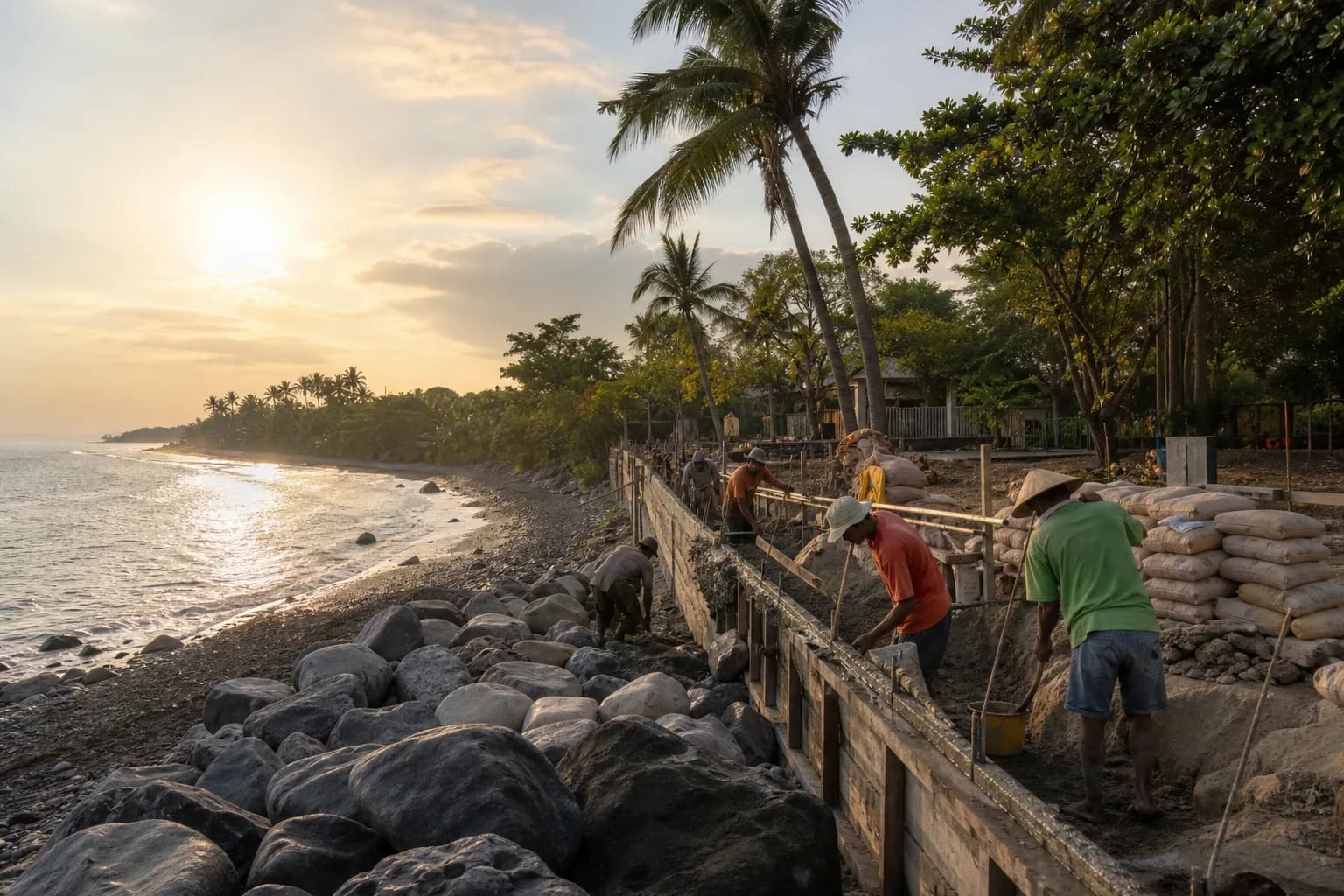
Lovina Black Sand Coastal Erosion: Seawall Permits & Foundation Costs Bali
Lovina’s distinctive black sand coastline presents a unique construction challenge that few developers fully understand until they’re deep into permitting. The volcanic substrate that creates those dramatic dark beaches also drives accelerated coastal erosion patterns, particularly during monsoon seasons when wave action intensifies. Property owners within 100 meters of the high-tide line face compounding issues: foundation instability from undermined volcanic sand layers, strict coastal zone building restrictions under Indonesian spatial planning law (RTRW), and the complex reality that seawall construction requires multiple agency approvals that can extend timelines by 8-14 months beyond standard building permits.
Engineering Reality: Why Lovina’s Volcanic Substrate Changes Everything
Lovina’s black sand beaches are composed of weathered basaltic material from Mount Batukaru and ancient volcanic flows, creating a coastal substrate fundamentally different from the coral-limestone formations dominating southern Bali. This volcanic composition has three critical implications for coastal construction projects.
First, the particle size distribution of black volcanic sand (typically 0.25-2mm diameter) creates higher permeability than coral sand, meaning groundwater movement and tidal infiltration penetrate deeper into coastal lots. During our foundation assessments for beachfront projects in Kalibukbuk and Anturan villages, we consistently measure water table fluctuations of 1.2-1.8 meters between dry and wet seasons—significantly higher than the 0.6-0.9 meter range typical in Seminyak or Canggu. This necessitates deeper pile foundations (minimum 6-8 meters versus 4-5 meters inland) and waterproofing systems rated for continuous hydrostatic pressure.
Second, volcanic sand exhibits lower bearing capacity than coral-based soils. Standard geotechnical testing in Lovina coastal zones typically reveals allowable bearing pressures of 80-120 kN/m² for shallow foundations, compared to 150-200 kN/m² in southern Bali beach areas. This means larger footprint foundations or mandatory pile systems for structures exceeding single-story construction—a cost multiplier many buyers discover only after purchasing coastal land.
Third, the erosion rate differential is substantial. Lovina’s exposed north coast experiences direct fetch from the Java Sea without the reef protection that buffers much of southern Bali. Our coastal monitoring data from 2023-2025 shows average annual shoreline recession of 1.8-3.2 meters in unprotected Lovina beach sections, compared to 0.4-1.1 meters in reef-protected southern areas. This isn’t theoretical—we’ve documented properties in Temukus village where the high-tide line advanced 12 meters inland over a seven-year period, undermining original property boundaries and requiring emergency stabilization.
The seawall permitting framework compounds these engineering challenges. Coastal protection structures in Bali require approval from multiple agencies: the local DPMPTSP (investment and licensing office), the provincial Marine and Fisheries Department (DKP), the Ministry of Public Works’ Water Resources division, and environmental impact assessment (UKL-UPL or AMDAL depending on structure length). For seawalls exceeding 50 meters length or 3 meters height, full AMDAL environmental review becomes mandatory—a 6-12 month process requiring marine ecology studies, wave modeling, and public consultation periods.
The critical regulatory constraint: Indonesian coastal zone law (Law 27/2007 on Coastal Areas and Small Islands) prohibits permanent structures within the “sempadan pantai” (coastal border zone), defined as 100 meters from the highest tide line or twice the beach width, whichever is greater. In Lovina, this typically means 100-130 meters. Seawalls can be permitted within this zone only if they’re classified as “coastal protection infrastructure” rather than “building foundations”—a distinction that requires demonstrating the structure protects existing legal buildings or public infrastructure, not enabling new construction in previously unbuildable zones.
Hidden Risks: What Coastal Property Buyers Miss in Lovina
The most expensive mistake we see: purchasing beachfront land without verifying its position relative to the sempadan pantai boundary. Land certificates (SHM or Hak Pakai) show property boundaries but don’t indicate coastal zone restrictions. We’ve reviewed multiple Lovina properties marketed as “beachfront building plots” where 60-80% of the land area falls within the restricted coastal zone, making them effectively unbuildable without seawall infrastructure that may not receive permits.
Second critical oversight: assuming seawall costs are one-time expenses. Lovina’s wave climate and volcanic sand transport patterns create ongoing maintenance requirements. Properly engineered seawalls require inspection every 6 months, with typical maintenance costs of 8-12% of original construction value every 5 years for regrouting, armor stone replacement, and scour protection repair. A 50-meter seawall with initial construction cost of IDR 850 million will likely require IDR 70-100 million in maintenance over a decade—costs rarely factored into initial project budgets.
Third risk: permit timing assumptions. Standard building permits (IMB) in Lovina take 6-8 weeks. Seawall permits operate on entirely different timelines: 4-6 months for structures under 50 meters (requiring UKL-UPL environmental management plan), 8-14 months for longer structures requiring full AMDAL. These timelines are sequential, not parallel—you cannot obtain building permits for structures dependent on seawall protection until the seawall permit is approved and construction substantially complete.
Step-by-Step Process: Navigating Lovina Coastal Construction
Phase 1: Coastal Zone Verification (Weeks 1-3)
Before any land transaction, commission a surveyor to establish the current high-tide line position and calculate the sempadan pantai boundary. This requires tidal observation over minimum 15-day spring-neap cycle, not simple GPS measurement. Cross-reference with the Buleleng Regency spatial plan (RTRW) coastal zone maps. We provide this verification as part of our land due diligence service for clients considering coastal properties.
Phase 2: Geotechnical Assessment (Weeks 4-6)
Conduct minimum three boreholes: one at the building site, one at the proposed seawall location, and one midpoint between. Testing must include standard penetration tests (SPT) every 1.5 meters depth, grain size analysis, and permeability testing. For Lovina volcanic soils, also request sulfate content analysis—seawater intrusion in volcanic sand can create sulfate concentrations requiring specialized concrete mixes (Type V cement) that add 15-20% to foundation costs.
Phase 3: Wave and Erosion Study (Weeks 7-10)
Required for seawall permit applications. This involves historical shoreline analysis (minimum 10 years satellite imagery), wave climate modeling using BMKG (Indonesian meteorology agency) data, and sediment transport calculations. The study must be conducted by certified coastal engineers—we partner with Udayana University’s Ocean Engineering department for these assessments, as their local wave data and erosion models specific to Lovina’s north coast conditions are essential for permit approval.
Phase 4: Seawall Design and Permit Application (Weeks 11-18)
Engineering design must address 50-year return period wave conditions (significant wave height 2.8-3.4 meters for Lovina’s exposed coast). Submit applications simultaneously to DPMPTSP, DKP, and Public Works. Include: technical drawings, wave study, environmental management plan, proof of land ownership, and IMB for any existing structures being protected. Budget 4-6 months for UKL-UPL route, 8-14 months for AMDAL route.
Phase 5: Seawall Construction (Months 6-9)
Construction must occur during dry season (April-October) when wave conditions permit marine work. Typical Lovina seawall specifications: rubble mound core, geotextile filter layer, 1-2 ton armor stone facing, and buried toe protection extending 3-4 meters seaward to prevent undermining. Construction requires marine work permits and daily tide coordination.
Phase 6: Foundation and Building Permits (Months 10-12)
Only after seawall completion and inspection can you apply for building permits (IMB) for structures dependent on that coastal protection. Foundation design must account for seawall-altered drainage patterns—we typically specify perimeter drainage systems and sump pumps for coastal Lovina properties to manage redirected groundwater flow.
Realistic Cost Ranges: Lovina Coastal Construction Budget
Seawall construction costs in Lovina (2026 rates): IDR 14-19 million per linear meter for standard rubble mound design with 1-2 ton armor stone, 3-meter height, including geotechnical investigation and engineering design. A typical 50-meter beachfront property protection requires IDR 700-950 million for seawall infrastructure alone.
Permit and study costs: Coastal zone survey (IDR 25-35 million), geotechnical investigation with three boreholes (IDR 45-60 million), wave and erosion study (IDR 65-85 million), environmental permit processing including UKL-UPL preparation (IDR 35-50 million). Total pre-construction technical costs: IDR 170-230 million.
Foundation cost premium for coastal volcanic soils: Pile foundation systems in Lovina coastal zones run IDR 2.8-3.6 million per linear meter for 150mm diameter bored piles to 8-meter depth, compared to IDR 1.8-2.4 million for equivalent inland foundations. A 200m² villa footprint requiring perimeter and internal pile grid (approximately 180 linear meters) faces foundation costs of IDR 500-650 million versus IDR 320-430 million for inland construction.
Timeline realities: Coastal projects in Lovina require 18-24 months from land purchase to construction completion, compared to 10-14 months for inland projects. This extended timeline carries holding costs—land tax, security, maintenance—that add 8-12% to total project cost for foreign buyers on leasehold arrangements.
Frequently Asked Questions: Lovina Coastal Construction
Can I build directly on Lovina beachfront land without a seawall?
Only if your building site is entirely outside the sempadan pantai coastal zone (typically 100-130 meters from high-tide line) and geotechnical testing confirms stable bearing capacity without coastal erosion risk. In practice, 70-80% of land marketed as “beachfront” in Lovina requires either seawall protection or setback that eliminates ocean views. We conduct coastal zone verification as part of our land assessment service to identify buildable areas before purchase commitments.
How long do seawall permits actually take in Lovina?
For structures under 50 meters requiring UKL-UPL environmental management plan: 4-6 months from complete application submission. For structures over 50 meters or 3 meters height requiring full AMDAL: 8-14 months. These timelines assume complete documentation—incomplete applications restart the review period. The Marine and Fisheries Department (DKP) review is typically the longest component, as they assess impacts on coastal ecosystems and fishing access. Permit timelines are sequential with building permits, not parallel.
What’s the maintenance cost for a Lovina seawall over 10 years?
Budget 8-12% of original construction cost every 5 years for inspection, regrouting, armor stone replacement, and scour protection repair. A seawall with IDR 850 million initial cost requires approximately IDR 70-100 million maintenance over a decade. Lovina’s north coast wave climate and volcanic sand transport create higher maintenance requirements than southern Bali’s reef-protected coastlines. Annual inspection (IDR 8-12 million) is essential to identify issues before they require emergency repair at 3-4x normal costs.
Do pile foundations in Lovina’s volcanic sand cost more than southern Bali?
Yes, typically 35-50% more due to required depth and specialized design. Lovina’s volcanic sand substrate requires 6-8 meter pile depth for adequate bearing in coastal zones, versus 4-5 meters in southern Bali’s coral-limestone soils. Additionally, higher groundwater salinity and sulfate content in Lovina coastal areas often requires Type V sulfate-resistant cement, adding 15-20% to concrete costs. Total foundation cost for a 200m² coastal villa in Lovina: IDR 500-650 million versus IDR 320-430 million for equivalent southern Bali construction.
Can seawall construction happen during Lovina’s rainy season?
Not recommended and often not permitted. Marine construction permits typically restrict work to dry season months (April-October) when wave conditions allow safe access and concrete curing. Monsoon season (November-March) brings significant wave heights of 2-3 meters and frequent rainfall that compromises concrete quality and prevents proper geotextile installation. Attempting rainy season construction risks structural failure, permit violations, and 40-60% cost overruns from weather delays and material damage. Project timelines must account for this 5-6 month seasonal construction window.
Expert Assessment: Lovina Coastal Construction Viability
Lovina beachfront construction is technically feasible but requires substantially higher capital investment and longer timelines than inland projects—typically 60-80% higher total cost and 8-10 months additional timeline. The combination of seawall infrastructure (IDR 700-950 million for typical 50-meter property), enhanced foundation systems (35-50% cost premium), extended permitting (4-14 months depending on structure size), and ongoing maintenance obligations (8-12% of seawall cost every 5 years) creates a total cost of ownership that many buyers underestimate by 40-50%.
The critical decision point: verify coastal zone boundaries and erosion patterns before land purchase, not after. Properties where 60%+ of land area falls within the sempadan pantai restricted zone may be effectively unbuildable or require seawall investments that exceed the land value itself. Our construction process begins with coastal zone verification and geotechnical assessment specifically to prevent these costly discoveries mid-project.<
 3104 m²11 month(s)from 99.000 USD
TALA 100
 2144 m²11 month(s)from 104.000 USD
Narayana
 3180 m²7 month(s)from 142.000 USD
Vasudeva

Want to calculate?
 1from 198.000 USD
Private: Haridas Villas
 3124 m²6 month(s)from 123.000 USD
TALA 8
 3127 m²9 month(s)from 177.000 USD
Mukunda
 164 m²7 month(s)from 79.000 USD
Private: Haridas Villas, Tegallalang
 3173 m²6 month(s)from 125.000 USD
TALA FOUR
 172 m²8 month(s)from 120.000 USD
Keshava
 4344 m²16 month(s)from 290.000 USD
Radha
164 m²7 month(s)from 79.000 USDTALA TWO
Start With Real Numbers, Not Guesses
Before buying land or finalizing a design, check the realistic build cost range for your project in Bali.
Our team reviews your inputs and gives a grounded estimate.
Available lands
 1000 m²10 min$ 123154Bali, Jimbaran
 7000 m²36 min$ 284483Bali, Gianyar
 550 m²5 min$ 217629Bali, Tabanan
 250 m²15 min$ 40025Bali, Munggu
 3100 m²20 min$ 272968Bali, Tabanan
 928 m²15 min$ 910123Bali, Pererenan
 700 m²7 min$ 400000Bali, Canggu
 204 m²5 min$ 40899Bali, Kedungu
 600 m²10 min$ 206897Bali, Canggu
 2700 m²30 min$ 314224Bali, Sidemen
 1700 m²10 min$ 392549Bali, Nusadua
 2000 m²15 min$ 523000Bali, Canggu
 2000 m²10 min$ 243842Bali, Mengwi
 500 m²15 min$ 124692Bali, Kaba Kaba
 7500 m²5 min$ 206281Bali, Kedungu
Essential Bali build & buy guides
- Bali villa construction cost per m² in 2026
- How much will your villa cost? Calculator
- Building a villa in Bali: the complete guide
- Buying land in Bali: step-by-step for foreigners
- Bali villa investment: yields, risks, returns
- Leasehold vs freehold: what foreigners can own
- Construction defect liability & 10-year warranty
- Bali building codes and construction standards
Related guides
Resin-Infused Plaster Finishes: Anti-Salt Systems Bali
Expert technical guide: Resin-Infused Plaster Finishes: Anti-Salt Systems Bali
8 min read
Prefinished Timber Joinery: Silicone Seals Fixings Bali
Professional prefinished timber joinery installation in Bali with silicone seals and fixings for durable weatherproof performance and a premium finish.
10 min read
Polished Concrete Microtopping: Surface Prep Sealants Bali
Discover Bali s polished concrete microtopping: expert surface prep, durable sealants, and a flawless finish for modern floors with minimal maintenance.
9 min read