Lovina Black Sand Beach Foundation Piling Costs Bali
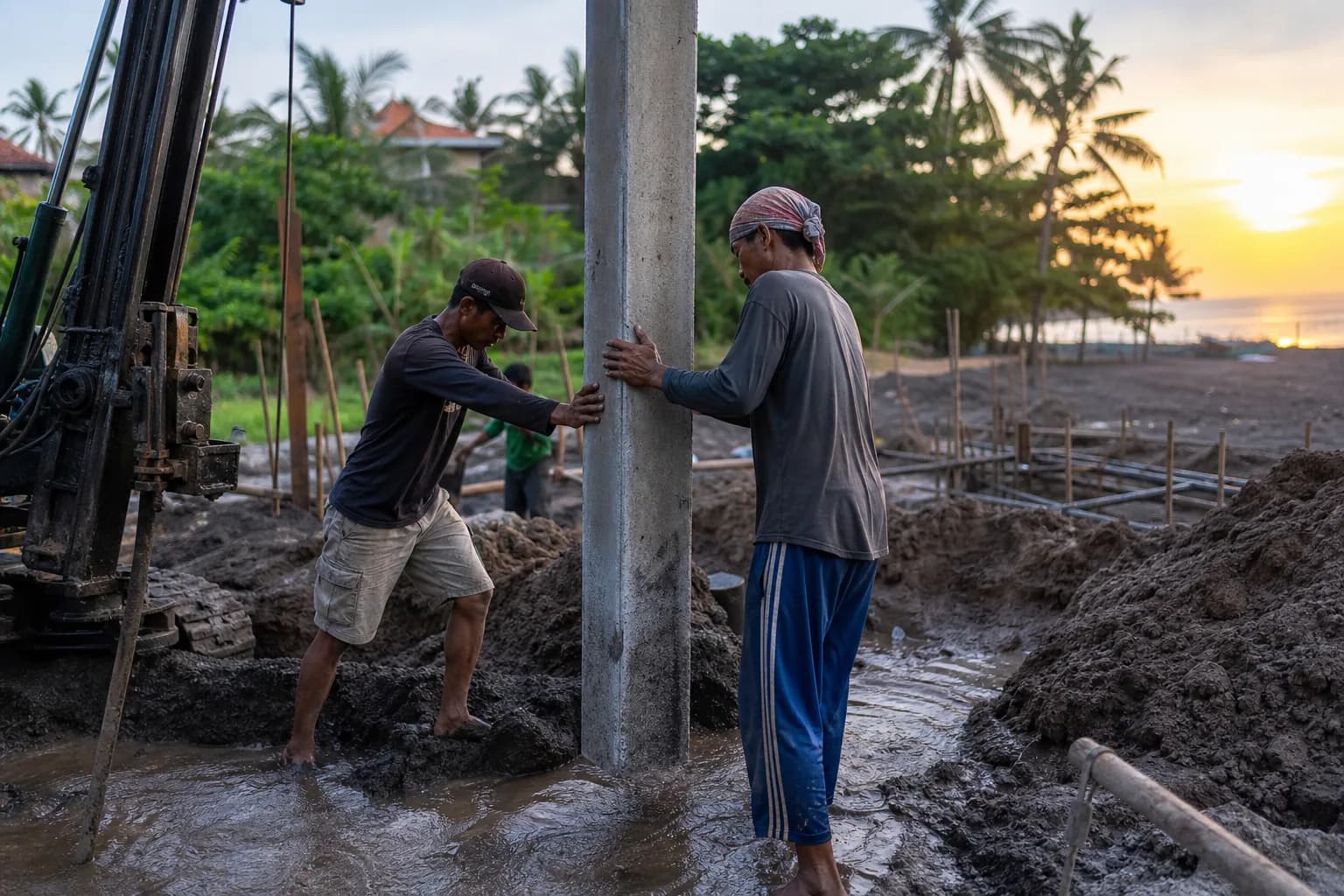
Why Lovina’s Black Sand Beaches Demand Specialized Foundation Engineering
Building near Lovina’s iconic black sand coastline presents a unique engineering challenge that separates experienced tropical construction firms from those unprepared for North Bali’s volcanic geology. The black sand—composed of weathered basalt and volcanic minerals—signals subsurface conditions that require specialized foundation piling strategies. Property developers purchasing coastal land in Lovina frequently underestimate the engineering complexity of volcanic soil profiles, leading to budget overruns of 40-60% when foundation issues emerge mid-construction. The question isn’t whether to invest in proper geotechnical analysis, but how to structure foundation systems that account for Lovina’s specific combination of volcanic ash layers, groundwater proximity, and seismic activity while controlling costs.
Volcanic Soil Composition and Foundation Load-Bearing Requirements in Lovina
Lovina’s coastal geology differs fundamentally from South Bali’s limestone-based substrates. The black sand beaches indicate a subsurface profile dominated by weathered volcanic materials from Mount Batukaru and historical eruptions, creating soil conditions with variable bearing capacities ranging from 0.8 kg/cm² in loose volcanic ash layers to 2.5 kg/cm² in compacted basaltic deposits. Standard shallow foundations adequate for Canggu or Seminyak become structurally inadequate within 500 meters of Lovina’s coastline.
Geotechnical investigations conducted between 2024-2026 reveal that Lovina’s coastal zone typically presents a three-layer soil profile: surface black sand (0-1.5m depth) with minimal bearing capacity, intermediate volcanic ash and pumice layers (1.5-4m) with high compressibility, and deeper basaltic bedrock or dense volcanic deposits (4-8m) suitable for pile termination. This stratification necessitates foundation piling rather than conventional footings for any structure exceeding single-story residential loads.
The volcanic ash content in Lovina’s soil presents both challenges and opportunities. Recent engineering studies demonstrate that locally-sourced volcanic ash can replace 20-40% of cement in concrete mixes while achieving 28-day compressive strengths of 24-32 MPa—meeting Indonesian structural concrete standards (SNI 2847:2019). This volcanic ash concrete (VAC) application reduces material costs by 15-25% compared to conventional Portland cement mixes while improving sulfate resistance in coastal environments. However, proper mix design requires laboratory testing specific to Lovina’s ash composition, as particle size distribution and pozzolanic reactivity vary significantly between volcanic sources.
Foundation piling in volcanic soils requires careful consideration of skin friction versus end-bearing capacity. Lovina’s volcanic ash layers provide limited skin friction (typically 0.3-0.6 kg/cm² along pile shafts) compared to clay soils, meaning piles must extend to competent bearing strata rather than relying on shaft resistance through upper soil layers. This typically adds 2-4 meters to required pile depths compared to initial assumptions based on visual site assessment.
Groundwater conditions further complicate foundation design. The water table in coastal Lovina typically sits 1.5-3 meters below surface grade, creating saturated conditions in the critical intermediate soil layers. Saturated volcanic ash exhibits significantly reduced bearing capacity and increased settlement potential under sustained loads. Foundation designs must account for buoyancy effects on pile caps and incorporate proper drainage systems to prevent hydrostatic pressure buildup against basement walls or ground-level slabs.
Seismic considerations cannot be overlooked. North Bali falls within Indonesia’s moderate seismic zone, requiring foundation systems designed for lateral loads and potential liquefaction of saturated volcanic soils during seismic events. Pile foundations must be tied together with reinforced grade beams capable of distributing lateral forces, adding 8-12% to foundation costs compared to non-seismic designs. The combination of volcanic soil compressibility and seismic requirements often necessitates pile diameters of 30-40cm rather than the 25cm piles sometimes adequate in more stable soil conditions.
Critical Mistakes Foreign Developers Make with Lovina Coastal Foundations
The most expensive error is proceeding with foundation design based on visual site assessment or advice from contractors unfamiliar with volcanic soil engineering. A standard soil boring test costs $800-1,200 in Lovina but prevents foundation redesigns that typically cost $15,000-30,000 when discovered during construction. Developers accustomed to South Bali’s relatively uniform limestone substrates often assume similar conditions exist throughout the island, leading to inadequate foundation specifications.
Another common mistake involves underestimating pile depths required to reach competent bearing strata. Contractors may propose 4-meter piles based on experience in other regions, when Lovina’s specific geology requires 6-8 meter depths for reliable end-bearing capacity. The cost difference between 4m and 7m piles is approximately $45-65 per pile, but the structural risk of inadequate depth includes differential settlement, cracking, and potential structural failure—issues that emerge 2-3 years post-construction when remediation costs exceed $80,000 for a typical villa.
Failing to specify volcanic ash concrete mix designs appropriate for coastal exposure represents another technical oversight. While volcanic ash replacement reduces cement costs, improper mix ratios or inadequate curing in Lovina’s humid coastal climate can result in concrete strengths 20-30% below design specifications. This requires either structural reinforcement additions or complete foundation reconstruction, both catastrophically expensive after construction begins.
Developers also frequently neglect the interaction between foundation systems and Lovina’s high water table. Without proper waterproofing membranes, drainage systems, and consideration of hydrostatic pressure, ground-level spaces experience moisture infiltration, efflorescence, and long-term concrete degradation. Remedial waterproofing after construction costs 3-4 times more than proper initial installation and rarely achieves the same performance level.
Engineering-Based Foundation Process for Lovina Black Sand Coastal Sites
The foundation engineering process for Lovina coastal construction begins with comprehensive geotechnical investigation, not architectural design. A proper soil study includes a minimum of two boreholes to 10-meter depth (or refusal on bedrock), standard penetration testing (SPT) at 1.5-meter intervals, laboratory analysis of soil samples for bearing capacity, compressibility, and chemical composition, and groundwater level monitoring. This investigation costs $1,800-2,800 for a typical villa site but provides the data necessary for accurate foundation design and cost estimation.
Based on geotechnical findings, structural engineers develop foundation specifications appropriate for Lovina’s volcanic soil profile. For two-story villas in coastal Lovina, this typically involves driven concrete piles (30-35cm diameter, 6-8m depth) spaced at 2-2.5 meter centers, tied together with reinforced grade beams (40x60cm minimum section) and a reinforced concrete slab-on-grade with vapor barrier and drainage layer. Single-story structures may utilize shorter piles (4-6m) with reduced spacing, while three-story buildings require larger diameter piles (40cm) or closer spacing to manage increased loads.
Pile installation method selection significantly impacts both cost and performance. Driven precast concrete piles offer quality control advantages and faster installation but require access for pile-driving equipment and generate significant vibration that may concern neighboring properties. Cast-in-place bored piles provide flexibility for varying depths and reduced vibration but require careful quality control during concrete placement, particularly below the water table. For Lovina’s volcanic soils, driven piles generally provide superior performance due to soil densification during installation, though site access constraints sometimes necessitate bored pile solutions.
The volcanic ash concrete mix design process involves laboratory testing of locally-sourced ash to determine optimal replacement ratios, particle size adjustments, and curing requirements. Properly designed VAC mixes for Lovina foundations typically replace 25-35% of cement with processed volcanic ash, incorporate additional water-reducing admixtures to maintain workability, and require extended moist curing (14 days minimum) to achieve full strength development. The mix design process adds 2-3 weeks to project timelines but reduces material costs by $1,200-2,400 for a typical villa foundation while improving long-term durability in coastal conditions.
Foundation construction sequencing in Lovina requires careful coordination with groundwater management. Dewatering systems (typically wellpoint arrays for coastal sites) must operate continuously during excavation and pile cap construction to maintain dry working conditions. Pile caps and grade beams require waterproofing membrane application before backfilling, with drainage systems directing groundwater away from the structure. The slab-on-grade incorporates a vapor barrier, drainage layer, and reinforcement designed for potential differential settlement between pile-supported perimeter walls and interior floor areas.
Quality control during foundation construction includes pile load testing (typically one test pile per project), concrete strength testing (minimum three cylinder sets per pour), reinforcement inspection before concrete placement, and surveying to verify pile locations and elevations. These quality measures add 5-8% to foundation costs but provide verification that the foundation performs as designed—critical for long-term structural integrity in Lovina’s challenging soil conditions.
Realistic Foundation Piling Costs for Lovina Coastal Construction
Foundation piling costs for Lovina black sand coastal sites range from $18,000-32,000 for a typical 200m² two-story villa, representing 22-28% of total construction costs compared to 15-18% for similar structures on better soil conditions in South Bali. The cost breakdown includes geotechnical investigation ($1,800-2,800), pile materials and installation ($8,500-15,000 for 25-35 piles at $340-430 per pile including mobilization), pile caps and grade beams ($4,200-7,500), waterproofing and drainage systems ($1,800-3,200), and engineering design and supervision ($1,700-3,500).
Volcanic ash concrete implementation reduces material costs by approximately $1,200-2,400 for foundation elements while maintaining structural performance, though this requires upfront investment in mix design testing ($600-900). The cost savings become more significant for larger projects where economies of scale apply to ash processing and quality control procedures.
Timeline expectations for foundation work in Lovina coastal areas span 6-9 weeks from geotechnical investigation through completed foundation, including 2-3 weeks for soil testing and analysis, 1-2 weeks for foundation design and permitting, 2-3 weeks for pile installation and pile cap construction, and 1-2 weeks for slab work and curing. Weather delays during Bali’s wet season (November-March) can extend timelines by 1-2 weeks due to groundwater management challenges and concrete curing requirements.
Frequently Asked Questions: Lovina Foundation Piling and Volcanic Soil Engineering
How does Lovina’s black sand composition affect foundation costs compared to other Bali regions?
Lovina’s volcanic black sand indicates subsurface conditions requiring deeper pile foundations (typically 6-8m versus 4-5m in South Bali limestone areas), increasing foundation costs by 35-50%. The volcanic ash layers provide limited bearing capacity and higher compressibility, necessitating pile-supported foundations for structures that might use shallow footings elsewhere. However, the availability of local volcanic ash for concrete production can offset 15-25% of material costs when properly engineered, partially compensating for increased foundation complexity. The net effect is foundation costs representing 22-28% of total construction budgets versus 15-18% in areas with more favorable soil conditions.
Can volcanic ash concrete from Lovina beaches meet structural requirements for foundation piling?
Yes, when properly engineered and tested. Recent studies demonstrate that Lovina volcanic ash can replace 20-40% of Portland cement in concrete mixes while achieving 28-day compressive strengths of 24-32 MPa, meeting Indonesian structural concrete standards (SNI 2847:2019) for foundation applications. However, this requires laboratory testing of specific ash sources to determine optimal replacement ratios, particle size distribution, and pozzolanic reactivity. Generic volcanic ash concrete mixes without site-specific testing risk understrength concrete and structural inadequacy. The mix design process costs $600-900 but ensures foundation concrete meets design specifications while reducing material costs. Proper curing (14+ days moist curing) is critical for volcanic ash concrete to achieve full strength development in Lovina’s coastal humidity.
What pile depth is typically required for two-story villas near Lovina’s black sand beaches?
Geotechnical investigations in coastal Lovina typically indicate required pile depths of 6-8 meters to reach competent bearing strata capable of supporting two-story villa loads. The upper 1.5-4 meters consist of loose black sand and compressible volcanic ash layers with inadequate bearing capacity, requiring piles to extend through these materials to denser basaltic deposits or bedrock. Pile depths vary based on specific site conditions—properties within 200 meters of the shoreline often require deeper piles (7-8m) due to thicker deposits of loose coastal sediments, while sites 500+ meters inland may achieve adequate bearing at 5-6 meter depths. Attempting to reduce costs by specifying shorter piles without geotechnical justification risks differential settlement, structural cracking, and foundation failure requiring expensive remediation. The cost difference between 6m and 8m piles is approximately $90-130 per pile, minimal compared to foundation reconstruction costs exceeding $80,000.
How does the high water table in coastal Lovina impact
Want to calculate?
 172 m²8 month(s)from 120.000 USD
Keshava
 164 m²7 month(s)from 79.000 USD
Private: Haridas Villas, Tegallalang
 3104 m²11 month(s)from 99.000 USD
TALA 100
 3180 m²7 month(s)from 142.000 USD
Vasudeva
 2144 m²11 month(s)from 104.000 USD
Narayana
164 m²7 month(s)from 79.000 USDTALA TWO
 3127 m²9 month(s)from 177.000 USD
Mukunda
 4344 m²16 month(s)from 290.000 USD
Radha
 1from 198.000 USD
Private: Haridas Villas
 3124 m²6 month(s)from 123.000 USD
TALA 8
 3173 m²6 month(s)from 125.000 USD
TALA FOUR
Start With Real Numbers, Not Guesses
Before buying land or finalizing a design, check the realistic build cost range for your project in Bali.
Our team reviews your inputs and gives a grounded estimate.
Available lands
 3800 m²15 min$ 100616Bali, Pererenan
 422 m²15 min$ 93547Bali, Kerobokan
 2800 m²2 min$ 713793Bali, Kedungu
 928 m²15 min$ 910123Bali, Pererenan
 800 m²8 min$ 113300Bali, Ungasan
 10000 m²19 min$ 232759Bali, Buleleng
 1000 m²10 min$ 184729Bali, Kutuh South Bali
 2850 m²15 min$ 315887Bali, Tabanan
 2230 m²15 min$ 410573Bali, Padonan
 3900 m²10 min$ 432266Bali, Tabanan
 500 m²15 min$ 124692Bali, Kaba Kaba
 1375 m²10 min$ 447044Bali, Canggu
 400 m²15 min$ 67192Bali, Tabanan
 680 m²15 min$ 110751Bali, Pererenan
 1533 m²5 min$ 165666Bali, Cepaka
Essential Bali build & buy guides
- Bali villa construction cost per m² in 2026
- How much will your villa cost? Calculator
- Building a villa in Bali: the complete guide
- Buying land in Bali: step-by-step for foreigners
- Bali villa investment: yields, risks, returns
- Leasehold vs freehold: what foreigners can own
- Construction defect liability & 10-year warranty
- Bali building codes and construction standards
Related guides
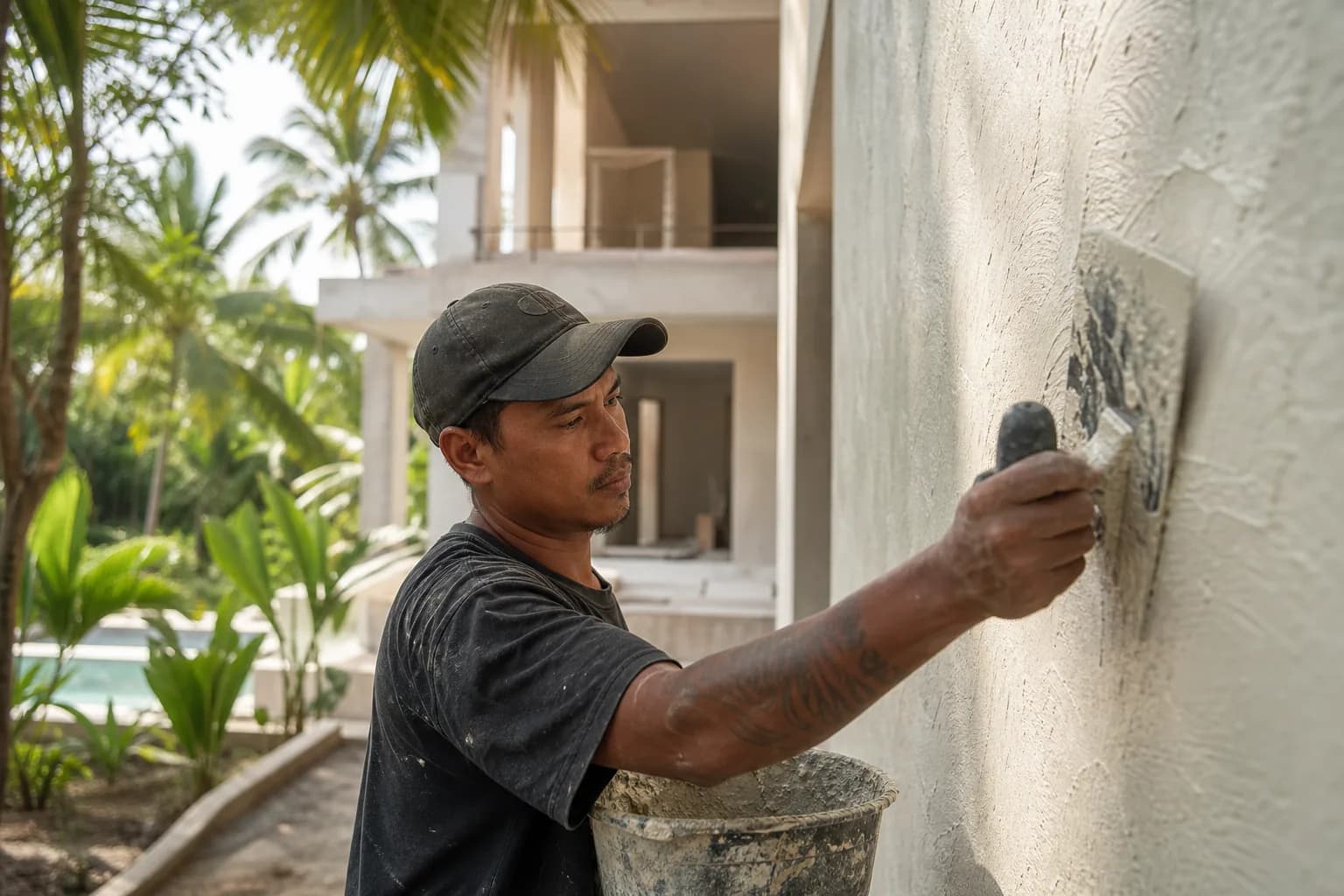
Resin-Infused Plaster Finishes: Anti-Salt Systems Bali
Expert technical guide: Resin-Infused Plaster Finishes: Anti-Salt Systems Bali
8 min read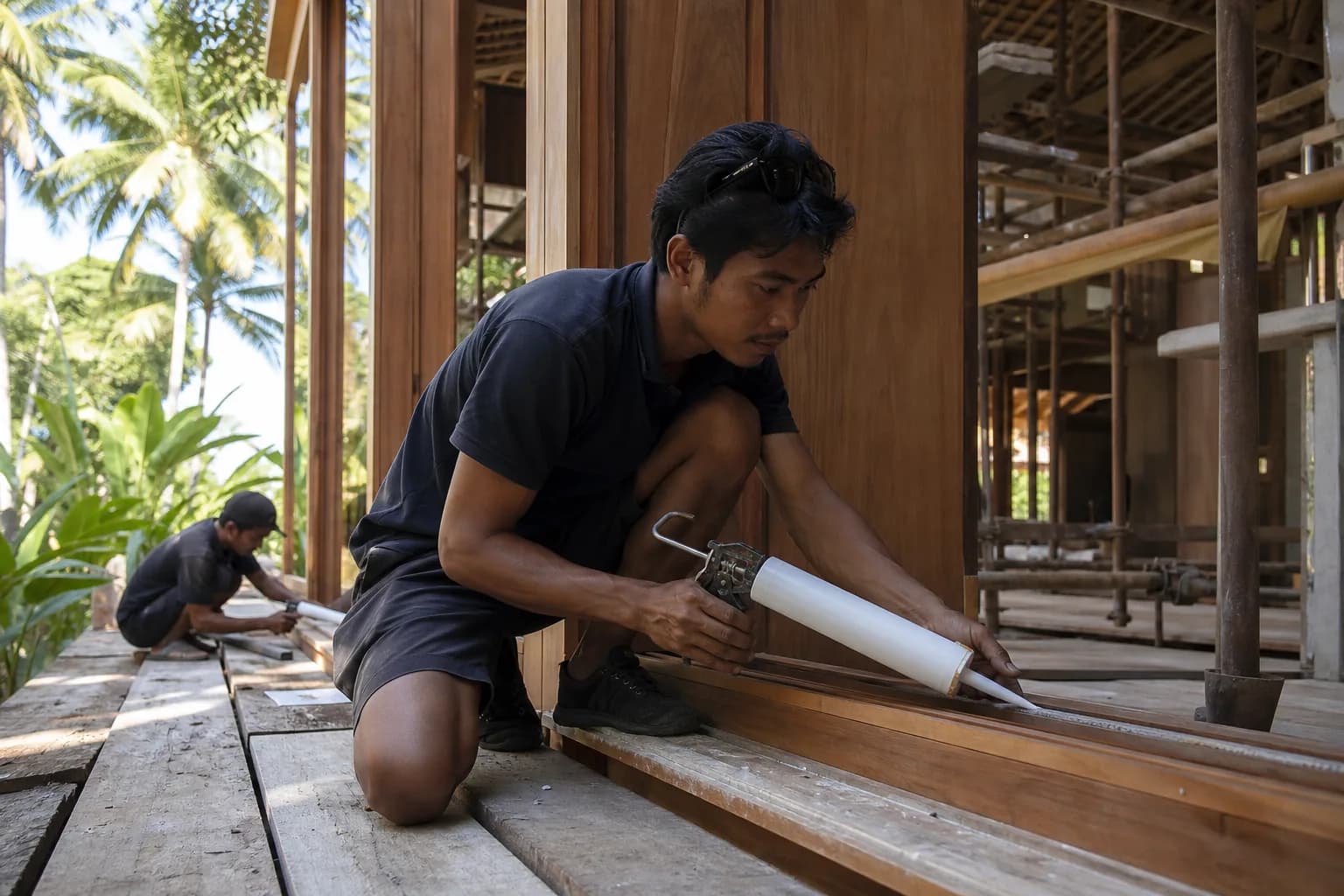
Prefinished Timber Joinery: Silicone Seals Fixings Bali
Professional prefinished timber joinery installation in Bali with silicone seals and fixings for durable weatherproof performance and a premium finish.
10 min read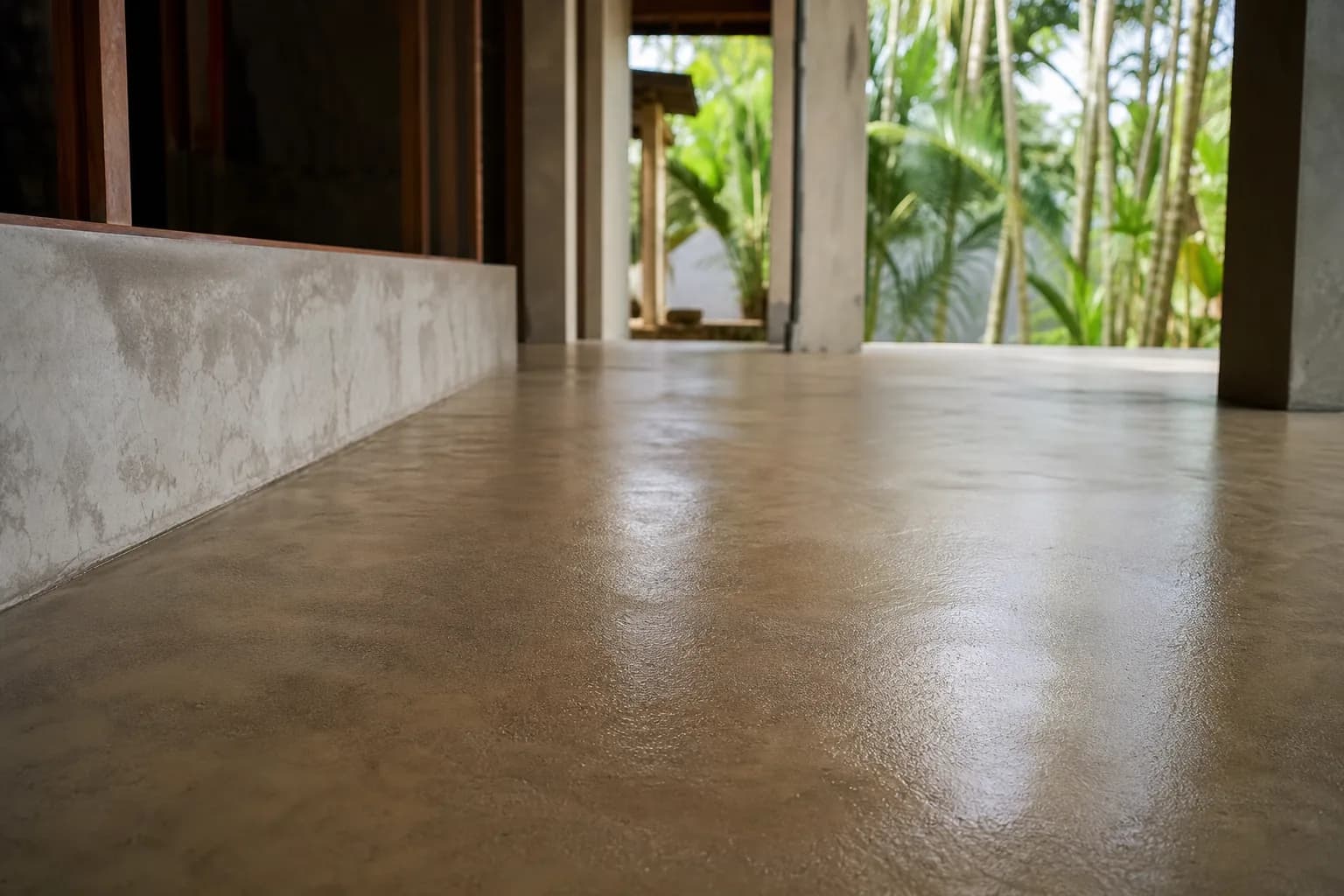
Polished Concrete Microtopping: Surface Prep Sealants Bali
Discover Bali s polished concrete microtopping: expert surface prep, durable sealants, and a flawless finish for modern floors with minimal maintenance.
9 min read