Limestone Quarry Blasting Vibration Damage Insurance in Bali
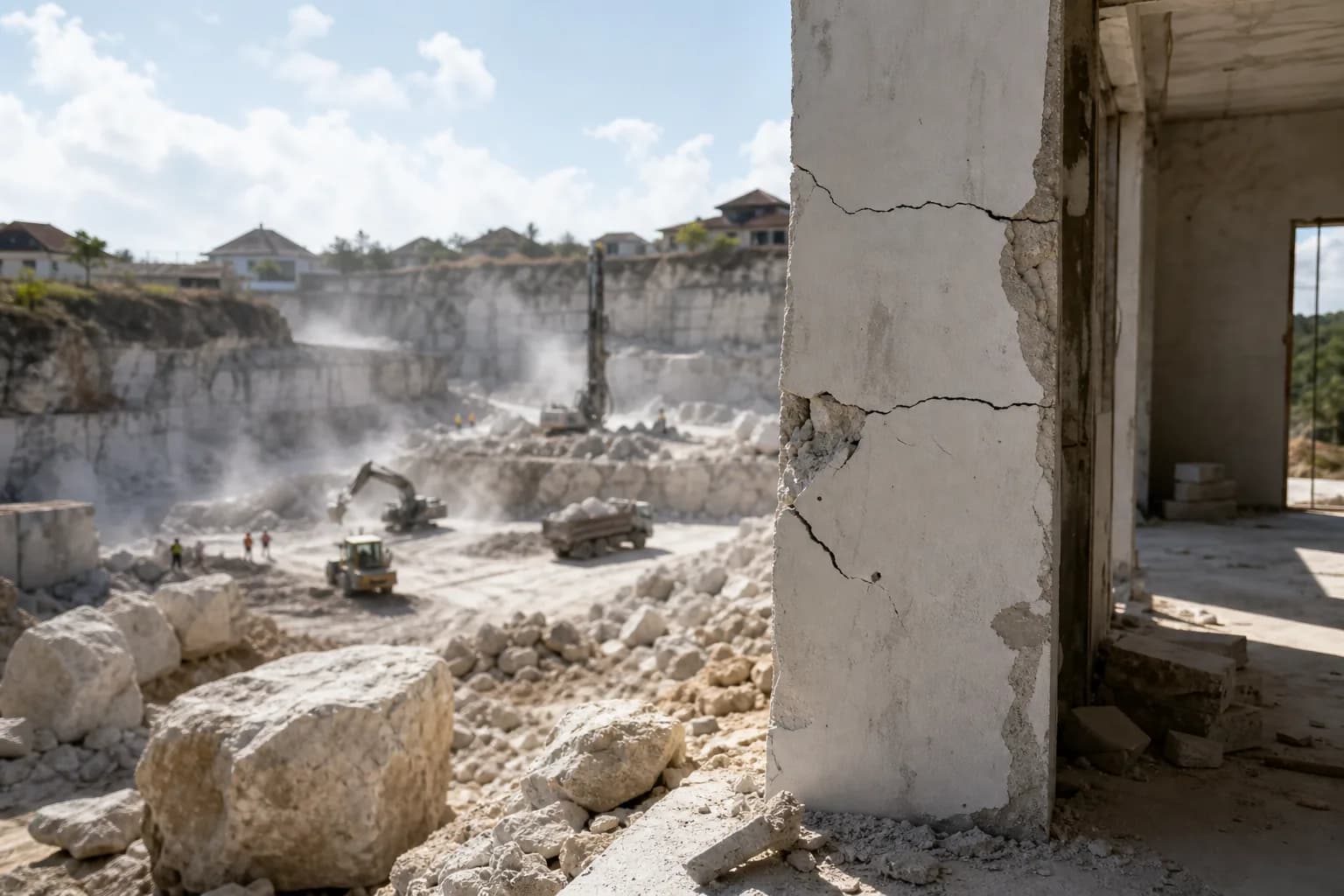
The Hidden Structural Threat: When Your Bali Villa Sits in a Quarry Blast Zone
Across Bukit Peninsula’s limestone plateau—from Jimbaran to Uluwatu—active quarrying operations create a construction risk rarely disclosed in property listings: repetitive blasting vibrations that can crack foundations, shift structural elements, and void insurance coverage. Unlike earthquake damage (covered by most policies), quarry-induced structural degradation falls into a grey zone where insurers deny claims, contractors dispute liability, and property owners face six-figure repair costs with no recourse. For anyone planning villa construction within 2-3 kilometers of active limestone extraction sites, understanding vibration thresholds, structural mitigation strategies, and insurance exclusions isn’t optional—it’s the difference between a durable asset and a depreciating liability with hairline cracks spreading through every concrete pour.
Engineering Reality: How Limestone Blasting Damages Structures Across Distance
Bukit Peninsula’s geological foundation—porous Miocene limestone with karst formations—makes it simultaneously valuable for construction aggregate and vulnerable to vibration transmission. Active quarries in Pecatu, Ungasan, and inland Jimbaran conduct controlled blasting 2-4 times weekly, generating peak particle velocity (PPV) waves that travel through bedrock far more efficiently than surface soils. German DIN 4150-3 standards (adopted by Indonesian engineers) set residential structure limits at 5mm/s PPV for modern buildings, 3mm/s for older structures—thresholds regularly exceeded within 1.5km of blast sites.
The structural damage mechanism operates in three phases. Immediate impact: blast waves create micro-fractures in fresh concrete (critical during 28-day curing), separate rebar from concrete bonding, and shift formwork during pours. Cumulative degradation: repeated low-level vibrations (below immediate damage thresholds) cause progressive weakening—expansion joints fail, tile adhesion breaks down, and hairline cracks in load-bearing walls widen over 18-36 months. Resonance amplification: certain building frequencies match blast wave frequencies, multiplying structural stress by 300-400% in specific elements like cantilevered pools or long-span roof structures.
Teville’s structural assessments in Pecatu (2023-2024) documented villas 2.1km from quarry operations showing foundation cracks within 14 months of completion—despite meeting all building codes. Seismograph monitoring revealed PPV readings of 6.2-8.7mm/s during blasting events, with resonance frequencies matching the natural frequency of 6-meter cantilever pool decks. Insurance claims were denied under “gradual deterioration” and “ground movement” exclusions, leaving owners with USD $47,000-$83,000 in structural repairs.
The legal framework compounds the problem. Indonesian mining regulations (UU No. 4/2009) require quarry operators to conduct vibration monitoring, but enforcement is inconsistent and liability thresholds favor industrial operations over residential structures. Property developers rarely disclose quarry proximity—no legal requirement exists for blast zone notification in sales contracts. Title certificates (SHM/Hak Milik) contain no annotations about nearby extraction activities, and IMB building permits don’t trigger additional structural requirements for quarry-adjacent sites.
Insurance policies contain specific exclusions that eliminate coverage for quarry-related damage. Standard property policies exclude: “damage caused by vibration from industrial operations,” “settling, cracking, or movement of foundations,” and “damage occurring over time rather than from a single event.” Even comprehensive policies with earthquake coverage explicitly exclude “man-made ground vibration.” International insurers (Allianz, AXA) operating in Bali maintain quarry exclusion databases—properties within mapped blast zones receive automatic coverage limitations or premium surcharges of 40-65%.
Vibration Transmission Through Bukit’s Limestone Geology
Bukit’s karst limestone transmits vibration energy 3-4 times more efficiently than volcanic soils found in Canggu or Ubud. The dense, crystalline structure propagates seismic waves with minimal energy dissipation—blast vibrations measurable at 3.2km distance still register 2.1mm/s PPV, just below damage thresholds. Underground void spaces (common in karst formations) create unpredictable resonance chambers that amplify specific frequencies, making vibration impact highly site-specific even within the same neighborhood.
What Property Buyers and Builders Consistently Miss
The most dangerous assumption: “If existing villas nearby look fine, the site is safe.” Quarry blast patterns change based on limestone seam depth—operations may shift from surface extraction (lower vibration) to deep blasting (higher intensity) within 6-12 months. A site experiencing 2mm/s PPV today could face 7mm/s next year as quarry operations expand vertically or laterally.
Due diligence gaps create liability exposure. Standard land surveys don’t include seismograph monitoring or quarry proximity analysis. Soil testing reports measure bearing capacity and composition but ignore vibration transmission characteristics. Title searches don’t reveal nearby mining permits (HGU for quarries), which are registered separately in provincial mining cadastres. Most buyers discover quarry proximity only after construction begins—when morning blasts shake scaffolding or crack freshly poured slabs.
Contractors without quarry-zone experience make critical errors: scheduling concrete pours without coordinating blast timing (resulting in ruined pours), using standard rebar spacing instead of enhanced seismic detailing, and omitting expansion joints that accommodate vibration-induced movement. These mistakes don’t appear during construction—they manifest as structural failures 12-24 months post-completion, after warranty periods expire and contractor liability ends.
Insurance procurement timing creates coverage gaps. Policies purchased after construction completion allow insurers to classify any existing micro-damage as “pre-existing conditions” excluded from coverage. Without baseline structural surveys documenting pre-construction condition, owners cannot prove quarry blasting caused subsequent damage—claims get denied as “normal settling” or “construction defects.”
Step-by-Step Risk Assessment and Mitigation Protocol
Phase 1: Pre-Purchase Quarry Proximity Analysis (2-3 Weeks)
Before land acquisition, obtain quarry location data from Bali’s Energy and Mineral Resources Agency (Dinas ESDM). Request active mining permit maps (IUP/IUPK) within 5km radius—these show current operations and approved expansion zones. Engage a geotechnical engineer to conduct desktop vibration risk assessment using distance, geology, and typical blast patterns. For sites within 3km of active quarries, commission 7-day seismograph monitoring during active quarry periods to establish baseline PPV readings at the specific plot.
Cross-reference quarry permit expiration dates—operations nearing permit renewal often intensify extraction rates, increasing blast frequency and intensity. Review provincial spatial plans (RTRW) to identify future quarry zones; Bukit’s limestone reserves make expansion likely in currently undeveloped areas.
Phase 2: Insurance Pre-Qualification (Before Design)
Contact 3-4 international insurers before architectural design begins. Provide quarry proximity data and request written confirmation of coverage terms, exclusions, and premium costs. Insurers may require: enhanced structural specifications, ongoing vibration monitoring, or blast coordination protocols as conditions of coverage. Negotiate “quarry damage endorsements” that explicitly cover blast-induced structural damage—expect 25-40% premium increases but gain enforceable coverage.
Document all communications in writing. Verbal assurances from insurance agents hold no legal weight—only policy documents and written endorsements create binding coverage obligations.
Phase 3: Enhanced Structural Engineering (Design Phase)
Specify seismic-grade structural detailing even if not required by code: increased rebar density (12mm @ 150mm spacing vs. standard 200mm), enhanced concrete strength (K-300 minimum vs. K-250 standard), and isolation joints every 8-10 meters to prevent crack propagation. Design foundations with vibration dampening: 150mm sand cushion layers beneath footings, flexible waterproofing membranes that accommodate movement, and separated structural elements (house foundation independent from pool structure).
Teville’s quarry-zone projects incorporate tuned mass damping principles—strategic placement of mass elements that counteract specific vibration frequencies. For Pecatu villas, this includes thickened ground-floor slabs (180mm vs. 120mm standard) and isolated pool structures with expansion gaps, reducing vibration transmission by 40-55%.
Phase 4: Construction Coordination Protocol
Establish formal communication with quarry operators (required under mining regulations but rarely enforced). Request 48-hour advance notice of blasting schedules. Coordinate concrete pours for non-blast days—vibration during curing compromises structural integrity permanently. Install temporary seismographs during critical construction phases (foundation pours, structural columns, roof beams) to document vibration exposure and prove compliance with engineering specifications.
Include blast coordination clauses in contractor agreements: liability for structural damage if pours occur during blast windows, requirements for vibration monitoring, and protocols for work stoppages during high-intensity blast periods.
Phase 5: Post-Construction Documentation
Commission comprehensive structural survey within 30 days of completion, documenting baseline condition with photography, crack mapping, and level surveys. This creates evidentiary foundation for future insurance claims. Establish ongoing monitoring: quarterly visual inspections, annual structural surveys, and seismograph monitoring during any period of increased quarry activity. Maintain detailed logs correlating any structural changes with blast events—essential for proving causation in insurance claims or legal disputes.
Real Cost Implications: Numbers Behind Quarry-Zone Construction
Enhanced structural specifications for quarry-adjacent sites add 8-12% to base construction costs. For a 250m² villa with standard construction cost of USD $185,000, quarry mitigation measures add USD $14,800-$22,200: increased rebar and concrete (USD $6,500-$8,200), seismic detailing labor (USD $3,800-$5,500), isolation joints and flexible systems (USD $2,900-$4,200), and engineering/monitoring (USD $1,600-$4,300).
Insurance premiums reflect risk exposure. Standard comprehensive property insurance: 0.15-0.25% of insured value annually. Quarry-zone properties with standard exclusions: 0.22-0.35% (minimal increase but no blast coverage). Policies with quarry damage endorsements: 0.35-0.55% of insured value—for USD $500,000 villa, annual premiums increase from USD $1,250 to USD $2,750, adding USD $37,500 over 25-year ownership.
Unmitigated damage costs dwarf prevention investments. Foundation crack repairs: USD $18,000-$34,000. Structural wall reconstruction: USD $12,000-$28,000 per affected wall. Pool structure repairs (common failure point): USD $23,000-$47,000. Total remediation for moderate quarry damage: USD $65,000-$140,000—costs borne entirely by owners when insurance claims are denied.
Timeline considerations: quarry proximity analysis adds 2-3 weeks to due diligence. Enhanced engineering and insurance procurement adds 3-4 weeks to pre-construction phase. Construction coordination (avoiding blast windows) may extend timelines by 2-3 weeks. Total project extension: 7-10 weeks—acceptable delay given the alternative of structural failure and uninsured losses.
Frequently Asked Questions: Quarry Blasting and Villa Construction
How do I find out if a property is near active limestone quarries before purchasing?
Request mining permit maps (peta IUP) from Bali’s Dinas ESDM (Energy and Mineral Resources Agency) covering 5km radius from your target property. Active quarries hold IUP (Izin Usaha Pertambangan) permits with registered coordinates. Hire a geotechnical consultant to conduct site visit—quarry operations are visible and audible within 2-3km. Check with neighboring property owners about blast frequency and intensity. For properties in Pecatu, Ungasan, and inland Jimbaran, assume quarry proximity until proven otherwise—these areas sit on Bukit’s primary limestone deposits. Teville’s land consultation service includes quarry proximity analysis for all Bukit Peninsula properties, providing clients with documented risk assessments before purchase commitments.
Can standard building permits and construction methods protect against blast vibration damage?
No. Indonesian building codes (SNI standards) address earthquake resistance but don’t specifically account for repetitive quarry blast vibrations, which create different structural stress patterns. Standard IMB (building permit) requirements don’t trigger enhanced specifications for quarry-adjacent sites—no regulatory framework exists for blast-zone construction standards. Protection requires voluntary engineering upgrades: seismic-grade rebar detailing, increased concrete strength, isolation joints, and vibration dampening systems. These specifications must be explicitly included in architectural and structural drawings. Teville’s construction methodology for Bukit projects incorporates quarry-zone engineering as standard practice, not optional upgrade, ensuring structural resilience regardless of future quarry activity changes.
Will my property insurance cover structural damage from nearby quarry blasting?
Standard policies explicitly exclude quarry-related damage through “industrial vibration,” “gradual deterioration,” and “ground movement” clauses. Even earthquake coverage doesn’t apply—insurers classify blast vibration as man-made, excluded event. To obtain coverage, you must negotiate specific “quarry damage endorsement” before policy inception, providing quarry proximity documentation and accepting premium increases of 25-40%. Crucially, insurance must be secured before construction begins—post-construction policies al
 2144 m²11 month(s)from 104.000 USD
Narayana
 3104 m²11 month(s)from 99.000 USD
TALA 100
 3124 m²6 month(s)from 123.000 USD
TALA 8
 3173 m²6 month(s)from 125.000 USD
TALA FOUR
 3127 m²9 month(s)from 177.000 USD
Mukunda
 3180 m²7 month(s)from 142.000 USD
Vasudeva
 1from 198.000 USD
Private: Haridas Villas

Want to calculate?
 4344 m²16 month(s)from 290.000 USD
Radha
 164 m²7 month(s)from 79.000 USD
TALA TWO
 172 m²8 month(s)from 120.000 USD
Keshava
164 m²7 month(s)from 79.000 USDPrivate: Haridas Villas, Tegallalang
Start With Real Numbers, Not Guesses
Before buying land or finalizing a design, check the realistic build cost range for your project in Bali.
Our team reviews your inputs and gives a grounded estimate.
Available lands
 1000 m²10 min$ 230911Bali, Kerobokan
 2130 m²10 min$ 495776Bali, Pecatu
 615 m²15 min$ 113608Bali, Tabanan
 13000 m²1 min$ 920567Bali, Pekutatan
 889 m²15 min$ 145612Bali, Cepaka
 3100 m²20 min$ 272968Bali, Tabanan
 420 m²15 min$ 41897Bali, Tabanan
 18900 m²2 min$ 6912931Bali, Pecatu
 2700 m²30 min$ 314224Bali, Sidemen
 700 m²15 min$ 162500Bali, Tabanan
 2800 m²15 min$ 310345Bali, Tabanan
 3254 m²5 min$ 631800Bali, All
 444 m²10 min$ 111000Bali, Tabanan
 400 m²15 min$ 67192Bali, Tabanan
 2115 m²5 min$ 1139547Bali, Pererenan
Essential Bali build & buy guides
- Bali villa construction cost per m² in 2026
- How much will your villa cost? Calculator
- Building a villa in Bali: the complete guide
- Buying land in Bali: step-by-step for foreigners
- Bali villa investment: yields, risks, returns
- Leasehold vs freehold: what foreigners can own
- Construction defect liability & 10-year warranty
- Bali building codes and construction standards
Related guides
Resin-Infused Plaster Finishes: Anti-Salt Systems Bali
Expert technical guide: Resin-Infused Plaster Finishes: Anti-Salt Systems Bali
8 min read
Prefinished Timber Joinery: Silicone Seals Fixings Bali
Professional prefinished timber joinery installation in Bali with silicone seals and fixings for durable weatherproof performance and a premium finish.
10 min read
Polished Concrete Microtopping: Surface Prep Sealants Bali
Discover Bali s polished concrete microtopping: expert surface prep, durable sealants, and a flawless finish for modern floors with minimal maintenance.
9 min read