Kuta Airport Noise Zone Soundproofing Costs Bali
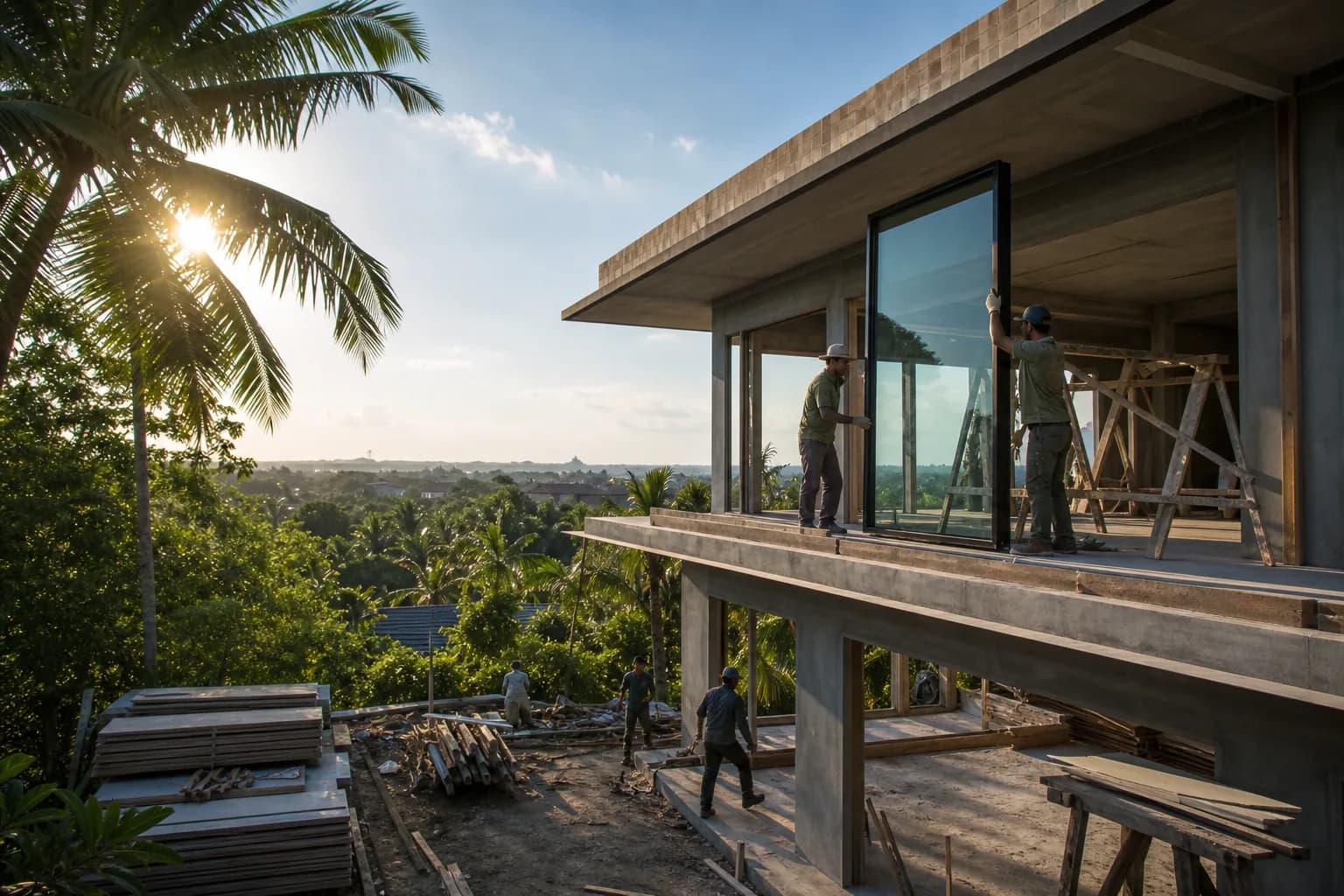
The Kuta Airport Noise Zone Challenge: Why Standard Villa Construction Fails Near Ngurah Rai
Building within 5 kilometers of Ngurah Rai International Airport presents a specific acoustic engineering challenge that most Bali villa developers underestimate. Aircraft approach paths over Kuta, Seminyak, and Canggu generate sustained noise levels between 65-75 dBA during peak hours, yet Indonesia lacks mandatory residential soundproofing standards comparable to ICAO Annex 16 guidelines. Property buyers discover post-construction that their IDR 8-12 billion villa investment produces interior noise levels exceeding 45 dBA—the threshold where sleep disruption and tenant complaints become inevitable. The technical question isn’t whether to soundproof, but how to engineer acoustic isolation that performs in Bali’s humid tropical climate without structural failure or mold growth within insulated wall cavities.
Technical Acoustic Engineering for Airport-Adjacent Construction
Ngurah Rai Airport operates under ICAO noise contour mapping that designates zones based on Day-Night Average Sound Level (DNL). Properties within the 65 DNL contour—extending approximately 3-4 kilometers from runway thresholds depending on prevailing wind patterns—experience noise events exceeding 75 dBA during takeoff cycles. Standard Bali villa construction using 150mm brick walls with cement render achieves only 35-40 dB Sound Transmission Class (STC) rating, insufficient for airport proximity.
Structural Acoustic Requirements
Effective soundproofing requires integrated wall, roof, and fenestration systems engineered as acoustic assemblies, not isolated components. For properties within 4 kilometers of Ngurah Rai, target specifications include:
- External wall assemblies: Minimum STC 50-55 using decoupled double-stud framing with staggered studs, dual-layer 12.5mm gypsum board, and 100mm mineral wool insulation (density 60-80 kg/m³)
- Roof systems: Concrete slab with suspended ceiling creating 200mm air gap, filled with acoustic insulation and vapor barrier to prevent tropical moisture accumulation
- Window specifications: Laminated acoustic glass (6mm-12mm-6mm minimum) with STC 38-42 rating, installed in thermally-broken aluminum frames with compression seals
- Door systems: Solid core doors (45mm minimum) with perimeter acoustic seals and automatic drop-seals at thresholds
- HVAC penetrations: Acoustic duct lining and silencers preventing sound flanking through mechanical systems
Tropical Climate Acoustic Engineering
Bali’s 80-95% humidity creates specific failure modes in soundproofing systems. Mineral wool insulation without proper vapor barriers absorbs moisture, reducing acoustic performance by 30-40% while promoting mold growth. Acoustic sealants and gaskets degrade rapidly under UV exposure and temperature cycling between 24-34°C. Our construction methodology addresses these through:
Vapor-permeable but water-resistant membrane systems on exterior faces, allowing wall assemblies to dry toward the outside while blocking rain penetration. Closed-cell spray foam in critical junctions where traditional batt insulation would trap moisture. Stainless steel or hot-dip galvanized fasteners preventing corrosion that compromises acoustic seal integrity. Silicone-based acoustic sealants rated for tropical UV and temperature ranges, not standard acrylic compounds that fail within 18-24 months.
Regulatory Framework and Compliance
Indonesia’s Ministry of Environment and Forestry Regulation No. 56/2019 establishes ambient noise standards but lacks specific construction requirements for airport noise zones. The regulation sets residential limits at 55 dBA daytime, 45 dBA nighttime—levels routinely exceeded near Ngurah Rai. Local building permits (IMB) in Badung Regency don’t mandate acoustic testing or soundproofing specifications, creating liability gaps where developers deliver legally-compliant but acoustically inadequate structures.
International buyers expecting ICAO-aligned noise mitigation programs will find none. Unlike airports in Australia, Singapore, or Europe with mandatory insulation schemes for affected properties, Ngurah Rai operators provide no compensation or retrofit programs. The construction burden falls entirely on the property developer to specify and verify acoustic performance—a technical requirement most Bali contractors lack expertise to deliver.
Hidden Risks in Airport-Adjacent Villa Development
The primary risk isn’t construction cost—it’s post-occupancy failure when acoustic specifications prove inadequate. We’ve assessed properties in Seminyak’s airport approach path where developers installed “soundproof windows” (single-pane laminated glass, STC 32) that reduced noise by only 8-10 dBA, leaving interior levels at 55-60 dBA during aircraft events. Tenant turnover exceeded 60% annually, and resale values dropped 15-20% below comparable properties 2 kilometers further from flight paths.
Specification Gaps in Standard Contracts
Most Bali construction contracts reference “soundproofing” without defining STC ratings, testing protocols, or performance guarantees. Contractors install 50mm fiberglass batts in standard stud walls—adequate for room-to-room privacy but providing negligible aircraft noise reduction. Window suppliers market “acoustic glass” that meets automotive standards (STC 28-32) rather than architectural acoustic requirements (STC 38-45 minimum for airport zones).
Moisture and Mold in Acoustic Assemblies
Sealed wall cavities with batt insulation trap condensation in Bali’s climate. Within 12-18 months, moisture accumulation degrades insulation R-value and acoustic performance while creating mold growth invisible behind finished walls. Remediation requires complete wall demolition—a IDR 150-250 million cost per villa that buyers don’t anticipate. Proper vapor barrier placement and ventilation cavity design prevents this failure mode but adds 8-12% to wall assembly costs that budget-focused developers eliminate.
HVAC System Acoustic Flanking
Achieving STC 50 walls becomes irrelevant when HVAC ducts, electrical conduits, and plumbing penetrations create unmitigated sound paths. Split AC systems—standard in Bali construction—require exterior wall penetrations that compromise acoustic isolation unless detailed with acoustic boots and sealed transitions. Centralized HVAC systems need acoustic duct lining and silencers adding IDR 35-50 million per villa, costs rarely included in preliminary budgets.
Step-by-Step Acoustic Engineering Process for Airport-Zone Villas
Phase 1: Site Acoustic Assessment (Pre-Design)
Commission 24-hour noise monitoring at the specific land parcel, not relying on generic airport contour maps. Aircraft approach paths shift with seasonal wind patterns—properties under the flight path during June-September southwest monsoon experience different noise profiles than November-March northeast monsoon periods. Measurement should capture Leq (equivalent continuous sound level), Lmax (maximum event levels), and frequency spectrum analysis identifying low-frequency rumble that requires different mitigation than high-frequency jet noise.
Document existing ambient noise from road traffic, commercial activities, and neighboring properties. A site with 55 dBA baseline from Jalan Sunset Road traffic requires different acoustic targets than a quiet residential lane with 40 dBA ambient levels. This data establishes realistic interior noise goals—typically 35-40 dBA for bedrooms, 40-45 dBA for living areas in high-noise zones.
Phase 2: Integrated Acoustic Design
Work with structural engineers to design wall and roof assemblies meeting STC targets without compromising tropical ventilation requirements. Standard double-stud walls consume 250-300mm of floor area—significant in land-constrained Bali plots where every square meter affects project economics. Alternative systems using mass-loaded vinyl barriers, resilient channels, and optimized insulation can achieve STC 50 in 200mm assemblies, preserving usable area.
Coordinate acoustic glass specifications with window suppliers early. Lead times for laminated acoustic glass exceed 8-12 weeks, and dimensional limitations (maximum 2.4m x 3.0m panels) affect architectural design. Larger openings require mullions that create acoustic weak points unless detailed with compression gaskets and structural silicone glazing. Review our completed villa projects showing acoustic glazing integration in tropical modern designs.
Phase 3: Contractor Qualification and Specification
Standard Bali contractors lack acoustic construction experience. Specification documents must include installation details, not just material lists: stud spacing, insulation compression limits, sealant application procedures, and acoustic testing protocols. Require mock-up wall sections demonstrating STC performance before full construction proceeds—a quality control step that identifies installation errors when correction costs IDR 5-8 million rather than IDR 150 million post-completion.
Establish hold points for inspection before acoustic assemblies are concealed. Verify vapor barrier continuity, insulation density, and seal integrity at all penetrations. Third-party acoustic consultants should validate critical assemblies, particularly window installations where improper shimming or inadequate sealant creates flanking paths that negate expensive acoustic glass investments.
Phase 4: Performance Testing and Commissioning
Post-construction acoustic testing verifies actual performance against design targets. Field STC testing using sound sources and calibrated measurement equipment costs IDR 25-35 million but provides objective data on assembly performance. Interior noise level monitoring during aircraft events confirms whether bedrooms achieve target 35-40 dBA levels or require remediation.
Document all test results for future buyers or tenants. Properties with verified acoustic performance command 8-12% premiums in airport-adjacent markets where most competitors offer unverified “soundproofing” claims. This data also supports land valuation assessments for properties in noise-affected zones.
Realistic Cost Ranges for Airport-Zone Acoustic Engineering
Acoustic engineering adds 12-18% to base construction costs for villas within 4 kilometers of Ngurah Rai Airport, varying with target performance levels and building design complexity. For a 250m² two-bedroom villa with base construction cost of IDR 650-750 million (excluding land), acoustic upgrades include:
- Enhanced wall assemblies: IDR 45-65 million (STC 50-55 systems vs. standard construction)
- Acoustic roof systems: IDR 35-50 million (suspended ceilings, insulation, vapor barriers)
- Acoustic glazing: IDR 85-120 million (laminated glass, acoustic frames, installation)
- Acoustic doors and seals: IDR 25-35 million (solid core doors, perimeter seals, thresholds)
- HVAC acoustic treatment: IDR 30-45 million (duct lining, silencers, sealed penetrations)
- Acoustic testing and commissioning: IDR 25-35 million (design consultation, field testing, verification)
Total acoustic premium: IDR 245-350 million, representing 15-18% of base villa cost. Larger villas (350-500m²) achieve economies of scale with acoustic premiums of 12-15%. These figures assume competent execution—remediation of failed acoustic systems costs 2-3x initial proper installation.
Timeline impacts include 3-4 additional weeks for acoustic material procurement and specialized installation. Acoustic glass lead times drive critical path scheduling, requiring orders 10-12 weeks before window installation phases. Get detailed cost projections for your specific project through our build cost estimation service.
Frequently Asked Questions: Kuta Airport Noise Zone Construction
Do Bali building permits require soundproofing for properties near Ngurah Rai Airport?
No. Badung Regency IMB (building permit) requirements don’t mandate acoustic specifications or soundproofing standards for airport-adjacent properties. Compliance focuses on structural safety, setbacks, and building coverage ratios. Acoustic performance is entirely at the developer’s discretion, creating significant quality variation in airport-zone properties. International buyers should specify acoustic requirements contractually with verifiable STC ratings and testing protocols, not rely on regulatory minimums that don’t exist.
What interior noise levels should I target for a villa 3 kilometers from the airport?
Target 35-40 dBA in bedrooms and 40-45 dBA in living areas during aircraft events. Properties 3 kilometers from Ngurah Rai experience exterior noise levels of 65-70 dBA during takeoffs and landings, requiring 25-30 dBA noise reduction through building envelope. Standard construction achieves only 15-20 dBA reduction, resulting in interior levels of 50-55 dBA—sufficient to disrupt sleep and conversation. Achieving target levels requires STC 50-55 wall assemblies, STC 38-42 windows, and comprehensive acoustic detailing at all penetrations and junctions.
Can I retrofit soundproofing after construction, or must it be built-in initially?
Effective acoustic performance requires integrated design—retrofit solutions achieve only 40-60% of properly-engineered new construction performance at 2-3x cost. Adding acoustic glass to existing windows improves performance 8-12 dBA but doesn’t address wall, roof, or flanking path deficiencies. Wall cavity insulation retrofit requires removing interior finishes, installing vapor barriers and insulation, then refinishing—essentially rebuilding walls at IDR 150-250 million per villa. Properties in airport zones should incorporate acoustic engineering from initial design, not attempt post-construction correction.
How does tropical humidity affect soundproofing materials and long-term performance?
Bali’s 80-95% humidity degrades acoustic insulation and sealants unless properly specified for tropical conditions. Standard fiberglass batts absorb moisture, losing 30-40% acoustic performance while promoting mold growth. Acoustic sealants formulated for
 3180 m²7 month(s)from 142.000 USD
Vasudeva
 164 m²7 month(s)from 79.000 USD
TALA TWO
 4344 m²16 month(s)from 290.000 USD
Radha
 2144 m²11 month(s)from 104.000 USD
Narayana
 1from 198.000 USD
Private: Haridas Villas
 3127 m²9 month(s)from 177.000 USD
Mukunda
 3173 m²6 month(s)from 125.000 USD
TALA FOUR
164 m²7 month(s)from 79.000 USDPrivate: Haridas Villas, Tegallalang
 172 m²8 month(s)from 120.000 USD
Keshava
 3104 m²11 month(s)from 99.000 USD
TALA 100

Want to calculate?
 3124 m²6 month(s)from 123.000 USD
TALA 8
Start With Real Numbers, Not Guesses
Before buying land or finalizing a design, check the realistic build cost range for your project in Bali.
Our team reviews your inputs and gives a grounded estimate.
Available lands
 2400 m²7 min$ 496552Bali, Canggu
 700 m²7 min$ 400000Bali, Canggu
 550 m²5 min$ 217629Bali, Tabanan
 2130 m²10 min$ 495776Bali, Pecatu
 1200 m²2 min$ 155172Bali, Klungkung
 1660 m²10 min$ 343448Bali, Kerobokan
 2230 m²15 min$ 410573Bali, Padonan
 500 m²2 min$ 175862Bali, Cemagi
 2800 m²2 min$ 713793Bali, Kedungu
 889 m²15 min$ 145612Bali, Cepaka
 800 m²8 min$ 113300Bali, Ungasan
 1158 m²12 min$ 291996Bali, Mengwi
 2800 m²15 min$ 310345Bali, Tabanan
 1300 m²10 min$ 312192Bali, Kutuh South Bali
 200 m²11 min$ 89286Bali, Tabanan
Essential Bali build & buy guides
- Bali villa construction cost per m² in 2026
- How much will your villa cost? Calculator
- Building a villa in Bali: the complete guide
- Buying land in Bali: step-by-step for foreigners
- Bali villa investment: yields, risks, returns
- Leasehold vs freehold: what foreigners can own
- Construction defect liability & 10-year warranty
- Bali building codes and construction standards
Related guides
Sanur and Nusa Dua vs Canggu: Stability Plays vs Hype
Canggu gets the headlines; Sanur and Nusa Dua quietly deliver steadier returns to a different kind of buyer. An honest 2026 comparison of the stability markets against the hype market — prices, demand drivers, oversupply risk, and who should buy where.
7 min read
Ubud and the Wellness Market: Buying or Building for Retreats
Ubud is Bali's wellness capital, and retreat-focused property behaves differently from beach villas: longer stays, group bookings, lower volatility. Here is what the market rewards, what zoning allows, and what it costs to buy or build a retreat property in 2026.
8 min read
Buying and Building on the Bukit: Uluwatu, Bingin and Balangan from a Buyer's Seat
A buyer's-seat 2026 guide to the Bukit peninsula — Uluwatu, Bingin and Balangan land prices, the water problem nobody budgets, cliff setbacks after the 2025 Bingin demolitions, and how to build there properly.
7 min read