Jimbaran Bay Seawall Engineering Costs Bali
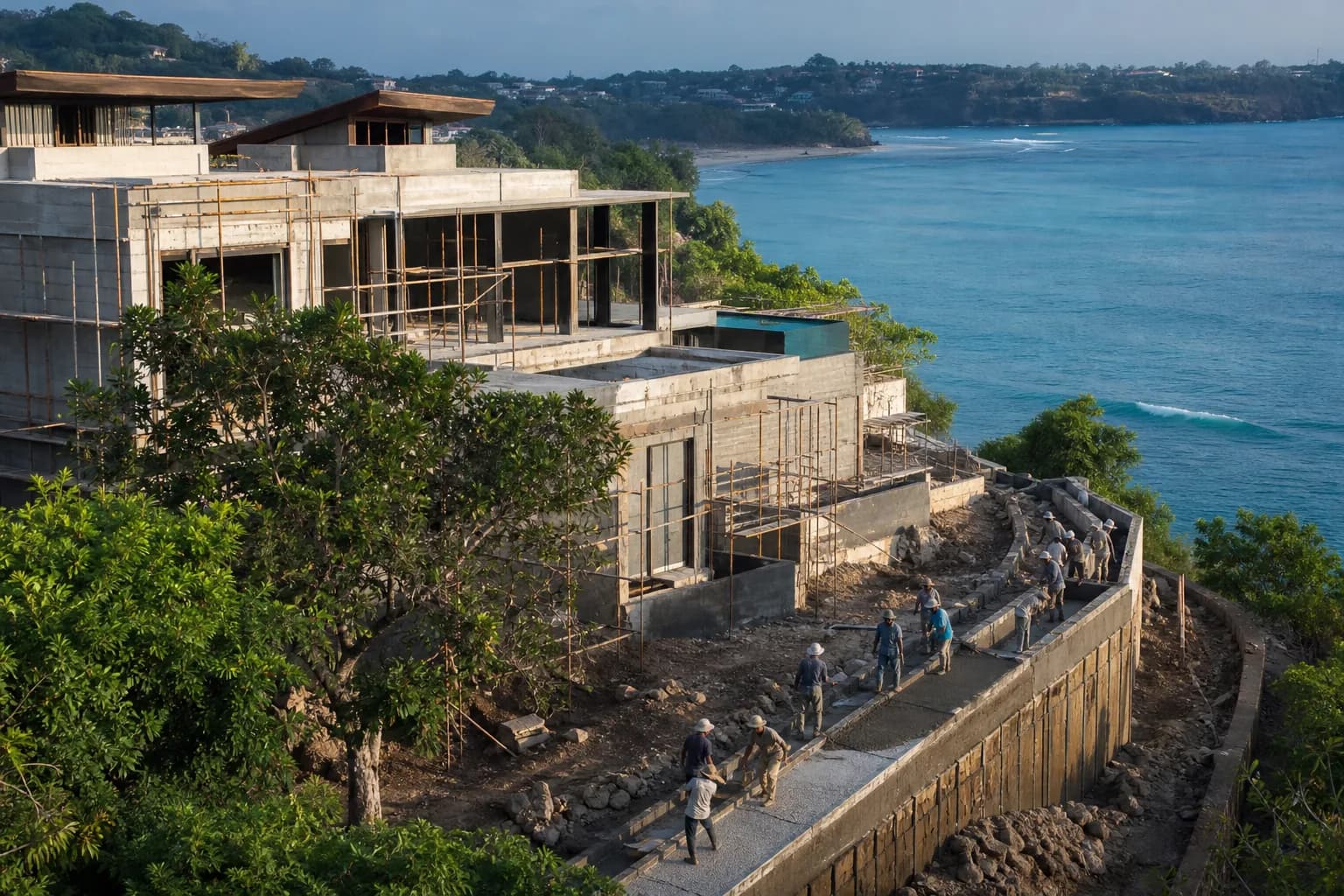
Jimbaran Bay Tidal Surge Protection: Seawall Engineering Costs Bali
Jimbaran Bay’s crescent shoreline faces accelerating tidal surge events that threaten beachfront properties with foundation erosion, saltwater intrusion, and structural undermining. Property owners along this premium coastal zone now confront a critical engineering question: what does comprehensive seawall protection actually cost, and which technical specifications prevent catastrophic failure during Bali’s increasingly volatile monsoon seasons? Recent government investment of Rp260 billion in Kuta Beach breakwater infrastructure signals the scale of coastal defense required, yet private property owners in Jimbaran must navigate fragmented regulatory frameworks, geological variability across the bay’s 3.2-kilometer curve, and engineering solutions that balance wave energy dissipation with environmental compliance.
Engineering Specifications for Jimbaran Bay Coastal Defense Systems
Jimbaran Bay’s tidal surge protection requires site-specific engineering that accounts for the bay’s unique hydrodynamic profile. The shallow bathymetry creates wave amplification during high tides combined with southwest monsoon swells, generating surge forces exceeding 8 kN/m² against vertical structures. Effective seawall design must address three distinct failure modes: toe scour from reflected wave energy, overtopping during spring tides coinciding with storm events, and progressive structural fatigue from cyclic loading.
The geological substrate varies dramatically across Jimbaran’s coastline. Northern sections near the fish market sit on compacted coral limestone with bearing capacities exceeding 250 kPa, while southern stretches toward the Four Seasons transition to softer marine clay requiring deep foundation systems. This geological variability directly impacts construction methodology and cost structure. A reinforced concrete gravity seawall on competent limestone may require 1.2-meter embedment depth, while identical protection on marine clay demands 3.5-meter driven piles or ground improvement through jet grouting.
Contemporary seawall engineering in tropical marine environments employs hybrid systems rather than monolithic concrete barriers. The most resilient Jimbaran installations combine a primary reinforced concrete core wall (minimum 400mm thickness, C30 concrete grade) with geotextile-wrapped rock revetment on the seaward face. This configuration dissipates wave energy through the permeable rock layer before impact reaches the structural wall, reducing peak loads by 40-60% compared to vertical face designs. The rock armor typically specifies 500-800kg individual stones in double-layer configuration, sourced from Sumatra or Java since Bali lacks suitable quarry stone.
Drainage integration separates functional seawalls from premature failures. Jimbaran’s high water table and seasonal rainfall create hydrostatic pressure behind coastal walls that can exceed design wave loads. Proper systems incorporate perforated drainage pipes at 3-meter horizontal spacing, connected to sump collection points with tidal check valves. The drainage aggregate layer (minimum 300mm crushed stone) must extend the full wall height with geotextile separation to prevent fine soil migration that causes settlement voids.
Regulatory compliance adds technical complexity beyond pure engineering. The Bali Provincial Maritime Affairs office requires Environmental Impact Analysis (AMDAL) for seawalls exceeding 50 linear meters or extending below mean low water. The analysis must demonstrate minimal impact on longshore sediment transport, critical for Jimbaran Bay where beach nourishment depends on natural sand movement from the southern headland. Many property owners discover mid-construction that their seawall design disrupts adjacent properties’ beach access, triggering legal disputes and construction halts. The technical solution involves tapered wing walls and sediment bypass systems, adding 15-25% to base construction costs.
Material specification directly determines longevity in Bali’s aggressive marine environment. Standard reinforced concrete experiences chloride-induced rebar corrosion within 8-12 years without proper protection. Durable construction requires 50mm minimum concrete cover, corrosion-inhibiting admixtures, and stainless steel or epoxy-coated reinforcement in the splash zone. The concrete mix design must achieve maximum 0.40 water-cement ratio with supplementary cementitious materials (fly ash or slag) replacing 25-30% of Portland cement to reduce permeability. These specifications increase material costs by approximately 40% compared to standard structural concrete but extend service life from 15 years to 50+ years.
Critical Oversights in Coastal Property Protection Planning
Property owners consistently underestimate the spatial footprint required for effective tidal surge protection. A properly engineered seawall system in Jimbaran typically requires 4-6 meters of land depth from the property boundary, including the wall structure, drainage zone, and access corridor for maintenance equipment. Beachfront lots with shallow setbacks may lose 30-40% of buildable area to coastal defense infrastructure, fundamentally altering villa design feasibility and site utilization. This spatial requirement often surfaces only during detailed engineering, after land purchase commitments.
The assumption that seawall construction represents a one-time capital expense ignores ongoing maintenance realities. Jimbaran’s wave climate and sediment dynamics require annual inspection and remedial work. Rock armor displacement occurs during major storm events, requiring repositioning with excavator equipment. Weep hole drainage systems clog with sand and organic matter, necessitating high-pressure flushing. Concrete surfaces develop chloride penetration that demands patch repairs and protective coating reapplication every 5-7 years. Realistic lifecycle budgeting allocates 3-5% of initial construction cost annually for maintenance, a recurring expense many owners fail to anticipate.
Coordination with adjacent property owners represents a frequently overlooked legal and technical requirement. Seawall construction on one parcel alters wave reflection patterns and sediment deposition on neighboring beaches. Bali’s customary law (adat) and national coastal regulations grant adjacent owners legal standing to challenge construction that damages their shoreline. The prudent approach involves joint engineering studies and potentially shared infrastructure, but individual property owners often proceed independently, creating structural discontinuities that concentrate erosion at property boundaries and generate expensive legal conflicts.
Implementation Process for Jimbaran Seawall Projects
Comprehensive site investigation forms the foundation of successful seawall engineering. The process begins with topographic survey extending 50 meters inland and bathymetric survey to -5 meter depth offshore, establishing baseline conditions. Geotechnical investigation requires minimum three boreholes to 15-meter depth, with standard penetration testing at 1.5-meter intervals and laboratory analysis of soil samples for bearing capacity, permeability, and corrosion potential. Wave climate analysis examines historical data from Benoa Harbor tide gauge and conducts site-specific wave measurement during southwest monsoon peak (July-August) to capture design conditions. This investigation phase typically requires 6-8 weeks and costs Rp85-120 million depending on access conditions and laboratory testing scope.
Engineering design development translates site data into construction-ready specifications. The structural engineer models wave-structure interaction using computational fluid dynamics to optimize wall geometry and armor sizing. Foundation design addresses bearing capacity, settlement, and seismic loading (Bali sits in Zone 4 seismic classification). The design package includes structural calculations, reinforcement detailing, material specifications, and construction sequencing. Concurrent environmental assessment evaluates sediment transport impacts and proposes mitigation measures. Design development requires 8-12 weeks for experienced coastal engineering firms, with fees ranging from Rp150-250 million for typical residential-scale projects (50-100 linear meters).
Permit acquisition navigates multiple regulatory authorities with overlapping jurisdiction. The primary Coastal Construction Permit (IMB Pantai) comes from the district-level Public Works office, requiring the complete engineering package, environmental clearance, and proof of land rights. Projects within 100 meters of high tide line need additional Maritime Affairs approval. Customary village (banjar) endorsement is legally required and practically essential to prevent community opposition. The permit process officially requires 30 working days but realistically extends 3-5 months due to document revisions, inter-agency coordination, and informal consultation requirements. Expediting services through experienced local consultants cost Rp40-75 million but significantly reduce timeline uncertainty.
Construction execution demands specialized marine contractors with relevant equipment and experience. Site mobilization establishes temporary access roads capable of supporting 20-ton excavators and concrete trucks, often requiring temporary bridges over drainage channels. Foundation work proceeds during low tide windows, with dewatering systems maintaining dry excavations in high water table conditions. Concrete placement uses tremie methods for underwater sections and requires marine-grade batching with strict quality control. Rock armor placement needs excavators with GPS positioning to achieve specified gradation and layer thickness. Weather dependency is significant—monsoon season construction faces 40-50% downtime from high seas preventing material delivery and concrete curing complications. A 75-meter seawall typically requires 12-16 weeks of construction time, weather permitting.
Post-construction monitoring validates design performance and identifies maintenance needs. The first monsoon season provides critical data on wave overtopping, drainage system function, and structural response. Professional inspection after major storm events documents any damage requiring immediate repair. Photographic documentation at 6-month intervals tracks concrete condition, armor stability, and beach profile changes. This monitoring phase, often neglected, provides early warning of developing problems when repairs remain minor and inexpensive rather than waiting for catastrophic failure requiring complete reconstruction.
Cost Structure and Timeline Expectations for Jimbaran Seawall Construction
Seawall construction costs in Jimbaran Bay range from Rp18-35 million per linear meter depending on design complexity, foundation conditions, and material specifications. A basic gravity wall on competent limestone with minimal rock protection sits at the lower range (Rp18-22 million/meter), while comprehensive hybrid systems on soft soil with deep foundations and extensive drainage reach the upper range (Rp28-35 million/meter). For a typical beachfront villa lot requiring 60 linear meters of protection, total construction investment spans Rp1.08-2.1 billion (approximately $72,000-140,000 USD at current exchange rates).
The cost breakdown reveals where investment concentrates: foundation work and ground improvement consume 30-35% of total budget on challenging soil conditions, structural concrete and reinforcement represent 25-30%, rock armor and geotextile materials account for 20-25%, with drainage systems, access construction, and finishing work comprising the remainder. Material costs have increased 25-30% since 2023 due to cement price inflation and imported rock armor logistics costs. Labor rates for skilled marine construction crews range Rp350,000-500,000 daily, significantly higher than standard construction due to specialized expertise and tidal work scheduling constraints.
Engineering and permitting costs add Rp235-370 million to project budgets (investigation, design, environmental assessment, and permit processing combined). Contingency allocation of 15-20% is prudent given the uncertainty inherent in marine construction—unexpected soil conditions, weather delays, and material availability issues frequently impact final costs. Total project investment including all soft costs and contingency typically reaches Rp1.4-2.7 billion for comprehensive protection of a standard beachfront residential parcel.
Frequently Asked Questions: Jimbaran Bay Seawall Engineering
How does seawall construction affect property value and future sale prospects in Jimbaran?
Professionally engineered seawall protection typically maintains property value by preventing erosion damage, but the construction cost rarely translates to equivalent value increase. Buyers view seawalls as necessary infrastructure rather than value-adding amenities. Properties with poorly designed or deteriorating seawalls face significant value discounts (20-35%) due to perceived liability and repair costs. The key value consideration is whether the seawall solves erosion problems permanently or represents ongoing maintenance burden. Documentation of proper engineering, permits, and maintenance history is essential for future sale negotiations. Properties sharing coordinated seawall systems with neighbors generally command better pricing than isolated individual walls that create boundary erosion issues.
Can existing seawalls be retrofitted or must they be completely replaced when showing deterioration?
Retrofit feasibility depends on the existing structure’s foundation integrity and design adequacy for current wave climate. Many older Jimbaran seawalls used inadequate embedment depth or lack proper drainage, making retrofit uneconomical compared to replacement. Structural assessment by qualified engineers determines whether reinforcement, drainage addition, or armor upgrades can extend service life. Partial replacement is often optimal—retaining competent foundation elements while reconstructing the upper wall and adding modern drainage. Retrofit costs typically range 60-75% of new construction but may only extend service life 10-15 years versus 50+ years for complete replacement. The decision requires lifecycle cost analysis comparing near-term retrofit savings against long-term replacement inevitability.
What regulatory changes are anticipated for coastal construction in Jimbaran given climate change concerns?
Bali Provincial Government is developing updated coasta
 3127 m²9 month(s)from 177.000 USD
Mukunda
 3180 m²7 month(s)from 142.000 USD
Vasudeva
 164 m²7 month(s)from 79.000 USD
TALA TWO
 2144 m²11 month(s)from 104.000 USD
Narayana
 172 m²8 month(s)from 120.000 USD
Keshava
 3124 m²6 month(s)from 123.000 USD
TALA 8
 3173 m²6 month(s)from 125.000 USD
TALA FOUR
164 m²7 month(s)from 79.000 USDPrivate: Haridas Villas, Tegallalang
 3104 m²11 month(s)from 99.000 USD
TALA 100
 4344 m²16 month(s)from 290.000 USD
Radha

Want to calculate?
 1from 198.000 USD
Private: Haridas Villas
Start With Real Numbers, Not Guesses
Before buying land or finalizing a design, check the realistic build cost range for your project in Bali.
Our team reviews your inputs and gives a grounded estimate.
Available lands
 3900 m²10 min$ 432266Bali, Tabanan
 1600 m²32 min$ 266010Bali, Tabanan
 6000 m²10 min$ 1330049Bali, Kutuh South Bali
 1350 m²5 min$ 283467Bali, Pecatu
 422 m²15 min$ 93547Bali, Kerobokan
 6000 m²30 min$ 55419Bali, Tabanan
 700 m²7 min$ 400000Bali, Canggu
 1950 m²7 min$ 150092Bali, Tabanan
 515 m²7 min$ 570813Bali, Canggu
 3000 m²15 min$ 1246921Bali, Tabanan
 1000 m²10 min$ 184729Bali, Kutuh South Bali
 3100 m²15 min$ 257697Bali, Tegallalang
 4270 m²10 min$ 394397Bali, Ubud
 200 m²11 min$ 89286Bali, Tabanan
 2800 m²15 min$ 310345Bali, Tabanan
Essential Bali build & buy guides
- Bali villa construction cost per m² in 2026
- How much will your villa cost? Calculator
- Building a villa in Bali: the complete guide
- Buying land in Bali: step-by-step for foreigners
- Bali villa investment: yields, risks, returns
- Leasehold vs freehold: what foreigners can own
- Construction defect liability & 10-year warranty
- Bali building codes and construction standards
Related guides
Sanur and Nusa Dua vs Canggu: Stability Plays vs Hype
Canggu gets the headlines; Sanur and Nusa Dua quietly deliver steadier returns to a different kind of buyer. An honest 2026 comparison of the stability markets against the hype market — prices, demand drivers, oversupply risk, and who should buy where.
7 min read
Ubud and the Wellness Market: Buying or Building for Retreats
Ubud is Bali's wellness capital, and retreat-focused property behaves differently from beach villas: longer stays, group bookings, lower volatility. Here is what the market rewards, what zoning allows, and what it costs to buy or build a retreat property in 2026.
8 min read
Buying and Building on the Bukit: Uluwatu, Bingin and Balangan from a Buyer's Seat
A buyer's-seat 2026 guide to the Bukit peninsula — Uluwatu, Bingin and Balangan land prices, the water problem nobody budgets, cliff setbacks after the 2025 Bingin demolitions, and how to build there properly.
7 min read