Grout Joint Width Standards for Pool Deck Tiles in Bali
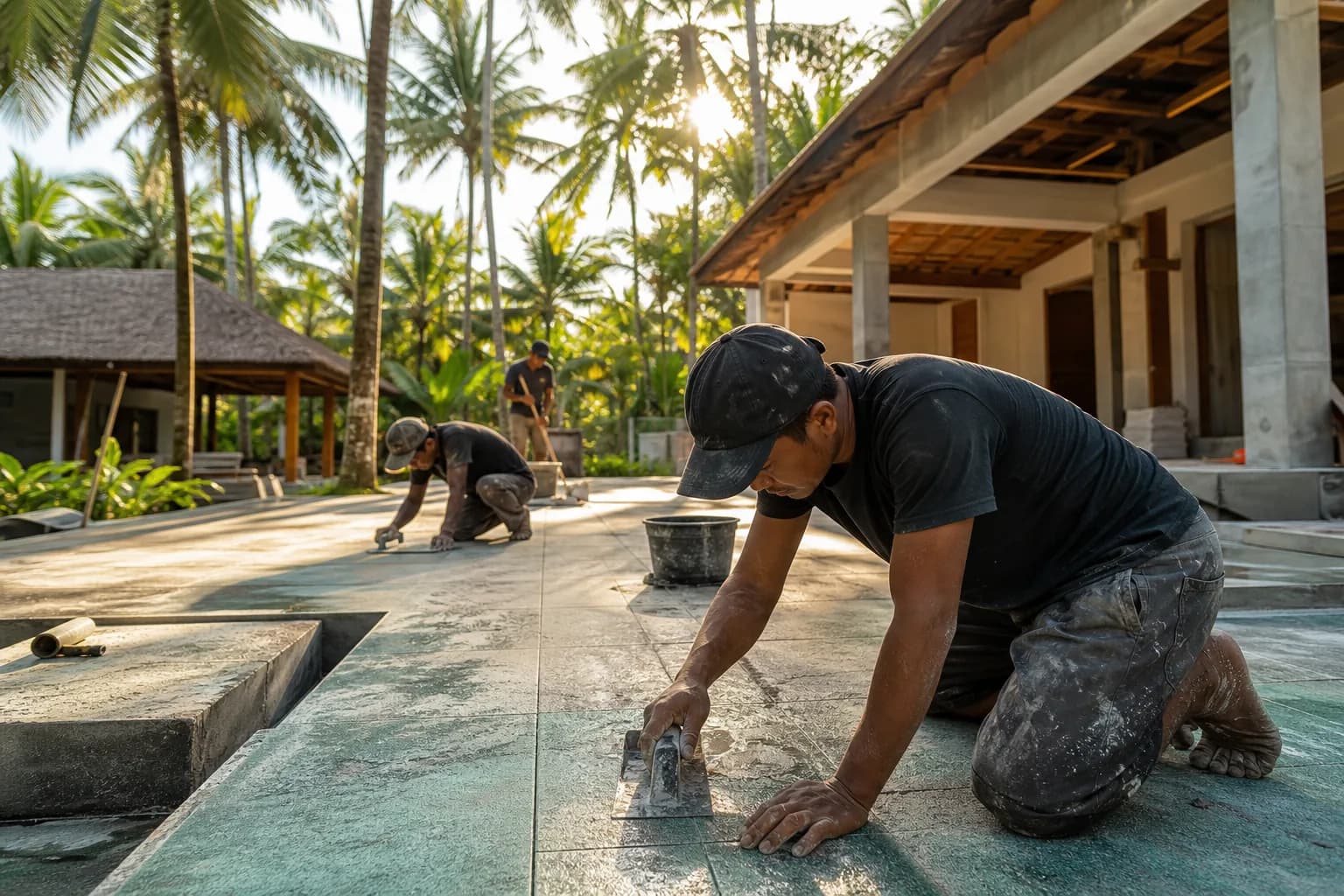
# Grout Joint Width Standards: Pool Deck Tile Installation Bali
The Critical Gap: Why Pool Deck Grout Width Determines Longevity in Bali’s Climate
Pool deck tile installations in Bali face a unique challenge that mainland construction rarely encounters: the combination of intense tropical heat, monsoon moisture, and constant pool chemical exposure creates expansion and contraction cycles that can crack improperly grouted tiles within months. The grout joint width—that seemingly minor gap between tiles—becomes the difference between a pool deck that lasts decades and one requiring expensive repairs within two years. Many villa owners discover too late that their contractor used mainland standards of 1/8″ joints on natural stone, only to watch grout crack and tiles lift during the first rainy season. Understanding proper grout joint width standards for Bali’s specific conditions isn’t just technical detail—it’s essential protection for your investment in villa construction and renovation Bali projects.
Technical Deep Dive: Grout Joint Engineering for Tropical Pool Environments
Grout joint width in pool deck installations serves three critical engineering functions that become amplified in Bali’s tropical environment. First, joints accommodate thermal expansion as tiles heat to 60°C under direct sun and cool to 25°C during evening rains—a 35-degree differential that occurs daily. Second, they compensate for dimensional variations in handmade or natural stone tiles common in Bali villa construction. Third, they create flexible zones that absorb substrate movement from ground settling and moisture fluctuation in Bali’s volcanic soil composition.
The standard 1/8″ to 1/4″ joint recommendation from temperate climates requires significant modification for Bali applications. For ceramic and porcelain tiles in the 300x300mm to 600x600mm range, we specify minimum 3mm (approximately 1/8″) joints, but increase this to 5mm (3/16″) for pool deck perimeters where sun exposure is most intense. Natural stone tiles—particularly the popular Batu Candi, Batu Palimanan, and travertine used in luxury villa projects—require 6mm to 8mm (1/4″ to 5/16″) joints due to their inherent dimensional irregularities and higher porosity that increases moisture absorption.
The substrate preparation directly impacts optimal joint width. Pool decks built on properly compacted aggregate base with reinforced concrete slabs can accommodate narrower joints. However, many Bali properties sit on expansive clay soils that swell during monsoon season. For these conditions, we increase joint width by 2mm across all tile types and incorporate expansion joints every 3-4 meters in both directions—a specification often overlooked in standard interior finishing Bali work but critical for exterior applications.
Grout material selection interacts with joint width in ways that affect long-term performance. Epoxy grouts, while more expensive, perform exceptionally well in Bali’s pool environments with joints as narrow as 3mm, providing superior chemical resistance and flexibility. Standard cement-based grouts require minimum 4mm joints for proper filling and compaction, while polymer-modified grouts offer middle-ground performance with 3-5mm joints. The wider the joint, the more critical proper grout consolidation becomes—joints over 6mm require multiple passes with a grout float to eliminate voids that become water infiltration points.
Color stability in tropical UV exposure also factors into joint width decisions. Darker grout colors fade more rapidly in Bali’s intense sunlight, and this fading becomes more visually prominent in wider joints. For aesthetic longevity, we recommend light gray or beige grouts in joints wider than 6mm, reserving darker colors for narrower joints where the reduced surface area minimizes UV degradation. This consideration becomes particularly important in villa projects where visual consistency matters for years, not just months.
The interaction between grout joint width and pool water chemistry creates another layer of complexity. Saltwater pools, increasingly popular in Bali villas, accelerate grout deterioration through salt crystallization cycles. Wider joints (6-8mm) with epoxy or high-polymer grouts provide better long-term resistance than narrow joints with standard cement grouts. Chlorinated pools require similar considerations, as chlorine penetration through narrow joints can reach the tile adhesive layer, causing bond failure from beneath—a failure mode we’ve documented in multiple renovation Bali projects where original installations used inadequate joint widths.
Materials and Standards for Bali Pool Deck Applications
Material specifications for pool deck grout joints must account for Bali’s unique environmental stressors. We specify polymer-modified cement grouts as minimum standard, with brands like Mapei Keracolor or Laticrete PermaColor providing adequate performance in 4-6mm joints. For premium installations, epoxy grouts such as Mapei Kerapoxy or Laticrete SpectraLOCK deliver superior chemical resistance and color stability, though they require experienced applicators due to their rapid set time in tropical heat.
Tile selection directly influences achievable joint width standards. Rectified porcelain tiles—machine-cut to precise dimensions—can utilize 3mm joints when properly installed. Non-rectified ceramic tiles require minimum 4mm joints to accommodate size variations. Natural stone tiles present the greatest variability: tumbled travertine may require 8-10mm joints, while honed limestone can work with 6mm joints. The popular Batu Candi stone used extensively in Bali villa construction typically requires 6-8mm joints due to its hand-cut nature and surface texture variations.
Substrate materials establish the foundation for joint width performance. We specify minimum 100mm reinforced concrete slabs for pool decks, with 150mm thickness for areas supporting heavy furniture or planters. The concrete mix must include waterproofing admixtures and achieve minimum 25 MPa compressive strength. Over this, a polymer-modified thin-set adhesive rated for exterior wet applications provides the tile bond, with notch trowel size selected based on tile size—8mm notches for tiles up to 400mm, 10mm for larger formats.
Quality standards for interior finishing Bali work extend to pool deck installations with specific additions. Joint width consistency must remain within ±0.5mm across the entire installation. Grout fill must reach minimum 2/3 tile thickness, with complete void elimination verified through test sections. Surface lippage—vertical displacement between adjacent tiles—cannot exceed 1mm for tiles under 400mm or 2mm for larger formats, as excessive lippage creates water pooling that accelerates grout deterioration.
Step-by-Step Pool Deck Tile Installation Process
The installation process for pool deck tiles with proper grout joint standards begins days before tile placement. Substrate preparation includes thorough cleaning, moisture testing (substrate must be below 5% moisture content), and application of waterproofing membrane extending 300mm beyond the pool coping. This membrane, often overlooked in rushed projects, prevents water migration from pool splashing and rain from compromising the tile bond—a critical consideration in Bali’s high-rainfall environment.
Layout planning determines joint width success before any tile is set. We establish reference lines from the pool edge, planning tile placement to minimize cuts and maintain consistent joint widths throughout. For natural stone installations common in luxury villa projects, we dry-lay tiles first, selecting and positioning each piece to optimize color flow and minimize joint width variations. This pre-planning phase typically requires 4-6 hours for a standard 50-square-meter pool deck but prevents costly corrections later.
Tile setting begins with mixing polymer-modified thin-set to manufacturer specifications—critical in Bali’s heat where improper water ratios cause premature setting. We apply adhesive in sections no larger than 1 square meter, using the appropriate notch trowel held at 45-degree angle to create uniform ridges. Each tile receives back-buttering—a thin adhesive layer on the tile reverse—ensuring 95% coverage minimum. Tile placement uses spacers sized to the specified joint width: 3mm spacers for rectified porcelain, 5mm for standard ceramic, 6-8mm for natural stone.
The spacer system requires careful attention in tropical installations. Standard plastic spacers can deform in Bali’s heat, so we use heat-resistant nylon spacers or the newer wedge-and-clip systems that maintain consistent pressure. For natural stone with irregular edges, we sometimes use temporary wooden spacers custom-cut to the specified width, removing them before grout application. The spacer pattern—cross or T-configuration—affects joint consistency, with cross patterns providing superior width control for renovation Bali projects where existing conditions may not be perfectly square.
Curing time before grouting becomes extended in Bali’s humidity. While mainland standards specify 24-hour curing, we require minimum 48 hours, and 72 hours for natural stone installations where moisture from the adhesive must fully evaporate. Premature grouting traps moisture, leading to efflorescence—white mineral deposits that permanently stain grout and stone. This patience in the construction process distinguishes quality installations from rushed work.
Grout application begins with thorough joint cleaning using compressed air and vacuum to remove all dust and debris. For joints wider than 6mm, we dampen the joint edges with clean water to prevent rapid moisture absorption from the grout. Grout mixing follows precise water ratios—typically 1.5-2 liters per 10kg bag for polymer-modified grouts—and we mix only quantities usable within 30 minutes given Bali’s accelerated set times. Application uses a rubber grout float held at 45-degree angle, working diagonally across tiles to pack grout firmly into joints.
The grouting technique varies by joint width. Narrow joints (3-4mm) require single-pass application with immediate cleanup. Medium joints (5-6mm) benefit from two passes: initial filling, 10-minute wait, then final packing. Wide joints (7-8mm and above) require three passes with intermediate compaction to eliminate voids. Each pass must achieve full depth penetration—we verify this by checking grout depth with a thin wire probe in test joints before proceeding across the entire deck.
Cleanup timing proves critical in tropical heat. Initial sponge cleaning begins when grout reaches thumbprint-firm consistency—typically 15-20 minutes after application in Bali conditions, versus 30-45 minutes in temperate climates. We use barely damp sponges in circular motions, rinsing frequently, removing grout haze without pulling material from joints. Final haze removal occurs after 2-4 hours using clean, dry microfiber cloths. For natural stone, we apply penetrating sealers 7 days after grouting, protecting both stone and grout from Bali’s intense UV and moisture exposure.
Cost Analysis and Project Timeline for Bali Pool Deck Installations
Pool deck tile installation costs in Bali vary significantly based on tile type, grout joint specifications, and quality standards. For a standard 50-square-meter pool deck using mid-range ceramic tiles with 4-5mm grout joints, material costs range from Rp 2,500,000 to Rp 4,000,000 (tiles, adhesive, grout, sealers). Labor costs for experienced installers capable of maintaining consistent joint widths add Rp 3,000,000 to Rp 5,000,000. Premium natural stone installations with wider joints (6-8mm) and epoxy grouts increase total costs to Rp 12,000,000 to Rp 18,000,000 for the same area, reflecting both material premiums and the specialized skills required.
The cost differential between standard and proper joint width specifications often surprises villa owners. Using appropriate 6mm joints with polymer-modified grout versus rushed 3mm joints with basic cement grout adds approximately 15-20% to material costs but extends service life from 3-5 years to 15-20 years—a compelling value proposition for Bali villa construction projects. Epoxy grout systems add another 40-50% to grout material costs but eliminate the need for regrouting, making them cost-effective for high-end installations.
Timeline planning must account for Bali’s climate and proper curing requirements. A typical 50-square-meter pool deck installation spans 8-12 working days: 2 days substrate preparation and waterproofing, 1 day layout and planning, 3-4 days tile setting (accounting for section-by-section work and curing), 2-3 days for adhesive curing, 1 day grouting, and 1 day final cleaning and sealing. Rushing this timeline—particularly the curing phases—compromises joint performance and leads to premature failure requiring costly renovation Bali interventions.
Seasonal timing affects both cost and quality outcomes. Dry season installations (April-October) proceed more smoothly, with predictable curing times and minimal weather delays. Wet season work (November-March) requires weather protection measures, extended curing times, and careful moisture management, potentially adding 20-30% to project duration. For detailed cost estimation specific to your project requirements, Teville provides comprehensive assessments through our cost estimation service, accounting for site-specific conditions and material selections.
Frequently Asked Questions: Pool Deck Grout Joint Standards
What grout joint width should I use for natural stone pool decks in Bali?
Natural stone pool decks in Bali require 6-8mm (1/4″ to 5/16″) grout joints as minimum standard. This width accommodates the dimensional variations inherent in hand-cut stone, provides adequate space for proper grout consolidation, and allows thermal expansion in Bali’s intense heat cycles. Tumbled or heavily textured stones may require up to 10mm joints. Using narrower joints with natural stone leads to lippage issues, incomplete grout filling, and premature cracking—problems we frequently encounter in renovation Bali projects correcting substandard original installations.
Can I use 2mm joints for rectified porcelain tiles around my pool?
 3127 m²9 month(s)from 177.000 USD
Mukunda
 3180 m²7 month(s)from 142.000 USD
Vasudeva
 172 m²8 month(s)from 120.000 USD
Keshava

Want to calculate?
 3104 m²11 month(s)from 99.000 USD
TALA 100
 2144 m²11 month(s)from 104.000 USD
Narayana
 164 m²7 month(s)from 79.000 USD
Private: Haridas Villas, Tegallalang
 3173 m²6 month(s)from 125.000 USD
TALA FOUR
 1from 198.000 USD
Private: Haridas Villas
 4344 m²16 month(s)from 290.000 USD
Radha
 3124 m²6 month(s)from 123.000 USD
TALA 8
164 m²7 month(s)from 79.000 USDTALA TWO
Start With Real Numbers, Not Guesses
Before finalizing your finishing works plan, check realistic cost ranges for your Bali villa project.
Available lands
 2700 m²30 min$ 314224Bali, Sidemen
 2000 m²10 min$ 243842Bali, Mengwi
 550 m²15 min$ 164594Bali, Mengwi
 260 m²5 min$ 51872Bali, Kedungu
 5815 m²5 min$ 815740Bali, Tabanan
 422 m²15 min$ 93547Bali, Kerobokan
 250 m²15 min$ 40025Bali, Munggu
 3700 m²15 min$ 738177Bali, Tabanan
 800 m²10 min$ 307882Bali, Tibubeneng
 1375 m²10 min$ 447044Bali, Canggu
 1660 m²10 min$ 343448Bali, Kerobokan
 1000 m²10 min$ 123154Bali, Jimbaran
 500 m²10 min$ 107143Bali, Tabanan
 420 m²15 min$ 41897Bali, Tabanan
 1200 m²2 min$ 155172Bali, Klungkung
Essential Bali build & buy guides
- Bali villa construction cost per m² in 2026
- How much will your villa cost? Calculator
- Building a villa in Bali: the complete guide
- Buying land in Bali: step-by-step for foreigners
- Bali villa investment: yields, risks, returns
- Leasehold vs freehold: what foreigners can own
- Construction defect liability & 10-year warranty
- Bali building codes and construction standards
Related guides
Sanur and Nusa Dua vs Canggu: Stability Plays vs Hype
Canggu gets the headlines; Sanur and Nusa Dua quietly deliver steadier returns to a different kind of buyer. An honest 2026 comparison of the stability markets against the hype market — prices, demand drivers, oversupply risk, and who should buy where.
7 min read
Ubud and the Wellness Market: Buying or Building for Retreats
Ubud is Bali's wellness capital, and retreat-focused property behaves differently from beach villas: longer stays, group bookings, lower volatility. Here is what the market rewards, what zoning allows, and what it costs to buy or build a retreat property in 2026.
8 min read
Buying and Building on the Bukit: Uluwatu, Bingin and Balangan from a Buyer's Seat
A buyer's-seat 2026 guide to the Bukit peninsula — Uluwatu, Bingin and Balangan land prices, the water problem nobody budgets, cliff setbacks after the 2025 Bingin demolitions, and how to build there properly.
7 min read