Grounding Electrode Systems for Bali Villa Electrical Safety
# Grounding Electrode Systems for Bali Villa Electrical Safety Code
The Hidden Foundation of Villa Electrical Safety
When renovating or constructing a villa in Bali, the grounding electrode system represents one of the most critical yet frequently overlooked electrical safety components. This underground network of conductive materials protects occupants from electrical faults, lightning strikes, and equipment damage—challenges particularly acute in Bali’s tropical environment with its high humidity, volcanic soil composition, and frequent electrical storms during monsoon season. A properly installed grounding electrode system isn’t merely a regulatory checkbox; it’s the invisible safety net that prevents potentially fatal electrical shocks and protects expensive villa equipment from voltage surges. For villa owners undertaking renovation Bali projects or new Bali villa construction, understanding the technical requirements and installation standards for grounding systems ensures both compliance with Indonesian electrical codes and long-term occupant safety in this unique tropical climate.
Technical Requirements for Bali Villa Grounding Systems
The grounding electrode system forms the critical connection between your villa’s electrical installation and the earth itself, providing a low-resistance path for fault currents and lightning discharge. In Bali’s specific geological and climatic conditions, this system must address unique challenges that differ significantly from temperate climate installations.
Fundamental Grounding Principles for Tropical Installations
A grounding electrode system consists of conductive materials buried in the earth that establish electrical contact with the ground mass. For Bali villa construction, the system must achieve a ground resistance typically below 5 ohms for residential installations, though lower values (1-3 ohms) are preferable for villas with sensitive electronic equipment, home automation systems, or medical devices. Bali’s volcanic soil composition presents both advantages and challenges—the mineral-rich soil can provide excellent conductivity when moist, but the same soil becomes highly resistive during dry season, creating seasonal resistance variations that must be engineered around.
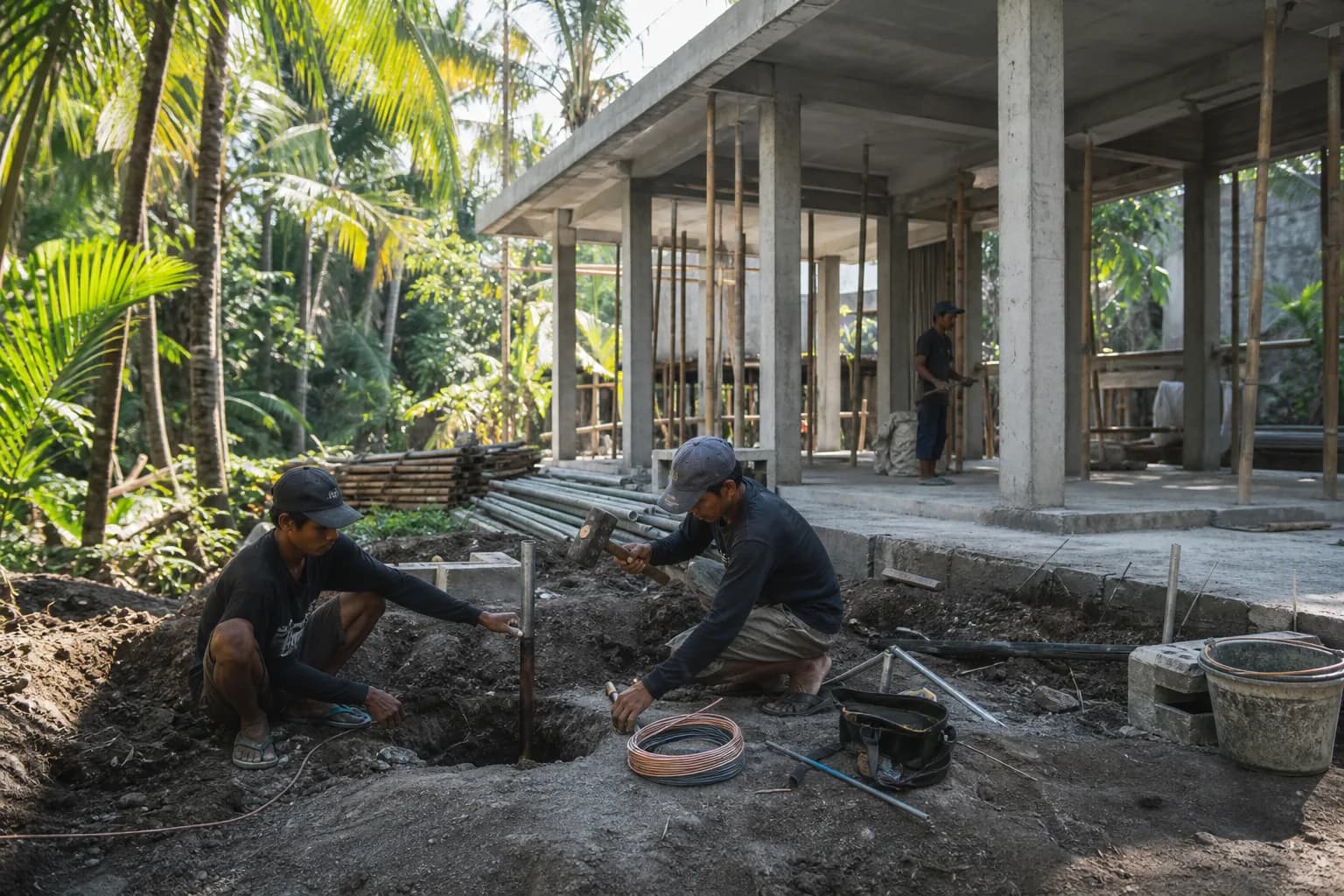
The primary grounding electrode typically consists of copper-clad steel rods driven vertically into the earth, with minimum dimensions of 16mm diameter and 2.4-3 meters length. However, Bali’s shallow bedrock in certain areas (particularly in Uluwatu, Pecatu, and parts of Canggu) may require horizontal electrode configurations or chemical enhancement of the surrounding soil. The electrode material selection is critical—pure copper offers superior conductivity and corrosion resistance in Bali’s saline coastal air, while copper-clad steel provides adequate performance at lower cost for inland locations.
Multi-Point Grounding Architecture
Modern villa electrical systems require multiple grounding points integrated into a unified system. The main grounding electrode connects to the electrical service entrance, but additional electrodes should be installed at equipment concentrations—outdoor kitchen areas, pool equipment rooms, generator installations, and air conditioning compressor banks. These supplementary electrodes connect via bare copper conductors (minimum 25mm² for main runs, 16mm² for branches) buried at least 600mm deep to prevent corrosion from surface moisture and landscaping activities.
For multi-story villas common in renovation Bali projects, the grounding system must integrate with the building’s structural steel or concrete reinforcement through exothermic welding connections. This creates a “Ufer ground” that leverages the building’s foundation as an additional grounding electrode—particularly effective in Bali where concrete remains in constant contact with moist soil. The connection points must be accessible for testing and maintenance, typically through inspection chambers positioned in garden areas or utility spaces.
Lightning Protection Integration
Bali experiences significant lightning activity, particularly during the November-March wet season. The grounding electrode system must integrate with lightning protection systems (LPS) for comprehensive villa safety. Lightning down conductors require dedicated grounding electrodes positioned at least 2 meters from the main electrical grounding to prevent dangerous voltage gradients during lightning strikes. However, all grounding systems must be bonded together at a single point to prevent potential differences between systems—a critical safety requirement often misunderstood in local installations.
The lightning grounding electrodes typically require lower resistance values (below 10 ohms) and may necessitate enhanced grounding techniques in rocky terrain. Chemical grounding rods filled with hygroscopic salts maintain consistent low resistance regardless of seasonal soil moisture variations—an essential feature for Bali’s dramatic wet-dry seasonal transitions.
Materials and Standards for Tropical Grounding Systems
Material selection for grounding electrode systems in Bali must account for accelerated corrosion from high humidity, salt air in coastal areas, and aggressive soil chemistry from volcanic minerals. Indonesian electrical standards (PUIL 2011 – Persyaratan Umum Instalasi Listrik) provide the regulatory framework, but international best practices from IEC 60364 standards offer additional guidance for premium villa installations.
Electrode Materials and Specifications
Copper-clad steel grounding rods represent the standard choice, with minimum copper thickness of 254 microns to ensure 30+ year service life in Bali’s conditions. Pure copper rods (16-20mm diameter) offer superior performance for high-end installations, particularly in coastal villas where salt air accelerates corrosion. Stainless steel electrodes provide excellent corrosion resistance but require larger diameters (20-25mm) to achieve equivalent conductivity.
Grounding conductors must be bare copper (not insulated) for direct earth contact, with tinned copper specified for coastal installations to resist corrosion. All above-ground connections use tinned copper lugs with stainless steel hardware, protected by waterproof junction boxes rated IP65 minimum. Exothermic welding (Cadweld or equivalent) creates permanent, low-resistance connections between conductors and electrodes—vastly superior to mechanical clamps that corrode and loosen in tropical conditions.
Enhancement Materials for Difficult Soil
Rocky or sandy soil conditions common in parts of Bali require ground enhancement materials. Bentonite clay mixed with the backfill around electrodes retains moisture and improves conductivity. Chemical grounding rods containing hygroscopic salts (magnesium sulfate, copper sulfate) gradually leach into surrounding soil, permanently reducing resistance. For large villa installations, conductive concrete (mixed with carbon or metallic additives) can be poured around electrode arrays to create low-resistance zones.
Step-by-Step Installation Process for Villa Grounding Systems
Professional grounding electrode installation for Bali villa construction follows a systematic process that ensures both immediate compliance and long-term reliability. This process typically occurs during the early construction phase, before concrete pours and landscaping, though retrofit installations during renovation Bali projects are certainly feasible with proper planning.
Phase 1: Site Assessment and System Design
The installation begins with soil resistivity testing using a four-point Wenner method or similar technique. Testing at multiple locations across the villa site identifies optimal electrode placement—typically targeting areas with naturally lower resistance. For Bali properties, testing should occur during dry season to establish worst-case resistance values. The assessment also identifies underground utilities, irrigation systems, and septic installations that must be avoided during electrode installation. Based on testing results, the electrical engineer designs the grounding system layout, specifying electrode quantity, configuration (vertical, horizontal, or combined), and conductor routing. This design phase typically requires 2-3 days for standard villa sites, longer for complex hillside or beachfront properties.
Phase 2: Excavation and Electrode Installation
Excavation for grounding electrodes begins with marking locations per the approved design. Vertical electrodes require driving rods to specified depth (typically 2.4-3 meters) using a pneumatic or hydraulic driver—manual driving risks rod damage and inadequate depth. In rocky soil, pre-drilling with a slightly smaller diameter creates a pilot hole, backfilled with bentonite slurry before rod installation. Horizontal electrodes (used where vertical installation is impractical) require trenches minimum 600mm deep, with bare copper conductors laid in direct contact with undisturbed soil. The trench bottom should be free of rocks that could damage the conductor. For chemical grounding rods, the installation includes a vertical PVC pipe that allows periodic recharging of the chemical compound—essential for maintaining low resistance over decades.
Phase 3: Conductor Installation and Bonding
Bare copper conductors connect all electrodes to form an integrated system, with exothermic welding at all underground connections. The main grounding conductor routes to the electrical service entrance, typically through PVC conduit where it transitions above ground. All metallic building systems—structural steel, reinforcing bars, metal water pipes, HVAC equipment, pool systems—connect to the grounding system through bonding conductors. This equipotential bonding prevents dangerous voltage differences between conductive surfaces during fault conditions. Bonding connections use listed compression lugs or exothermic welds, never solder (which fails in high-current fault conditions). Each major system (pool, generator, solar array) requires dedicated bonding conductors sized per electrical code—typically 16-25mm² depending on the protected circuit size.
Phase 4: Testing and Documentation
Before backfilling trenches, the complete grounding system undergoes resistance testing using a calibrated ground resistance tester. The measurement technique (fall-of-potential or clamp-on method) must account for Bali’s soil conditions and nearby grounding systems that could affect readings. Acceptable resistance values (typically <5 ohms for residential, <3 ohms for sensitive equipment) must be achieved before proceeding. If resistance exceeds specifications, additional electrodes are installed or enhancement materials applied until compliance is achieved. All test results, electrode locations, and conductor routing are documented in as-built drawings—critical information for future maintenance or system modifications. This documentation should be provided to the villa owner and retained by the electrical contractor.
Phase 5: Backfilling and Protection
Approved systems are backfilled with excavated soil, avoiding rocks or debris that could damage conductors. In enhanced grounding installations, specialized backfill (bentonite clay mixture or conductive concrete) surrounds the electrodes before native soil backfill. Conductor routes are marked with warning tape 300mm above the buried conductors to prevent accidental damage during future excavation. Above-ground portions of the grounding system receive physical protection—PVC conduit for conductors, lockable enclosures for test points and bonding connections. All grounding system components are labeled per electrical code requirements, identifying them as part of the safety grounding system.
Cost Considerations and Installation Timeline
Grounding electrode system costs for Bali villa construction vary significantly based on site conditions, villa size, and system complexity. Understanding these cost factors helps villa owners budget appropriately for this essential safety system.
Material and Labor Cost Breakdown
A basic grounding system for a standard 3-bedroom villa (200-300m²) typically requires 15-25 million IDR for materials and installation, including 4-6 copper-clad grounding rods, 50-80 meters of bare copper conductor, exothermic welding supplies, and testing. Enhanced systems for larger villas or difficult soil conditions may reach 35-50 million IDR, incorporating additional electrodes, chemical grounding rods, or conductive concrete enhancement. Coastal villas requiring marine-grade materials (tinned copper, stainless steel hardware) add 20-30% to material costs. Labor represents approximately 40% of total cost, with experienced electrical contractors charging 8-12 million IDR for installation and testing of standard systems. The investment in professional installation pays dividends in system reliability and compliance—amateur installations frequently fail resistance testing and require costly remediation.
Installation Timeline
Grounding electrode installation for new Bali villa construction typically requires 3-5 working days from site assessment through final testing. The timeline breaks down as: soil testing and system design (1 day), electrode installation and conductor routing (1-2 days), bonding connections and system integration (1 day), testing and documentation (0.5-1 day). Difficult site conditions (rocky soil, limited access, complex villa layouts) may extend the timeline to 7-10 days. For renovation Bali projects requiring retrofit grounding systems, the timeline extends to 5-8 days due to the need to work around existing structures, landscaping, and occupied spaces. Weather significantly impacts scheduling—excavation and concrete work should avoid heavy rain periods, though light rain doesn’t typically delay electrode driving or conductor installation.
Frequently Asked Questions About Villa Grounding Systems
How often should grounding systems be tested after installation?
Grounding electrode systems in Bali should undergo resistance testing annually, preferably during dry season when resistance values are highest. This testing identifies degradation from corrosion, soil changes, or connection failures before they compromise safety. Villas with lightning protection systems or sensitive electronic equipment benefit from semi-annual testing. After any lightning strike to
 3104 m²11 month(s)from 99.000 USD
TALA 100
 164 m²7 month(s)from 79.000 USD
TALA TWO
164 m²7 month(s)from 79.000 USDPrivate: Haridas Villas, Tegallalang
 3127 m²9 month(s)from 177.000 USD
Mukunda
 1from 198.000 USD
Private: Haridas Villas
 172 m²8 month(s)from 120.000 USD
Keshava
 3173 m²6 month(s)from 125.000 USD
TALA FOUR
 4344 m²16 month(s)from 290.000 USD
Radha
 3124 m²6 month(s)from 123.000 USD
TALA 8
 2144 m²11 month(s)from 104.000 USD
Narayana
 3180 m²7 month(s)from 142.000 USD
Vasudeva

Want to calculate?
Start With Real Numbers, Not Guesses
Before finalizing your finishing works plan, check realistic cost ranges for your Bali villa project.
Available lands
 550 m²15 min$ 164594Bali, Mengwi
 2500 m²5 min$ 609606Bali, Kedungu
 2000 m²5 min$ 1440887Bali, Pecatu
 2800 m²2 min$ 713793Bali, Kedungu
 1000 m²10 min$ 384852Bali, Canggu
 1950 m²7 min$ 150092Bali, Tabanan
 8313 m²15 min$ 716670Bali, Buduk
 1362 m²15 min$ 335468Bali, Tumbak
 1375 m²10 min$ 447044Bali, Canggu
 2680 m²10 min$ 1732759Bali, Pererenan
 1100 m²8 min$ 280419Bali, Ungasan
 3254 m²5 min$ 631800Bali, All
 960 m²15 min$ 91034Bali, Mengwi
 1200 m²2 min$ 155172Bali, Klungkung
 400 m²15 min$ 67192Bali, Tabanan
Essential Bali build & buy guides
- Bali villa construction cost per m² in 2026
- How much will your villa cost? Calculator
- Building a villa in Bali: the complete guide
- Buying land in Bali: step-by-step for foreigners
- Bali villa investment: yields, risks, returns
- Leasehold vs freehold: what foreigners can own
- Construction defect liability & 10-year warranty
- Bali building codes and construction standards
Related guides
Resin-Infused Plaster Finishes: Anti-Salt Systems Bali
Expert technical guide: Resin-Infused Plaster Finishes: Anti-Salt Systems Bali
8 min read
Prefinished Timber Joinery: Silicone Seals Fixings Bali
Professional prefinished timber joinery installation in Bali with silicone seals and fixings for durable weatherproof performance and a premium finish.
10 min read
Polished Concrete Microtopping: Surface Prep Sealants Bali
Discover Bali s polished concrete microtopping: expert surface prep, durable sealants, and a flawless finish for modern floors with minimal maintenance.
9 min read