Epoxy Resin Flooring Installation for Bali Villa Wet Rooms
# Epoxy Resin Flooring Installation for Bali Villa Wet Rooms
The Critical Challenge of Wet Room Flooring in Bali’s Tropical Climate
Bali villa wet rooms face unique challenges that standard flooring solutions simply cannot address. The combination of constant moisture exposure, high humidity levels averaging 75-85%, and temperature fluctuations creates an environment where traditional tile grout deteriorates, concrete surfaces develop efflorescence, and water penetration leads to structural damage. Epoxy resin flooring has emerged as the superior solution for Bali villa construction projects, offering a seamless, impermeable barrier that withstands tropical conditions while delivering exceptional aesthetic appeal. The installation process, however, requires precise technical execution and understanding of substrate preparation specific to Bali’s climate conditions.
Technical Properties of Epoxy Resin Systems for Tropical Wet Environments
Epoxy resin flooring systems consist of two-part thermosetting resins that undergo a chemical curing process to form a rigid, adhesive surface. For interior finishing Bali wet room applications, understanding the material science is essential to achieving long-term performance. The epoxy matrix creates a cross-linked polymer structure with exceptional compressive strength exceeding 10,000 psi, significantly outperforming traditional cementitious finishes.
In Bali’s tropical environment, the impermeability of epoxy systems becomes critical. The cured resin forms a continuous membrane with water vapor transmission rates below 0.1 perms, effectively preventing moisture migration into the concrete substrate. This characteristic addresses the primary failure mode of wet room floors in humid climates—subsurface moisture accumulation that leads to delamination and biological growth.
The chemical resistance of epoxy coatings provides protection against the acidic conditions common in Bali’s groundwater and the alkaline cleaning agents used in villa maintenance. Unlike polyurethane alternatives, epoxy maintains its bond strength and surface integrity when exposed to pH ranges from 2 to 12, making it ideal for shower areas, spa rooms, and outdoor wet zones where chemical exposure varies.
Thermal stability represents another crucial performance factor. Quality epoxy systems maintain structural integrity across temperature ranges from 5°C to 60°C, accommodating the thermal cycling that occurs in Bali villa wet rooms between air-conditioned interiors and sun-exposed outdoor shower areas. The coefficient of thermal expansion closely matches concrete substrates, minimizing stress at the bond interface that could cause cracking or delamination.
For renovation Bali projects, epoxy’s self-leveling properties enable installation over existing concrete surfaces with minor imperfections, reducing substrate preparation costs while achieving a perfectly flat finish. The material’s low viscosity during application allows it to penetrate surface pores, creating mechanical interlocking that enhances adhesion beyond simple surface bonding.
Aesthetic versatility distinguishes epoxy from utilitarian coating systems. Metallic epoxy formulations incorporate aluminum or mica pigments that create three-dimensional visual effects resembling natural stone, flowing water, or custom artistic patterns. Clear epoxy topcoats provide UV stability and gloss retention, maintaining the visual appeal critical to luxury villa environments. The seamless nature eliminates grout lines that trap moisture and harbor bacteria, contributing to both hygiene and visual continuity in wet room design.
Material Selection and Quality Standards for Bali Applications
Selecting appropriate epoxy formulations for Bali villa wet rooms requires understanding the specific performance requirements of tropical construction. Not all epoxy systems perform equally in high-humidity, high-temperature environments. Commercial-grade epoxy coatings designed for industrial applications often lack the aesthetic refinement required for luxury villa interior finishing Bali projects, while decorative systems may compromise on chemical resistance or mechanical durability.
The base resin should be 100% solids epoxy rather than water-based or solvent-based formulations. Solvent-based systems introduce volatile organic compounds that off-gas slowly in humid conditions, creating odor issues and potential health concerns. Water-based epoxies, while environmentally friendly, exhibit reduced chemical resistance and lower film build, making them unsuitable for continuous water exposure in shower floors and wet room applications.
Hardener selection impacts cure characteristics and final performance. Cycloaliphatic amine hardeners provide superior color stability and UV resistance compared to aliphatic polyamines, essential for wet rooms with natural lighting or outdoor exposure. The mixing ratio must be precisely controlled—typically 2:1 or 3:1 by volume—as deviations affect cure time, final hardness, and chemical resistance.
For metallic epoxy installations, pigment quality determines longevity and visual impact. Aluminum-based metallic powders offer brilliant reflectivity but may oxidize over time in moisture-rich environments. Mica-based alternatives provide more stable coloration with slightly reduced metallic intensity. Pigment loading typically ranges from 3-8% by weight, with higher concentrations producing more dramatic visual effects but potentially compromising mechanical properties.
Primer selection depends on substrate conditions. For new concrete with moisture content below 4%, a penetrating epoxy primer creates the necessary bond. Older concrete or surfaces with previous coatings may require specialized primers with enhanced adhesion promoters. In Bali’s high-humidity environment, moisture-tolerant primers containing isocyanate functional groups enable application on substrates with up to 8% moisture content, expanding installation windows during the wet season.
Topcoat specifications should include UV inhibitors and HALS (Hindered Amine Light Stabilizers) to prevent yellowing and gloss loss in naturally lit spaces. Aliphatic polyurethane topcoats over epoxy base layers combine the adhesion and impermeability of epoxy with the superior UV resistance of polyurethane, creating a hybrid system optimized for Bali’s intense tropical sunlight.
Step-by-Step Installation Process for Wet Room Epoxy Flooring
Successful epoxy resin flooring installation in Bali villa wet rooms follows a systematic process that addresses tropical climate challenges at each stage. At Teville, our construction process emphasizes meticulous preparation and quality control to ensure long-term performance.
Phase 1: Substrate Assessment and Preparation
Begin with comprehensive substrate evaluation using a moisture meter to verify concrete moisture content below 4% for standard epoxies or 8% for moisture-tolerant systems. In Bali’s climate, concrete slabs require minimum 28-day curing before epoxy application, though 60-90 days provides optimal results. Test for surface contamination using water droplet tests—water should absorb within 30 seconds, indicating adequate porosity for primer penetration.
Mechanical preparation through diamond grinding or shot blasting creates the surface profile necessary for mechanical bonding. Target a CSP (Concrete Surface Profile) of 2-3 on the ICRI scale, providing sufficient texture without excessive roughness. Remove all laitance, curing compounds, and existing sealers that would prevent epoxy adhesion. Vacuum thoroughly to eliminate dust particles that could create defects in the finished surface.
Address any structural cracks or spalling before coating application. Inject epoxy crack fillers into active cracks, or rout and fill dormant cracks with flexible polyurethane sealants. Level significant depressions using epoxy mortar patching compounds, feathering edges to create smooth transitions. The substrate must achieve flatness within 3mm over 3 meters for self-leveling epoxy systems.
Phase 2: Environmental Control and Priming
Establish environmental conditions within specification ranges: ambient temperature 18-30°C, substrate temperature minimum 15°C, and relative humidity below 85%. In Bali villa construction, this often requires temporary climate control using dehumidifiers and fans, particularly during monsoon season. Substrate temperature must remain at least 3°C above dew point to prevent moisture condensation during application and cure.
Apply penetrating epoxy primer at coverage rates of 4-6 square meters per liter, depending on substrate porosity. Use roller application for uniform coverage, back-rolling to work primer into surface pores. On highly porous concrete, apply a second primer coat after the first achieves tack-free cure (typically 4-6 hours at 25°C). The primer creates a moisture barrier and provides the chemical bond for subsequent epoxy layers.
Phase 3: Base Coat Application
Mix epoxy base coat components using low-speed drill mixers (300-400 RPM) to minimize air entrainment. Combine resin and hardener in precise ratios, mixing for 3-5 minutes until completely homogeneous. For metallic epoxy systems, add metallic pigments to the mixed epoxy and blend thoroughly before application. Pot life typically ranges from 20-40 minutes at 25°C, requiring efficient work practices and appropriate batch sizing.
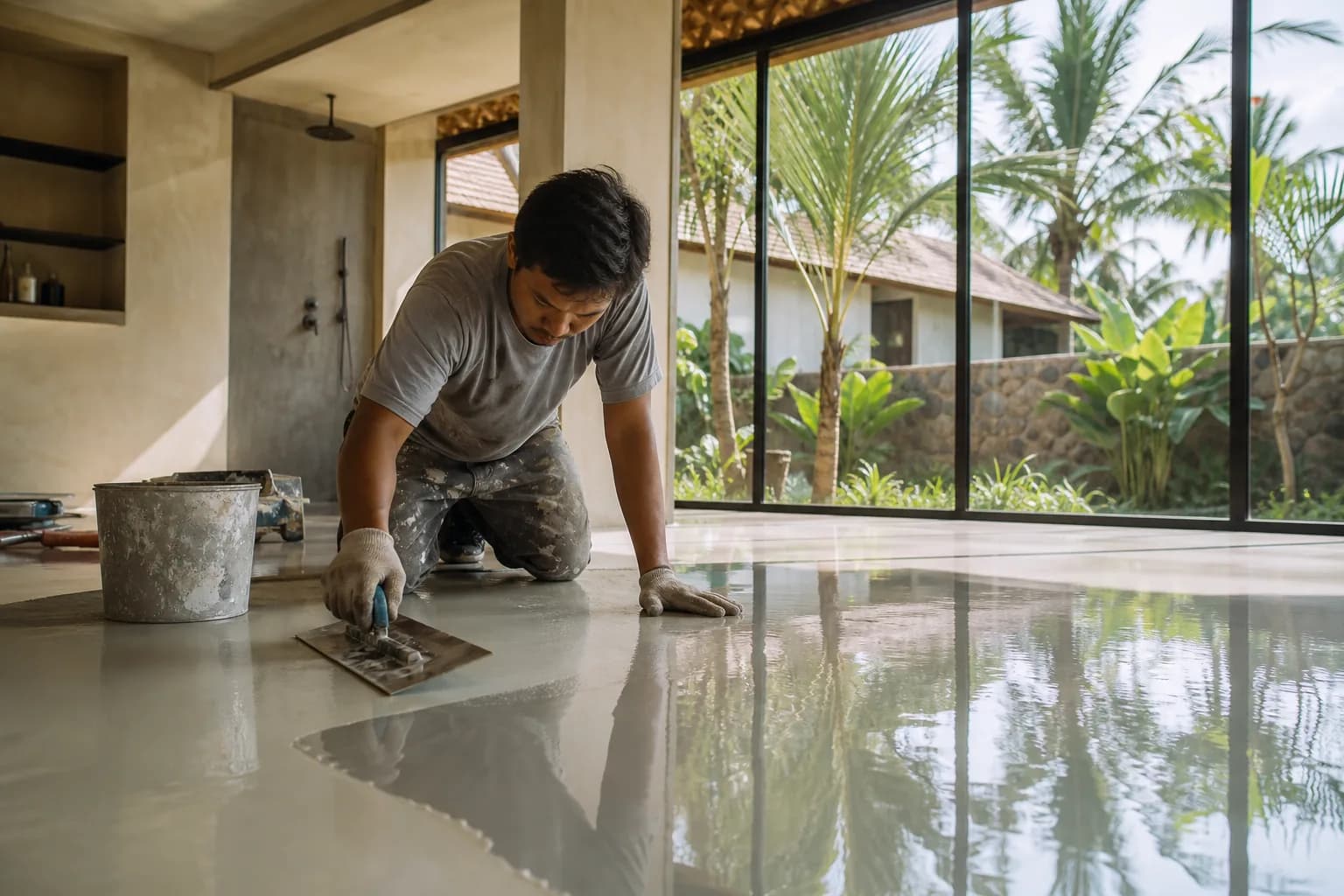
Pour mixed epoxy onto the prepared substrate in ribbon patterns, then spread using notched squeegees to achieve uniform thickness of 2-3mm. For metallic finishes, manipulate the wet epoxy using specialized tools, brushes, or air blowers to create desired visual effects. The material remains workable for 15-30 minutes, allowing time for artistic manipulation while maintaining proper film thickness. Overlap application areas while edges remain wet to prevent visible seams.
Phase 4: Topcoat and Finishing
After base coat cure (typically 16-24 hours at 25°C), lightly abrade the surface using 120-grit sandpaper to promote topcoat adhesion. Clean thoroughly to remove sanding residue. Apply clear epoxy or polyurethane topcoat in two layers, with the first coat at 100-150 microns and the second at 80-120 microns. The topcoat provides UV protection, enhances gloss, and creates the final wear surface. For wet room applications, incorporate anti-slip additives in the final coat to achieve slip resistance ratings of R10-R11, balancing safety with ease of cleaning.
Allow minimum 48-72 hours cure time before light foot traffic and 7 days before full water exposure. In Bali’s humid conditions, cure times may extend 20-30% beyond manufacturer specifications. Our villa projects demonstrate the exceptional finish quality achievable through proper installation protocols.
Cost Considerations and Project Timeline for Bali Villa Installations
Epoxy resin flooring installation costs for Bali villa wet rooms vary based on system complexity, surface preparation requirements, and project accessibility. Standard epoxy coating systems range from IDR 450,000-750,000 per square meter for basic solid-color applications. Metallic epoxy installations with custom artistic effects typically cost IDR 850,000-1,500,000 per square meter, reflecting the specialized materials and skilled labor required for premium finishes.
Surface preparation represents 30-40% of total project costs but determines long-term performance. Existing floor removal, concrete repair, and moisture mitigation add IDR 150,000-400,000 per square meter depending on substrate condition. For renovation Bali projects involving older villas, budget additional costs for addressing underlying moisture issues or structural repairs discovered during preparation.
Project timelines for typical wet room installations span 5-8 working days for spaces of 15-25 square meters. This includes 1-2 days for substrate preparation, 1 day for priming, 1-2 days for base coat application and manipulation, 1 day for topcoat application, and 2-3 days for curing before handover. Larger installations or complex metallic designs may extend to 10-12 days. Weather conditions significantly impact scheduling in Bali—plan installations during dry season months (April-October) when possible, or budget for temporary environmental control during wet season work.
Material costs account for approximately 40% of total project expense, with quality epoxy systems priced at IDR 180,000-350,000 per square meter of coverage. Labor and equipment represent the remaining 60%, reflecting the technical expertise required for proper installation. For accurate project budgeting specific to your villa requirements, Teville provides detailed cost estimation services that account for site-specific conditions and design preferences.
Frequently Asked Questions About Epoxy Wet Room Flooring
How long does epoxy flooring last in Bali’s humid climate?
Properly installed epoxy resin flooring in Bali villa wet rooms typically provides 10-15 years of service life with minimal maintenance. The key factors affecting longevity include substrate preparation quality, appropriate material selection for tropical conditions, and proper installation protocols. Unlike tile installations where grout deteriorates within 3-5 years requiring re-grouting, epoxy’s seamless nature eliminates this maintenance requirement. UV-stable topcoats prevent yellowing and gloss loss even in naturally lit wet rooms. Regular cleaning with pH-neutral detergents maintains appearance and performance throughout the service life.
Can epoxy flooring be installed during Bali’s rainy season?
Epoxy installation during monsoon season requires careful environmental control but remains feasible with proper precautions. Moisture-tolerant primer systems enable application on substrates with up to 8% moisture content, expanding installation windows. However, ambient humidity must remain below 85% during application and initial cure to prevent surface defects like blushing or poor adhesion. Temporary enclosures with dehumidification equipment create controlled environments for wet season installations. At Teville, we assess site-specific conditions and implement appropriate measures to ensure quality outcomes regardless of seasonal timing, though dry season installations remain optimal for Bali villa construction projects.
 172 m²8 month(s)from 120.000 USD
Keshava
 1from 198.000 USD
Private: Haridas Villas
 3124 m²6 month(s)from 123.000 USD
TALA 8
 3180 m²7 month(s)from 142.000 USD
Vasudeva
 4344 m²16 month(s)from 290.000 USD
Radha
 164 m²7 month(s)from 79.000 USD
Private: Haridas Villas, Tegallalang
 2144 m²11 month(s)from 104.000 USD
Narayana
 3104 m²11 month(s)from 99.000 USD
TALA 100
 3173 m²6 month(s)from 125.000 USD
TALA FOUR
 3127 m²9 month(s)from 177.000 USD
Mukunda
164 m²7 month(s)from 79.000 USDTALA TWO

Want to calculate?
Start With Real Numbers, Not Guesses
Before finalizing your finishing works plan, check realistic cost ranges for your Bali villa project.
Available lands
 7900 m²25 min$ 413485Bali, Tabanan
 5815 m²5 min$ 815740Bali, Tabanan
 500 m²10 min$ 107143Bali, Tabanan
 660 m²10 min$ 175567Bali, Mengwi
 3300 m²15 min$ 449889Bali, Tabanan
 1200 m²2 min$ 155172Bali, Klungkung
 2800 m²15 min$ 310345Bali, Tabanan
 29000 m²6 min$ 3857143Bali, Tabanan
 2400 m²7 min$ 496552Bali, Canggu
 911 m²15 min$ 248217Bali, Pererenan
 1000 m²8 min$ 134544Bali, Bukit
 1000 m²10 min$ 384852Bali, Canggu
 615 m²15 min$ 113608Bali, Tabanan
 700 m²20 min$ 90517Bali, Cepaka
 300 m²55 min$ 32475Bali, Tegelalang
Essential Bali build & buy guides
- Bali villa construction cost per m² in 2026
- How much will your villa cost? Calculator
- Building a villa in Bali: the complete guide
- Buying land in Bali: step-by-step for foreigners
- Bali villa investment: yields, risks, returns
- Leasehold vs freehold: what foreigners can own
- Construction defect liability & 10-year warranty
- Bali building codes and construction standards
Related guides
Resin-Infused Plaster Finishes: Anti-Salt Systems Bali
Expert technical guide: Resin-Infused Plaster Finishes: Anti-Salt Systems Bali
8 min read
Prefinished Timber Joinery: Silicone Seals Fixings Bali
Professional prefinished timber joinery installation in Bali with silicone seals and fixings for durable weatherproof performance and a premium finish.
10 min read
Polished Concrete Microtopping: Surface Prep Sealants Bali
Discover Bali s polished concrete microtopping: expert surface prep, durable sealants, and a flawless finish for modern floors with minimal maintenance.
9 min read