Concealed Low-Profile Cable Trunking EMI Shielding in Bali
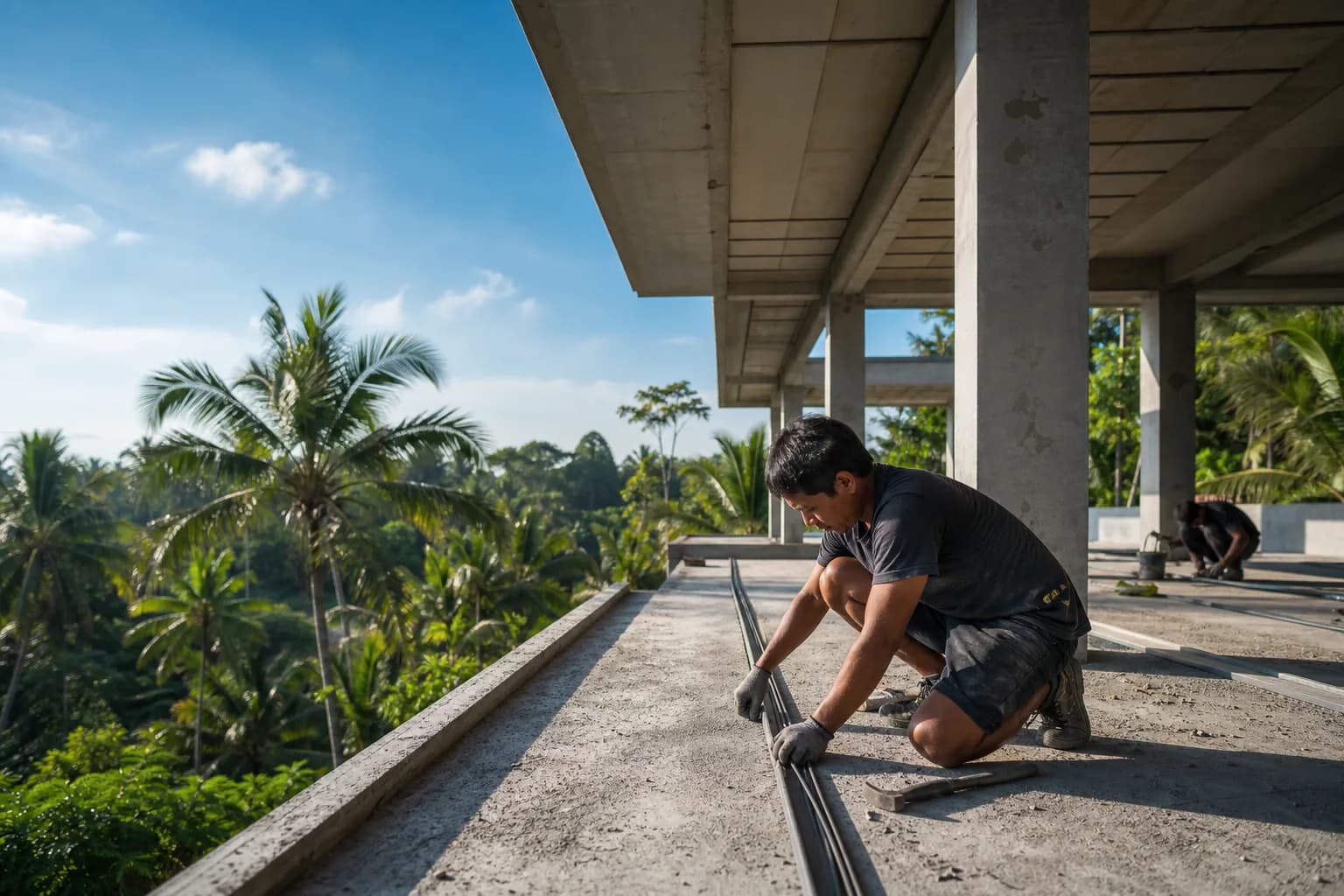
Concealed Low-Profile Cable Trunking & EMI Shielding in Bali Villas: Finishing-Grade Integration
Specific Problem/Question
How do you hide power and data cabling in a Bali villa so the interior remains pristine—while also preventing electromagnetic interference (EMI) from generators, solar inverters, pumps, and smart-home devices? In renovation Bali scenarios and new Bali villa construction alike, clients want clean lines, silent walls, and reliable networks. This guide explains how Teville integrates concealed low-profile cable trunking with professional EMI shielding—inside walls, skirtings, and furniture—so you get durable, serviceable, and moisture-resilient results that protect signal quality without compromising finishing.
Technical Deep Dive: What “Concealed Low-Profile + EMI Shielded” Means in Practice
Low-profile trunking is a slim cable raceway (often half-round or D-shaped) designed to disappear into finishing layers or furniture details. In interior finishing Bali projects, we recess these profiles into plaster, within gypsum partitions, under skirtings, or behind custom millwork. The goal: near-zero visual impact, controlled cable routing, and easy future access. Where EMI risks exist—adjacent to switchboards, lift motors, solar inverters, gensets, or dense AV racks—we add shielding to preserve signal integrity.
Key installation contexts in Bali villas:
- Skirting integration: The trunking is let into a shadow-gap skirting or purpose-made plinth channel. This keeps cables accessible while fully concealed, ideal for retrofits and furniture installation.
- Behind wall finishes: For renovation Bali work, we chase rendered walls lightly or use cavity spaces in gypsum partitions. We maintain cover depth and use finishing compounds compatible with humid, salt-air conditions.
- Furniture and joinery: Inside wardrobes, TV walls, headboards, and kitchen kickers we route low-profile raceways with removable access strips. This supports clean AV and data distribution without visible looms.
Fundamentals that protect finishing quality and network stability:
- Cable fill and bend radius: We keep trunking fill to about 40–60% and respect minimum bend radii for data and coax. Overfill causes heat and pull stress; tight bends degrade signal.
- Separation: Power and data require physical separation or a bonded metallic divider. For typical villas, we maintain 50–200 mm spacing where feasible; if not, a metal partition or entirely separate raceway is used.
- Shielding strategies: Options include using aluminum or steel trunking (bonded to earth), lining PVC trunking internally with conductive copper foil (with conductive adhesive), installing braided sleeves over sensitive runs, or adding conductive paints/fabrics behind equipment walls. All shields are continuous and bonded to the grounding system to be effective.
- Grounding and bonding: Shielding is only as good as the bond. We create a low-impedance path back to the main earthing bar, avoid ground loops, and verify continuity. Where practical, we tie into an isolated technical ground for AV/data as per the project’s electrical design.
- Moisture and salt air: Bali’s humidity and coastal exposure demand UV-stable, fungus-resistant materials; stainless fixings (A2/A4, 304/316 near the ocean); anti-corrosion practice for dissimilar metals; and sealants that tolerate thermal movement.
- Thermal expansion and adhesion: Low-profile PVC or aluminum expands; we allow movement joints and use MS polymer adhesives and stainless micro-screws rather than brittle glues. Finishing compounds are selected to avoid hairline cracking.
- Access and maintainability: Wherever electronics may be upgraded, we design removable skirting caps, magnet-held panels, or discreet screw-fixed covers. Blanked inspection points are color-matched to finishes.
EMI sources we routinely address in Bali villas include: gensets (especially during PLN outages), VFD-driven pool pumps, solar PV inverters and battery systems, long 230 V runs parallel to CAT6/7, Wi-Fi 6/6E access points near AV cabling, and metallic lift structures. Practical mitigations are route zoning, shielded raceways, star earthing, ferrite suppression on device ends, and careful termination practices. Our process is tuned to finishing-led work: do the dirty work once, then protect the finish for years.
Materials & Standards We Apply in Bali Conditions
Trunking and accessories:
- Low-profile PVC/uPVC trunking (half-round, D-shape, or open-slot) with UV-stable, halogen-free, low-smoke options for interior safety and durability.
- Aluminum or galvanized steel mini-trunking where shielding and impact resistance are required; factory gaskets for tightness when needed.
- Stainless (A2/A4) screws and clips; MS polymer adhesives; anti-fungal paint and sealants.
Shielding components:
- Copper foil tapes with conductive adhesive for lining non-metallic trunking and bonding joints.
- Braided copper sleeves, shielded transition glands, EMI gaskets for access covers.
- Conductive paints or fabrics behind AV walls if a larger shield plane is required.
- Dedicated earth bonding straps and bars; ferrite cores on equipment tails where appropriate.
Fire, safety, and performance references (applied as project-appropriate):
- PUIL (Indonesia electrical installation requirements) and relevant SNI references.
- IEC 60364 (LV installations, earthing and bonding best practice).
- IEC 61386 (conduit/trunking systems), IEC 60529 (IP ratings), UL94 V-0 and IEC 60754/61034 for low-smoke zero-halogen where specified.
- IEC 61000 series (EMC practices), EN 50174 and ISO/IEC 11801/TIA-568 for data cabling pathways and separation.
- ISO 12944 for corrosion categories; stainless 316 is preferred near beachfronts.
We design to these benchmarks while complying with local authority guidance. Teville’s specification balances finish quality, serviceability, and long-term resilience in tropical conditions.
Step-by-Step Process: Teville’s Finishing-Grade Method
- 1) Brief and audit: Understand client devices, AV/data loads, and sensitivity. Note genset, inverter, pool plant, and lift positions. Review architectural intent to preserve interior finishing Bali aesthetics.
- 2) Site survey and EMI scan: Map current and likely interference sources. Use handheld spectrum/EMI meters and cable testers. Record wall build-ups and moisture readings to choose fixings and sealants.
- 3) Route design and shop drawings: Define concealed zones: skirtings, gypsum cavities, headboards, wardrobes, and utility chases. Separate power/data routes or add metal partitions. Detail access points disguised in furniture lines.
- 4) Samples and mock-ups: Provide a 1–2 m mock-up of low-profile trunking with the planned finish (paint or veneer), plus a shielded section. Client signs off on visibility and access method.
- 5) Surface preparation: Mask finishes, set dust control. For renovations, pre-score render to prevent spall. Verify no reinforcement or services conflict in chase zones.
- 6) Chasing and cavity creation: Perform minimal-depth chases with dust extraction. In drywalls, open the cavity at stud bays; in furniture, route concealed channels with jigs for repeatability.
- 7) Trunking installation: Fix low-profile trunking using stainless micro-screws and MS polymer adhesive beads. Allow expansion gaps at joints. Keep cable fill ≤60% and plan gentle sweep bends.
- 8) Shielding application: For PVC raceways, line interior with copper foil; overlap and bond at seams; bring pigtails to earthing studs. For metal trunking, deburr ends, use star washers, and bond each segment; ensure continuity across couplings and access covers with EMI gaskets or braid jumpers.
- 9) Earthing and verification: Create a clean, low-impedance bond to the project’s earthing system. Test continuity end-to-end, aiming for minimal resistance and no floating sections. Avoid loops by single-point bonding for signal lines as specified.
- 10) Cable pull and segregation: Pull data, AV, and control cables after shielding verification. Maintain separation or use dividers. Respect bend radii. Label every run to a documented schedule.
- 11) Penetrations and firestopping: At wall/floor crossings, maintain shielding continuity with conductive sleeves and then apply approved firestop mastics/collars. Seal to prevent moisture ingress in humid zones.
- 12) Finishing and blending: Close chases with compatible compounds; sand and prime. Use anti-fungal primers; paint to match. In furniture, refit veneer or skirting caps on magnets or concealed fixings for future access.
- 13) Commissioning tests: Re-scan EMI hot spots, certify earthing continuity of shielded sections, and perform network tests (wiremap, NEXT/attenuation as relevant). Verify no audible hum on audio lines and stable displays on AV.
- 14) Documentation and handover: Provide as-builts, trunking routes, access points, bonding scheme, and maintenance notes. Include spare capacity for upgrades.
Throughout, our finishing foreman coordinates with electricians, joiners, and painters to sequence dusty works first, shield installation second, and delicate finishes last—critical in lived-in villas and premium fit-outs.
Costs & Timeline (Indicative in Bali)
Final pricing depends on route complexity, finish level, and shielding scope. Typical ranges:
- Concealed low-profile PVC trunking, installed and finished: IDR 180,000–350,000 per meter.
- Shielded solution (copper-lined PVC or bonded metal mini-trunking): IDR 450,000–1,100,000 per meter, depending on continuity requirements, gaskets, and testing.
- Furniture-integrated runs (veneered skirting panels, magnetic access): IDR 900,000–1,800,000 per meter.
- EMI survey and reporting (villa scale): IDR 5,000,000–15,000,000.
Timeline: Design and shop drawings: 3–5 working days. Procurement: 5–10 days for specialty shielding materials. Installation pace: 20–40 m/day for simple runs; 8–15 m/day for shielded and furniture-integrated routes. A 300 m mixed-scope villa typically spans 10–14 working days on-site, plus curing and final painting. For a project-specific estimate, see our process and request a quote via How We Build and Cost Estimation.
FAQ: Concealed Trunking and EMI Shielding in Bali
Do I always need EMI shielding?No. For short runs with clear separation from power, standard low-profile trunking is enough. We recommend shielding when routes pass near inverters, gens
 4344 m²16 month(s)from 290.000 USD
Radha
 164 m²7 month(s)from 79.000 USD
TALA TWO
 2144 m²11 month(s)from 104.000 USD
Narayana
 3104 m²11 month(s)from 99.000 USD
TALA 100
 3124 m²6 month(s)from 123.000 USD
TALA 8
 3180 m²7 month(s)from 142.000 USD
Vasudeva
 172 m²8 month(s)from 120.000 USD
Keshava
 3173 m²6 month(s)from 125.000 USD
TALA FOUR
 1from 198.000 USD
Private: Haridas Villas

Want to calculate?
164 m²7 month(s)from 79.000 USDPrivate: Haridas Villas, Tegallalang
 3127 m²9 month(s)from 177.000 USD
Mukunda
Start With Real Numbers, Not Guesses
Before finalizing your finishing works plan, check realistic cost ranges for your Bali villa project.
Available lands
 444 m²10 min$ 111000Bali, Tabanan
 700 m²8 min$ 165517Bali, Umalas
 750 m²15 min$ 187038Bali, Kerobokan
 5028 m²10 min$ 361000Bali, Ubud
 1000 m²10 min$ 230911Bali, Kerobokan
 1200 m²2 min$ 155172Bali, Klungkung
 550 m²5 min$ 217629Bali, Tabanan
 7900 m²25 min$ 413485Bali, Tabanan
 260 m²5 min$ 51872Bali, Kedungu
 1000 m²10 min$ 123154Bali, Jimbaran
 800 m²8 min$ 113300Bali, Ungasan
 2700 m²30 min$ 314224Bali, Sidemen
 3800 m²15 min$ 100616Bali, Pererenan
 1100 m²8 min$ 280419Bali, Ungasan
 1533 m²5 min$ 165666Bali, Cepaka
Essential Bali build & buy guides
- Bali villa construction cost per m² in 2026
- How much will your villa cost? Calculator
- Building a villa in Bali: the complete guide
- Buying land in Bali: step-by-step for foreigners
- Bali villa investment: yields, risks, returns
- Leasehold vs freehold: what foreigners can own
- Construction defect liability & 10-year warranty
- Bali building codes and construction standards
Related guides
Sanur and Nusa Dua vs Canggu: Stability Plays vs Hype
Canggu gets the headlines; Sanur and Nusa Dua quietly deliver steadier returns to a different kind of buyer. An honest 2026 comparison of the stability markets against the hype market — prices, demand drivers, oversupply risk, and who should buy where.
7 min read
Ubud and the Wellness Market: Buying or Building for Retreats
Ubud is Bali's wellness capital, and retreat-focused property behaves differently from beach villas: longer stays, group bookings, lower volatility. Here is what the market rewards, what zoning allows, and what it costs to buy or build a retreat property in 2026.
8 min read
Buying and Building on the Bukit: Uluwatu, Bingin and Balangan from a Buyer's Seat
A buyer's-seat 2026 guide to the Bukit peninsula — Uluwatu, Bingin and Balangan land prices, the water problem nobody budgets, cliff setbacks after the 2025 Bingin demolitions, and how to build there properly.
7 min read