Cat6A Structured Cabling Patch Panel Installation Bali
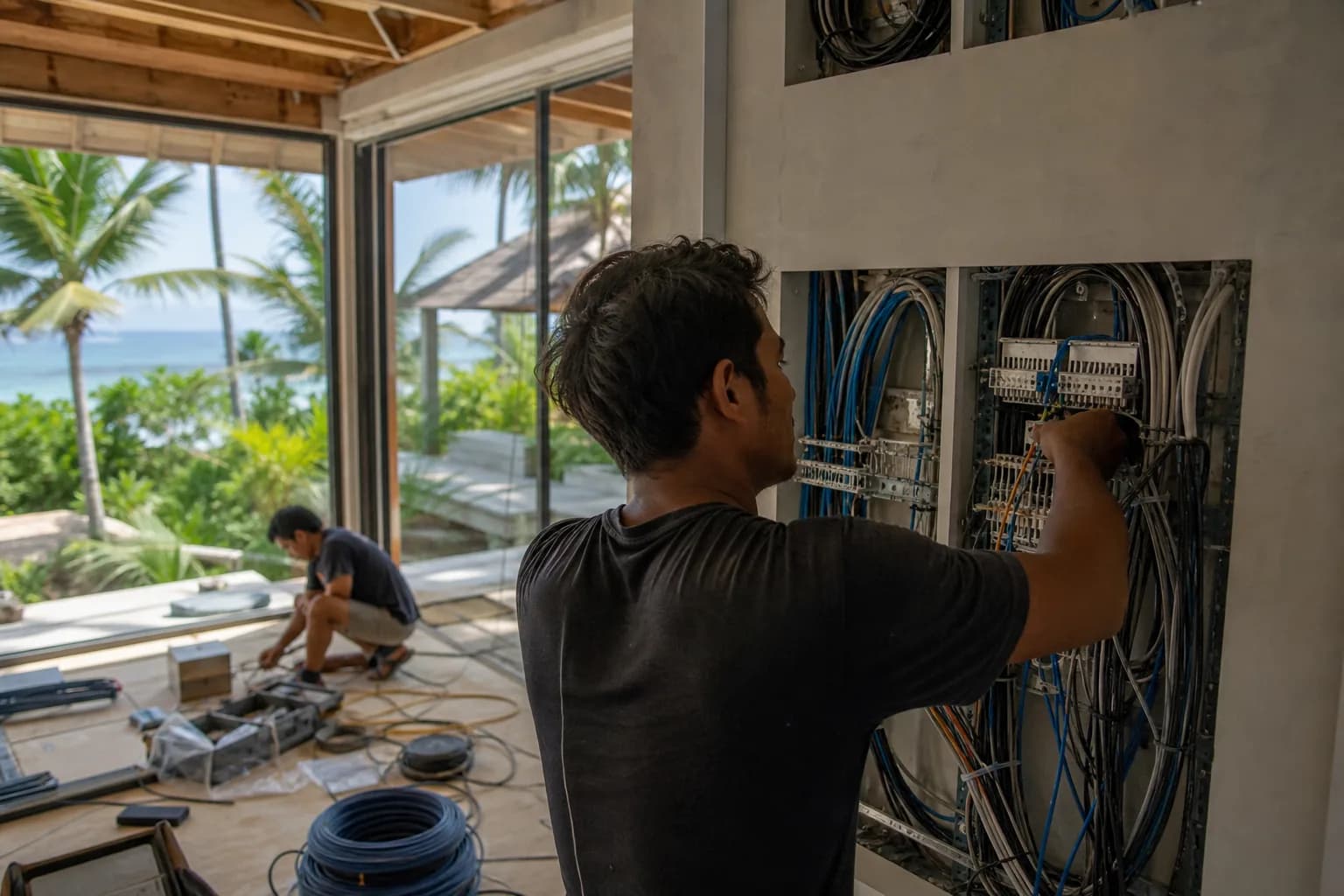
Cat6A Structured Cabling & Patch Panel Installation Bali: Finishing-Grade Network Infrastructure for Villas and Renovations
1) Specific Problem/Question
How do you implement Cat6A structured cabling and patch panel installation in Bali villas—within real-world finishing constraints—so it stays hidden, operates at 10G speeds, tolerates coastal humidity and heat, powers PoE devices reliably, and integrates elegantly with furniture and interior finishes during new builds or renovation Bali projects? As a finishing-focused contractor, Teville aligns data infrastructure with villa utilities, millwork, and décor—delivering durable performance without compromising the aesthetic.
2) Technical Deep Dive: What “Finishing-Grade” Cat6A Means in Bali
Cat6A (Augmented Category 6) enables 10GBASE‑T up to 100 m, but real-world success in Bali villa construction depends on pathway design, climate mitigation, and meticulous terminations. The goal: certified performance plus durable, discrete install that respects interior finishing Bali standards.
- Pathways and bends: Maintain minimum bend radius (≥4x cable OD; typically ≥25–32 mm for Cat6A). Avoid kinks and tight pull angles at column penetrations and cabinet transitions. Conduit fill should not exceed ~40% to ease pulls and reduce alien crosstalk pressure.
- Separation from power: Observe TIA pathway guidance; keep low-voltage at least 50 mm from power in parallel runs; cross at 90° where unavoidable. In Bali’s villas, plan ceiling service corridors that separate lighting drivers and PoE bundles.
- Tropical climate mitigation: Humidity, salt air, and thermal cycling demand corrosion-resistant terminations and hardware. Use stainless-steel screws, UV-stable conduits outdoors, gaskets on exterior boxes (IP54+), and seal wall penetrations with neutral-cure silicone or fire-rated putty. Create drip loops before entry points and keep junctions off slab level to prevent splash-back intrusion.
- EMI and shielding: For most residential runs, Cat6A U/UTP performs well if pathways are properly separated. Near lift motors, solar inverters, or generator rooms, consider F/UTP with bonded foil and verified bonding. If using shielded systems, ensure a single-point earthing scheme per TIA-607 to prevent ground loops.
- PoE and heat: With IEEE 802.3bt (Type 3/4) powering cameras, Wi‑Fi 7 APs, and access controls, bundle heating matters. Follow TSB-184-A recommendations: limit bundle size (e.g., ≤24 for continuous high-power PoE), use ventilated cable trays in ceiling voids, and avoid burying dense bundles behind insulation. In cabinetry, vent the back panels and allow 20–30 mm airflow behind switches and patch panels.
- Patch panel placement: Place the villa’s “head-end” in a dry, serviceable spot: a utility closet with conditioned air or a ventilated low-voltage cabinet integrated into millwork. For smaller villas, a wall-mounted 6–9U rack with a 24-port Cat6A patch panel is often ideal; larger estates may require 12–24U mini-IT racks. Products such as wall-mounted Cat6A panels from trueCABLE are robust options when aligned with the design intent.
- Finishing-first workmanship: Keep all faceplates aligned to the same datum line, flush to wall finish with ±1 mm tolerance. Use painter’s tape during grouting/painting. Behind furniture, provide recessed boxes and brush grommets; pre-cut cable ports in wardrobes, desks, and media walls with edge grommets so cables exit cleanly without chafing.
- Testing and documentation: Certify every permanent link with a Cat6A field tester (e.g., Fluke DSX) for NEXT, PSNEXT, ACRF, Return Loss, Propagation Delay, and Alien Crosstalk per TIA-568.2-D. Provide labeled test reports, as-builts, and patch schedules so villa utilities remain maintainable.
- Renovation constraints: In lived-in villas or heritage finishes, use low-dust chasing, surface-mount raceways that match wall color, or route through joinery and ceiling voids. Schedule “no-noise” windows for guest occupancy and apply meticulous dust containment with zipper walls and HEPA extraction.
- ISP and distribution: Terminate fiber/ONT to the same head-end. Use short Cat6A patch leads to the gateway/firewall and switches. For Wi‑Fi 6E/7, pull home-run Cat6A to each AP location (typically 3–6 per villa) and power via PoE, keeping AP backhaul unconstrained by legacy copper.
Done right, Cat6A becomes a near-invisible backbone that supports work-from-villa, CCTV, access control, audio-video, and future upgrades—without visible clutter or premature corrosion.
3) Materials & Standards
We specify materials that balance performance, durability, and finishing elegance for Bali’s coastal climate:
- Cables: Cat6A solid copper (23 AWG) U/UTP for general use; F/UTP or S/FTP in high-EMI areas. Choose LSZH or low-smoke PVC jacketing where appropriate. Ensure verified 10G rating to 100 m and PoE++ capability.
- Patch panels: 24-port or 48-port Cat6A panels (1U/2U), rack or wall-mount. Consider field-friendly, toolless keystones for tight spaces. Reference quality options from Primus Cable and PatchSave Solutions, and the wall-mounted Cat6A panel overview from trueCABLE.
- Connectivity: Cat6A keystones, field-terminable RJ45 plugs for device-end cords behind TVs or ceiling APs, 110/Krone compatible tools, and pass-through strain relief boots. Use stranded Cat6A patch cords for equipment interconnects.
- Pathways: UV-rated conduits outdoors, halogen-free trunking indoors, stainless saddles, low-profile dado trunking for renovations, brush grommets for desks/media walls, and cable management bars for patch panels.
- Hardware: Stainless or coated fixings, ventilated mini-racks, surge protective devices (SPDs) on service entrance, and bonding lugs for shielded systems.
- Labeling and docs: Heat-shrink or wrap-around labels, panel schedules, and as-builts per TIA-606-C. Provide QR-coded cabinet map for quick reference.
Standards we follow or reference:
- ANSI/TIA-568.2-D: Balanced twisted-pair specs for Cat6A performance and testing.
- ANSI/TIA-569-D: Pathways and spaces; clearance from power, bend radii, and access.
- ANSI/TIA-606-C: Administration: labeling, records, and color coding.
- ANSI/TIA-607-D: Bonding/earthing for telecom spaces—critical with shielded systems.
- IEEE 802.3af/at/bt: PoE standards for powering APs, cameras, intercoms.
- TSB-184-A: PoE installation practices to control bundle temperatures.
- ISO/IEC 11801: International generic cabling standards for premises.
Practical guidance from the field is equally important; see installation tips from Ring and Ping Inc.. For local execution capacity, Bali providers such as CV. Data Piranti Utama indicate market availability of skilled technicians for LAN deployments.
4) Step-by-Step Process (Teville Method)
Step 1 — Briefing and Site Survey
We align the network scope with your Bali villa construction or renovation program: room functions, smart systems, Wi‑Fi coverage, IPTV, CCTV, access control, and workspace needs. We document finishes (plasters, paneling, stone), furniture layouts, and appliance lists to map outlet positions discreetly. For existing villas, we perform signal and pathway audits, and moisture/salt checks in service zones.
Step 2 — Design and Coordination
- Create a Cat6A structured cabling plan with outlet schedule, head-end location, pathway drawings, and AP heatmaps.
- Coordinate with MEP to separate power and data; confirm ceiling access, shaft availabilities, and cabinet ventilation.
- Integrate with joinery shop drawings to pre-cut cable ports, service hatches, and rack recesses. Millwork ventilation is detailed (slots at top/bottom, 20–30 mm stand-off).
- Approve faceplate styles and colorways to match interior finishing Bali palettes.
Step 3 — Rough-In and Pathways
- Install conduits/trunking with gentle sweeps, no sharp elbows. Maintain bend radius and pull strings in all conduits.
- Mount recessed back boxes at consistent heights and datum lines; seal rear penetrations to block humid air migration.
- Where surface routes are unavoidable (renovation Bali), use slim trunking color-matched to walls or concealed within wardrobes and skirting voids.
- Provide cable trays in ceiling voids with separation from drivers and ballasts.
Step 4 — Cable Pulling
- Pull Cat6A solid in measured groups; observe max pull force and avoid twisting. Keep bundle sizes conservative for PoE heat control.
- Label both ends immediately with permanent IDs. Leave service loops at outlets and the panel to ease termination.
- Protect cable ends with caps; no copper exposed to salt-laden air during construction.
Step 5 — Termination and Patch Panel Build
- Terminate to Cat6A keystones using T568B pinout; verify conductor fully seated, jacket maintained to within recommended distance of the IDC, and pair untwist ≤6 mm.
- At the head-end, dress cables on lacing bars, velcro (no zip ties on pairs), and terminate to a 24/48-port Cat6A patch panel. Where space is tight, wall-mounted panels like those in trueCABLE’s guide can be efficient.
- Install PoE switches, surge protection, and cable managers. Maintain front-to-back airflow with perforated doors or side vents in furniture.
Step 6 — Finishing Integration
- Set faceplates flush and level; protect with removable covers during final painting. Where outlets sit behind media cabinets or desks, use recessed boxes and brush plates for clean exits.
- Coordinate with furniture installation to route hidden patch leads through grommets and conceal power bricks. Provide discreet access panels for maintenance.
- For outdoor areas (gazebos, pools), use IP-rated boxes, UV-stable conduits, and stainless fixings, with drip loops on exterior drops.
Step 7 — Testing and Certification
- Field-certify to ANSI/TIA-568.2-D Cat6A with a calibrated tester for every permanent link; conduct alien crosstalk spot checks on dense bundles.
- Document results with labeled PDFs and a panel schedule. Verify PoE load tests for APs/cameras and confirm switch thermal performance inside joinery.
Step 8 — Handover and Aftercare
- Deliver as-builts, labeling legend, maintenance notes, and a quick-reference diagram inside the cabinet.
- Offer seasonal salt/humidity checks and re-torque inspections for shield bonding and rack fixings.
For a visual sense of quality, see Teville’s portfolio and how we coordinate finishes in our construction process. Explore relevant villa typologies in our projects catalog.
5) Costs & Timeline
Every site is unique, but the following ranges help planning for Bali villa construction and renovation Bali scopes. Figures reflect finishing-grade hardware, climate-resilient fixings, and professional certification; they are indicative and refined by survey.
 164 m²7 month(s)from 79.000 USD
Private: Haridas Villas, Tegallalang
164 m²7 month(s)from 79.000 USDTALA TWO
 4344 m²16 month(s)from 290.000 USD
Radha
 3104 m²11 month(s)from 99.000 USD
TALA 100
 1from 198.000 USD
Private: Haridas Villas
 3127 m²9 month(s)from 177.000 USD
Mukunda

Want to calculate?
 172 m²8 month(s)from 120.000 USD
Keshava
 3173 m²6 month(s)from 125.000 USD
TALA FOUR
 3124 m²6 month(s)from 123.000 USD
TALA 8
 2144 m²11 month(s)from 104.000 USD
Narayana
 3180 m²7 month(s)from 142.000 USD
Vasudeva
Start With Real Numbers, Not Guesses
Before finalizing your finishing works plan, check realistic cost ranges for your Bali villa project.
Available lands
 18900 m²2 min$ 6912931Bali, Pecatu
 770 m²5 min$ 163578Bali, Kedungu
 2500 m²5 min$ 609606Bali, Kedungu
 2000 m²15 min$ 261700Bali, Babakan
 1375 m²10 min$ 447044Bali, Canggu
 1430 m²5 min$ 209862Bali, Klungkung
 600 m²12 min$ 101970Bali, Mengwi
 610 m²10 min$ 165271Bali, Seminyak
 889 m²15 min$ 145612Bali, Cepaka
 800 m²10 min$ 307882Bali, Tibubeneng
 8313 m²15 min$ 716670Bali, Buduk
 1700 m²10 min$ 392549Bali, Nusadua
 3100 m²15 min$ 257697Bali, Tegallalang
 6000 m²30 min$ 55419Bali, Tabanan
 325 m²15 min$ 44472Bali, Ungasan
Essential Bali build & buy guides
- Bali villa construction cost per m² in 2026
- How much will your villa cost? Calculator
- Building a villa in Bali: the complete guide
- Buying land in Bali: step-by-step for foreigners
- Bali villa investment: yields, risks, returns
- Leasehold vs freehold: what foreigners can own
- Construction defect liability & 10-year warranty
- Bali building codes and construction standards
Related guides
Resin-Infused Plaster Finishes: Anti-Salt Systems Bali
Expert technical guide: Resin-Infused Plaster Finishes: Anti-Salt Systems Bali
8 min read
Prefinished Timber Joinery: Silicone Seals Fixings Bali
Professional prefinished timber joinery installation in Bali with silicone seals and fixings for durable weatherproof performance and a premium finish.
10 min read
Polished Concrete Microtopping: Surface Prep Sealants Bali
Discover Bali s polished concrete microtopping: expert surface prep, durable sealants, and a flawless finish for modern floors with minimal maintenance.
9 min read