Canggu Sewage Treatment Plant Capacity Limits Costs Bali
Why Canggu’s Sewage Infrastructure Capacity Directly Impacts Your Villa Construction Budget
Canggu’s rapid development has created a critical infrastructure bottleneck that most foreign villa developers discover too late: the area lacks centralized sewage treatment capacity, forcing every property to install independent septic systems or private sewage treatment plants (STPs). With Bali’s waste treatment facilities operating at less than 60% efficiency and Canggu experiencing exponential construction growth, understanding sewage capacity limits and accurate septic tank costs isn’t optional—it’s the difference between a legally compliant villa and a construction project that fails environmental inspections, faces neighbor complaints, or requires expensive remediation within three years of completion.
Technical Reality: Canggu’s Sewage Treatment Infrastructure and Capacity Constraints
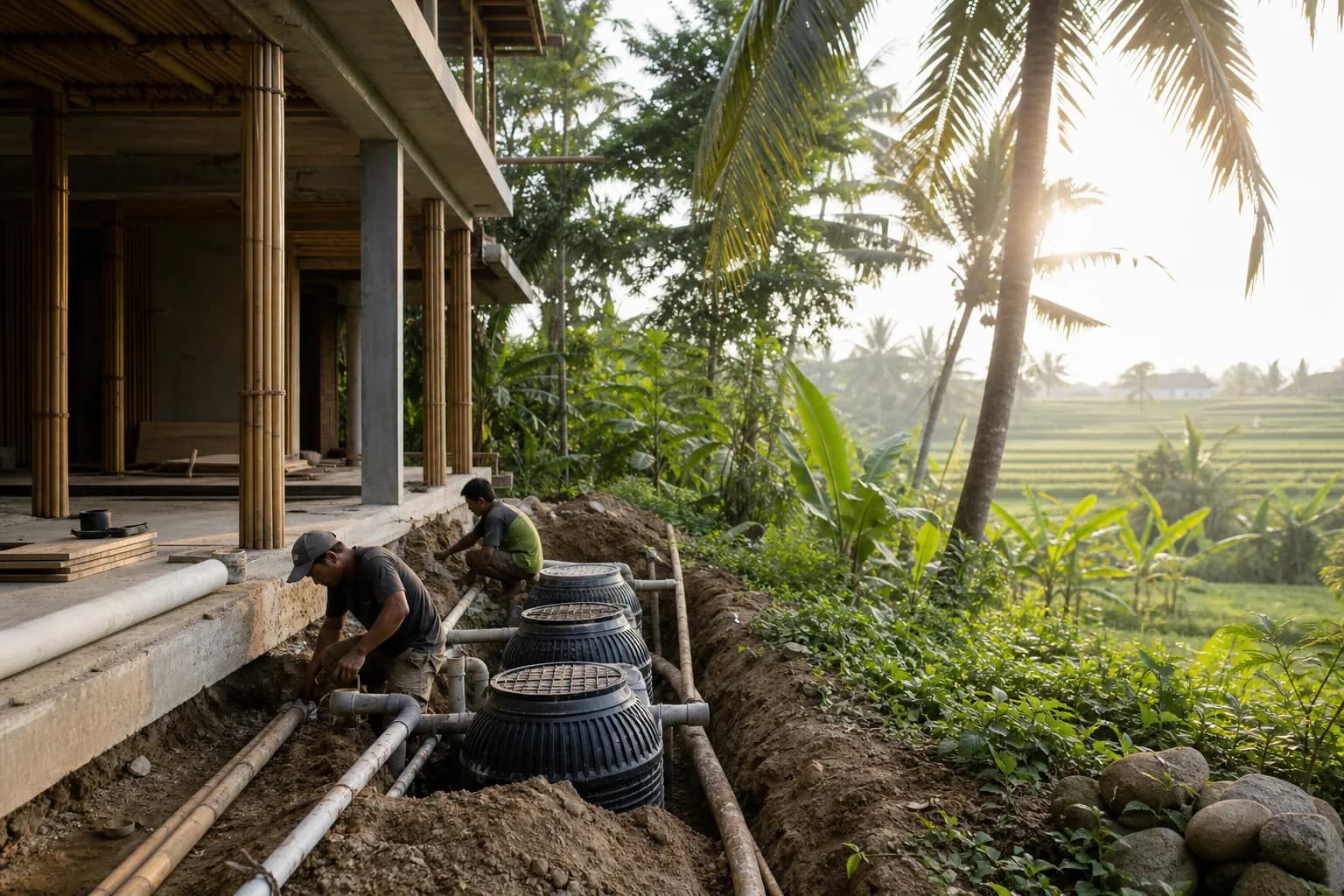
Canggu operates without municipal sewage lines connecting to centralized treatment facilities. Unlike developed urban centers, every villa, guesthouse, and commercial property must manage wastewater independently. This decentralized approach creates three critical engineering challenges that directly impact construction feasibility and long-term operational costs.
Current Infrastructure Limitations
Bali’s existing waste treatment plants face documented underperformance, with facilities operating at 40-60% of designed capacity due to maintenance issues, inadequate funding, and technical limitations. For Canggu specifically, this means no relief infrastructure is coming to rescue properties with undersized or failing septic systems. The Denpasar Sarbagita Sewerage Development Project, which theoretically could extend services to southern Bali areas, remains years from completion and unlikely to reach Canggu’s northern coastal zone within the next decade.
The practical implication: your villa construction must incorporate a fully self-sufficient wastewater treatment solution sized for peak capacity, designed for Bali’s high water table conditions, and engineered to meet Indonesian environmental discharge standards (Peraturan Menteri Lingkungan Hidup No. 68 Tahun 2016) without relying on future municipal infrastructure.
Soil Percolation and Water Table Engineering Constraints
Canggu’s coastal geography creates unique septic system challenges. The water table sits 1-3 meters below surface level in most areas, rising during monsoon season. Soil composition varies dramatically—from volcanic sand near Batu Bolong to dense clay in Pererenan—directly affecting percolation rates and septic field design requirements.
Standard septic tank installations assume soil absorption capacity of 20-30 liters per square meter per day. Canggu’s clay-heavy soils in inland areas often achieve only 10-15 liters per square meter, requiring 50-100% larger leach field areas than conventional calculations suggest. High water tables prevent deep excavation, forcing horizontal expansion that consumes valuable land area and increases installation costs by 30-40% compared to ideal conditions.
For a typical 3-bedroom villa generating 800-1,200 liters of wastewater daily, this translates to minimum leach field requirements of 60-120 square meters—space that many compact Canggu land parcels cannot accommodate without compromising building footprint, pool placement, or garden areas.
Regulatory Capacity Requirements
Indonesian environmental regulations (PERMEN LHK 68/2016) mandate specific treatment standards before wastewater discharge: BOD (Biological Oxygen Demand) below 30 mg/L, TSS (Total Suspended Solids) below 30 mg/L, and pH between 6-9. Standard septic tanks achieve only primary treatment, typically producing effluent with BOD of 150-200 mg/L—five times above legal discharge limits.
This regulatory gap forces villa developers into three options: oversized septic systems with extended retention times (increasing costs 40-60%), aerobic treatment units with mechanical components (adding ongoing maintenance requirements), or biofilter systems requiring specialized design and larger footprints. The choice directly impacts both upfront construction costs and 20-year operational expenses, yet most developers make this decision based on contractor recommendations rather than engineering analysis of site-specific conditions and long-term performance requirements.
Hidden Risks: What Foreign Developers Miss About Sewage System Capacity
The most expensive sewage-related mistakes occur when developers treat septic system design as a standard construction checkbox rather than a site-specific engineering challenge requiring geological assessment, capacity modeling, and regulatory compliance verification.
Undersizing for Actual Usage Patterns
Standard septic tank sizing formulas assume 150 liters per person per day. Bali villas with pools, outdoor showers, multiple bathrooms, and guest facilities routinely generate 200-300 liters per person daily. A 4-bedroom villa designed for 8 occupants theoretically needs 1,200-liter daily capacity—but actual usage with pool backwash, laundry, and kitchen facilities often reaches 2,000-2,500 liters daily during peak occupancy.
Installing a 3,000-liter septic tank (the contractor “standard” recommendation) creates a system operating at 80-85% capacity during normal use, with zero buffer for peak loads. Within 18-24 months, these undersized systems show failure symptoms: slow drains, odors, surfacing effluent, and required emergency pumping every 2-3 months instead of the expected 12-18 month intervals.
Ignoring Monsoon Season Hydraulic Loading
Canggu receives 1,500-2,000mm annual rainfall, with 70% concentrated in November-March monsoon months. Rising water tables during this period reduce soil absorption capacity by 40-60%, effectively halving your septic system’s treatment capacity for 4-5 months annually. Systems that function adequately during dry season fail catastrophically during monsoons, creating emergency situations when contractors are busiest and least available for repairs.
Proper engineering accounts for wet-season conditions by oversizing leach fields 50-80% beyond dry-season calculations, incorporating drainage systems to manage groundwater intrusion, and designing overflow capacity for extreme rainfall events. These provisions add 25-35% to installation costs but prevent the far greater expense of system replacement or emergency remediation.
Neglecting Long-Term Maintenance Access and Costs
Septic tanks require pumping every 12-18 months; biofilter systems need media replacement every 3-5 years; aerobic treatment units require annual mechanical servicing. Developers who bury tanks under hardscaping, position them in locations inaccessible to pumping trucks, or fail to install proper inspection ports create maintenance nightmares that reduce property value and increase operational costs throughout the villa’s lifespan.
Step-by-Step Process: Engineering Compliant Sewage Treatment for Canggu Villas
Step 1: Site-Specific Geological Assessment (Week 1-2)
Before architectural design begins, conduct percolation testing to determine actual soil absorption rates. Dig test pits to 2-3 meters depth to identify water table levels and soil stratification. This data determines whether conventional septic systems are viable or whether you need alternative treatment technologies. Cost: $300-600 for professional assessment. Skipping this step risks designing a system that cannot function on your specific site conditions.
Step 2: Wastewater Generation Modeling (Week 2-3)
Calculate realistic daily wastewater volumes based on actual villa specifications: number of bathrooms, kitchen facilities, laundry provisions, pool volume and backwash frequency, outdoor showers, and expected occupancy patterns. Add 30-40% buffer for peak usage and future expansion. For rental villas, assume maximum occupancy 60-70% of the time rather than average occupancy, as sewage systems must handle peak loads without failure.
A properly sized system for a 3-bedroom Canggu villa typically requires 4,000-6,000 liter septic tank capacity with 80-120 square meter leach field area, significantly larger than the 2,500-3,000 liter “standard” systems most contractors propose.
Step 3: Treatment Technology Selection (Week 3-4)
Match treatment technology to site constraints, regulatory requirements, and operational preferences. Options include: conventional septic with extended leach fields (lowest upfront cost, highest land requirement), biofilter systems with sand/gravel media (moderate cost, reduced footprint, minimal maintenance), aerobic treatment units (highest treatment quality, mechanical components requiring regular servicing), or constructed wetlands (largest footprint, lowest operational cost, excellent treatment quality).
For compact Canggu lots under 300 square meters, biofilter systems typically offer the best balance of treatment performance, space efficiency, and long-term reliability. Larger properties above 500 square meters can consider conventional systems with properly sized leach fields, reducing upfront costs while maintaining compliance.
Step 4: Regulatory Compliance Documentation (Week 4-6)
Prepare technical specifications meeting PERMEN LHK 68/2016 standards for environmental permit (SPPL – Surat Pernyataan Kesanggupan Pengelolaan dan Pemantauan Lingkungan Hidup) submission. This documentation must include: treatment system design drawings, capacity calculations, effluent quality projections, maintenance schedules, and monitoring protocols. Environmental permits are increasingly scrutinized during IMB (building permit) applications, particularly in Canggu where development density raises environmental concerns.
Step 5: Installation Supervision and Testing (Construction Phase)
Septic system installation occurs early in construction, typically weeks 2-4 of the building timeline. Critical supervision points include: verifying tank structural integrity before backfilling, confirming proper slope gradients (minimum 2% for drain lines), installing inspection ports at all junctions, testing watertightness before covering, and documenting as-built locations for future maintenance access.
Post-installation testing should include hydraulic load testing (filling system to capacity and monitoring drainage rates) and initial water quality sampling to establish baseline performance. These tests cost $200-400 but provide documentation proving system functionality and regulatory compliance.
Realistic Cost Ranges: Canggu Sewage Treatment System Investment
Conventional Septic Systems
Basic 3,000-liter concrete septic tank with standard leach field (60-80 sqm): $1,800-2,800 installed. Properly sized 5,000-6,000 liter system with extended leach field (100-120 sqm) for 3-4 bedroom villa: $3,500-5,500. Costs increase 30-40% for sites with high water tables requiring raised leach fields or drainage systems. Annual maintenance (pumping, inspection): $150-250.
Biofilter Treatment Systems
Complete biofilter system (4,000-6,000 liter capacity) with sand/gravel media, distribution system, and discharge chamber: $5,500-8,500 installed. These systems occupy 40-60% less land area than conventional leach fields, making them cost-effective for compact lots despite higher upfront investment. Media replacement every 4-5 years: $800-1,200. Annual maintenance: $200-300.
Aerobic Treatment Units (ATUs)
Packaged aerobic treatment plants (1,000-2,000 liter daily capacity): $6,500-12,000 installed, including electrical connections and control systems. These produce highest quality effluent (suitable for irrigation reuse) but require reliable electricity and annual mechanical servicing ($300-500). Best suited for environmentally sensitive sites or properties planning greywater recycling for gardens.
Hidden Costs Often Overlooked
Geological assessment and percolation testing: $300-600. Environmental permit documentation: $400-800. Excavation complications (rock, high water table): add 20-40%. Pumping truck access improvements (widening gates, reinforcing driveways): $500-1,500. First three years of maintenance and monitoring: $600-1,200 total. These additions typically increase total sewage system investment by 25-35% beyond basic installation quotes.
Frequently Asked Questions: Canggu Sewage Treatment Capacity and Costs
Can I connect to municipal sewage lines in Canggu to avoid septic system costs?
No municipal sewage infrastructure exists in Canggu, and none is planned for the foreseeable future. Every property must install independent wastewater treatment systems. The Sarbagita Sewerage Project focuses on Denpasar, Badung, Gianyar, and Tabanan urban centers, with no timeline for extending services to Canggu’s coastal area. Budget for complete on-site treatment capacity as a permanent requirement, not a temporary solution until municipal services arrive.
What septic tank size does a 3-bedroom Canggu villa actually need?
Minimum 4,000-5,000 liter capacity for a 3-bedroom villa with pool, assuming 6-8 occupants generating 200-250 liters per person daily. Standard 2,500-3,000 liter tanks contractors commonly propose are undersized for actual usage patterns including pool maintenance, multiple bathrooms, outdoor showers, and laundry facilities. Undersized systems require pumping every 2-3 months instead of 12-18 months, increasing operational costs and failure risk. Invest in proper capacity upfront—retrofitting larger tanks after construction costs 3-4 times more than correct initial installation.
How does Canggu’s high water table affect septic system design and costs?
Water tables 1-3 meters below surface prevent deep excavation and reduce soil absorption capacity, requiring 50-100% larger leach field areas than standard calculations. High water table sites need: watertight tank construction to prevent groundwater infiltration (adding 15-20% to tank costs), raised leach fields or mound systems (increasing installation costs 30-50%), perimeter drainage to manage groundwater (adding $1,500-3,000), and wet-season capacity buffers. Total cost impact: 40-60% above standard septic system pricing. Sites with water tables above 1.5 meters may require biofilter or aerobic treatment systems instead of conventional septic, further increasing investment.
What are the legal consequences of undersized or failing septic systems in Bali?
Environmental violations under PERMEN LHK 68/2016 carry fines up to 500 million IDR ($31,000
 3127 m²9 month(s)from 177.000 USD
Mukunda
 3104 m²11 month(s)from 99.000 USD
TALA 100
 1from 198.000 USD
Private: Haridas Villas
 172 m²8 month(s)from 120.000 USD
Keshava
 164 m²7 month(s)from 79.000 USD
TALA TWO

Want to calculate?
164 m²7 month(s)from 79.000 USDPrivate: Haridas Villas, Tegallalang
 4344 m²16 month(s)from 290.000 USD
Radha
 3124 m²6 month(s)from 123.000 USD
TALA 8
 2144 m²11 month(s)from 104.000 USD
Narayana
 3180 m²7 month(s)from 142.000 USD
Vasudeva
 3173 m²6 month(s)from 125.000 USD
TALA FOUR
Start With Real Numbers, Not Guesses
Before buying land or finalizing a design, check the realistic build cost range for your project in Bali.
Our team reviews your inputs and gives a grounded estimate.
Available lands
 13000 m²1 min$ 920567Bali, Pekutatan
 600 m²12 min$ 101970Bali, Mengwi
 7500 m²5 min$ 206281Bali, Kedungu
 200 m²5 min$ 59113Bali, Bukit
 1600 m²32 min$ 266010Bali, Tabanan
 800 m²5 min$ 295567Bali, Seseh
 2680 m²10 min$ 1732759Bali, Pererenan
 1230 m²15 min$ 132543Bali, Tegallalang
 3300 m²15 min$ 449889Bali, Tabanan
 422 m²15 min$ 93547Bali, Kerobokan
 3000 m²15 min$ 1246921Bali, Tabanan
 250 m²15 min$ 40025Bali, Munggu
 1000 m²5 min$ 350431Bali, Drupadi
 1430 m²5 min$ 209862Bali, Klungkung
 700 m²15 min$ 109052Bali, Buduk
Essential Bali build & buy guides
- Bali villa construction cost per m² in 2026
- How much will your villa cost? Calculator
- Building a villa in Bali: the complete guide
- Buying land in Bali: step-by-step for foreigners
- Bali villa investment: yields, risks, returns
- Leasehold vs freehold: what foreigners can own
- Construction defect liability & 10-year warranty
- Bali building codes and construction standards
Related guides
Resin-Infused Plaster Finishes: Anti-Salt Systems Bali
Expert technical guide: Resin-Infused Plaster Finishes: Anti-Salt Systems Bali
8 min read
Prefinished Timber Joinery: Silicone Seals Fixings Bali
Professional prefinished timber joinery installation in Bali with silicone seals and fixings for durable weatherproof performance and a premium finish.
10 min read
Polished Concrete Microtopping: Surface Prep Sealants Bali
Discover Bali s polished concrete microtopping: expert surface prep, durable sealants, and a flawless finish for modern floors with minimal maintenance.
9 min read