Canggu Septic Tank Capacity Rules Biofilter Upgrade Costs Bali
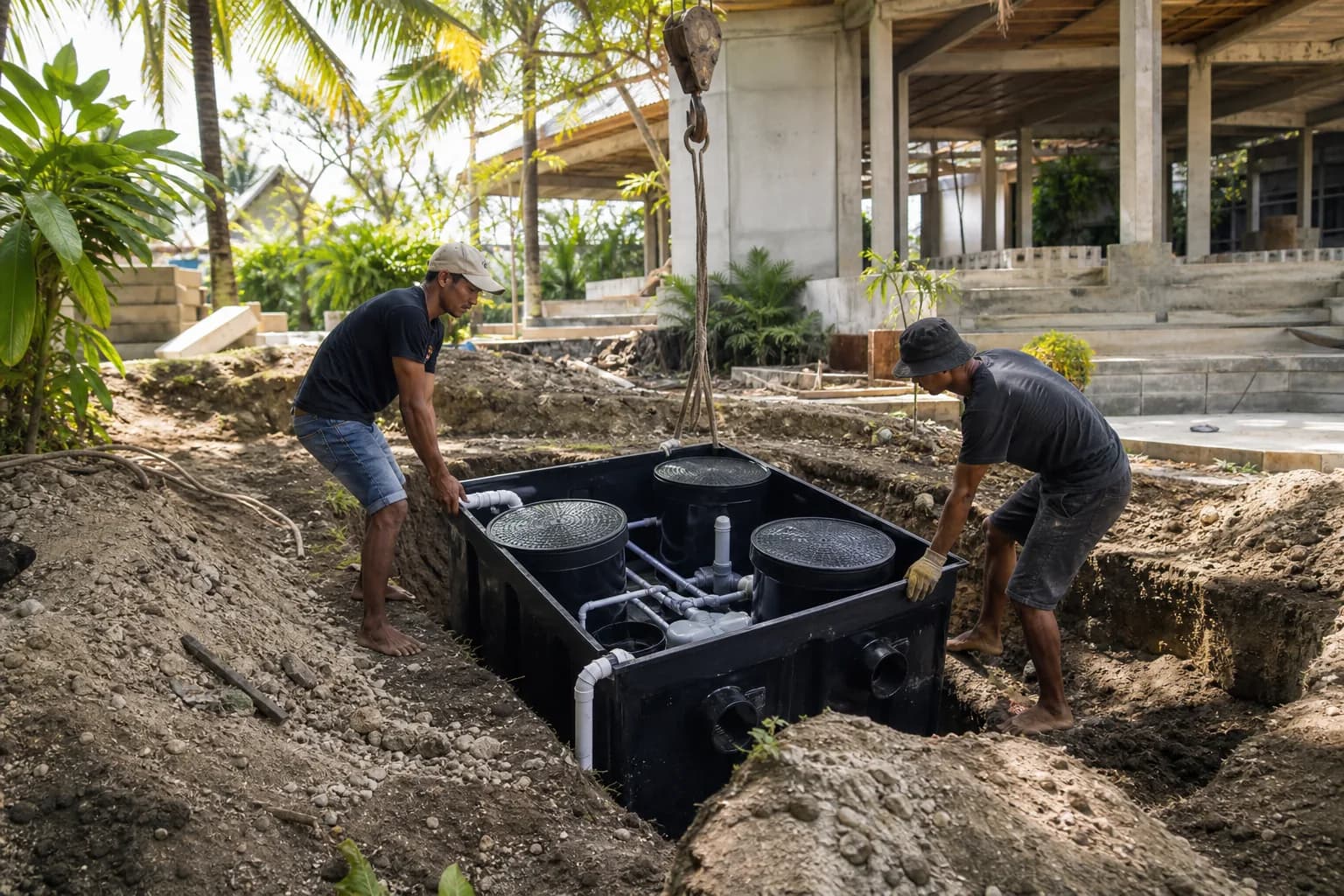
Canggu Septic Tank Capacity Rules & Biofilter Upgrade Costs Bali
Canggu’s rapid development has triggered stricter enforcement of wastewater management regulations, catching many villa owners and developers off-guard. The 2026 compliance deadline for biofilter upgrades means properties with outdated septic systems face mandatory retrofits, with costs ranging from IDR 35-120 million depending on capacity and site conditions. The technical challenge isn’t just installation—it’s calculating correct capacity for your specific property type, navigating Canggu’s high water table conditions, and ensuring your system meets both provincial regulations and local banjar requirements that often exceed minimum standards.
Technical Requirements for Canggu Septic Tank Capacity Calculation
Bali’s Provincial Regulation No. 5/2021 establishes baseline septic tank capacity requirements, but Canggu’s specific conditions demand engineering adjustments that generic calculations miss. The standard formula—1 cubic meter per bedroom plus 0.5 cubic meters per additional occupant—serves as a starting point, but Canggu’s clay-heavy soil composition and seasonal water table fluctuations require capacity buffers of 25-40% above calculated minimums.
For a typical 3-bedroom villa in Canggu, the baseline calculation yields 4.5 cubic meters (3 bedrooms + 3 occupants). However, proper engineering accounts for peak occupancy during high season, greywater volume from outdoor showers and pool bathrooms, and the reduced infiltration rates in Canggu’s compacted subsoil. The realistic requirement becomes 6-7 cubic meters of primary chamber capacity, with an additional 4-5 cubic meter biofilter chamber.
The construction specifications are non-negotiable: primary chambers must be watertight concrete (minimum K-250 grade) or certified fiberglass units, with wall thickness of at least 15cm for concrete construction. The critical engineering detail most contractors overlook is the inlet baffle configuration—Canggu’s high groundwater requires extended baffles (minimum 40cm depth) to prevent hydraulic overload during monsoon season when water tables rise to within 1.5 meters of surface grade.
Biofilter chambers represent the 2026 compliance focal point. These secondary treatment units must achieve 70% BOD reduction and 60% TSS reduction before discharge. The biofilter media specification—typically volcanic rock or specialized plastic media—must provide minimum 3 square meters of surface area per cubic meter of daily flow. For Canggu properties, this translates to biofilter chambers of 4-6 cubic meters for residential villas, with proper aeration systems that many existing installations lack.
The positioning of systems in Canggu requires site-specific analysis. Properties within 500 meters of the coastline face additional scrutiny due to environmental protection zones. Your system must maintain 5-meter setbacks from property boundaries, 10 meters from water wells, and 15 meters from surface water bodies—constraints that eliminate many preferred locations on typical Canggu land parcels of 200-400 square meters. The high water table (often 2-3 meters depth during wet season) necessitates either elevated biofilter systems or engineered drainage solutions that add IDR 15-25 million to standard installation costs.
Material and Design Standards for Tropical Conditions
Canggu’s corrosive soil conditions and temperature variations demand material specifications beyond standard Indonesian construction codes. Concrete tanks require waterproofing with crystalline admixtures, not just surface coatings that fail within 3-5 years. Fiberglass tanks must be UV-stabilized and rated for continuous groundwater immersion—specifications that eliminate 60% of tanks marketed in Bali. The connection piping must be Schedule 40 PVC minimum, with flexible joints every 3 meters to accommodate soil settlement common in Canggu’s former rice field areas.
Hidden Risks in Canggu Septic System Compliance
The most expensive mistake is discovering your existing system’s actual capacity only when applying for building permits or during property transactions. Many Canggu properties built between 2015-2020 have undersized systems installed by contractors who used bedroom count alone, ignoring the outdoor bathrooms, staff facilities, and pool changing rooms that add 30-50% to actual wastewater volume. Retrofitting an undersized system after construction means excavating through completed landscaping, potentially relocating pools or structures, and costs that reach 3-4 times the original installation expense.
The banjar approval process introduces requirements that provincial regulations don’t specify. Several Canggu banjars now require quarterly maintenance contracts with certified service providers and annual water quality testing—ongoing costs of IDR 8-12 million per year that weren’t factored into original project budgets. Properties without documented banjar approval for their septic systems face complications during IMB renewals and property transfers, even if the system meets technical standards.
Groundwater contamination liability represents an emerging risk. As Canggu’s density increases, properties with failing septic systems face potential claims from neighboring properties if groundwater testing reveals contamination traceable to their system. The legal framework is evolving, but recent cases show liability exposure of IDR 200-500 million for remediation and damages. This risk is highest for properties on the former rice field areas of Pererenan and Padonan where water tables are shallowest.
The 2026 biofilter deadline creates a compliance bottleneck. With an estimated 2,000+ properties in Canggu requiring upgrades, the limited number of certified installers means scheduling delays of 4-6 months and price inflation of 20-30% as the deadline approaches. Properties that wait until 2025 to upgrade will face both higher costs and potential penalties for non-compliance that start at IDR 50 million.
Step-by-Step Process for Septic System Compliance in Canggu
The compliance process begins with accurate capacity assessment, not contractor estimates. Engage a civil engineer to conduct a site survey that documents actual wastewater generation from all sources—indoor bathrooms, outdoor showers, kitchen facilities, staff quarters, and any commercial elements if you’re operating a rental villa. This survey should include soil percolation testing at the proposed biofilter location, groundwater depth measurement during wet season, and setback verification from all restricted areas. Budget IDR 5-8 million for proper engineering assessment; skipping this step leads to undersized systems or failed installations.
Design development requires coordination between your engineer and local environmental authorities (Dinas Lingkungan Hidup). Submit preliminary designs showing tank dimensions, biofilter configuration, and discharge management. Canggu properties often require engineered discharge solutions—either connection to emerging neighborhood collection systems or enhanced infiltration fields—that aren’t apparent from standard designs. This approval phase takes 3-4 weeks with complete documentation, or 3-4 months if you’re revising inadequate initial submissions.
Banjar consultation must occur before construction begins. Present your approved design to the banjar environmental committee (not just the kelian), and document their specific requirements. Some Canggu banjars require larger capacity than provincial minimums, specific biofilter media types, or access provisions for inspection. Obtain written confirmation of banjar approval; verbal agreements create problems during later permit processes. The banjar review typically requires 2-3 meetings over 4-6 weeks.
Contractor selection should prioritize certified septic system installers with verifiable Canggu experience. Request documentation of at least 5 completed biofilter installations in Canggu, with contact information for those property owners. Verify the contractor holds proper licensing (SIUJK classification for environmental infrastructure) and carries liability insurance—requirements that eliminate most general contractors. The contractor should provide material certifications for tanks, biofilter media, and all piping components before installation begins.
Installation supervision requires daily site visits during critical phases: excavation and groundwater management, tank placement and leveling, biofilter media installation, and connection testing. The most critical inspection point is the pressure test of the primary chamber—24 hours of water retention with less than 2cm water level drop. Many contractors rush this test; insist on documented results with photographic evidence. The biofilter aeration system must be tested under load conditions, not just switched on briefly.
Final documentation includes obtaining the environmental compliance certificate (Surat Keterangan Laik Lingkungan) from Dinas Lingkungan Hidup, banjar completion confirmation, and as-built drawings showing actual installation dimensions and locations. These documents are essential for IMB applications, property transfers, and demonstrating 2026 compliance. Store both physical and digital copies; replacement documentation requires repeating much of the approval process.
Maintenance Protocol Establishment
Establish a maintenance contract before system activation. Canggu’s high water tables and intensive use patterns require quarterly inspections and annual desludging—more frequent than the national standard. Document baseline performance with initial water quality testing of the biofilter discharge; this establishes your compliance baseline and provides comparison data for future testing. Budget IDR 10-15 million annually for proper maintenance; deferred maintenance leads to system failure and replacement costs of IDR 80-150 million.
Realistic Cost Ranges for Canggu Biofilter Upgrades
New biofilter installation for a 3-bedroom villa ranges from IDR 65-95 million, including engineering, materials, installation, and initial approvals. This assumes straightforward site conditions—accessible location, water table below 3 meters, and no rock excavation. Properties with challenging conditions face supplements: high water table dewatering adds IDR 12-18 million, rock excavation costs IDR 8-15 million per cubic meter, and elevated biofilter systems (required when water tables exceed 2 meters depth) add IDR 20-30 million.
Retrofitting existing systems with biofilter chambers costs IDR 45-75 million when the primary septic tank has adequate capacity and proper location. This includes biofilter chamber construction, media installation, aeration system, and connection modifications. However, 40% of Canggu retrofit projects discover the existing primary tank is undersized or improperly constructed, requiring complete replacement that pushes total costs to IDR 85-120 million.
Larger properties face proportionally higher costs. A 5-bedroom villa with staff quarters requires 9-11 cubic meter primary capacity and 6-8 cubic meter biofilter capacity, with installation costs of IDR 110-160 million. Commercial properties (restaurants, cafes, small hotels) require industrial-grade systems with costs starting at IDR 200 million for proper capacity and treatment levels.
Timeline expectations: engineering and approvals require 8-12 weeks, installation takes 3-4 weeks for residential systems, and final testing and documentation adds 2-3 weeks. Total project duration of 4-5 months is realistic; contractors promising completion in 6-8 weeks are either cutting corners or haven’t accounted for approval processes. The 2026 compliance deadline means projects starting in late 2024 or early 2025 face the most favorable pricing and scheduling; waiting until 2025 introduces significant cost and timeline risks.
Frequently Asked Questions: Canggu Septic Tank Compliance
Can I upgrade just the biofilter without replacing my existing septic tank?
Biofilter-only upgrades are possible if your existing primary septic tank meets three conditions: adequate capacity for your property’s actual wastewater generation (not just bedroom count), watertight construction verified by pressure testing, and proper inlet/outlet baffle configuration. However, engineering assessment reveals that approximately 60% of Canggu properties built before 2020 have primary tanks that fail at least one of these criteria. The most common issue is undersized capacity—tanks sized for 3 bedrooms but serving properties with outdoor bathrooms, pool facilities, and staff quarters that generate 40-50% more wastewater. A proper engineering assessment costs IDR 5-8 million and prevents the expensive mistake of installing a biofilter that your primary tank cannot adequately supply, leading to system failure within 12-18 months.
What happens if I don’t upgrade by the 2026 deadline?
Non-compliance after the 2026 deadline triggers multiple consequences. Initial penalties start at IDR 50 million for residential properties, with monthly accumulating fines of IDR 5-10 million. More significantly, properties without compliant systems face IMB renewal rejection, which blocks any legal construction activity and complicates property transfers. Banks increasingly require environmental compliance documentation for property-secured loans, and insurance companies are beginning to exclude coverage for properties with non-compliant wastewater systems. The practical impact extends to rental operations—platforms like Airbnb and Booking.com are implementing compliance verification requirements in response to environmental regulations. Properties that delay upgrades until 2025 face contractor scheduling delays of 4-6 months and cost inflation of 20-30% as demand peaks before the deadline.
How does Canggu’s high water table affect biofilter system design and cost?
Canggu’s water table—typically 2-3 meters below surface during wet season and 3-4 meters during dry season—creates two critical engineering challenges. First, biofilter chambers require either elevated installation (raising the system 1-1.5 meters above grade) or engineered drainage systems to prevent groundwater infiltration that dilutes treatment effectiveness. Elevated systems add IDR 20-30 million to installation costs and require pump systems for wastewater delivery, introducing ongoing electrical costs and maintenance requirements. Second, high water tables create buoyancy forces on empty or partially filled tanks, requiring either thickened concrete walls (increasing material costs by 30-40%) or ground anchoring s

Want to calculate?
 3124 m²6 month(s)from 123.000 USD
TALA 8
 164 m²7 month(s)from 79.000 USD
Private: Haridas Villas, Tegallalang
 3104 m²11 month(s)from 99.000 USD
TALA 100
 3180 m²7 month(s)from 142.000 USD
Vasudeva
164 m²7 month(s)from 79.000 USDTALA TWO
 4344 m²16 month(s)from 290.000 USD
Radha
 172 m²8 month(s)from 120.000 USD
Keshava
 1from 198.000 USD
Private: Haridas Villas
 2144 m²11 month(s)from 104.000 USD
Narayana
 3173 m²6 month(s)from 125.000 USD
TALA FOUR
 3127 m²9 month(s)from 177.000 USD
Mukunda
Start With Real Numbers, Not Guesses
Before buying land or finalizing a design, check the realistic build cost range for your project in Bali.
Our team reviews your inputs and gives a grounded estimate.
Available lands
 250 m²15 min$ 40025Bali, Munggu
 1720 m²2 min$ 241478Bali, Tabanan
 2130 m²10 min$ 495776Bali, Pecatu
 3254 m²5 min$ 631800Bali, All
 1300 m²10 min$ 348214Bali, Tabanan
 515 m²7 min$ 570813Bali, Canggu
 200 m²11 min$ 89286Bali, Tabanan
 750 m²15 min$ 187038Bali, Kerobokan
 3700 m²15 min$ 738177Bali, Tabanan
 1100 m²8 min$ 280419Bali, Ungasan
 1000 m²5 min$ 350431Bali, Drupadi
 550 m²15 min$ 164594Bali, Mengwi
 680 m²15 min$ 110751Bali, Pererenan
 13000 m²1 min$ 920567Bali, Pekutatan
 2850 m²15 min$ 315887Bali, Tabanan
Essential Bali build & buy guides
- Bali villa construction cost per m² in 2026
- How much will your villa cost? Calculator
- Building a villa in Bali: the complete guide
- Buying land in Bali: step-by-step for foreigners
- Bali villa investment: yields, risks, returns
- Leasehold vs freehold: what foreigners can own
- Construction defect liability & 10-year warranty
- Bali building codes and construction standards
Related guides
Sanur and Nusa Dua vs Canggu: Stability Plays vs Hype
Canggu gets the headlines; Sanur and Nusa Dua quietly deliver steadier returns to a different kind of buyer. An honest 2026 comparison of the stability markets against the hype market — prices, demand drivers, oversupply risk, and who should buy where.
7 min read
Ubud and the Wellness Market: Buying or Building for Retreats
Ubud is Bali's wellness capital, and retreat-focused property behaves differently from beach villas: longer stays, group bookings, lower volatility. Here is what the market rewards, what zoning allows, and what it costs to buy or build a retreat property in 2026.
8 min read
Buying and Building on the Bukit: Uluwatu, Bingin and Balangan from a Buyer's Seat
A buyer's-seat 2026 guide to the Bukit peninsula — Uluwatu, Bingin and Balangan land prices, the water problem nobody budgets, cliff setbacks after the 2025 Bingin demolitions, and how to build there properly.
7 min read