Canggu Groundwater Salinity Rebar Corrosion Protection in Bali
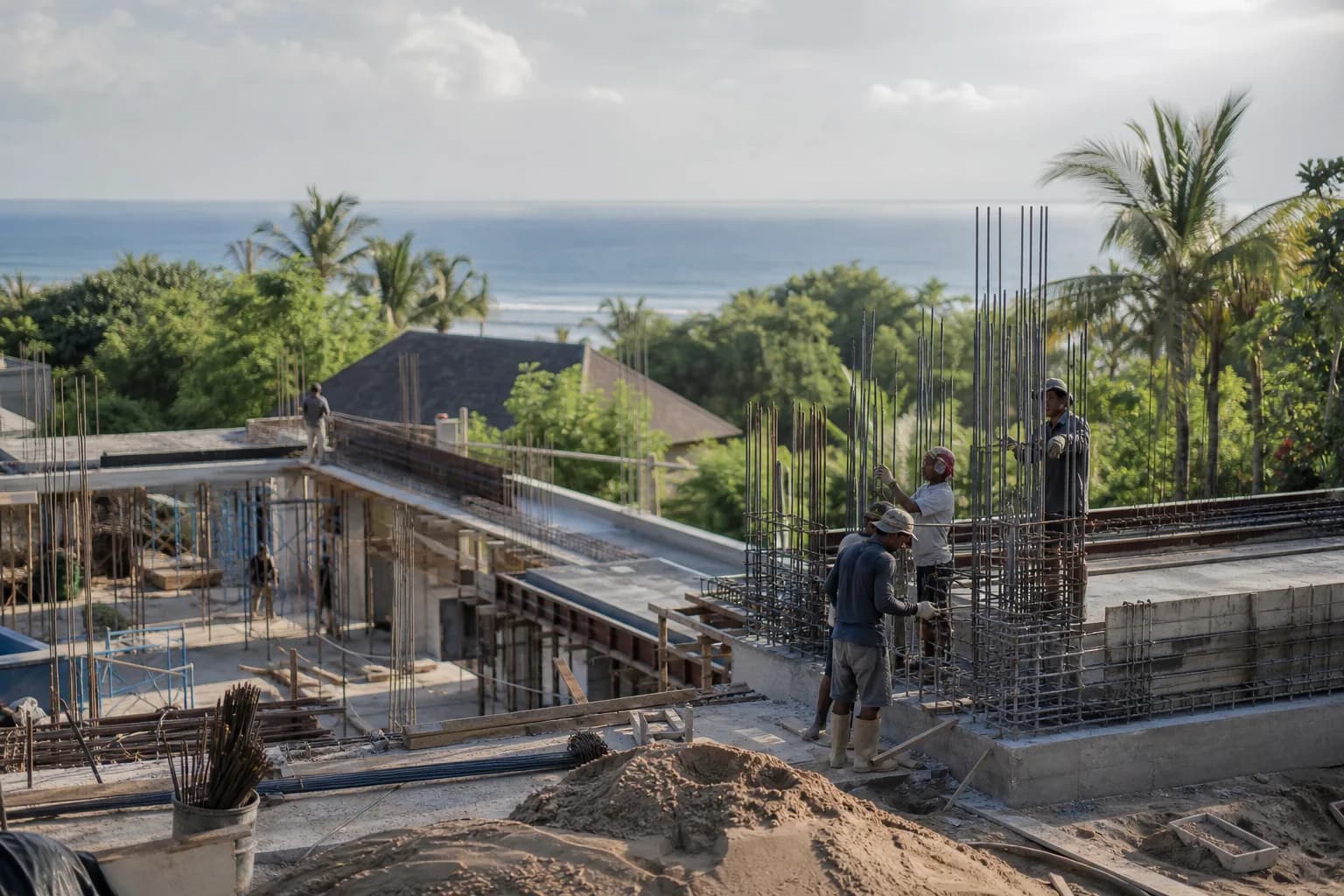
The Silent Threat: Why Canggu’s Groundwater Chemistry Destroys Unprotected Rebar
Canggu’s proximity to the Indian Ocean creates a unique groundwater challenge that most villa developers discover only after structural damage appears. The coastal water table in this region contains elevated chloride concentrations—often exceeding 3,500 ppm within 500 meters of the shoreline—that penetrate concrete and initiate electrochemical corrosion of steel reinforcement. Unlike inland Bali locations where groundwater remains relatively neutral, Canggu’s subsurface salinity creates an aggressive environment where unprotected rebar can lose 20-40% of its cross-sectional area within 5-7 years, compromising structural integrity long before visible cracking alerts owners to the problem.
Understanding Canggu’s Groundwater Salinity Profile and Corrosion Mechanisms
The hydrogeology of Canggu presents a complex salinity gradient that varies dramatically based on distance from the coast, elevation, and seasonal rainfall patterns. Groundwater sampling conducted across the Canggu-Berawa corridor reveals chloride ion concentrations ranging from 1,200 ppm at 800 meters inland to over 5,000 ppm in beachfront locations during dry season months. This saline intrusion occurs through both direct seawater infiltration and capillary rise through porous volcanic soils that characterize much of the area’s geology.
When concrete foundations and ground-level structural elements contact this chloride-rich groundwater, a predictable corrosion sequence initiates. Chloride ions penetrate the concrete matrix through capillary pores and microcracks, eventually reaching the steel reinforcement surface. Once chloride concentration at the rebar interface exceeds the critical threshold—typically 0.4-0.6% by weight of cement—the passive oxide layer protecting the steel breaks down. This depassivation triggers active corrosion, where iron oxidizes and expands to 2-6 times its original volume, generating internal stresses that crack and spall the concrete cover.
Research by Hongji Cao et al. (2023) demonstrates that coated reinforcement systems maintain corrosion rates below 0.1 mm/year even under cyclic wet-dry conditions in coral concrete environments—conditions analogous to Canggu’s coastal setting. Their electrochemical impedance spectroscopy analysis showed that epoxy-coated and zinc-rich coated rebar exhibited charge transfer resistance values 15-40 times higher than uncoated steel, effectively blocking the electrochemical reactions that drive corrosion progression.
The specific challenge in Canggu involves not just static groundwater contact but dynamic wetting-drying cycles. During Bali’s wet season (November-March), groundwater levels rise 0.5-1.2 meters, saturating foundation elements. The subsequent dry season draws water downward, creating a capillary zone where salts concentrate through evaporation. This cycling accelerates corrosion by repeatedly introducing oxygen—essential for the cathodic reaction—while maintaining high chloride concentrations at the rebar surface.
Teville’s construction methodology addresses this through multi-layer protection strategies. For projects within 600 meters of the coastline, we specify minimum concrete cover depths of 50-60mm (versus the standard 40mm), utilize low-permeability concrete mixes with supplementary cementitious materials, and implement coated rebar systems appropriate to the site-specific salinity profile. Electrochemical testing of groundwater samples from each verified land parcel informs the protection specification, ensuring the corrosion mitigation strategy matches the actual exposure severity.
The chloride diffusion coefficient—a key parameter governing how quickly chlorides penetrate concrete—varies significantly based on concrete quality. Standard concrete mixes common in Bali construction exhibit diffusion coefficients of 8-12 × 10⁻¹² m²/s, allowing chlorides to reach 40mm depth within 3-5 years in high-salinity groundwater. By incorporating silica fume or fly ash and reducing water-cement ratios to 0.40 or below, diffusion coefficients drop to 2-4 × 10⁻¹² m²/s, extending the time to corrosion initiation to 15-25 years—a critical difference for long-term structural durability.
Hidden Risks: What Standard Construction Practices Miss in Saline Groundwater Zones
Most Canggu villa construction proceeds without groundwater chemical analysis, relying instead on generic concrete specifications developed for inland conditions. This oversight creates latent structural vulnerabilities that manifest years after construction completion, often after ownership has transferred and warranty periods have expired. The visual inspection approach—waiting for rust staining or concrete spalling—detects corrosion only after significant rebar section loss has occurred, when repair costs escalate dramatically.
A particularly insidious risk involves the interaction between stray electrical currents and saline groundwater. Improperly grounded electrical systems, common in rapid construction scenarios, can create galvanic cells that accelerate corrosion rates by 3-8 times compared to natural corrosion. In one Berawa project we analyzed, stray current from a poorly isolated pool pump system caused 60% rebar section loss in ground beams within just 4 years—a failure mode that standard corrosion protection cannot prevent without proper electrical isolation.
Another frequently overlooked factor is the quality variation in locally sourced aggregates. Canggu’s construction boom has led to increased use of crushed coral and beach sand in concrete mixes—materials that inherently contain chlorides and reduce concrete density. We’ve measured chloride contents exceeding 0.15% in “washed” beach sand supplies, meaning the concrete itself introduces corrosion-initiating ions before any groundwater contact occurs. This internal chloride source dramatically shortens the time to corrosion initiation, making coated rebar systems essential rather than optional.
Step-by-Step Corrosion Protection Implementation for Canggu Projects
Phase 1: Site-Specific Groundwater Assessment
Before foundation design begins, conduct hydrogeological investigation including groundwater sampling at the depth of planned foundation elements. Laboratory analysis should quantify chloride ion concentration, pH, sulfate content, and electrical resistivity. For Canggu sites, we typically drill 2-3 monitoring wells to 3-4 meters depth, collecting samples during both wet and dry seasons when possible. This data establishes the exposure classification per ACI 318 or equivalent standards, determining whether moderate, severe, or very severe corrosion protection measures are required.
Phase 2: Protection System Selection
Based on measured chloride concentrations, select appropriate rebar protection. For groundwater chloride levels of 1,500-3,000 ppm, fusion-bonded epoxy-coated rebar (ASTM A775) provides adequate protection when combined with quality concrete (w/c ≤ 0.45, minimum 50mm cover). For concentrations exceeding 3,500 ppm—common in beachfront Canggu locations—specify either stainless steel reinforcement (316L grade) for critical elements or dual-layer protection combining epoxy-coated rebar with supplementary corrosion inhibitors in the concrete mix.
Teville’s villa projects in high-salinity zones utilize a tiered approach: stainless steel for ground beams and foundation elements in direct groundwater contact, epoxy-coated rebar for elevated ground floor slabs within the capillary rise zone, and standard rebar for upper-level elements above 1.5 meters elevation where chloride exposure becomes negligible.
Phase 3: Concrete Mix Optimization
Specify low-permeability concrete incorporating supplementary cementitious materials. A typical Canggu foundation mix includes 10-15% silica fume or 25-35% fly ash replacement of Portland cement, water-cement ratio of 0.38-0.42, and minimum 28-day compressive strength of 35 MPa. Require aggregate testing to verify chloride content below 0.06% and prohibit beach sand or unwashed coral aggregates. Include crystalline waterproofing admixtures that react with moisture to seal capillary pores, further reducing chloride ingress rates.
Phase 4: Construction Quality Control
Implement rigorous placement protocols to maintain specified concrete cover. Use plastic spacers rated for the cover depth, inspect rebar positioning before concrete placement, and employ vibration techniques that ensure complete consolidation without displacing reinforcement. For coated rebar, inspect coating integrity before placement and repair any damage per manufacturer specifications—even small coating breaches create localized corrosion cells that can propagate rapidly in saline environments.
Phase 5: Post-Construction Monitoring
For high-value projects in severe exposure zones, install embedded corrosion monitoring sensors that measure rebar potential and corrosion rate. These systems provide early warning of corrosion initiation, allowing intervention before structural damage occurs. While adding 0.3-0.5% to construction costs, monitoring systems offer invaluable data for maintenance planning and can detect problems like stray current corrosion that visual inspection misses entirely.
Realistic Cost Implications and Performance Expectations
Implementing comprehensive corrosion protection for a typical 250 m² villa in Canggu’s high-salinity zone adds approximately 8-14% to structural costs compared to standard construction. Epoxy-coated rebar costs 40-60% more than standard rebar, while stainless steel reinforcement runs 4-6 times standard rebar pricing. For a project using 4,500 kg of reinforcement, upgrading foundation and ground-level elements (roughly 35% of total rebar) to epoxy-coated material adds USD 1,200-1,800, while specifying stainless steel for critical ground beams adds USD 3,500-5,000.
Low-permeability concrete with supplementary cementitious materials increases concrete costs by 15-25% but requires only 20-30% more expenditure overall since only groundwater-contact elements need the upgraded mix. For a 250 m² villa, this translates to USD 2,500-4,000 additional concrete material costs. When combined with enhanced cover requirements and quality control measures, total corrosion protection adds USD 8,000-15,000 to a typical villa construction budget—representing 2-3% of total villa construction cost.
The performance return on this investment is substantial. Properly protected structures maintain structural integrity for 50+ years in saline groundwater environments, while unprotected construction often requires major remediation within 8-15 years. Rebar corrosion repair—involving concrete removal, rebar cleaning or replacement, and reinstatement—typically costs 3-5 times the original protection investment, with additional expenses for temporary shoring, occupant displacement, and finishes restoration.
Frequently Asked Questions: Canggu Groundwater Corrosion Protection
How do I know if my Canggu land requires enhanced corrosion protection?
Any property within 800 meters of the coastline in Canggu should undergo groundwater chemical analysis before design finalization. The critical parameter is chloride ion concentration: levels above 1,000 ppm indicate moderate corrosion risk requiring enhanced concrete quality and increased cover, while concentrations exceeding 3,000 ppm demand coated or stainless reinforcement. Distance from coast provides rough guidance, but local hydrogeology varies significantly—we’ve measured 4,200 ppm chlorides at 600 meters inland in one Berawa location due to subsurface flow patterns. Professional groundwater testing costs USD 300-500 but prevents costly specification errors.
Can I use cathodic protection instead of coated rebar?
Impressed current cathodic protection (ICCP) systems can protect rebar in saline groundwater environments but present practical challenges for residential construction. ICCP requires permanent power supply, regular monitoring, and periodic anode replacement—operational commitments that many villa owners cannot maintain. The system also adds USD 12,000-20,000 to construction costs for a typical villa. We recommend cathodic protection only for large commercial projects with dedicated maintenance programs. For residential construction, passive protection through coated rebar and quality concrete provides more reliable long-term performance without operational requirements.
What about waterproofing membranes—do they eliminate corrosion risk?
External waterproofing membranes on foundation walls reduce but do not eliminate chloride exposure. Membranes can be damaged during backfilling, degrade over time, or fail at penetrations and joints. More critically, they don’t protect the underside of ground slabs or footings in direct groundwater contact. Waterproofing should be viewed as a supplementary measure that reduces moisture ingress and slows chloride transport, not as primary corrosion protection. Teville’s approach combines waterproofing with inherent concrete durability and rebar protection, creating defense-in-depth rather than relying on any single barrier.
How does Canggu’s groundwater salinity compare to other Bali coastal areas?
Canggu exhibits higher groundwater salinity than most other Bali coastal construction zones due to intensive groundwater extraction, limited recharge areas, and permeable volcanic soils. Comparative testing shows Canggu groundwater chloride levels 40-80% higher than Sanur at equivalent distances from the coast, and 2-3 times higher than Uluwatu’s limestone plateau where geological barriers limit seawater intrusion. Only Kuta’s heavily developed beachfront areas show comparable salinity levels. This makes Canggu one of Bali’s most challenging environments for concrete durability, requiring more stringent protection measures than generic “coastal construction” specifications provide.
Can existing villas be retrofitted with corrosion protection?
Retrofitting corrosion protection to existing structures is possible but expensive and disruptive. Options include applying corrosion-inhibiting surface treatments that penetrate concrete and form protective layers on rebar (USD 40-70/m² for quality products), installing sacrificial anodes at strategic locations, or in severe cases, removing concrete cover to apply coatings directly to exposed rebar. The most co
 2144 m²11 month(s)from 104.000 USD
Narayana
 164 m²7 month(s)from 79.000 USD
Private: Haridas Villas, Tegallalang
164 m²7 month(s)from 79.000 USDTALA TWO
 3180 m²7 month(s)from 142.000 USD
Vasudeva
 3124 m²6 month(s)from 123.000 USD
TALA 8
 1from 198.000 USD
Private: Haridas Villas

Want to calculate?
 3127 m²9 month(s)from 177.000 USD
Mukunda
 172 m²8 month(s)from 120.000 USD
Keshava
 3173 m²6 month(s)from 125.000 USD
TALA FOUR
 3104 m²11 month(s)from 99.000 USD
TALA 100
 4344 m²16 month(s)from 290.000 USD
Radha
Start With Real Numbers, Not Guesses
Before buying land or finalizing a design, check the realistic build cost range for your project in Bali.
Our team reviews your inputs and gives a grounded estimate.
Available lands
 1300 m²10 min$ 312192Bali, Kutuh South Bali
 608 m²15 min$ 310377Bali, Seminyak
 4270 m²10 min$ 394397Bali, Ubud
 2400 m²7 min$ 496552Bali, Canggu
 1000 m²10 min$ 123154Bali, Jimbaran
 2000 m²5 min$ 1440887Bali, Pecatu
 300 m²55 min$ 32475Bali, Tegelalang
 1200 m²2 min$ 155172Bali, Klungkung
 928 m²15 min$ 910123Bali, Pererenan
 200 m²5 min$ 59113Bali, Bukit
 3300 m²15 min$ 449889Bali, Tabanan
 2800 m²2 min$ 713793Bali, Kedungu
 1100 m²8 min$ 280419Bali, Ungasan
 18900 m²2 min$ 6912931Bali, Pecatu
 444 m²10 min$ 111000Bali, Tabanan
Essential Bali build & buy guides
- Bali villa construction cost per m² in 2026
- How much will your villa cost? Calculator
- Building a villa in Bali: the complete guide
- Buying land in Bali: step-by-step for foreigners
- Bali villa investment: yields, risks, returns
- Leasehold vs freehold: what foreigners can own
- Construction defect liability & 10-year warranty
- Bali building codes and construction standards
Related guides
Sanur and Nusa Dua vs Canggu: Stability Plays vs Hype
Canggu gets the headlines; Sanur and Nusa Dua quietly deliver steadier returns to a different kind of buyer. An honest 2026 comparison of the stability markets against the hype market — prices, demand drivers, oversupply risk, and who should buy where.
7 min read
Ubud and the Wellness Market: Buying or Building for Retreats
Ubud is Bali's wellness capital, and retreat-focused property behaves differently from beach villas: longer stays, group bookings, lower volatility. Here is what the market rewards, what zoning allows, and what it costs to buy or build a retreat property in 2026.
8 min read
Buying and Building on the Bukit: Uluwatu, Bingin and Balangan from a Buyer's Seat
A buyer's-seat 2026 guide to the Bukit peninsula — Uluwatu, Bingin and Balangan land prices, the water problem nobody budgets, cliff setbacks after the 2025 Bingin demolitions, and how to build there properly.
7 min read