Canggu Coastal Construction: Saltwater Corrosion Prevention in Ba
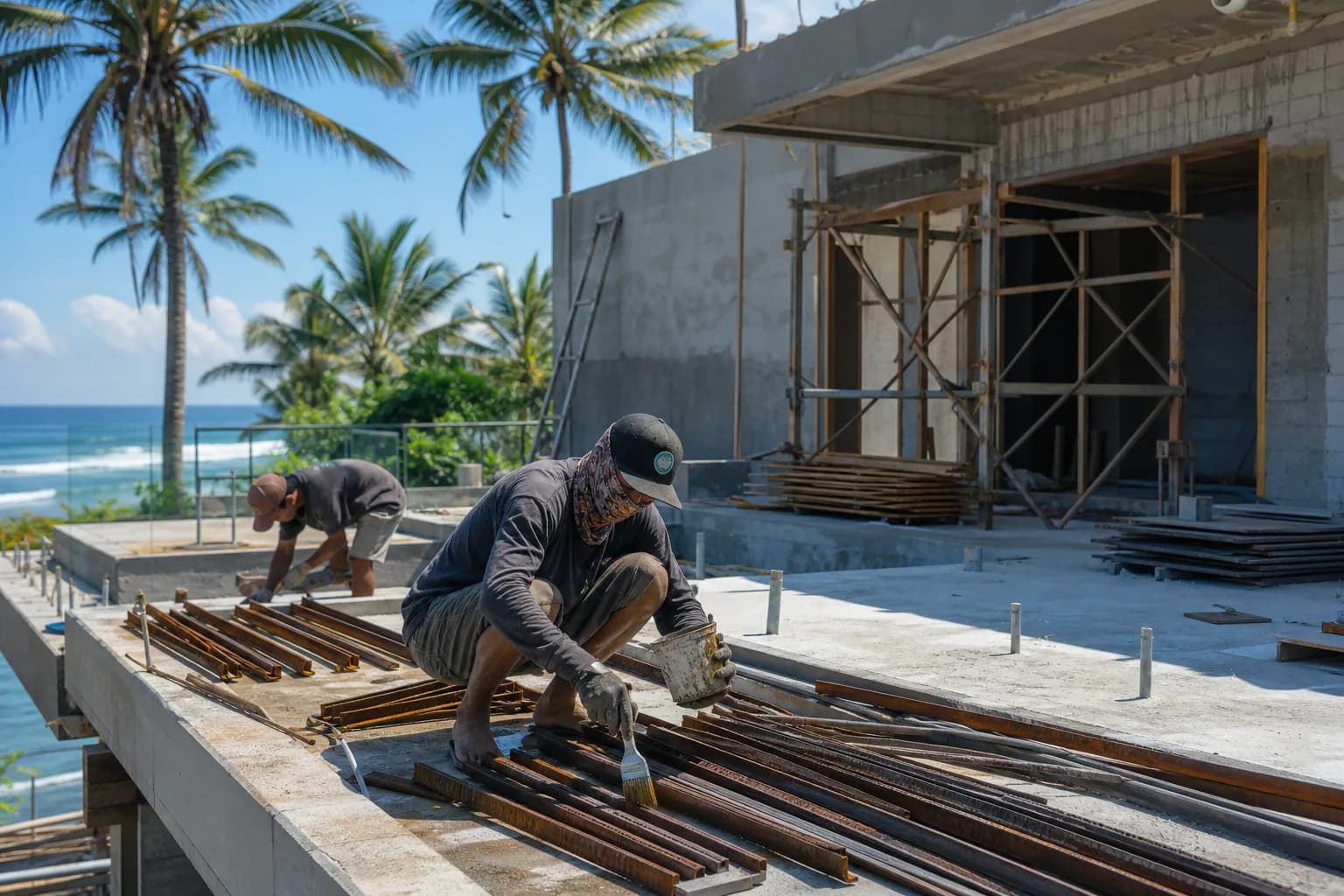
Why Canggu’s Coastal Environment Demands Specialized Corrosion Prevention
Canggu’s beachfront construction sites face an aggressive corrosion environment that destroys standard building materials within 3-5 years. The combination of saltwater spray, high humidity averaging 75-85%, and tropical temperatures creates electrochemical reactions that accelerate metal degradation at rates 400-600% faster than inland Bali locations. Property owners who overlook corrosion prevention during construction face structural failures, aesthetic deterioration, and reconstruction costs exceeding 40% of original build value. Understanding Canggu-specific corrosion mechanisms—from chloride ion penetration in concrete to galvanic corrosion between dissimilar metals—is essential before breaking ground on any coastal villa or commercial project.
Technical Deep Dive: Corrosion Science in Canggu’s Marine Climate
Canggu’s coastal construction zone extends approximately 500 meters inland from the shoreline, where saltwater aerosols remain suspended in air and deposit chloride concentrations exceeding 300mg/m²/day during monsoon seasons. This chloride-rich environment initiates multiple corrosion pathways that compromise structural integrity through distinct mechanisms.
Chloride-Induced Concrete Deterioration
Reinforced concrete structures in Canggu face chloride ion penetration that breaks down the protective alkaline layer surrounding steel reinforcement bars. When chloride concentrations at rebar depth exceed 0.4% by cement weight, depassivation occurs, initiating corrosion that expands steel volume by 600%, creating internal pressures of 15-20 MPa that crack concrete cover. Canggu’s porous coral limestone aggregate—commonly used in local concrete mixes—accelerates this process through increased permeability, allowing chloride penetration rates of 8-12mm annually in unprotected structures.
The corrosion current density in Canggu’s marine atmosphere typically ranges from 0.5-2.0 μA/cm², compared to 0.1-0.5 μA/cm² in inland areas. This translates to steel mass loss rates of 50-200 microns per year for unprotected reinforcement, reducing structural load capacity by 15-25% within the first decade of exposure.
Atmospheric Corrosion of Exposed Metals
Metal building components in Canggu experience continuous wet-dry cycling as salt deposits absorb atmospheric moisture, creating electrolyte films that sustain corrosion even without direct water contact. Mild steel fixtures lose 80-150 microns of thickness annually, while aluminum alloys without proper anodization develop pitting corrosion with penetration rates of 20-40 microns per year. The critical relative humidity threshold for corrosion activation drops from 80% to 60% when salt contamination exceeds 50mg/m² surface density—a condition present year-round within 300 meters of Canggu’s coastline.
Galvanic Corrosion Acceleration
Canggu’s high-conductivity environment intensifies galvanic corrosion when dissimilar metals contact each other. The potential difference between stainless steel fasteners and aluminum window frames can generate corrosion currents exceeding 100 μA/cm² at junction points, causing aluminum degradation rates 10-15 times faster than isolated exposure. The electrolyte film created by salt deposits extends the effective galvanic couple distance from typical 5mm to 25-30mm, meaning protective isolation measures must account for larger separation zones.
Microbiologically Influenced Corrosion
Canggu’s tropical climate supports sulfate-reducing bacteria colonies in foundation zones where groundwater tables fluctuate seasonally. These microorganisms accelerate corrosion of buried steel elements by generating hydrogen sulfide that disrupts protective oxide layers, increasing corrosion rates by 200-400% compared to sterile conditions. Foundation piles and underground utilities require specific biocide treatments and enhanced cathodic protection systems to maintain 25-year design life expectations.
Hidden Risks & Common Mistakes in Canggu Coastal Construction
The most costly mistake in Canggu construction is specifying materials based on Jakarta or Denpasar standards without accounting for marine exposure severity. Standard Grade 40 rebar used successfully 5km inland fails catastrophically within 8-12 years in Canggu beachfront applications, yet 60% of local contractors continue using identical specifications across all Bali locations.
Inadequate Concrete Cover Depth
Indonesian building codes specify 20mm minimum concrete cover for reinforcement, but Canggu’s chloride exposure requires 50-75mm cover depth for 50-year durability. Contractors unfamiliar with marine construction frequently use standard 25mm spacers, resulting in premature rebar corrosion that manifests as concrete spalling within 5-7 years. This oversight alone accounts for 35% of structural repair costs in Canggu properties aged 10-15 years.
Mixing Incompatible Metal Systems
Combining galvanized steel roofing with stainless steel fasteners creates galvanic couples that corrode zinc coating at accelerated rates. The 0.85V potential difference drives corrosion currents that perforate 2mm galvanized sheet within 3-4 years in Canggu’s conductive atmosphere. Proper material compatibility matrices must guide all metal component selections, yet this engineering step is omitted in approximately 70% of villa construction projects.
Insufficient Drainage Design
Water pooling on horizontal surfaces concentrates chloride deposits and extends surface wetness duration from 6 hours to 18+ hours daily. Flat roof sections without 2% minimum slope, improperly detailed window sills, and inadequate foundation drainage create localized corrosion hotspots with degradation rates 300% higher than properly drained areas. Teville’s engineering team identifies drainage deficiencies as the primary accelerant in 45% of premature corrosion failures observed in Canggu renovations.
Neglecting Coating System Compatibility
Applying incompatible coating layers—such as epoxy primers under acrylic topcoats—creates delamination pathways that trap moisture and chlorides against substrate surfaces. These trapped environments generate corrosion rates exceeding uncoated exposure by 150-200%. Proper coating system specification requires matching primer, intermediate, and topcoat chemistries with verified inter-coat adhesion testing, a protocol followed in less than 40% of Canggu construction projects.
Step-by-Step Corrosion Prevention Implementation Process
Phase 1: Site-Specific Corrosion Risk Assessment
Before design development, conduct atmospheric corrosivity classification per ISO 9223 standards. Measure chloride deposition rates using wet candle methodology at multiple site elevations and distances from shoreline. Canggu sites within 200m of breaking waves typically register C5-M (very high marine) classification, requiring the most stringent material specifications. Document groundwater chloride concentrations and pH levels for foundation design—Canggu’s coastal aquifer often contains 3,000-8,000 ppm chlorides compared to 200-500 ppm inland. This assessment phase requires 2-3 weeks and costs $800-1,500 but prevents specification errors that generate $40,000-80,000 in future remediation expenses.
Phase 2: Material Selection and Specification
Specify corrosion-resistant materials based on documented site conditions. For structural steel, require hot-dip galvanization with minimum 610 g/m² zinc coating (85 microns) or stainless steel grades 316L for critical connections. Concrete mixes must incorporate supplementary cementitious materials—30% fly ash or 8-10% silica fume—to reduce permeability below 1,000 coulombs in ASTM C1202 rapid chloride permeability testing. Aluminum components require marine-grade 5000 or 6000 series alloys with factory-applied anodization thickness exceeding 25 microns. Create detailed material compatibility matrices preventing galvanic couple formation, specifying isolation gaskets and coatings at all dissimilar metal junctions.
Phase 3: Design Detailing for Corrosion Control
Implement design features that minimize corrosion exposure: increase concrete cover to 65mm for beams and columns, 50mm for slabs; eliminate horizontal surfaces where water and salt accumulate; detail all penetrations with continuous waterproofing and drainage paths; specify 3-5 degree minimum slopes on all exterior horizontal elements. Design roof overhangs extending 1.2-1.5 meters to reduce direct salt spray on wall surfaces—this single detail reduces facade chloride deposition by 60-70%. Position critical structural connections in protected zones away from direct weather exposure. Teville’s construction methodology integrates these corrosion-resistant details into every coastal project design phase.
Phase 4: Protective Coating Application
Apply multi-layer coating systems to all exposed metal surfaces following ISO 12944 specifications for C5-M environments. Surface preparation requires Sa 2.5 blast cleaning (near-white metal) with surface profile of 50-75 microns. Apply zinc-rich epoxy primer at 75 microns dry film thickness, epoxy intermediate coat at 150 microns, and polyurethane topcoat at 75 microns for total system thickness of 300 microns minimum. Verify coating thickness with electronic gauges at 10 points per square meter, documenting all measurements for warranty compliance. Coating application requires controlled environment with relative humidity below 85% and surface temperature 3°C above dew point—conditions achievable in Canggu during dry season months (May-October) or within temporary enclosures.
Phase 5: Quality Control and Verification Testing
Implement third-party testing protocols verifying corrosion protection measures: concrete chloride permeability testing on trial mixes before production; coating adhesion pull-off testing achieving minimum 5 MPa bond strength; holiday detection on all coating systems using high-voltage spark testing; concrete cover depth verification using electromagnetic covermeters at 5-meter grid intervals. Document all test results in construction quality files, establishing baseline conditions for future maintenance planning.
Realistic Cost Ranges for Canggu Corrosion Prevention
Implementing comprehensive corrosion prevention in Canggu coastal construction adds 12-18% to baseline structural costs but extends maintenance-free service life from 8-12 years to 35-50 years, reducing lifecycle costs by 60-70%. Specific cost increments include:
- Enhanced concrete specifications: Adding supplementary cementitious materials and reducing water-cement ratio increases concrete costs by $15-25 per cubic meter, representing 8-12% premium over standard mixes
- Corrosion-resistant reinforcement: Epoxy-coated rebar costs $850-1,100 per ton versus $650-750 for standard Grade 40, while stainless steel reinforcement ranges $2,800-3,500 per ton for critical applications
- Hot-dip galvanized structural steel: Galvanization adds $180-250 per ton to fabricated steel costs, with typical villa requiring 4-8 tons of structural steel
- Marine-grade aluminum systems: Anodized aluminum window and door systems cost $320-450 per square meter installed versus $180-240 for standard powder-coated aluminum
- Protective coating systems: Three-layer epoxy-polyurethane systems cost $28-42 per square meter of coated surface, with typical 300m² villa requiring 150-200m² of coated metal surfaces
- Increased concrete cover: Additional 30-40mm cover depth increases formwork complexity and concrete volume by 8-12%, adding $3,500-6,000 to typical villa foundation and structural frame
For a 250m² two-bedroom villa in Canggu’s coastal zone, comprehensive corrosion prevention measures add $18,000-28,000 to construction costs but eliminate the $45,000-75,000 structural rehabilitation typically required at year 12-15 in standard construction. Request detailed cost estimation for your specific Canggu project parameters.
Frequently Asked Questions About Canggu Coastal Corrosion Prevention
How far inland from Canggu beach does saltwater corrosion remain a critical concern?
Saltwater corrosion severity in Canggu decreases with distance from shoreline but remains significant up to 800 meters inland during monsoon periods when onshore winds carry salt aerosols. The highest corrosivity zone (ISO C5-M classification) extends 0-250 meters from breaking waves, where chloride deposition exceeds 250mg/m²/day and requires maximum protection measures. The moderate-high zone (C4 classification) extends 250-500 meters, still demanding enhanced specifications beyond standard Indonesian building codes. Beyond 500 meters, corrosivity gradually approaches C3 classification by 800-1,000 meters, though elevated humidity and occasional salt spray still warrant corrosion-conscious design. Site-specific assessment is essential because topography, vegetation barriers, and prevailing wind patterns create localized variations—properties on elevated ground 400 meters inland may experience lower exposure than sea-level sites 600 meters away.
Can existing Canggu properties be retrofitted with corrosion protection, or is prevention only effective during new construction?
Existing structures can receive corrosion mitigation treatments, though effectiveness and cost-efficiency decrease significantly compared to integrated protection during construction. Surface-applied corrosion inhibitors like calcium nitrite or amino-alcohol compounds can penetrate 15-25mm into existing concrete, providing 5-8 years of additional protection for reinforcement not yet actively corroding. Cathodic protection systems using impressed current or sacrificial anodes can arrest ongoing corrosion but require installation costs of $180-280 per square meter of treated surface. External coating systems applied to existing structures provide barrier protection but cannot address chloride contamination already present in concrete matrix. Structural elements showing active corrosion (rust staining, concrete spalling) require removal of deteriorated concrete, rebar cleaning or replacement, and reconstruction with proper cover depth—costs typically reaching $450-750 per square meter of affected area. Teville’s renovation assessment service evaluates existing corrosion damage and determines optimal intervention strategies, though prevention during initial construction remains 60-70% more cost-effective than remediation.
What maintenance schedule should Canggu coastal properties follow to maximize corrosion protection longevity?
Canggu coastal properties require quarterly visual inspections focusing on coating integrity, drainage function, and early corrosion indicators, with comprehensive technical assessments every 24 months. Quarterly inspections should document coating condition on all exposed metal surfaces, checking for chalking, cracking, or delamination; verify drainage systems remain clear and functional; examine concrete surfaces for rust staining or cracking; and remove salt accumulation from horizontal surfaces using freshwater washing. Annual maintenance should include high-pressure freshwater washing of all exterior surfaces to remove chloride deposits, touch-up coating repairs on areas showing degradation, and sealant inspection/renewal at all penetrations and joints. Biennial technical assessments should measure coating thickness on representative surfaces, conduct concrete cover depth verification using covermeters, perform chloride content testing on concrete cores from 3-5 locations, and evaluate structural connections for corrosion initiation. Properties implementing this maintenance protocol maintain protective systems at 85-95% effectiveness throughout 30-40 year service life, while neglected properties experience protection system failure within 12-18 years requiring major rehabilitation.
Are there specific Canggu microclimates where corrosion risk differs significantly from general coastal conditions?
Canggu’s corrosion environment varies substantially based on microclimate factors creating localized high-risk and reduced-risk zones. Properties directly facing prevailing southwest monsoon winds (June-September) experience 40-60% higher chloride deposition than sites with northern or eastern exposure, even at identical distances from shoreline. The Pererenan area north of Canggu Club benefits from dense coconut palm vegetation that filters salt aerosols, reducing effective corrosivity by one ISO classification level compared to open beachfront sites. Conversely, the exposed coastline from Echo Beach to Batu Bolong experiences maximum salt spray impact with minimal vegetation buffering. Elevation significantly affects exposure—properties on the elevated ridge along Jalan Pantai Batu Bolong (15-20 meters above sea level) experience 30-50% lower chloride deposition than sea-level sites 100 meters further inland. Rice field areas with standing water create localized high-humidity zones that extend corrosion-active periods by 3-4 hours daily. Site-specific corrosion assessment identifies these microclimate variations, allowing optimized protection strategies that avoid over-specification in lower-risk zones while ensuring adequate protection in high-exposure areas.
How do Canggu’s volcanic soil conditions interact with saltwater to affect foundation corrosion?
Canggu’s foundation zone consists of volcanic ash deposits and coral limestone layers with groundwater tables fluctuating between 1.5-4 meters depth seasonally, creating complex corrosion conditions for buried structural elements. The volcanic ash contains sulfate concentrations of 800-1,500 ppm that combine with chlorides from saltwater intrusion (3,000-8,000 ppm in coastal aquifer) to create aggressive soil conditions classified as “very severe” per ACI 318 exposure categories. This combination accelerates corrosion of standard concrete through sulfate attack that degrades cement matrix while chlorides attack embedded reinforcement simultaneously. Foundation piles and grade beams require concrete with maximum 0.40 water-cement ratio, minimum 390 kg/m³ cement content using sulfate-resistant Type V cement, and supplementary cementitious materials providing chloride resistance. Buried steel elements need enhanced protection through hot-dip galvanization plus coal tar epoxy coating, or substitution with fiber-reinforced polymer materials immune to electrochemical corrosion. The fluctuating water table creates particularly aggressive conditions through repeated wet-dry cycling that concentrates corrosive species at the waterline elevation—this zone requires 50% thicker protective coatings or cathodic protection systems for steel elements expected to provide 40+ year service life.
What warranty considerations should property owners expect for corrosion protection systems in Canggu construction?
Comprehensive corrosion protection systems in Canggu coastal construction should carry differentiated warranties reflecting material and application quality: hot-dip galvanized steel warrants 15-25 years depending on coating thickness and exposure severity; marine-grade powder-coated or anodized aluminum systems warrant 10-15 years against perforation corrosion; three-layer epoxy-po
 3127 m²9 month(s)from 177.000 USD
Mukunda

Want to calculate?
 4344 m²16 month(s)from 290.000 USD
Radha
 3173 m²6 month(s)from 125.000 USD
TALA FOUR
 172 m²8 month(s)from 120.000 USD
Keshava
 3104 m²11 month(s)from 99.000 USD
TALA 100
 1from 198.000 USD
Private: Haridas Villas
 3124 m²6 month(s)from 123.000 USD
TALA 8
 164 m²7 month(s)from 79.000 USD
Private: Haridas Villas, Tegallalang
 2144 m²11 month(s)from 104.000 USD
Narayana
164 m²7 month(s)from 79.000 USDTALA TWO
 3180 m²7 month(s)from 142.000 USD
Vasudeva
Start With Real Numbers, Not Guesses
Before buying land or finalizing a design, check the realistic build cost range for your project in Bali.
Our team reviews your inputs and gives a grounded estimate.
Available lands
 1600 m²32 min$ 266010Bali, Tabanan
 800 m²5 min$ 295567Bali, Seseh
 1660 m²10 min$ 343448Bali, Kerobokan
 1950 m²7 min$ 150092Bali, Tabanan
 2200 m²3 min$ 183842Bali, Berawa
 660 m²10 min$ 175567Bali, Mengwi
 7900 m²25 min$ 413485Bali, Tabanan
 2115 m²5 min$ 1139547Bali, Pererenan
 1158 m²12 min$ 291996Bali, Mengwi
 2800 m²15 min$ 310345Bali, Tabanan
 7250 m²56 min$ 235714Bali, Tabanan
 3800 m²15 min$ 100616Bali, Pererenan
 2000 m²15 min$ 110837Bali, Karangasem
 1000 m²10 min$ 384852Bali, Canggu
 1000 m²8 min$ 134544Bali, Bukit
Essential Bali build & buy guides
- Bali villa construction cost per m² in 2026
- How much will your villa cost? Calculator
- Building a villa in Bali: the complete guide
- Buying land in Bali: step-by-step for foreigners
- Bali villa investment: yields, risks, returns
- Leasehold vs freehold: what foreigners can own
- Construction defect liability & 10-year warranty
- Bali building codes and construction standards
Related guides
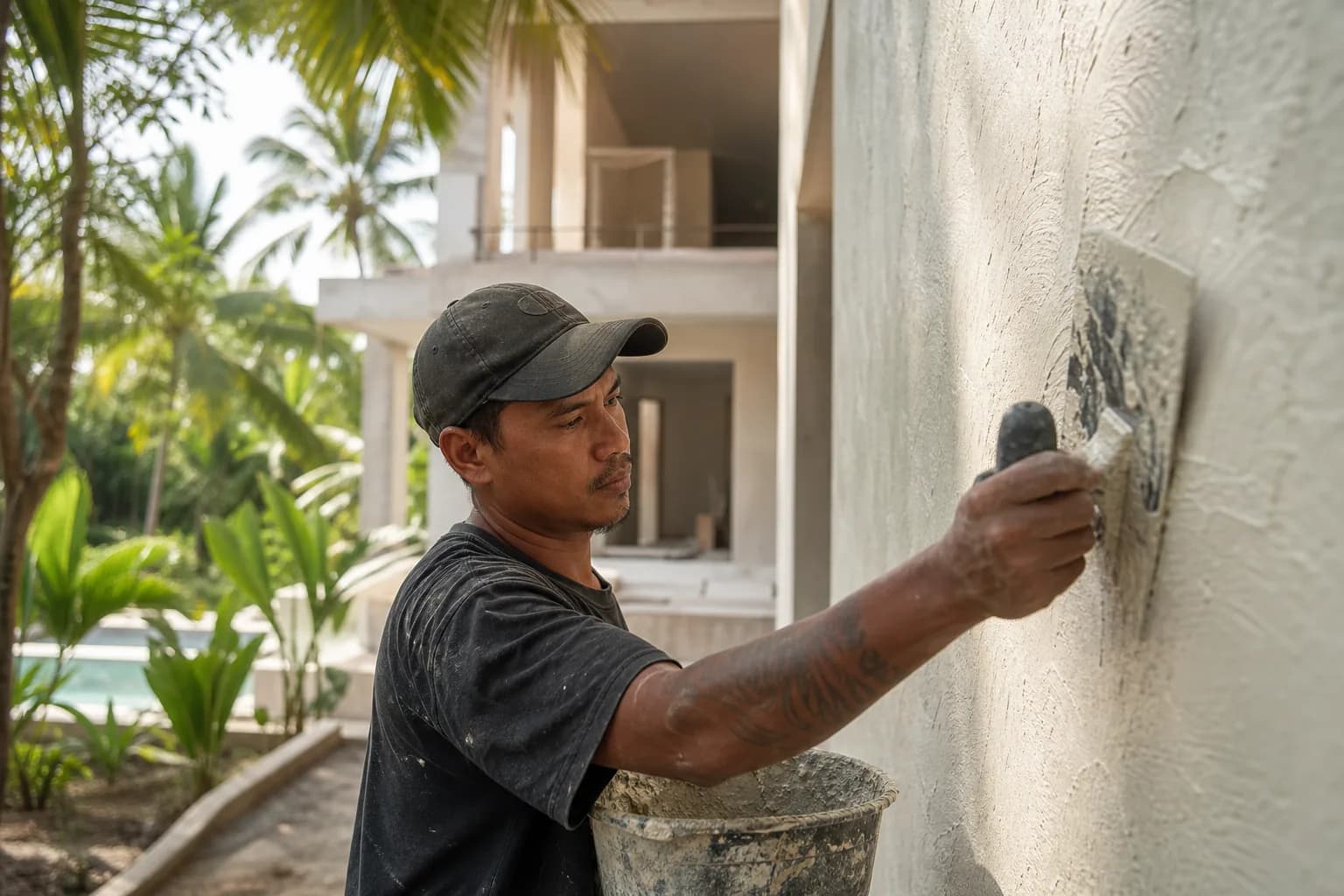
Resin-Infused Plaster Finishes: Anti-Salt Systems Bali
Expert technical guide: Resin-Infused Plaster Finishes: Anti-Salt Systems Bali
8 min read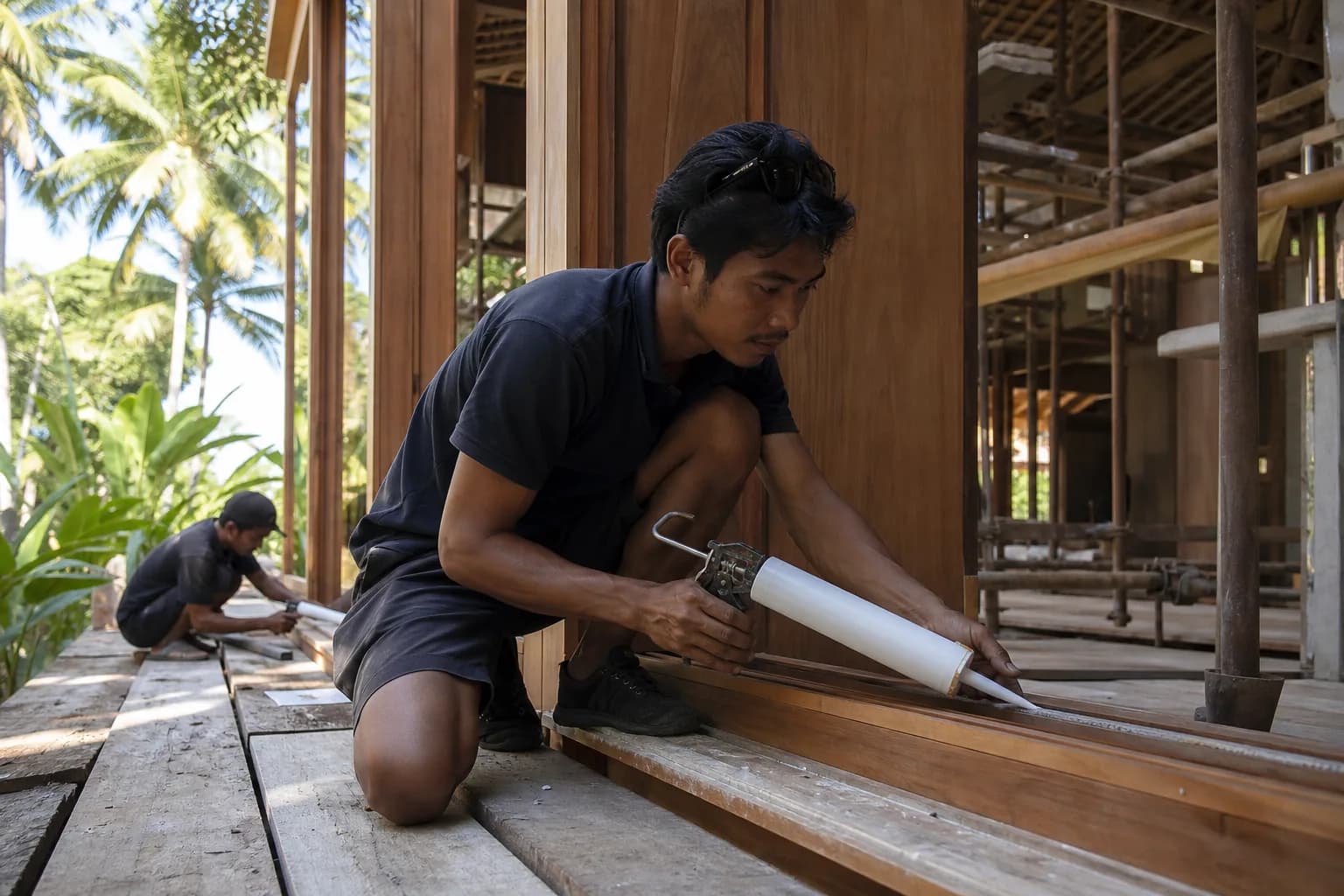
Prefinished Timber Joinery: Silicone Seals Fixings Bali
Professional prefinished timber joinery installation in Bali with silicone seals and fixings for durable weatherproof performance and a premium finish.
10 min read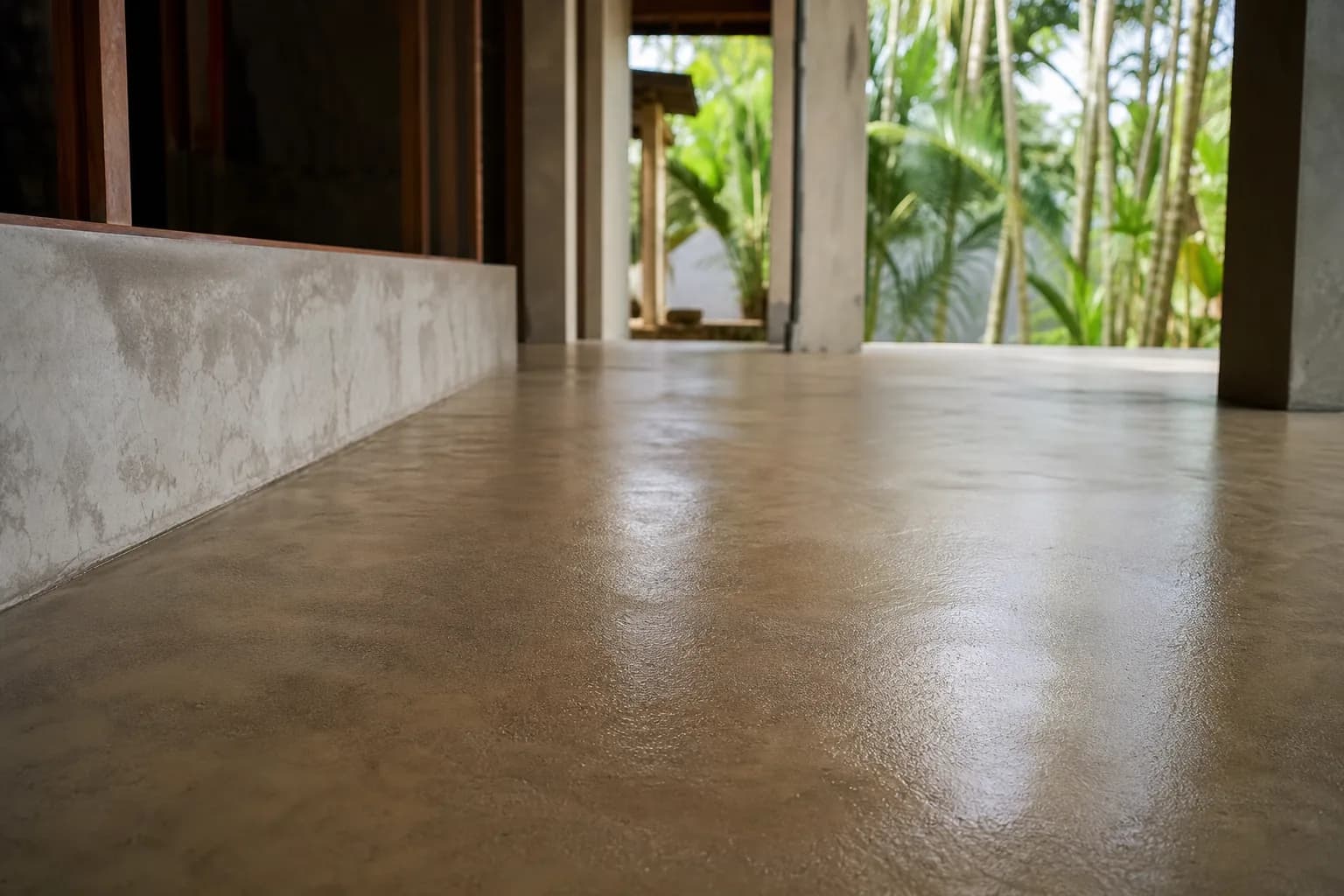
Polished Concrete Microtopping: Surface Prep Sealants Bali
Discover Bali s polished concrete microtopping: expert surface prep, durable sealants, and a flawless finish for modern floors with minimal maintenance.
9 min read