Canggu Beach Erosion Setback Rules Coastal Construction Permits
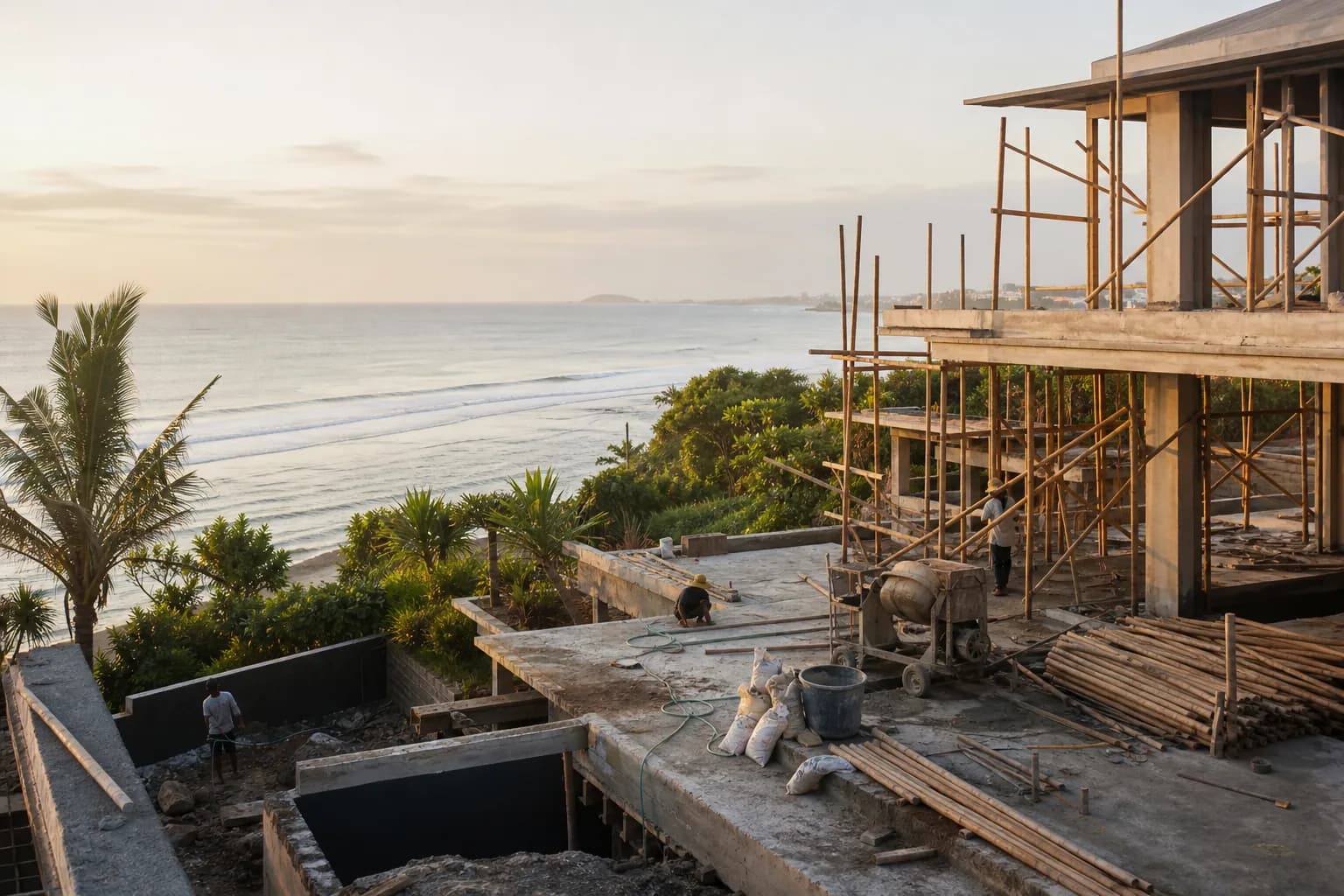
Canggu’s Coastal Setback Crisis: Why Beach Erosion Is Rewriting Construction Rules
Canggu’s beachfront has lost an estimated 15-30 meters of shoreline over the past decade, transforming what were once legal beachfront properties into coastal setback violations. Property owners who purchased land 50 meters from the high-tide line in 2015 now find their villas sitting within the prohibited 100-meter zone as the ocean advances inland. This isn’t theoretical risk—it’s measurable coastal retreat documented by satellite imagery and provincial surveys. The engineering challenge isn’t just about obtaining permits; it’s about understanding whether your intended construction site will remain legally compliant as Canggu’s coastline continues its documented pattern of erosion at 1.5-3 meters annually in vulnerable sections.
The Engineering Reality of Canggu’s Shifting Coastal Setback Boundaries
Bali’s coastal setback regulation mandates that permanent structures remain 100 meters landward from the high-tide line, measured perpendicular to the shoreline. In stable coastal environments, this creates a fixed construction boundary. Canggu presents a fundamentally different engineering scenario: the high-tide line itself migrates inland as beach erosion progresses, effectively expanding the prohibited zone into previously buildable land.
The technical mechanism driving this expansion involves several interconnected factors specific to Canggu’s coastal morphology. The area’s black sand beaches consist of volcanic sediment with lower cohesion than coral-derived white sand, making them more susceptible to wave action and longshore drift. Seasonal monsoon patterns create asymmetric sediment transport, with the northwest monsoon (November-March) generating wave energy that removes more material than the southeast monsoon deposits. Human interventions—seawalls, groins, and harbor structures at nearby Pererenan—have disrupted natural sediment flow patterns, creating erosion hotspots in previously stable beach sections.
From a construction permitting perspective, this creates a moving target. The Spatial Planning Office (Dinas Tata Ruang) determines setback compliance based on current high-tide measurements, but these measurements can shift 2-5 meters between dry and wet season surveys in erosion-affected areas. A property that receives preliminary approval during August (dry season, minimal wave action) may fail final inspection during February (wet season, maximum erosion) if the high-tide line has migrated landward in the interim.
The provincial government’s response has been to implement stricter interpretation protocols. As of 2024-2025, coastal construction permits in designated erosion zones require geotechnical surveys documenting five-year erosion trends, not just current setback measurements. For Canggu properties within 150 meters of the current high-tide line, this means commissioning coastal engineering assessments that analyze historical satellite imagery, seasonal tide data, and sediment transport modeling. These studies typically cost $8,000-$15,000 and take 6-10 weeks to complete—adding significant time and expense before construction can even be considered.
The structural engineering implications extend beyond permit acquisition. Properties that technically comply with the 100-meter setback but sit within 120-130 meters face elevated foundation requirements. Coastal proximity means higher groundwater salinity, increased soil moisture fluctuation, and potential for saltwater intrusion during king tides. Foundation systems must account for these factors through enhanced waterproofing, corrosion-resistant reinforcement, and deeper pile systems that reach stable soil layers below the water table. For a typical 300-square-meter villa, these coastal-specific foundation upgrades add $25,000-$40,000 compared to inland construction specifications.
The legal framework compounds these technical challenges. Bali’s coastal protection law (Provincial Regulation No. 16/2009, reinforced by updates through 2024) grants authorities discretionary power to deny permits in areas experiencing “active erosion,” even if current setback measurements technically comply. This discretionary authority means that two adjacent properties with identical setback distances may receive different permit outcomes based on the reviewing engineer’s assessment of erosion risk. There is no standardized definition of “active erosion” in the regulatory text, creating interpretation variability between district offices and individual permit reviewers.
Hidden Risks Property Buyers Consistently Underestimate in Canggu Coastal Zones
The most financially devastating mistake involves purchasing land based on outdated survey data. Sellers frequently provide topographic surveys conducted 2-3 years prior, showing setback compliance that no longer reflects current conditions. In Canggu’s Berawa and Batu Bolong beach sections, we’ve documented cases where the high-tide line migrated 8-12 meters landward between the seller’s survey (2021) and the buyer’s permit application (2024), transforming compliant land into unbuildable coastal zone. The buyer absorbs the full loss—typically $180,000-$350,000 for beachfront parcels—with no legal recourse against the seller for providing technically accurate but temporally obsolete documentation.
Another critical oversight involves misunderstanding the difference between IMB (building permit) approval and ongoing compliance obligations. Obtaining an IMB for a property at 105 meters from the high-tide line doesn’t create permanent legal protection if erosion subsequently reduces that distance to 95 meters. The provincial government has established precedent for requiring structural modifications or partial demolition of previously permitted buildings that fall into setback violation due to coastal retreat. The property owner bears full responsibility for monitoring ongoing compliance—there is no government notification system alerting owners when erosion brings their structure into violation.
The insurance and financing implications receive insufficient attention during purchase decisions. International property insurance providers increasingly exclude coastal erosion damage from standard policies for Bali beachfront properties, or apply exclusion zones for structures within 150 meters of eroding coastlines. Indonesian banks similarly apply higher risk premiums or outright lending restrictions for properties in designated coastal erosion zones, limiting future resale liquidity even if the structure remains legally compliant.
Step-by-Step Process for Navigating Canggu Coastal Construction Permits
Phase 1: Coastal Erosion Risk Assessment (Weeks 1-8)
Before land purchase or design commitment, commission an independent coastal engineering study from a firm with specific Bali erosion modeling experience. This study should include: analysis of 10-year satellite imagery showing shoreline position changes; seasonal high-tide line mapping across both monsoon periods; sediment transport modeling for your specific beach section; and projected erosion scenarios over a 20-year timeframe. Cost range: $8,000-$15,000. This investment prevents catastrophic losses from purchasing land in active erosion zones that will never receive construction permits.
Phase 2: Regulatory Pre-Clearance (Weeks 9-14)
Submit your coastal engineering study to the Badung Regency Spatial Planning Office (for most Canggu locations) along with current topographic survey and preliminary site plans. Request formal written determination of setback compliance and permit eligibility before proceeding with land purchase or detailed design. This pre-clearance process costs $1,200-$2,500 in administrative and consultant fees but provides documented evidence of buildability. Verbal assurances from land agents or sellers have zero legal value—only written determination from the permitting authority establishes construction feasibility.
Phase 3: Enhanced Foundation Engineering (Weeks 15-20)
For properties within 120 meters of the high-tide line, engage structural engineers with coastal construction specialization to design foundation systems addressing saltwater exposure, high water tables, and soil instability. Standard Bali villa foundation specifications are inadequate for coastal proximity. Required enhancements typically include: marine-grade concrete with reduced permeability; epoxy-coated or stainless steel reinforcement; deeper pile foundations (4-6 meters vs. 2-3 meters inland); comprehensive waterproofing membranes; and drainage systems managing groundwater intrusion. Budget an additional 15-25% above standard foundation costs.
Phase 4: IMB Application with Coastal Documentation (Weeks 21-32)
The standard IMB application process extends 4-8 weeks longer for coastal properties due to additional review requirements. Your submission must include: the coastal engineering study; geotechnical investigation with groundwater analysis; foundation design calculations addressing marine exposure; and environmental impact assessment (AMDAL or UKL-UPL depending on project scale). Processing fees for coastal properties run $3,500-$6,500, approximately 40% higher than inland equivalents due to specialist review requirements. Expect multiple revision requests—coastal permit applications average 2.3 revision cycles vs. 1.4 for inland properties.
Phase 5: Ongoing Compliance Monitoring (Post-Construction)
Establish annual monitoring protocol to document ongoing setback compliance as erosion continues. This involves commissioning yearly topographic surveys measuring distance from structure to current high-tide line, with surveys conducted during wet season (January-February) when erosion is maximum. Annual survey cost: $800-$1,500. Maintain documented compliance record in case of future government audits or enforcement actions. If erosion reduces your setback distance below 100 meters, immediately engage legal counsel specializing in coastal property law—early intervention provides more remediation options than waiting for enforcement notice.
Realistic Cost Ranges for Canggu Coastal Construction Compliance
Pre-construction coastal assessment and permitting costs for Canggu beachfront properties range $15,000-$28,000 beyond standard inland permit expenses. This includes coastal engineering studies ($8,000-$15,000), enhanced geotechnical investigation ($3,500-$6,000), regulatory pre-clearance consultation ($1,200-$2,500), and elevated IMB processing fees ($3,500-$6,500). These are unavoidable costs for properties within 150 meters of the current high-tide line in erosion-affected areas.
Foundation system upgrades for coastal proximity add $25,000-$40,000 for a typical 300-square-meter villa, representing 18-25% premium over inland foundation costs. This covers marine-grade concrete specifications, corrosion-resistant reinforcement, deeper pile systems, comprehensive waterproofing, and enhanced drainage infrastructure. Attempting to use standard inland foundation specifications in coastal zones results in accelerated concrete degradation, reinforcement corrosion, and structural integrity issues within 5-8 years.
Timeline extensions for coastal construction permits add 8-16 weeks to standard permitting schedules. The coastal engineering study alone requires 6-10 weeks, followed by extended regulatory review periods for coastal-specific documentation. For projects requiring environmental impact assessments (structures over 500 square meters or within 50 meters of erosion zones), add an additional 12-20 weeks. Total pre-construction timeline for compliant coastal projects: 32-48 weeks from initial assessment to construction commencement, compared to 16-24 weeks for inland properties.
Violation remediation costs—if erosion brings a previously compliant structure into setback violation—range from $45,000 for partial structural modifications to $180,000-$220,000 for full demolition and reconstruction landward of the setback line. These costs fall entirely on the property owner with no government compensation or assistance programs currently available.
Frequently Asked Questions: Canggu Coastal Setback Compliance
Can I obtain a variance or exemption from the 100-meter setback rule for my Canggu beachfront property?
Variance mechanisms exist in theory but are extraordinarily rare in practice for new construction. The provincial regulation allows exemptions for “strategic tourism infrastructure” or “public benefit facilities,” categories that do not include private residential villas. Between 2020-2024, Badung Regency granted fewer than 12 coastal setback variances, primarily for resort developments with demonstrated economic impact exceeding $15 million and employment creation above 200 positions. Private villa projects—regardless of investment value—do not qualify under current interpretation. Properties claiming existing structures can apply for “legalization” permits, but this requires proving the structure predates the 2009 coastal protection regulation and has maintained continuous occupancy, a difficult evidentiary standard. Legal consultation for variance applications costs $8,000-$15,000 with success probability below 5% for residential projects.
How do I determine if my intended Canggu property is in an active erosion zone before purchase?
Commission an independent coastal engineering assessment analyzing 10-year erosion trends using satellite imagery, historical surveys, and seasonal monitoring data. Reputable coastal engineering firms in Bali include those with published erosion studies and university affiliations—avoid general civil engineering firms without specific coastal morphology expertise. The assessment should quantify annual erosion rates for your specific beach section, identify seasonal variation patterns, and project future shoreline positions under different scenarios. Cost: $8,000-$15,000, timeline: 6-10 weeks. Do not rely on seller-provided surveys older than 6 months or verbal assurances from real estate agents. The Badung Regency Spatial Planning Office maintains erosion zone maps, but these are updated irregularly and may not reflect current conditions. Your independent assessment provides legally defensible documentation of due diligence if future disputes arise.
What happens if beach erosion causes my legally-permitted villa to fall into setback violation after construction?
You become responsible for bringing the property back into compliance, either through structural modifications, partial demolitio
 3104 m²11 month(s)from 99.000 USD
TALA 100
 1from 198.000 USD
Private: Haridas Villas

Want to calculate?
 172 m²8 month(s)from 120.000 USD
Keshava
 3173 m²6 month(s)from 125.000 USD
TALA FOUR
 3124 m²6 month(s)from 123.000 USD
TALA 8
 164 m²7 month(s)from 79.000 USD
TALA TWO
164 m²7 month(s)from 79.000 USDPrivate: Haridas Villas, Tegallalang
 3127 m²9 month(s)from 177.000 USD
Mukunda
 3180 m²7 month(s)from 142.000 USD
Vasudeva
 2144 m²11 month(s)from 104.000 USD
Narayana
 4344 m²16 month(s)from 290.000 USD
Radha
Start With Real Numbers, Not Guesses
Before buying land or finalizing a design, check the realistic build cost range for your project in Bali.
Our team reviews your inputs and gives a grounded estimate.
Available lands
 550 m²15 min$ 164594Bali, Mengwi
 500 m²10 min$ 107143Bali, Tabanan
 5000 m²8 min$ 424877Bali, Ungasan
 7900 m²25 min$ 413485Bali, Tabanan
 1230 m²15 min$ 132543Bali, Tegallalang
 300 m²55 min$ 32475Bali, Tegelalang
 3000 m²15 min$ 1246921Bali, Tabanan
 1533 m²5 min$ 165666Bali, Cepaka
 515 m²7 min$ 570813Bali, Canggu
 10000 m²19 min$ 232759Bali, Buleleng
 2500 m²5 min$ 609606Bali, Kedungu
 2000 m²15 min$ 261700Bali, Babakan
 7500 m²5 min$ 206281Bali, Kedungu
 2200 m²15 min$ 508005Bali, Canggu
 3100 m²15 min$ 257697Bali, Tegallalang
Essential Bali build & buy guides
- Bali villa construction cost per m² in 2026
- How much will your villa cost? Calculator
- Building a villa in Bali: the complete guide
- Buying land in Bali: step-by-step for foreigners
- Bali villa investment: yields, risks, returns
- Leasehold vs freehold: what foreigners can own
- Construction defect liability & 10-year warranty
- Bali building codes and construction standards
Related guides
Sanur and Nusa Dua vs Canggu: Stability Plays vs Hype
Canggu gets the headlines; Sanur and Nusa Dua quietly deliver steadier returns to a different kind of buyer. An honest 2026 comparison of the stability markets against the hype market — prices, demand drivers, oversupply risk, and who should buy where.
7 min read
Ubud and the Wellness Market: Buying or Building for Retreats
Ubud is Bali's wellness capital, and retreat-focused property behaves differently from beach villas: longer stays, group bookings, lower volatility. Here is what the market rewards, what zoning allows, and what it costs to buy or build a retreat property in 2026.
8 min read
Buying and Building on the Bukit: Uluwatu, Bingin and Balangan from a Buyer's Seat
A buyer's-seat 2026 guide to the Bukit peninsula — Uluwatu, Bingin and Balangan land prices, the water problem nobody budgets, cliff setbacks after the 2025 Bingin demolitions, and how to build there properly.
7 min read