Bukit Peninsula Septic Tank Rules Percolation Test Costs Bali
Why Bukit Peninsula Septic Tank Capacity Rules Determine Your Villa’s Legal Viability
The Bukit Peninsula’s limestone geology and high water table create unique wastewater management challenges that many villa developers discover too late. Unlike Bali’s volcanic soil regions, Bukit’s porous karst formations require specialized septic system engineering that directly impacts your construction permit approval, operational costs, and long-term environmental compliance. When soil percolation rates fail to meet Indonesian wastewater standards (SNI 03-2398-2002), your project faces mandatory redesign, alternative treatment systems costing 40-60% more than conventional septic tanks, or in extreme cases, site abandonment. Understanding Bukit-specific capacity calculations and percolation testing protocols before land purchase prevents costly engineering surprises that can delay villa completion by 4-8 months.
Technical Deep Dive: Bukit Peninsula Septic Engineering Requirements
Indonesian Wastewater Standards Applied to Bukit Geology
Bali’s wastewater management falls under national regulation Peraturan Menteri Pekerjaan Umum No. 16/PRT/M/2008 and technical standard SNI 03-2398-2002, which mandate minimum septic tank capacity based on occupancy and daily water consumption. For residential villas, the calculation follows: Tank Volume (liters) = Number of Occupants × Daily Water Use (120-150 liters/person) × Retention Time (2-3 days). A standard 3-bedroom villa with 8-person capacity requires minimum 2,880-liter (760-gallon) septic tank volume, though Bukit Peninsula projects typically install 3,000-4,000 liter systems to accommodate tourist occupancy patterns and account for reduced soil absorption rates.
The Bukit’s limestone substrate creates three critical engineering variables absent in other Bali regions. First, percolation rates vary dramatically within 50-meter distances—cliff-edge properties may show 5mm/hour absorption (requiring alternative systems), while inland parcels 200 meters away achieve 25mm/hour (acceptable for conventional leach fields). Second, the shallow water table (often 3-8 meters depth during wet season) mandates elevated septic tank placement and specialized drainage field design to prevent groundwater contamination. Third, karst fissures can create unpredictable drainage patterns where effluent migrates laterally rather than vertically, potentially affecting neighboring properties and triggering environmental violations under Peraturan Daerah Provinsi Bali No. 5 Tahun 2011.
Percolation Testing Protocols for Bukit Sites
Professional percolation testing in Bukit Peninsula follows modified procedures accounting for limestone geology. Standard protocol requires excavating 3-5 test pits to proposed leach field depth (typically 1.2-1.8 meters), pre-soaking for 24 hours to simulate saturated conditions, then measuring water level drop over 60-minute intervals. Bukit sites demand additional deep-bore testing to 4-6 meters to identify subsurface fissures and water table proximity—critical data that surface perc tests miss. Acceptable percolation rates for conventional septic systems range 15-60mm/hour; rates below 10mm/hour require engineered sand filters or aerobic treatment units, while rates exceeding 100mm/hour indicate excessive drainage risking groundwater pollution.
Timing significantly impacts test accuracy. Conducting percolation tests during Bukit’s dry season (May-October) can yield falsely optimistic results, as water tables drop 2-4 meters and soil moisture decreases. Responsible engineering firms like those partnering with Teville’s construction process conduct wet-season verification testing (December-March) to capture worst-case drainage conditions. This dual-season approach prevents the common scenario where septic systems approved based on dry-season data fail during monsoon months, causing effluent surfacing, odor issues, and potential health department citations.
Capacity Calculations for Tourist Villa Operations
Tourist villas face different capacity requirements than residential homes due to occupancy fluctuations and higher water consumption. A 4-bedroom villa marketed for 8-10 guests requires septic capacity calculated at 150 liters/person/day (accounting for multiple daily showers, pool use, and laundry), yielding 4,500-liter minimum tank volume. However, Bukit’s limited soil absorption capacity often necessitates oversizing by 30-50% to prevent system overload during peak occupancy. This translates to 6,000-7,000 liter septic tanks for mid-size villas—significantly larger than the 3,000-liter systems common in Canggu or Ubud where volcanic soil provides superior drainage.
The leach field sizing follows equally stringent calculations. Indonesian standards require 2.5-4 square meters of drainage field per person for soil with 20-30mm/hour percolation rates. An 8-person villa in Bukit with measured 22mm/hour perc rate needs minimum 28 square meters of leach field area, typically configured as parallel trenches 0.6 meters wide, 1.5 meters deep, spaced 2 meters apart. Properties with marginal percolation (12-18mm/hour) may require 40-50 square meters of drainage field, consuming significant land area and potentially conflicting with pool placement, garden design, or setback requirements.
Hidden Risks & Mistakes in Bukit Septic System Planning
The most expensive mistake occurs when developers purchase Bukit land without preliminary percolation assessment, assuming all sites support conventional septic systems. Approximately 15-20% of Bukit Peninsula parcels—particularly those within 150 meters of cliff edges in Uluwatu, Pecatu, and Bingin—exhibit percolation rates below 10mm/hour, requiring alternative treatment systems costing IDR 80-150 million (USD 5,000-9,500) versus IDR 35-60 million for standard septic installations. This cost differential, combined with increased maintenance requirements, fundamentally alters project economics and should inform land acquisition decisions.
Undersizing septic capacity represents another critical error. Many contractors default to 2,500-3,000 liter tanks regardless of villa size, creating systems that function adequately during construction and initial occupancy but fail within 12-18 months under tourist rental loads. Symptoms include slow drains, sewage odors, and premature tank filling requiring monthly pumping instead of annual service. Retrofitting larger capacity after construction completion costs 3-4 times initial installation expense due to excavation complexity, landscaping restoration, and potential structural impacts to completed foundations or pools.
Ignoring wet-season water table elevation causes long-term operational failures. Bukit’s water table can rise 3-5 meters during extended monsoon periods, submerging improperly positioned septic tanks and leach fields. Submerged systems lose treatment capacity as anaerobic bacteria die, and effluent may surface in gardens or flow toward lower elevations. Proper engineering positions tank bases minimum 1.5 meters above wet-season water table—data obtainable only through seasonal monitoring or consultation with experienced local engineers familiar with specific micro-regions within Bukit Peninsula.
Step-by-Step Process: Bukit Septic System Compliance
Phase 1: Pre-Purchase Site Assessment (2-3 Weeks)
Before finalizing land acquisition, commission preliminary percolation testing from licensed environmental consultants (biaya approximately IDR 8-15 million for comprehensive assessment). This involves excavating 3-5 test pits across the proposed building envelope, conducting standard perc tests, and drilling 1-2 exploratory bores to 6-meter depth to identify water table and subsurface geology. Request wet-season water table data from neighboring properties or local desa records. Document results in technical report including GPS-mapped perc rates, soil classification, and preliminary septic system recommendations. This data informs land negotiation—properties requiring engineered treatment systems justify 8-12% price reduction reflecting increased development costs.
Phase 2: Integrated Design Development (3-4 Weeks)
During architectural design, coordinate septic system placement with villa layout, pool location, and landscape features. Position septic tanks minimum 5 meters from building foundations, 15 meters from wells or water sources, and 3 meters from property boundaries per Indonesian building code. Design leach fields in areas with optimal percolation rates (identified in Phase 1 testing) while maintaining 10-meter setback from pools and 5-meter clearance from large trees. For marginal sites, evaluate alternative systems: sand filter beds (add IDR 45-70 million), aerobic treatment units (add IDR 85-120 million), or constructed wetlands (add IDR 60-95 million). Teville’s villa concepts integrate septic engineering during initial design phases, preventing costly redesigns during permit application.
Phase 3: Permit Documentation & Approval (6-10 Weeks)
Submit septic system plans as component of IMB (Izin Mendirikan Bangunan) application to Badung Regency DPMPTSP office. Required documentation includes: site plan showing septic tank and leach field locations with setback dimensions, technical drawings with tank capacity calculations, percolation test results from certified laboratory, and environmental impact assessment for systems exceeding 5,000-liter capacity. Badung authorities increasingly scrutinize Bukit Peninsula wastewater plans due to groundwater protection concerns, often requesting additional hydrogeological studies for properties near coastal cliffs or within 500 meters of beaches. Budget 8-12 weeks for review and approval, with possible requests for design modifications if initial plans show inadequate capacity or improper placement.
Phase 4: Installation & Verification (2-3 Weeks)
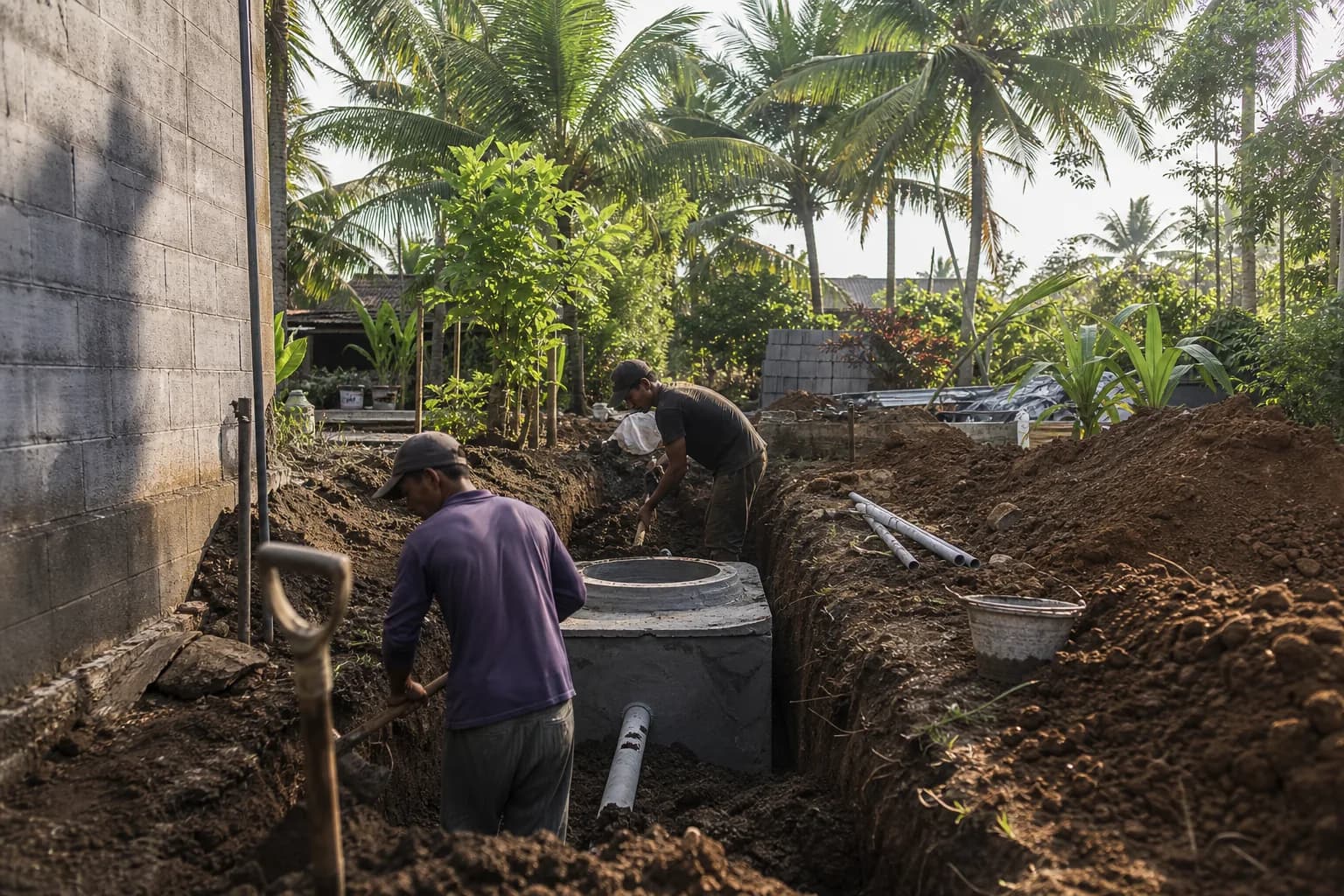
Septic system installation occurs during early construction phases, typically after foundation completion but before structural framing. Excavation depths range 2.5-3.5 meters for tank placement plus 1.5-2 meters for leach field trenches. Bukit’s limestone requires specialized excavation equipment—expect rock-breaking costs adding IDR 8-15 million for difficult sites. Install tanks with proper inlet/outlet baffles, ventilation pipes, and access manholes per SNI specifications. Leach field construction uses 20-40mm gravel bedding with perforated distribution pipes, covered with geotextile fabric and backfilled. Conduct water-tightness testing (filling tank and monitoring for leaks over 24 hours) before backfilling. Request inspection from building department before covering—some jurisdictions require photographic documentation of completed installation prior to concealment.
Realistic Numbers & Timeframes for Bukit Septic Projects
Percolation testing costs in Bukit Peninsula range IDR 8-18 million (USD 500-1,150) depending on site accessibility, number of test locations, and whether deep-bore investigation is included. Basic 3-pit surface testing costs IDR 8-10 million, while comprehensive assessment with 5 test locations plus two 6-meter exploratory bores runs IDR 15-18 million. Wet-season verification testing adds IDR 4-6 million. These costs represent essential due diligence—the IDR 15 million investment can prevent IDR 80-150 million in alternative system costs or identify deal-breaking site constraints before purchase.
Standard septic system installation (3,000-4,000 liter capacity with conventional leach field) costs IDR 35-60 million (USD 2,200-3,800) in Bukit Peninsula. This includes excavation, precast concrete tank, distribution box, 30-40 square meters of leach field with gravel and piping, and backfilling. Rocky sites requiring hydraulic breakers add IDR 10-18 million. Larger capacity systems (5,000-7,000 liters) for tourist villas range IDR 65-95 million. Alternative systems for poor-percolation sites cost significantly more: sand filter systems IDR 80-125 million, aerobic treatment units IDR 120-180 million, constructed wetlands IDR 85-140 million.
Timeline from percolation testing through operational system spans 14-20 weeks: initial testing (2-3 weeks), design integration (3-4 weeks), permit approval (6-10 weeks), installation (2-3 weeks). Projects requiring wet-season verification testing add 4-6 months to accommodate seasonal monitoring. Expedited permitting through experienced consultants can reduce approval time to 4-6 weeks but rarely less due to mandatory technical review periods. Teville’s cost estimation process includes site-specific septic engineering in preliminary budgets, preventing mid-construction surprises.
Frequently Asked Questions: Bukit Septic Systems
Do all Bukit Peninsula properties require percolation testing before construction?
While not explicitly mandated by Badung Regency for all residential projects, percolation testing is effectively required for proper septic system design per SNI 03-2398-2002 technical standards. Building departments increasingly request perc test documentation during IMB review, particularly for properties in environmentally sensitive zones (within 500m of coastline, near groundwater recharge areas). More importantly, constructing without perc testing creates significant risk of system failure and expensive post-construction remediation. Responsible developers conduct testing during due diligence phase, treating the IDR 8-15 million cost as essential site characterization rather than optional expense.
What happens if my Bukit land fails percolation testing?
Percolation rates below 10mm/hour don’t necessarily prevent development but require alternative wastewater treatment systems. Options include: engineered sand filter beds (adding IDR 45-70 million to costs), aerobic treatment units with mechanical aeration (adding IDR 85-120 million), or constructed wetland systems (adding IDR 60-95 million). Some developers negotiate land price reductions of 8-15% when perc testing reveals poor drainage, as these costs materially impact project economics. In extreme cases with percolation below 3mm/hour combined with high water table, sites may require connection to municipal sewer systems (where available in developed Bukit areas) or prove unsuitable for development without prohibitively expensive engineered solutions.
How does Bukit’s limestone geology affect septic tank longevity?
Limestone’s alkaline chemistry (pH 7.5-8.5) act
 172 m²8 month(s)from 120.000 USD
Keshava

Want to calculate?
 3104 m²11 month(s)from 99.000 USD
TALA 100
 2144 m²11 month(s)from 104.000 USD
Narayana
 3127 m²9 month(s)from 177.000 USD
Mukunda
 164 m²7 month(s)from 79.000 USD
TALA TWO
164 m²7 month(s)from 79.000 USDPrivate: Haridas Villas, Tegallalang
 4344 m²16 month(s)from 290.000 USD
Radha
 3124 m²6 month(s)from 123.000 USD
TALA 8
 3173 m²6 month(s)from 125.000 USD
TALA FOUR
 1from 198.000 USD
Private: Haridas Villas
 3180 m²7 month(s)from 142.000 USD
Vasudeva
Start With Real Numbers, Not Guesses
Before buying land or finalizing a design, check the realistic build cost range for your project in Bali.
Our team reviews your inputs and gives a grounded estimate.
Available lands
 680 m²15 min$ 110751Bali, Pererenan
 1362 m²15 min$ 335468Bali, Tumbak
 2130 m²10 min$ 495776Bali, Pecatu
 2000 m²15 min$ 523000Bali, Canggu
 1200 m²2 min$ 155172Bali, Klungkung
 1533 m²5 min$ 165666Bali, Cepaka
 515 m²7 min$ 570813Bali, Canggu
 1000 m²10 min$ 123154Bali, Jimbaran
 2200 m²15 min$ 508005Bali, Canggu
 1950 m²7 min$ 150092Bali, Tabanan
 500 m²10 min$ 107143Bali, Tabanan
 600 m²10 min$ 206897Bali, Canggu
 4270 m²10 min$ 394397Bali, Ubud
 7000 m²36 min$ 284483Bali, Gianyar
 1700 m²10 min$ 632257Bali, Kuta
Essential Bali build & buy guides
- Bali villa construction cost per m² in 2026
- How much will your villa cost? Calculator
- Building a villa in Bali: the complete guide
- Buying land in Bali: step-by-step for foreigners
- Bali villa investment: yields, risks, returns
- Leasehold vs freehold: what foreigners can own
- Construction defect liability & 10-year warranty
- Bali building codes and construction standards
Related guides
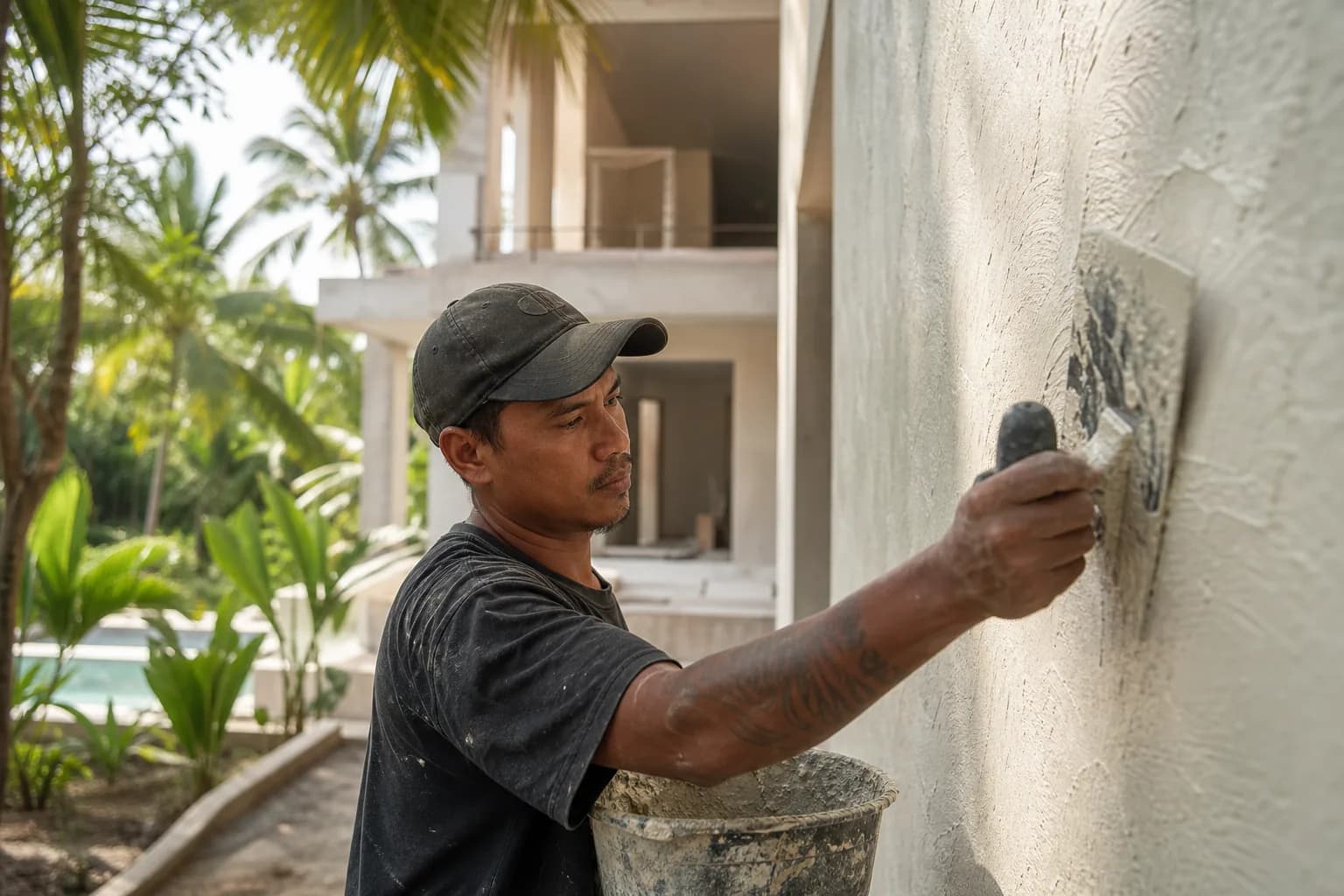
Resin-Infused Plaster Finishes: Anti-Salt Systems Bali
Expert technical guide: Resin-Infused Plaster Finishes: Anti-Salt Systems Bali
8 min read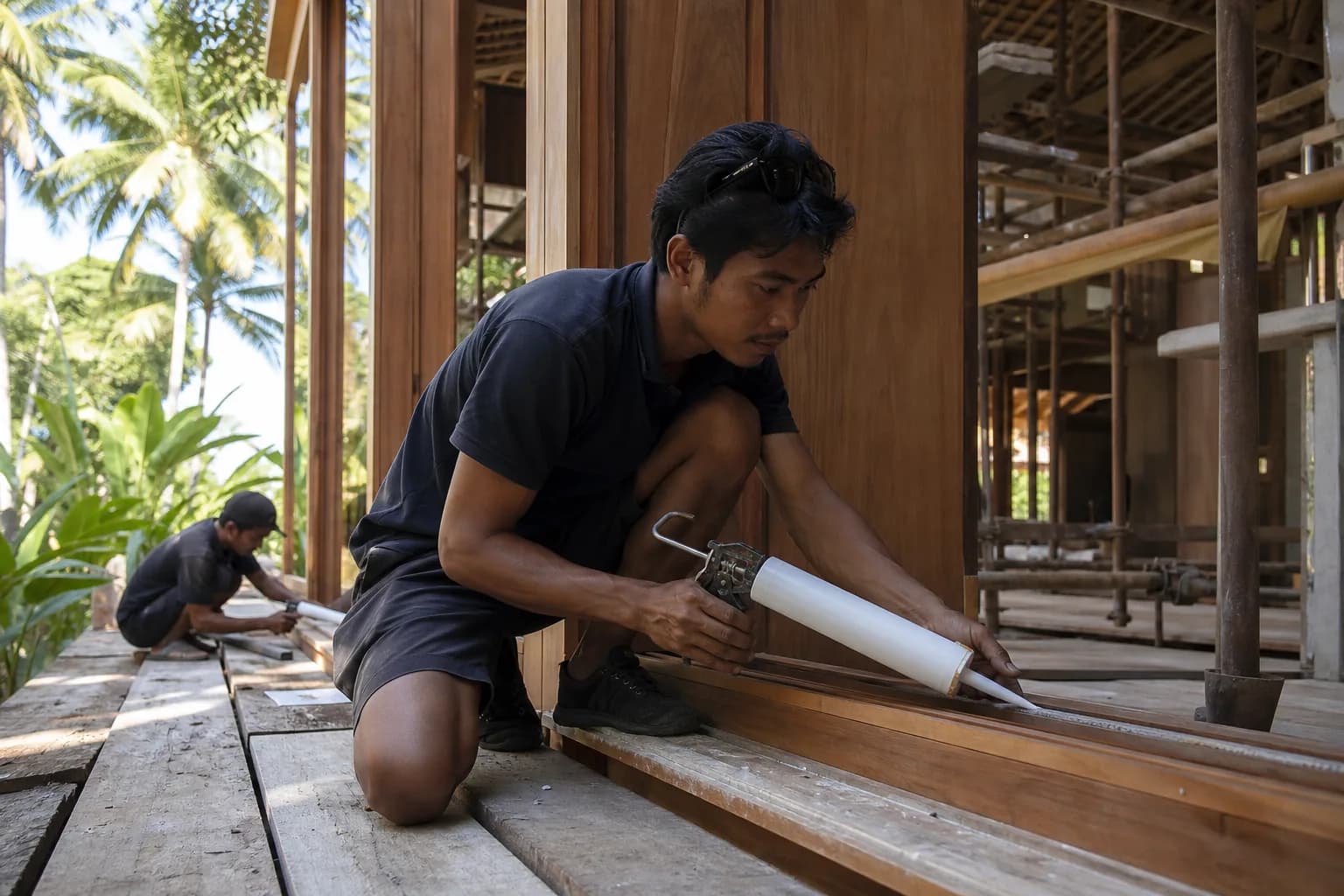
Prefinished Timber Joinery: Silicone Seals Fixings Bali
Professional prefinished timber joinery installation in Bali with silicone seals and fixings for durable weatherproof performance and a premium finish.
10 min read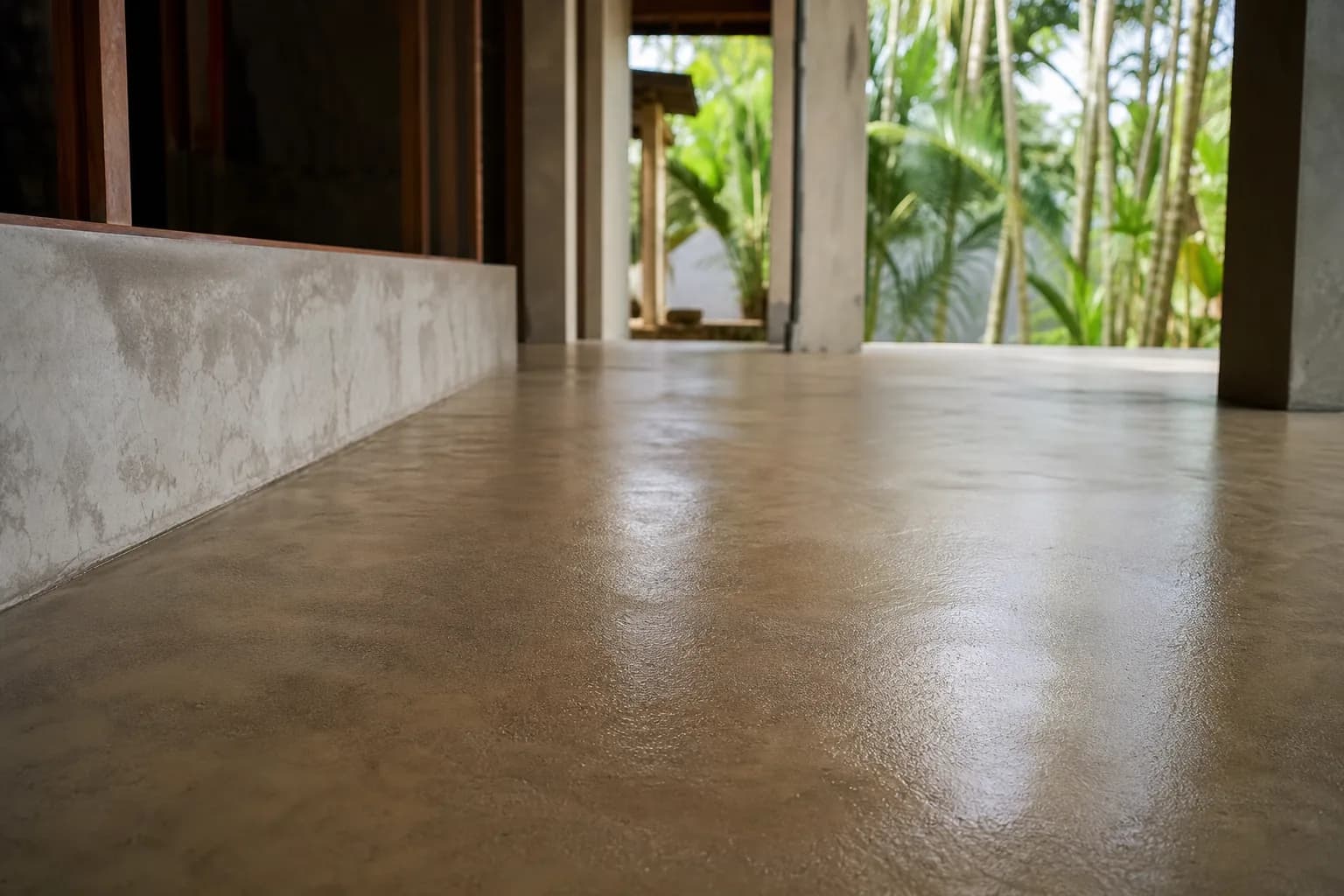
Polished Concrete Microtopping: Surface Prep Sealants Bali
Discover Bali s polished concrete microtopping: expert surface prep, durable sealants, and a flawless finish for modern floors with minimal maintenance.
9 min read