Bukit Peninsula Limestone Blasting Permits Costs Bali
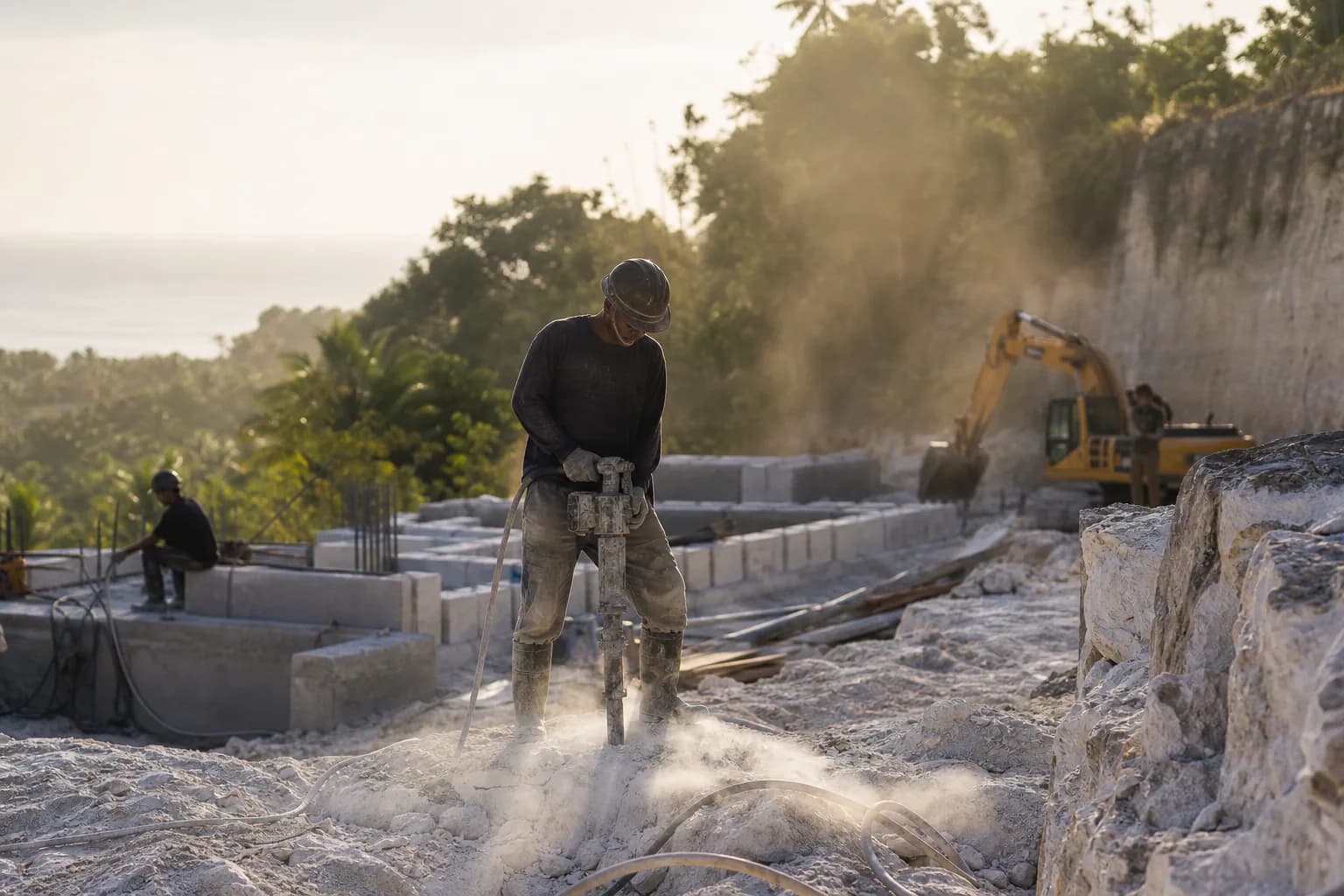
The Coral Limestone Challenge: Why Bukit Peninsula Blasting Permits Define Your Construction Budget
The Bukit Peninsula’s dramatic clifftop views come with a geological reality that catches most foreign buyers unprepared: dense coral limestone bedrock that can add Rp150M-Rp400M to your villa construction budget. Unlike Bali’s volcanic soil regions in Canggu or Ubud, Bukit’s ancient coral formations require controlled blasting permits, specialized drilling equipment, and multi-agency approvals that extend timelines by 3-6 months. The question isn’t whether you’ll encounter limestone—it’s how deep, how dense, and whether your contractor has secured the legal authority and technical capacity to excavate it without structural damage to neighboring properties or regulatory shutdown.
Technical Deep Dive: Bukit Peninsula Coral Limestone Geology and Blasting Permit Framework
The Bukit Peninsula sits on uplifted Pleistocene coral reef formations, creating limestone bedrock that ranges from 2-15 meters below surface level depending on elevation and proximity to cliff edges. This geological composition fundamentally differs from Bali’s volcanic regions, requiring specialized excavation approaches that trigger distinct permitting pathways.
Geological Characteristics Affecting Construction
Bukit coral limestone presents three construction challenges: density variation (compressive strength 20-80 MPa), karst cavity formation (unpredictable voids that compromise foundation stability), and high calcium carbonate content (accelerates concrete degradation without proper waterproofing). Standard excavation equipment cannot penetrate formations exceeding 40 MPa—the threshold where blasting becomes technically necessary rather than optional.
Sites in Uluwatu, Pecatu, and Ungasan typically encounter limestone at 1.5-3 meters depth for hillside plots, while clifftop locations may find bedrock immediately below topsoil. The critical engineering decision occurs during soil testing: if your geotechnical report indicates limestone exceeding 50 MPa within your foundation zone, you’re legally required to obtain blasting permits rather than proceed with hydraulic breakers alone.
Regulatory Framework for Explosive Use in Bali
Blasting permits in Bali fall under Kepolisian Negara Republik Indonesia (POLRI) jurisdiction, specifically the Explosive Materials Control Division (Satuan Bahan Peledak). This is not a construction permit—it’s a security clearance requiring separate application beyond your IMB (Izin Mendirikan Bangunan). The process involves four government layers:
- POLRI Explosive Permit (Izin Penggunaan Bahan Peledak): Federal-level authorization requiring company registration, certified blasting operator credentials, and site-specific safety plans
- BPBD Coordination (Badan Penanggulangan Bencana Daerah): Provincial disaster management approval confirming blast radius safety and emergency protocols
- Dinas PUPR Structural Clearance: District public works verification that blasting won’t compromise adjacent infrastructure or buildings within 50-meter radius
- Banjar/Desa Adat Community Approval: Customary village consent, often requiring ceremony costs (Rp5M-Rp15M) and neighbor notification protocols
The permit explicitly prohibits blasting within 100 meters of temples, 50 meters of occupied structures, or 200 meters of cliff edges in protected coastal zones—restrictions that eliminate blasting as an option for many premium clifftop sites, forcing alternative excavation methods at 2-3x cost.
Technical Blasting Methods for Residential Construction
Residential limestone blasting in Bukit employs controlled micro-blasting rather than quarry-scale explosives. Certified operators drill 50-100mm diameter holes at calculated spacing (typically 1.5-2 meter grid), insert measured ANFO (ammonium nitrate fuel oil) charges, and detonate in sequenced delays to fragment limestone without ground shock exceeding 5mm/second peak particle velocity—the threshold for structural damage to nearby buildings.
Each blast event requires 24-hour advance notice to neighbors, seismograph monitoring at property boundaries, and POLRI observer presence. Most contractors limit blasting to 2-3 events per week to maintain community relations and comply with noise ordinances (prohibited before 8 AM or after 5 PM). For a typical 500m² villa footprint requiring 2-meter foundation depth, expect 8-15 separate blast events over 4-6 weeks.
Hidden Risks and Common Mistakes in Bukit Limestone Projects
The “We’ll Handle Permits Later” Trap
Many contractors propose starting excavation with hydraulic breakers, promising to “see how deep the limestone goes” before committing to blasting permits. This approach violates Indonesian law—using explosives without prior authorization carries criminal penalties including project shutdown and equipment confiscation. More critically, you’ve now exposed limestone that must be removed before foundation work proceeds, creating schedule pressure that forces either illegal blasting or prohibitively expensive mechanical excavation (Rp8M-Rp15M per cubic meter versus Rp2M-Rp4M with permitted blasting).
Underestimating Blast Radius Impact on Neighbors
Bukit’s high-density villa development means your 50-meter blast radius likely encompasses 8-15 neighboring properties. A single structural crack claim from vibration damage can halt your project for months during investigation and trigger liability claims exceeding Rp200M. Professional blasting contractors conduct pre-blast structural surveys of all adjacent buildings, documenting existing conditions with timestamped photography and third-party engineering reports—insurance against false damage claims but adding Rp25M-Rp40M to upfront costs.
Karst Cavity Discovery Mid-Construction
Bukit limestone frequently contains solution cavities—voids ranging from 0.5-5 meters diameter created by groundwater dissolution. These appear without warning during excavation, requiring emergency structural engineering to bridge voids or extend foundations to competent bedrock below. Budget contingency of 15-20% specifically for cavity remediation; projects without this reserve face construction loans exhausted at 60-70% completion.
Step-by-Step Process: Securing Blasting Permits and Managing Limestone Excavation
Phase 1: Pre-Purchase Geological Assessment (Weeks 1-3)
Before land acquisition, commission a geotechnical investigation with minimum three boreholes to 8-meter depth. Specify laboratory testing for limestone compressive strength and cavity detection via standard penetration testing (SPT). This Rp15M-Rp25M investment reveals whether blasting is avoidable, likely, or certain—information that should adjust your land offer price by Rp500K-Rp1.5M per square meter for high-density limestone sites.
Request the geotechnical firm provide a preliminary blasting feasibility opinion addressing proximity restrictions. If your preferred site falls within prohibited blast zones, you’ll need alternative excavation cost modeling before financial commitment.
Phase 2: Blasting Permit Application (Weeks 4-16)
Engage a licensed blasting contractor (requires Sertifikat Juru Ledak certification) to prepare permit applications. The contractor submits to POLRI with required documentation:
- Company explosive handling license (Izin Pengelolaan Bahan Peledak)
- Site-specific blasting plan showing charge calculations, hole patterns, and safety zones
- Certified blaster personnel credentials (minimum 5 years experience for residential projects)
- Insurance coverage minimum Rp5 billion for blast-related damage claims
- Neighbor notification records and community approval letters
POLRI review takes 8-12 weeks for initial applications, 4-6 weeks for contractors with established track records. Expect requests for plan revisions or additional safety measures that extend timelines. Concurrent with POLRI application, your contractor coordinates BPBD and PUPR clearances—these agencies typically defer to POLRI technical review but require separate documentation submission.
Phase 3: Community Coordination and Pre-Blast Survey (Weeks 14-18)
While permits process, conduct formal neighbor notifications through your banjar. This isn’t courtesy—it’s legal requirement with documentation proving each adjacent property owner received written notice including blast schedule, safety protocols, and damage claim procedures. Budget Rp3M-Rp8M for banjar ceremony and community relations.
Simultaneously, commission independent structural engineers to survey all buildings within 75-meter radius, documenting pre-existing cracks, settlement, and structural conditions. Video documentation with GPS timestamps provides legal protection; cost runs Rp18M-Rp30M depending on neighbor density but is non-negotiable for liability management.
Phase 4: Controlled Blasting Execution (Weeks 19-25)
With permits secured, blasting proceeds under strict protocols: seismograph monitoring at minimum three boundary locations, POLRI observer presence for each blast event, and 24-hour advance notice to neighbors before each detonation. Professional contractors limit daily blasting to single events (morning hours) to minimize community disruption.
Post-blast, engineers inspect monitored structures for any vibration-related damage before proceeding to next blast sequence. This cautious approach extends excavation timelines but prevents the project-killing scenario of neighbor injunctions or government stop-work orders.
Phase 5: Foundation Adaptation for Limestone Conditions (Weeks 26-32)
Blasted limestone creates irregular excavation profiles requiring foundation design adaptation. Your structural engineer may specify deeper pile foundations to bypass fractured zones, mass concrete fills for cavity bridging, or reinforced grade beams to distribute loads across variable bedrock conditions. These modifications add 10-25% to foundation costs but ensure long-term stability in Bukit’s challenging geology.
Realistic Cost Ranges and Timeline Expectations for Bukit Limestone Blasting
Direct Blasting and Permit Costs
For a typical 500m² villa footprint requiring 2-meter foundation depth (1,000m³ excavation volume) in medium-density limestone:
- Geotechnical investigation: Rp15M-Rp25M (3 boreholes, lab testing)
- Blasting permit applications: Rp35M-Rp55M (POLRI, BPBD, PUPR coordination, legal documentation)
- Pre-blast structural surveys: Rp18M-Rp30M (adjacent property documentation)
- Blasting execution: Rp120M-Rp180M (Rp2M-Rp3.5M per cubic meter including drilling, explosives, labor, monitoring)
- Post-blast excavation and hauling: Rp40M-Rp65M (fragmented limestone removal)
- Community relations and ceremonies: Rp8M-Rp15M (banjar approvals, neighbor goodwill)
Total limestone blasting budget: Rp236M-Rp370M for moderate-complexity site. High-density limestone or cavity remediation can push costs to Rp400M-Rp550M.
Alternative Excavation Costs (When Blasting Prohibited)
Sites within blast restriction zones require mechanical excavation using specialized rock breakers or chemical expansion agents. Costs escalate dramatically: Rp8M-Rp15M per cubic meter versus Rp2M-Rp3.5M for blasting. The same 1,000m³ excavation runs Rp800M-Rp1.5B mechanically—often making clifftop sites economically unviable for mid-market villa projects.
Timeline Impact
Limestone blasting extends construction schedules by 4-6 months compared to standard soil excavation: 12-16 weeks for permit acquisition, 6-8 weeks for controlled blasting execution, and 2-4 weeks for foundation adaptation. Total project timelines for Bukit villas typically run 16-20 months versus 12-14 months in volcanic soil regions.
Frequently Asked Questions: Bukit Peninsula Limestone Blasting
Can I avoid blasting costs by choosing a different Bukit location?
Partially. Lower-elevation sites in Jimbaran and northern Pecatu encounter limestone at greater depths (3-5 meters), potentially allowing shallow foundation designs that avoid bedrock entirely. However, premium view locations in Uluwatu, Bingin, and Padang Padang sit directly on limestone with minimal soil cover—blasting or mechanical excavation is unavoidable. Review geotechnical reports before land purchase; Teville’s verified land listings include geological assessments identifying limestone depth and density for informed decision-making.
What happens if we start construction and discover limestone deeper than expected?
This scenario triggers expensive mid-construction permit applications and schedule delays of 10-16 weeks while blasting authorization processes. Worse, you’ve committed to foundation depths that now require limestone removal, eliminating design flexibility to avoid bedrock. Professional contractors conduct geotechnical investigations during design phase specifically to prevent this situation. If your contractor proposes “testing as we go,” you’re accepting significant financial and timeline risk—insist on pre-construction soil testing to 150% of planned foundation depth.
Are blasting permits transferable if I buy land with existing approvals?
No. Blasting permits are project-specific and contractor-specific, tied to the licensed blasting company’s insurance and certified personnel. Previous owner’s permits provide no legal authorization for your construction. However, recent geotechnical reports (less than 2 years old) remain valuable for understanding site conditions and can reduce your investigation costs by Rp8M-Rp12M if data quality meets current standards.
How do I verify my contractor has legitimate blasting credentials?
Request copies of the blasting supervisor’s Sertifikat Juru Ledak (certified blaster license) issued by POLRI, company explosive handling permit, and current insurance certificates covering blast-related damage minimum Rp5 billion. Verify credentials directly with POLRI Explosive Control Division—fraudulent blasting operations exist, and using unlicensed contractors exposes you to criminal liability as the project owner.
 2144 m²11 month(s)from 104.000 USD
Narayana
 3124 m²6 month(s)from 123.000 USD
TALA 8
 3180 m²7 month(s)from 142.000 USD
Vasudeva

Want to calculate?
 4344 m²16 month(s)from 290.000 USD
Radha
 3104 m²11 month(s)from 99.000 USD
TALA 100
 172 m²8 month(s)from 120.000 USD
Keshava
 3173 m²6 month(s)from 125.000 USD
TALA FOUR
 164 m²7 month(s)from 79.000 USD
TALA TWO
164 m²7 month(s)from 79.000 USDPrivate: Haridas Villas, Tegallalang
 3127 m²9 month(s)from 177.000 USD
Mukunda
 1from 198.000 USD
Private: Haridas Villas
Start With Real Numbers, Not Guesses
Before buying land or finalizing a design, check the realistic build cost range for your project in Bali.
Our team reviews your inputs and gives a grounded estimate.
Available lands
 680 m²15 min$ 110751Bali, Pererenan
 2000 m²15 min$ 523000Bali, Canggu
 220 m²2 min$ 66565Bali, Cemagi
 1430 m²5 min$ 209862Bali, Klungkung
 2000 m²5 min$ 1440887Bali, Pecatu
 960 m²15 min$ 91034Bali, Mengwi
 6000 m²30 min$ 55419Bali, Tabanan
 2230 m²15 min$ 410573Bali, Padonan
 444 m²10 min$ 111000Bali, Tabanan
 18900 m²2 min$ 6912931Bali, Pecatu
 5815 m²5 min$ 815740Bali, Tabanan
 1375 m²10 min$ 447044Bali, Canggu
 600 m²12 min$ 101970Bali, Mengwi
 700 m²20 min$ 90517Bali, Cepaka
 1200 m²2 min$ 155172Bali, Klungkung
Essential Bali build & buy guides
- Bali villa construction cost per m² in 2026
- How much will your villa cost? Calculator
- Building a villa in Bali: the complete guide
- Buying land in Bali: step-by-step for foreigners
- Bali villa investment: yields, risks, returns
- Leasehold vs freehold: what foreigners can own
- Construction defect liability & 10-year warranty
- Bali building codes and construction standards
Related guides
Resin-Infused Plaster Finishes: Anti-Salt Systems Bali
Expert technical guide: Resin-Infused Plaster Finishes: Anti-Salt Systems Bali
8 min read
Prefinished Timber Joinery: Silicone Seals Fixings Bali
Professional prefinished timber joinery installation in Bali with silicone seals and fixings for durable weatherproof performance and a premium finish.
10 min read
Polished Concrete Microtopping: Surface Prep Sealants Bali
Discover Bali s polished concrete microtopping: expert surface prep, durable sealants, and a flawless finish for modern floors with minimal maintenance.
9 min read