Bukit Peninsula Cistern Sizing Guide for Bali Construction
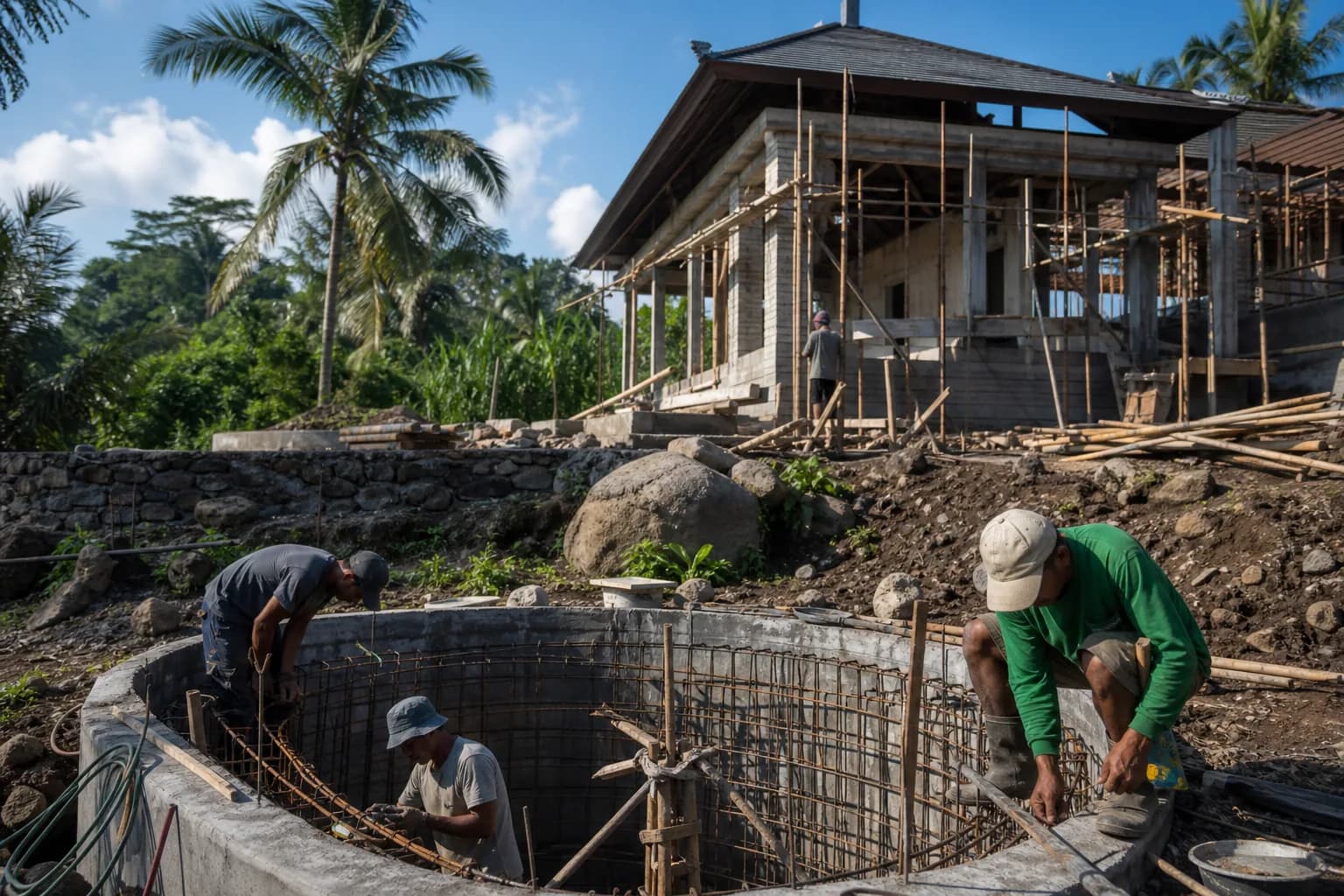
The Critical Miscalculation That Halts Construction in Bukit’s Dry Season
Construction sites across Bali’s Bukit Peninsula face a recurring crisis between May and October: undersized cisterns that cannot sustain concrete curing schedules, worker facilities, and dust suppression during the six-month dry season when PDAM municipal supply becomes intermittent. A villa project in Ungasan recently lost 23 days of construction time and IDR 47 million when their 5,000-liter temporary tank proved inadequate for a 400m² build requiring 180 liters daily for concrete work alone. The engineering reality is stark—Bukit’s limestone geology, limited aquifer recharge, and growing construction density demand precise cistern sizing calculations before excavation begins, not reactive water trucking that doubles operational costs and delays critical path activities.
Engineering Fundamentals: Calculating Construction Water Demand in Bukit’s Hydrogeological Context
Bukit Peninsula’s water infrastructure challenge stems from its raised limestone plateau geology with minimal surface water retention and aquifer systems depleted by tourism and construction growth. Unlike Canggu or Seminyak with shallow water tables, Bukit sites typically encounter bedrock at 3-8 meters depth, making temporary wells impractical and expensive. Construction cistern sizing must account for total project water demand across multiple consumption categories simultaneously.
Primary Construction Water Consumption Categories:
- Concrete mixing and curing: 180-220 liters per cubic meter of concrete poured, with tropical curing requiring continuous moisture for 7-14 days post-pour
- Masonry and plastering: 45-60 liters per square meter of wall surface for mixing mortar and maintaining workability in 32°C ambient temperatures
- Dust suppression: 80-150 liters daily for sites 300-500m², increasing to 200+ liters during land clearing and excavation phases
- Worker facilities: 25 liters per worker per day minimum (drinking, sanitation, tool cleaning) for crews of 8-15 personnel
- Equipment cleaning: 40-80 liters daily for mixer trucks, vibrators, and formwork maintenance
For a typical 350m² two-story villa construction in Bukit, the engineering calculation proceeds as follows: Foundation phase requires approximately 18m³ of concrete (3,960 liters), structural columns and beams add 22m³ (4,840 liters), and floor slabs contribute 15m³ (3,300 liters). Masonry for 280m² of wall surface consumes 15,400 liters across the build cycle. Daily operational water for 12 workers, dust control, and equipment maintenance averages 420 liters. Peak demand occurs during foundation and structural pours when concrete curing, ongoing masonry, and operational needs overlap—potentially 850+ liters daily for 10-14 consecutive days.
The critical engineering parameter is storage capacity relative to supply reliability. PDAM water supply in Bukit areas (Uluwatu, Ungasan, Pecatu, Jimbaran hills) operates on rotating schedules during dry season—typically 4-6 hours of pressure every 2-3 days. Water trucking costs IDR 450,000-650,000 per 5,000-liter delivery with 24-48 hour lead times. The cistern must bridge supply gaps while maintaining minimum operational reserves.
Recommended Sizing Formula for Bukit Construction Sites:
Minimum Cistern Capacity = (Peak Daily Demand × Supply Gap Days) + (Emergency Reserve × 1.3 Safety Factor)
For the 350m² villa example: (850 liters × 3 days) + (850 liters × 1.3) = 3,655 liters minimum. However, this addresses only operational continuity. Best practice adds buffer for concrete curing overlap and delivery delays: 3,655 × 1.5 = 5,483 liters, rounded to 6,000-liter installed capacity.
Larger projects require proportional scaling. A 600m² villa with pool construction demands 10,000-12,000 liter primary cisterns, often implemented as dual 6,000-liter tanks for redundancy and phased filling. Commercial projects exceeding 1,000m² typically install 15,000-20,000 liters with automated level monitoring and scheduled truck delivery contracts.
Material selection impacts longevity and water quality. Fiberglass-reinforced polyester (FRP) tanks resist Bukit’s saline coastal air better than mild steel, which corrodes rapidly without cathodic protection. Concrete cisterns built in-situ offer durability but require 28-day curing before use—impractical for immediate construction needs. Modular HDPE tanks (high-density polyethylene) provide optimal cost-performance for temporary construction use, with UV-stabilized formulations essential for above-ground installations in Bukit’s intense equatorial sun.
Hidden Risks: What Construction Teams Consistently Underestimate
Seasonal Demand Variability: Most cistern sizing errors occur when contractors calculate average daily demand without accounting for phase-specific peaks. Foundation waterproofing in Bukit’s limestone requires additional 300-400 liters for membrane application and testing. Pool construction adds 600-800 liters daily for shotcrete curing and finish work. Projects starting in March-April (late wet season) often size cisterns for current abundant supply, then face critical shortages by June when dry season intensifies and PDAM pressure drops 40-60%.
Water Quality Degradation: Bukit’s trucked water often contains elevated TDS (total dissolved solids) from limestone aquifers—280-450 ppm versus 150-200 ppm optimal for concrete. High mineral content accelerates rebar corrosion and reduces concrete compressive strength by 8-12% over 28-day curing. Cisterns without sediment settling chambers or basic filtration introduce particulates that clog spray equipment and compromise plaster finishes. The hidden cost: remedial work and structural durability reduction that manifests years after construction completion.
Regulatory Compliance Gaps: Bali’s 2024 construction water management regulations (Peraturan Daerah No. 5/2024) require construction sites over 200m² to demonstrate water storage capacity for 72-hour supply interruption and implement greywater recycling for non-potable uses. Many contractors install minimum cisterns to pass initial IMB (building permit) inspection, then rely on continuous trucking—a practice increasingly scrutinized during random compliance audits that can result in stop-work orders and IDR 15-25 million fines.
Step-by-Step Cistern Sizing and Implementation Process
Step 1: Project Water Demand Audit (Week 1-2 of Planning)
Conduct detailed quantity surveying of all concrete pours, masonry work, and finishes from architectural and structural drawings. Calculate phase-specific water requirements using tropical climate factors (1.3× standard consumption for curing, 1.2× for evaporation losses). Document peak demand periods when multiple high-consumption activities overlap. For Teville projects, this analysis integrates with our construction sequencing methodology to align water availability with critical path activities.
Step 2: Supply Reliability Assessment (Week 2)
Contact local PDAM office (Kantor PDAM Kabupaten Badung) to obtain written confirmation of supply schedule for specific site location. In Bukit, supply reliability varies dramatically—Jimbaran town center receives daily pressure, while Uluwatu clifftop sites may have 3-4 day gaps. Identify approved water trucking vendors with capacity for 24-hour emergency delivery. Map distance from site to nearest reliable water source (typically 4-8 km in Bukit) to calculate delivery logistics and costs.
Step 3: Cistern Capacity Calculation (Week 2-3)
Apply sizing formula: (Peak Daily Demand × Maximum Supply Gap) + (Emergency Reserve × 1.3-1.5 Safety Factor). For Bukit sites, minimum safety factor should be 1.4× due to supply unpredictability and trucking delays during high construction season (April-October). Round up to next standard tank size—common modular capacities are 2,000L, 3,000L, 5,000L, 6,000L, 10,000L, and 15,000L. Consider dual-tank configurations for projects exceeding 500m² to enable continuous operation during refilling cycles.
Step 4: Site Integration and Infrastructure Design (Week 3-4)
Position cisterns to minimize pumping distances to primary use points (concrete mixing area, worker facilities, dust suppression stations). Bukit’s sloped terrain often requires elevated tank placement for gravity-fed distribution, reducing pump energy costs. Design truck access for filling—minimum 3.5-meter width, 4-meter overhead clearance, and reinforced surface to support 8-ton delivery vehicles. Install level indicators (float switches minimum, ultrasonic sensors preferred) and overflow drainage directed to landscaped areas, not directly to limestone substrate which causes erosion.
Step 5: Permitting and Installation (Week 4-6)
Submit cistern specifications as part of IMB application technical drawings. Bali regulations require cisterns over 10,000L to include secondary containment (bund walls or double-wall tanks) to prevent groundwater contamination. Install tanks on engineered foundations—minimum 100mm compacted aggregate base with perimeter drainage for above-ground installations, or reinforced concrete pads for tanks exceeding 8,000L. Connect to PDAM supply with backflow prevention devices and separate metering for construction water tracking. Commission system with full-capacity test fill and 24-hour leak inspection before construction activities commence.
Step 6: Operational Monitoring and Adjustment (Throughout Construction)
Implement daily water level logging and consumption tracking against projected demand. Bukit’s variable weather patterns (unexpected dry season rain or extended drought) require adaptive management. Establish trigger points for scheduled trucking—typically when cistern levels drop below 40% capacity, allowing 48-hour buffer for delivery coordination. Document water quality issues (discoloration, odor, sediment) that may indicate contaminated trucked supply requiring source changes.
Realistic Cost and Timeline Parameters for Bukit Construction Sites
Cistern Equipment Costs (2026 Bali Market Rates):
- 5,000L HDPE modular tank: IDR 4,200,000-5,800,000 (UV-stabilized, food-grade)
- 10,000L fiberglass tank with stand: IDR 12,500,000-16,000,000 (includes installation)
- 15,000L dual-tank system: IDR 22,000,000-28,000,000 (automated level control, filtration)
- Pumping and distribution infrastructure: IDR 3,500,000-7,000,000 (pressure pumps, piping, valves)
- Foundation and civil works: IDR 2,000,000-4,500,000 (varies with site conditions and tank size)
Operational Water Costs During Construction:
- PDAM connection and metering: IDR 3,200,000-4,800,000 (one-time, includes deposit)
- PDAM water rate: IDR 8,500-12,000 per cubic meter (construction category tariff)
- Trucked water delivery: IDR 450,000-650,000 per 5,000L (Bukit premium due to distance)
- Typical 350m² villa total water cost: IDR 18,000,000-26,000,000 over 8-10 month build
- Undersized cistern penalty cost: Additional IDR 8,000,000-15,000,000 in emergency trucking and delays
Implementation Timeline:
Cistern procurement and installation requires 3-4 weeks from order to operational status for standard sizes, extending to 5-6 weeks for custom configurations or during peak construction season when supplier inventory depletes. PDAM connection approval in Bukit areas averages 4-6 weeks, making early application critical—ideally concurrent with IMB submission. Projects on Teville’s verified land inventory benefit from pre-assessed water infrastructure status, reducing planning uncertainty.
Frequently Asked Questions: Bukit Peninsula Construction Water Management
Can I use a smaller cistern and rely primarily on water trucking for my Bukit construction project?
While technically possible, this approach introduces significant risk and cost penalties. Water trucking in Bukit costs IDR 90-130 per liter versus IDR 8.50-12 per liter for PDAM supply—a 10× cost differential. More critically, trucking reliability degrades during peak construction season (May-September) when demand surges and delivery delays of 48-72 hours become common. Concrete curing cannot be interrupted without compromising structural integrity, and worker safety regulations require continuous water availability. The engineering recommendation is sizing cisterns for 3-5 day autonomy with trucking as backup, not primary supply. Projects that attempt trucking-dependent models typically spend 40-60% more on water costs while experiencing schedule delays that cascade through dependent activities.
How does Bukit’s limestone geology affect cistern placement and foundation requirements?
Bukit’s karst limestone substrate presents unique challenges for cistern installation. The porous rock provides poor bearing capacity for heavy water-filled tanks—10,000 liters equals 10 metric tons of load requiring engineered foundations. Surface limestone often contains voids and solution channels that cause differential settlement, potentially cracking rigid tanks or destabilizing support structures. Best practice requires geotechnical assessment for tanks exceeding 8,000L capacity, with foundations extending to competent rock or utilizing reinforced concrete rafts that distribute loads across larger areas. The limestone’s high permeability also means spills or leaks rapidly contaminate groundwater—Bali’s 2024 environmental regulations mandate secondary containment (bund walls or double-wall tanks) for construction cisterns over 10,000L in karst areas. Installation costs in Bukit run 25-35% higher than in Canggu or Sanur due to these geological factors.
What water quality standards apply to construction water in Bali, and how do I ensure compliance?
Indonesian National Standard SNI 03-2847-2019 specifies construction water quality requirements: pH 6.0-8.0, chloride content below 500 ppm, sulfate below 400 ppm, and total dissolved solids under 2,000 ppm for reinforced concrete work. Bukit’s limestone aquifer water often exceeds chloride limits (350-600 ppm) due to seawater intrusion in coastal areas, accelerating rebar corrosion. Trucked water quality varie
 2144 m²11 month(s)from 104.000 USD
Narayana
 3173 m²6 month(s)from 125.000 USD
TALA FOUR
 4344 m²16 month(s)from 290.000 USD
Radha

Want to calculate?
 172 m²8 month(s)from 120.000 USD
Keshava
 3127 m²9 month(s)from 177.000 USD
Mukunda
 1from 198.000 USD
Private: Haridas Villas
 164 m²7 month(s)from 79.000 USD
TALA TWO
 3104 m²11 month(s)from 99.000 USD
TALA 100
164 m²7 month(s)from 79.000 USDPrivate: Haridas Villas, Tegallalang
 3180 m²7 month(s)from 142.000 USD
Vasudeva
 3124 m²6 month(s)from 123.000 USD
TALA 8
Start With Real Numbers, Not Guesses
Before buying land or finalizing a design, check the realistic build cost range for your project in Bali.
Our team reviews your inputs and gives a grounded estimate.
Available lands
 5000 m²8 min$ 424877Bali, Ungasan
 550 m²15 min$ 164594Bali, Mengwi
 2000 m²15 min$ 110837Bali, Karangasem
 2230 m²15 min$ 410573Bali, Padonan
 700 m²15 min$ 162500Bali, Tabanan
 615 m²15 min$ 113608Bali, Tabanan
 2800 m²15 min$ 310345Bali, Tabanan
 444 m²10 min$ 111000Bali, Tabanan
 2700 m²30 min$ 314224Bali, Sidemen
 1000 m²10 min$ 384852Bali, Canggu
 2000 m²15 min$ 261700Bali, Babakan
 400 m²15 min$ 67192Bali, Tabanan
 325 m²15 min$ 44472Bali, Ungasan
 2000 m²15 min$ 523000Bali, Canggu
 1375 m²10 min$ 447044Bali, Canggu
Essential Bali build & buy guides
- Bali villa construction cost per m² in 2026
- How much will your villa cost? Calculator
- Building a villa in Bali: the complete guide
- Buying land in Bali: step-by-step for foreigners
- Bali villa investment: yields, risks, returns
- Leasehold vs freehold: what foreigners can own
- Construction defect liability & 10-year warranty
- Bali building codes and construction standards
Related guides
Resin-Infused Plaster Finishes: Anti-Salt Systems Bali
Expert technical guide: Resin-Infused Plaster Finishes: Anti-Salt Systems Bali
8 min read
Prefinished Timber Joinery: Silicone Seals Fixings Bali
Professional prefinished timber joinery installation in Bali with silicone seals and fixings for durable weatherproof performance and a premium finish.
10 min read
Polished Concrete Microtopping: Surface Prep Sealants Bali
Discover Bali s polished concrete microtopping: expert surface prep, durable sealants, and a flawless finish for modern floors with minimal maintenance.
9 min read