Bathroom Exhaust Fan Duct Termination in Bali Villas
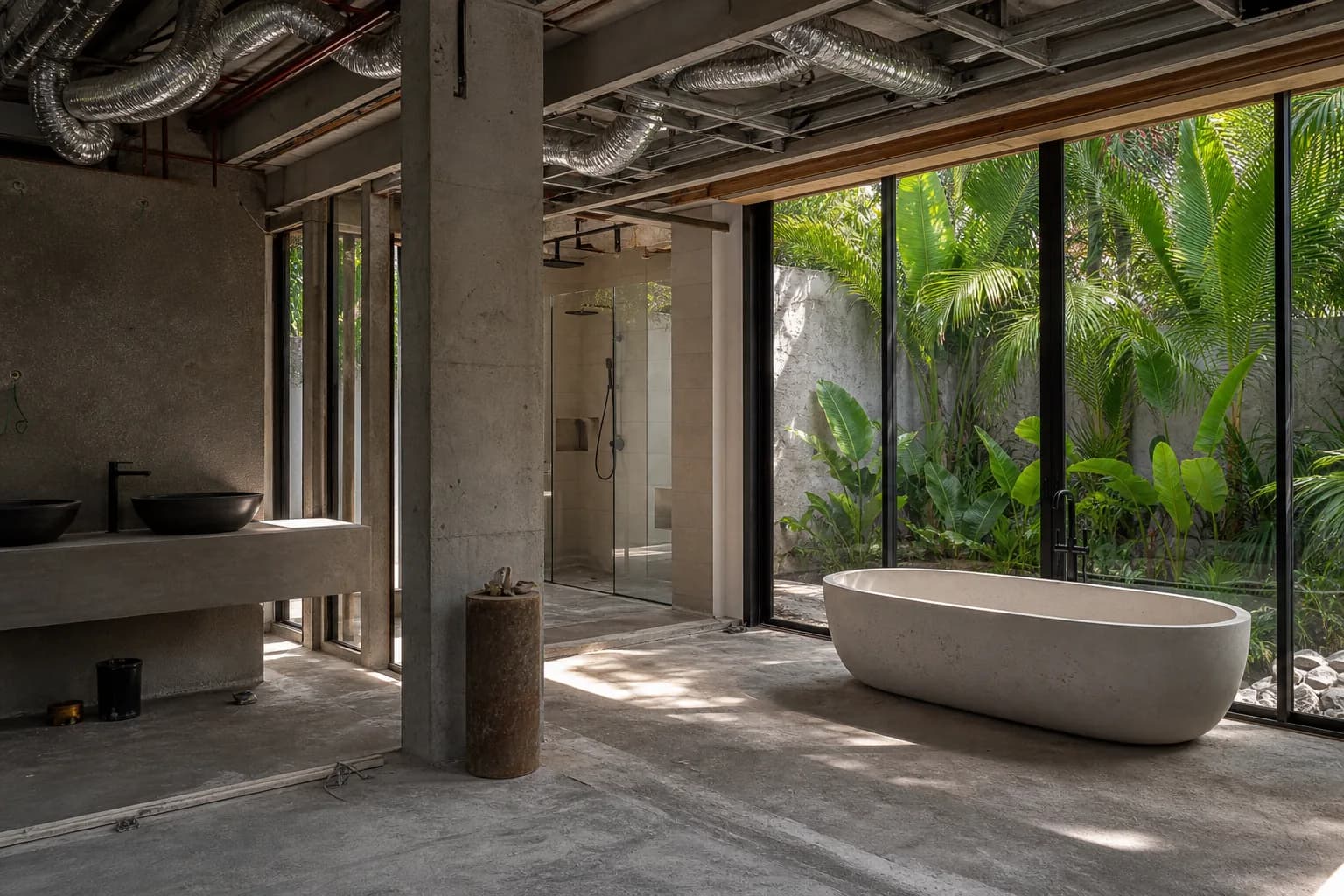
# Bathroom Exhaust Fan Duct Termination: Mold Prevention Bali Villas
The Hidden Threat in Bali Villa Bathrooms: Improper Exhaust Termination
In Bali’s tropical climate, where humidity levels consistently hover between 70-90% year-round, bathroom exhaust fan duct termination represents one of the most critical yet frequently overlooked aspects of villa construction and renovation. Many villa owners discover black mold colonies spreading through ceiling cavities, warped timber framing, and deteriorating insulation—all stemming from a single installation error: exhaust ducts terminating inside roof spaces rather than properly venting to the exterior. This seemingly minor finishing detail can transform a luxury villa bathroom into a breeding ground for toxic mold within months, causing thousands of dollars in structural damage and creating serious health hazards for occupants. The difference between proper and improper duct termination isn’t merely cosmetic—it’s the distinction between a durable, healthy living environment and a villa plagued by persistent moisture problems that compromise both structural integrity and indoor air quality.
Technical Deep Dive: Understanding Exhaust Duct Termination in Tropical Environments
Bathroom exhaust fan duct termination involves the final connection point where moisture-laden air exits the ventilation system and disperses into the outdoor environment. In Bali villa construction, this finishing detail requires exceptional precision due to the island’s unique climatic challenges. The fundamental principle is straightforward: every cubic meter of humid air extracted from bathrooms must travel through properly sealed ductwork and discharge completely outside the building envelope—never into attics, roof cavities, soffit spaces, or wall cavities.
The physics behind proper termination becomes critical in tropical climates. When a bathroom exhaust fan operates, it creates negative pressure that pulls warm, moisture-saturated air from shower and bath areas. This air typically contains 3-5 liters of water vapor per hour during active use. If the duct terminates inside a roof cavity where temperatures are 5-10 degrees cooler than the bathroom air, condensation occurs immediately. In Bali’s climate, where outdoor humidity already saturates the air, this condensed moisture has nowhere to evaporate, creating perfect conditions for mold colonization within 24-48 hours.
Professional Bali villa construction requires understanding three termination zones: the duct run, the termination point, and the exterior discharge area. The duct run must maintain consistent diameter (typically 100-150mm for residential applications) without compression, sharp bends exceeding 90 degrees, or flexible duct sections longer than 2 meters. Each bend reduces airflow efficiency by approximately 15-20%, meaning a poorly planned duct route can render even powerful exhaust fans ineffective.
The termination point itself demands specific finishing techniques. Standard practice involves installing a weatherproof termination cap or hood that prevents rain infiltration while allowing unrestricted airflow. In Bali’s monsoon conditions, where horizontal rain can penetrate standard vent caps, specialized tropical-grade termination fittings with integrated baffles and drainage channels become essential. These fittings must be positioned on exterior walls or roof surfaces where prevailing winds assist moisture dispersal rather than forcing humid air back into the duct system.
The exterior discharge area requires careful consideration of building orientation and landscaping. Terminating exhaust ducts on north-facing walls (which receive less direct sun exposure in the Southern Hemisphere) can create persistent damp patches on exterior finishes. Similarly, discharging directly above planted areas or water features can create localized humidity zones that encourage mold growth on exterior surfaces. Optimal termination positions discharge onto sun-exposed walls or roof areas where natural evaporation assists moisture dispersal, positioned at least 3 meters from operable windows, air conditioning intakes, or outdoor living areas.
Interior finishing work around duct penetrations represents another critical technical consideration. Where ducts pass through ceiling planes, proper sealing prevents conditioned air loss and blocks moisture migration into ceiling cavities. This requires specialized flexible sealants that accommodate thermal expansion while maintaining airtight integrity. In renovation Bali projects, we frequently encounter original installations where ducts simply pass through rough-cut ceiling holes with no sealing whatsoever—creating direct pathways for moisture infiltration and insect entry.
Materials and Standards for Tropical Climate Installations
Material selection for bathroom exhaust duct systems in Bali villas differs significantly from temperate climate specifications. Standard galvanized steel ductwork, while code-compliant in many regions, corrodes rapidly in tropical humidity, typically failing within 3-5 years. Professional installations utilize either rigid PVC duct systems rated for continuous moisture exposure or marine-grade aluminum ducting with specialized corrosion-resistant coatings.
Rigid PVC ductwork offers superior longevity in Bali’s climate, with expected service life exceeding 25 years when properly installed. Schedule 40 PVC pipe in 100mm or 150mm diameter provides smooth interior surfaces that minimize airflow resistance and prevent condensation accumulation. All joints require solvent welding rather than mechanical connections to ensure complete moisture sealing. The material’s thermal properties also reduce condensation risk—PVC’s lower thermal conductivity means less temperature differential between duct interior and exterior surfaces.
Flexible aluminum ducting, while convenient for complex routing situations, should be limited to short connection runs (maximum 1.5 meters) between rigid duct sections and fan housings or termination points. The corrugated interior surface of flexible duct creates significant airflow resistance and provides numerous condensation points where moisture can accumulate. When flexible duct is unavoidable, marine-grade aluminum with reinforced wire helix and vapor barrier lamination becomes essential for interior finishing Bali projects.
Termination fittings must meet specific tropical climate standards. Standard builder-grade plastic vent caps crack and discolor within months under Bali’s intense UV exposure. Professional installations specify UV-stabilized polycarbonate or powder-coated aluminum termination hoods with integrated insect screens (minimum 3mm mesh to prevent gecko entry while maintaining airflow). Backdraft dampers within termination fittings should utilize stainless steel springs and pivots—standard steel components seize within weeks due to salt air corrosion in coastal villa locations.
Sealants and adhesives require equal attention to material specifications. Silicone-based sealants degrade rapidly in tropical heat, losing adhesion and allowing moisture infiltration. Professional finishing work utilizes polyurethane-based sealants specifically formulated for high-humidity environments, maintaining flexibility and adhesion through temperature cycles ranging from 20°C nighttime lows to 45°C+ roof cavity temperatures during midday sun exposure.
Step-by-Step Professional Installation Process
Proper bathroom exhaust fan duct termination begins during the design phase, not during installation. The first step involves calculating required airflow capacity based on bathroom volume and usage patterns. Indonesian building standards recommend minimum 8 air changes per hour for bathroom spaces, meaning a 12 cubic meter bathroom requires an exhaust fan rated for at least 96 cubic meters per hour (CMH). In practice, professional villa construction specifications typically specify 120-150 CMH capacity to account for duct resistance and ensure effective moisture removal.
Step one of physical installation involves mapping the optimal duct route from fan location to exterior termination point. This route should minimize total duct length (ideally under 6 meters), eliminate unnecessary bends, and avoid passing through unconditioned spaces where temperature differentials increase condensation risk. The termination point must be marked on exterior walls or roof surfaces, ensuring minimum 3-meter separation from windows, doors, and air conditioning condensers. In multi-story villas, vertical duct runs through wall cavities often provide the most direct route to exterior termination.
Step two involves preparing penetration points through building envelope components. For wall penetrations, core drilling creates clean openings sized 10mm larger than duct diameter to accommodate sealing materials. Roof penetrations require more complex preparation, including temporary waterproofing, flashing installation, and coordination with roofing contractors to maintain warranty coverage. All penetration points must slope slightly downward toward the exterior (minimum 2-degree angle) to prevent condensation from draining back into ductwork.
Step three encompasses duct assembly and installation. Rigid PVC sections are cut to precise lengths using fine-tooth saws, deburred to remove sharp edges, and dry-fitted before final assembly. Solvent welding requires applying primer to both male and female joint surfaces, followed by solvent cement application and immediate assembly with quarter-turn twist to ensure even cement distribution. Each joint must cure for minimum 30 minutes before handling. Support brackets should be installed every 1.5 meters along horizontal runs and every 2 meters on vertical sections, using stainless steel hardware to prevent corrosion staining on finished surfaces.
Step four involves termination fitting installation. The exterior termination hood mounts to the building envelope using corrosion-resistant fasteners, with generous application of polyurethane sealant around the entire perimeter. The hood should extend minimum 25mm beyond the exterior wall surface to create a drip edge that prevents water tracking back to the penetration point. Interior duct connections to the termination fitting require the same solvent welding process used for main duct runs, ensuring no mechanical connections that could separate over time.
Step five addresses interior finishing details. Where ducts penetrate ceiling planes, the annular space around the duct receives fire-rated expanding foam insulation, trimmed flush after curing, then covered with flexible polyurethane sealant. Ceiling finish materials (typically gypsum board or timber paneling in Bali villas) are cut to fit snugly around the duct with 3-5mm clearance, with the gap sealed using color-matched flexible caulk. This finishing work ensures both aesthetic integration and functional moisture barrier performance.
Step six involves fan connection and system testing. The exhaust fan housing connects to ductwork using flexible aluminum connector sections maximum 300mm length, secured with stainless steel duct clamps. After electrical connection by licensed contractors, the system undergoes airflow testing using anemometer measurements at the exterior termination point. Acceptable performance shows airflow within 10% of fan rated capacity, confirming minimal duct resistance and proper installation throughout the system.
Cost Considerations and Project Timeline
Professional bathroom exhaust fan duct termination installation in Bali villas involves several cost components that vary based on project complexity and material specifications. Material costs for a typical single-bathroom installation range from IDR 2,500,000 to IDR 4,500,000, including quality exhaust fan (120-150 CMH capacity), rigid PVC ductwork, termination fittings, sealants, and mounting hardware. Premium specifications using marine-grade aluminum ductwork and commercial-grade termination fittings can increase material costs to IDR 6,000,000-8,000,000 per bathroom.
Labor costs for professional installation typically range from IDR 3,000,000 to IDR 5,500,000 per bathroom, depending on duct run complexity and building envelope penetration requirements. Installations requiring roof penetrations with custom flashing fabrication or multi-story vertical duct runs through wall cavities command premium labor rates due to increased technical complexity and coordination requirements. Renovation Bali projects involving existing structure modifications may incur additional costs for exploratory work, asbestos testing (in older villas), and structural repairs around new penetration points.
Project timeline for new construction installations typically spans 2-3 days per bathroom, including duct routing, penetration preparation, installation, and finishing work. This timeline assumes coordination with other trades—electrical contractors for fan wiring, ceiling installers for finish work around duct penetrations, and painters for final touch-up. Renovation projects generally require 3-5 days per bathroom due to additional time needed for existing system removal, structural assessment, and integration with existing finishes.
Long-term maintenance costs should factor into overall project budgeting. Professional exhaust systems require annual inspection and cleaning, typically costing IDR 500,000-750,000 per bathroom. This maintenance includes duct interior cleaning, termination fitting inspection, fan motor lubrication, and airflow performance testing. Properly installed systems using quality materials should operate maintenance-free for 5-7 years before requiring component replacement, with total system lifespan exceeding 15 years in tropical climate conditions.
Frequently Asked Questions: Bathroom Exhaust Termination
Can bathroom exhaust fans terminate into attic spaces in Bali villas?
Absolutely not. Terminating exhaust ducts into attic or roof cavity spaces represents the single most common cause of mold problems in Bali villa construction. The humid air discharged into these enclosed spaces has no escape route, causing immediate condensation on cooler roof surfaces and timber framing. Within 48 hours, mold colonies begin forming. Within weeks, structural timber shows moisture damage. Professional villa utilities installation always te
 3104 m²11 month(s)from 99.000 USD
TALA 100
 1from 198.000 USD
Private: Haridas Villas
 172 m²8 month(s)from 120.000 USD
Keshava
 3124 m²6 month(s)from 123.000 USD
TALA 8
 3173 m²6 month(s)from 125.000 USD
TALA FOUR
 3127 m²9 month(s)from 177.000 USD
Mukunda
 164 m²7 month(s)from 79.000 USD
TALA TWO

Want to calculate?
 3180 m²7 month(s)from 142.000 USD
Vasudeva
 2144 m²11 month(s)from 104.000 USD
Narayana
164 m²7 month(s)from 79.000 USDPrivate: Haridas Villas, Tegallalang
 4344 m²16 month(s)from 290.000 USD
Radha
Start With Real Numbers, Not Guesses
Before finalizing your finishing works plan, check realistic cost ranges for your Bali villa project.
Available lands
 1600 m²32 min$ 266010Bali, Tabanan
 1660 m²10 min$ 343448Bali, Kerobokan
 585 m²8 min$ 165702Bali, Mengwi
 29000 m²6 min$ 3857143Bali, Tabanan
 2700 m²30 min$ 314224Bali, Sidemen
 600 m²10 min$ 206897Bali, Canggu
 1000 m²10 min$ 230911Bali, Kerobokan
 2000 m²5 min$ 1440887Bali, Pecatu
 1200 m²2 min$ 155172Bali, Klungkung
 7250 m²56 min$ 235714Bali, Tabanan
 2200 m²3 min$ 183842Bali, Berawa
 615 m²15 min$ 113608Bali, Tabanan
 3000 m²15 min$ 738916Bali, Cepaka
 250 m²15 min$ 40025Bali, Munggu
 2000 m²5 min$ 738916Bali, Ungasan
Essential Bali build & buy guides
- Bali villa construction cost per m² in 2026
- How much will your villa cost? Calculator
- Building a villa in Bali: the complete guide
- Buying land in Bali: step-by-step for foreigners
- Bali villa investment: yields, risks, returns
- Leasehold vs freehold: what foreigners can own
- Construction defect liability & 10-year warranty
- Bali building codes and construction standards
Related guides
Resin-Infused Plaster Finishes: Anti-Salt Systems Bali
Expert technical guide: Resin-Infused Plaster Finishes: Anti-Salt Systems Bali
8 min read
Prefinished Timber Joinery: Silicone Seals Fixings Bali
Professional prefinished timber joinery installation in Bali with silicone seals and fixings for durable weatherproof performance and a premium finish.
10 min read
Polished Concrete Microtopping: Surface Prep Sealants Bali
Discover Bali s polished concrete microtopping: expert surface prep, durable sealants, and a flawless finish for modern floors with minimal maintenance.
9 min read