Amed Volcanic Soil Load-Bearing Tests Foundation Costs Bali
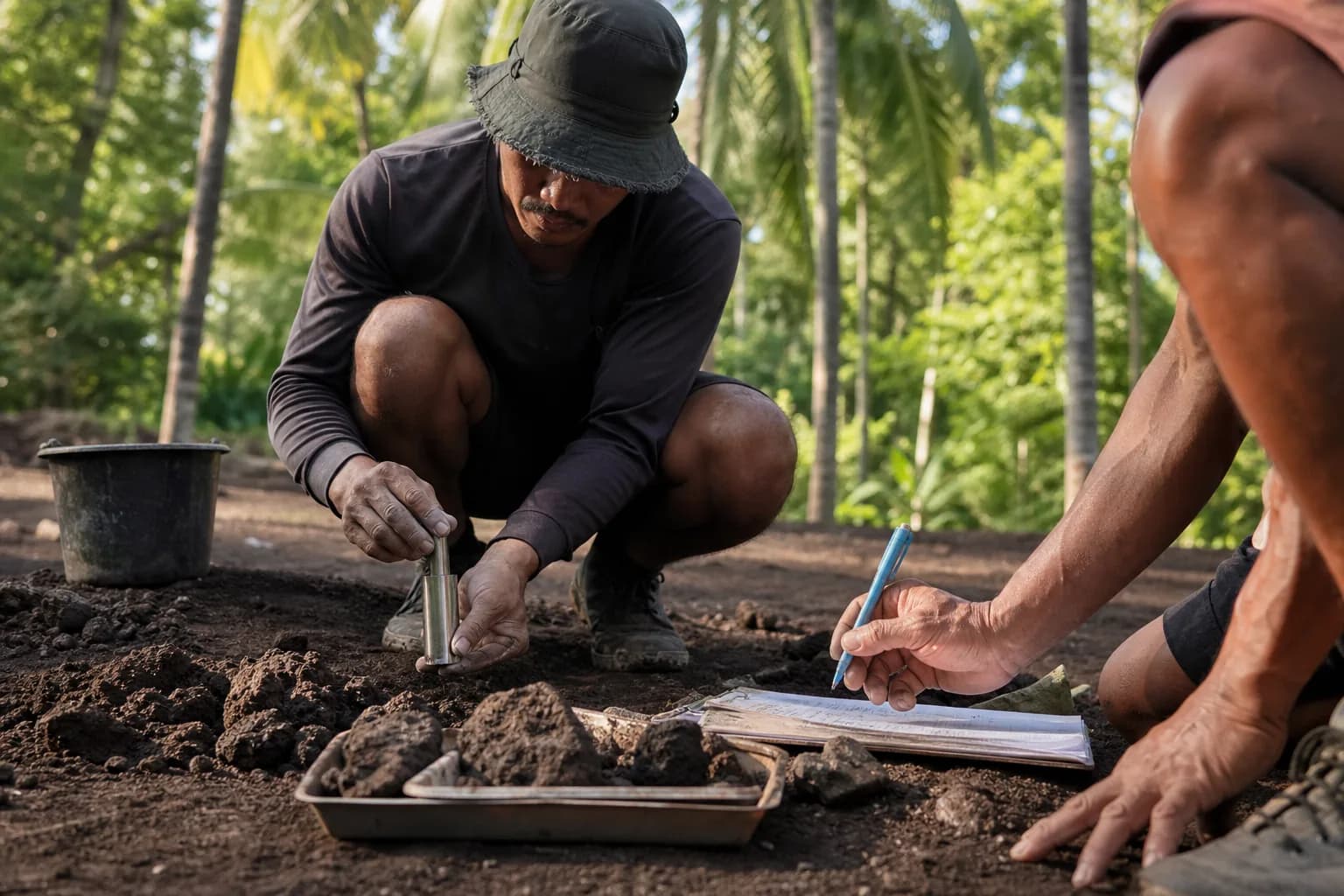
Why Amed’s Black Volcanic Soil Creates Foundation Engineering Challenges Most Builders Ignore
Amed’s coastline sits on layered volcanic deposits from Mount Agung’s historical eruptions, creating soil profiles that shift dramatically within 50-meter distances. Property buyers purchasing land in Amed villages—Jemeluk, Bunutan, Lipah—frequently discover their “beachfront paradise” sits on 2-4 meters of loose volcanic ash over fractured basalt, requiring foundation solutions that cost 40-60% more than standard Bali construction. The critical question isn’t whether soil testing is necessary in Amed—it’s understanding how volcanic soil stratification, seasonal groundwater fluctuation, and proximity to active seismic zones create load-bearing requirements that generic foundation designs cannot address safely or cost-effectively.
Amed Volcanic Soil Composition: Engineering Analysis of Load-Bearing Capacity
Amed’s geological profile differs fundamentally from southern Bali’s limestone or Ubud’s clay-rich soils. The region’s soil structure consists of three distinct layers that directly impact foundation engineering:
Volcanic Ash Surface Layer (0-1.5m depth)
The topmost layer contains weathered volcanic ash (locally called “pasir hitam”) with particle sizes ranging 0.05-2mm. This material exhibits poor cohesion when dry and becomes semi-fluid when saturated during monsoon periods. Standard penetration tests in Amed consistently show N-values of 4-8 in this layer—well below the N=10 minimum for shallow foundation support. The ash layer’s bearing capacity typically measures 0.8-1.2 kg/cm² without compaction, requiring either complete excavation or deep compaction protocols before any structural loading.
Intermediate Volcanic Soil Mix (1.5-3.5m depth)
Below the ash layer, Amed sites typically encounter a mixed stratum of compacted volcanic soil, weathered rock fragments, and occasional clay pockets. This layer shows higher variability than any other Bali region—bearing capacity can range from 1.5-4.5 kg/cm² within the same 500m² plot. The inconsistency stems from historical lava flow patterns and differential weathering rates. Geotechnical investigations in Amed must include minimum 4-point soil boring to map this layer’s characteristics, as single-point testing creates dangerous assumptions about uniform bearing capacity.
Fractured Basalt Bedrock (3.5m+ depth)
Competent bedrock in Amed appears at depths ranging 3-7 meters, significantly deeper than Canggu (1.5-2.5m) or Uluwatu (2-4m). The basalt layer itself presents engineering challenges—it’s fractured from seismic activity and shows weathering patterns that create pockets of weakness. When foundation piles reach this layer, engineers must verify rock quality designation (RQD) values exceed 50% to confirm adequate end-bearing capacity. Amed’s proximity to the Flores Thrust fault system means this bedrock experiences ongoing micro-seismic stress that can propagate existing fractures over time.
Groundwater Dynamics and Seasonal Variation
Amed’s coastal properties face groundwater tables that fluctuate 1.5-2.5 meters seasonally. During dry season (April-October), water tables drop to 4-6m depth in most locations. Monsoon periods (November-March) raise tables to 2-3m depth, particularly in properties within 200m of the coastline. This fluctuation creates two critical foundation challenges: seasonal bearing capacity reduction in the ash layer (up to 40% loss when saturated) and hydrostatic pressure on below-grade structures. Foundation designs must account for worst-case wet-season conditions, not dry-season testing results that many builders use to reduce costs.
Volcanic Ash Concrete Performance in Amed Foundations
Recent material testing shows Amed’s volcanic ash can partially replace Portland cement in concrete mixes, achieving 24-28 MPa compressive strength at 28 days with 20-25% ash replacement. However, this application requires specific protocols: ash must be ground to <45 microns, dried to <1% moisture content, and mixed with plasticizers to maintain workability. For foundation concrete in Amed, engineers typically specify 25 MPa minimum strength for footings and 30 MPa for pile caps—achievable with volcanic ash supplementation but requiring batch testing and quality control that most local contractors don't implement. The cost savings (15-20% reduction in cement costs) only materialize with proper material preparation and testing infrastructure.
Hidden Risks in Amed Foundation Projects That Soil Reports Don’t Always Reveal
Standard soil testing in Amed often misses three critical risk factors that emerge during construction or post-occupancy:
Differential Settlement from Non-Uniform Ash Deposits
Volcanic ash layers in Amed rarely deposit uniformly. A single building footprint can span areas where ash depth varies 0.8-2.2 meters, creating differential settlement potential that simple bearing capacity tests don’t quantify. Buildings on shallow foundations (footings at 1-1.5m depth) commonly experience 15-40mm differential settlement within the first 18 months, causing door jamming, tile cracking, and structural stress. The solution—either excavating all ash to reach competent soil or using deep pile foundations—adds IDR 180-320 million to typical villa foundation costs but prevents long-term structural damage.
Seismic Liquefaction Potential in Saturated Ash
Amed sits 15km from the Flores Thrust, an active subduction zone that produces magnitude 5-6 earthquakes every 3-7 years. When seismic waves pass through saturated volcanic ash, the material can temporarily lose bearing capacity through liquefaction—essentially behaving like liquid for 10-30 seconds. Properties built on shallow foundations without proper compaction or ground improvement face severe damage risk during seismic events. Geotechnical reports should include liquefaction potential index (LPI) calculations for Amed sites, but many basic soil tests omit this analysis. Sites with LPI >5 require ground improvement (stone columns, deep soil mixing) or pile foundations extending below the liquefiable layer.
Chloride Contamination in Coastal Foundation Concrete
Amed properties within 150m of the coastline face aggressive chloride exposure from sea spray and groundwater intrusion. Standard concrete mixes deteriorate rapidly—rebar corrosion begins within 3-5 years without proper specification. Foundation concrete in coastal Amed requires: maximum 0.4 water-cement ratio, minimum 50mm rebar cover, corrosion-inhibiting admixtures, and ideally stainless steel or epoxy-coated reinforcement. These specifications add 25-35% to foundation concrete costs but prevent the catastrophic rebar corrosion that affects 40% of coastal Bali properties built before 2015 with inadequate specifications.
Step-by-Step Process: Amed Soil Testing Through Foundation Completion
Phase 1: Comprehensive Geotechnical Investigation (Week 1-2)
Proper Amed soil investigation requires minimum 3-4 boring points for plots under 500m², increasing to 6-8 points for larger sites. Each boring should extend minimum 6 meters depth or until reaching competent bedrock with N-values >30. The investigation must include: standard penetration testing (SPT) at 1-meter intervals, undisturbed sampling for laboratory analysis, groundwater level monitoring, and particle size distribution analysis of the ash layer. Cost for comprehensive investigation: IDR 25-45 million depending on site access and number of boring points. Timeline: 8-12 days including laboratory analysis.
Phase 2: Foundation Engineering Design (Week 3-4)
With soil data, structural engineers develop foundation solutions specific to Amed’s conditions. Options typically include: shallow footings with complete ash excavation and engineered fill (suitable only for sites with <1.2m ash depth), grade beam and pile foundation systems (most common for 1.5-3m ash depth), or deep pile foundations to bedrock (required for >3m ash depth or high liquefaction risk). The engineering design must address: bearing capacity with safety factors of 3.0 minimum, differential settlement limits (<20mm), seismic load combinations per SNI 1726:2019, and groundwater management. Engineering fees for Amed foundation design: IDR 15-28 million for typical 2-3 bedroom villa.
Phase 3: Ground Preparation and Improvement (Week 5-7)
For shallow foundation systems, ash excavation requires removing 1.2-2.5 meters of material across the entire building footprint plus 1-meter perimeter extension. Excavated ash must be replaced with engineered fill (typically crushed stone or select granular material) placed in 200mm lifts with mechanical compaction to 95% standard Proctor density. Each lift requires density testing—shortcuts here cause long-term settlement issues. For pile foundation systems, ground preparation involves site leveling and establishing pile cap excavation depths. Deep soil mixing or stone column installation (when required for liquefaction mitigation) occurs during this phase. Ground preparation costs in Amed: IDR 280-520/m² for excavation and engineered fill, or IDR 850-1,200/linear meter for stone columns.
Phase 4: Foundation Construction (Week 8-11)
Foundation construction follows engineered designs with material specifications appropriate for Amed’s conditions. For pile foundations (most common solution), this includes: pile installation to design depth with load testing on minimum 2% of piles, pile cap construction with marine-grade concrete specifications, and grade beam installation connecting all pile caps. Concrete specifications for Amed coastal foundations: 30 MPa minimum strength, maximum 0.40 w/c ratio, minimum 50mm cover, Type V cement (sulfate-resistant) for groundwater contact, and corrosion inhibitors at 2-4% by cement weight. Foundation construction timeline: 18-25 days for typical 150-200m² villa footprint including curing periods.
Phase 5: Verification Testing and Documentation (Week 12)
Before proceeding with superstructure, foundation completion requires: pile load testing verification (if applicable), concrete strength testing (minimum 3 cylinder samples per pour), survey verification of foundation levels (tolerance ±10mm), and photographic documentation for building permit compliance. This documentation becomes critical for IMB (building permit) approval and future property transactions. Many Amed projects skip proper verification—creating permit issues and structural uncertainty that reduces property value and insurability.
Realistic Foundation Cost Ranges for Amed Construction Projects
Foundation costs in Amed vary significantly based on soil conditions and building design, but typical ranges for 2026 construction include:
Shallow Foundation System (Suitable for <1.2m Ash Depth)
- Soil investigation: IDR 28-38 million
- Ash excavation and engineered fill: IDR 85-140 million (for 150m² footprint)
- Foundation concrete and reinforcement: IDR 180-240 million
- Total foundation cost: IDR 293-418 million (USD 18,000-26,000)
- Timeline: 8-10 weeks from investigation to completion
Pile Foundation System (Required for 1.5-3.5m Ash Depth)
- Comprehensive soil investigation: IDR 35-50 million
- Pile installation (25-30 piles, 4-6m depth): IDR 220-340 million
- Pile caps and grade beams: IDR 240-320 million
- Total foundation cost: IDR 495-710 million (USD 30,000-44,000)
- Timeline: 10-12 weeks from investigation to completion
Deep Pile with Ground Improvement (High Liquefaction Risk Sites)
- Advanced geotechnical investigation: IDR 45-65 million
- Ground improvement (stone columns/deep mixing): IDR 180-280 million
- Deep pile foundation system: IDR 280-420 million
- Total foundation cost: IDR 505-765 million (USD 31,000-47,000)
- Timeline: 12-14 weeks from investigation to completion
These costs represent 22-35% of total villa construction budgets in Amed—significantly higher than the 15-20% foundation cost ratio typical in southern Bali. The investment in proper foundation engineering prevents structural issues that cost 3-5x more to remediate post-construction.
Frequently Asked Questions: Amed Volcanic Soil and Foundation Engineering
Can I use the same foundation design from my Canggu or Seminyak project in Amed?
No—this approach causes 60% of foundation failures in Amed. Southern Bali’s limestone-based soils have bearing capacities of 2.5-4.0 kg/cm² at shallow depths (1-1.5m), while Amed’s volcanic ash provides only 0.8-1.2 kg/cm² without deep excavation or piling. Foundation designs are site-specific and must respond to actual soil conditions verified through testing. Using generic or imported designs in Amed typically results in: differential settlement causing structural cracking, inadequate depth for seismic stability, and missing specifications for chloride exposure in coastal locations. Site-specific geotechnical investigation and engineering design cost IDR 40-75 million but prevent foundation failures that cost IDR 400-800 million to remediate.
How deep do foundation piles need to go in Amed, and how does this affect costs?
Pile depth in Amed ranges 4-8 meters depending on ash layer thickness and bedrock depth. Most residential projects require 4-6 meter piles, with 25-35 piles for a typical 150m² villa footprint. Pile installation costs IDR 850,000-1,200,000 per linear meter including materials, installation, and load testing. Deeper ash deposits (>3m) in areas like Bunutan or Lipah require longer piles, increasing foundation costs by IDR 120-200 million compared to shallower sites. The geotechnical investigation identifies required pile depths—attempting to reduce pile length below engineered specifications to save costs creates bearing capacity deficiencies that cause settlement and structural damage within 2-4 years.
What’s the difference between standard soil testing and the comprehensive investigation Amed requires?
Standard soil testing (often called “sondir” testing) provides single-point penetration resistance data to 4-6 meters depth, costing IDR 8-15 million. This basic testing is insufficient for Amed because it: doesn’t capture soil variability across the building footprint, provides no laboratory analysis of ash properties, omits groundwater level monitoring, and doesn’t assess liquefaction potential. Comprehensive geotechnical investigation includes: multiple boring points (3-4 minimum), undisturbed sampling for lab analysis, groundwater monitori
 3180 m²7 month(s)from 142.000 USD
Vasudeva
 3173 m²6 month(s)from 125.000 USD
TALA FOUR
 172 m²8 month(s)from 120.000 USD
Keshava
 1from 198.000 USD
Private: Haridas Villas
 3127 m²9 month(s)from 177.000 USD
Mukunda
 3124 m²6 month(s)from 123.000 USD
TALA 8

Want to calculate?
 164 m²7 month(s)from 79.000 USD
Private: Haridas Villas, Tegallalang
 3104 m²11 month(s)from 99.000 USD
TALA 100
 4344 m²16 month(s)from 290.000 USD
Radha
 2144 m²11 month(s)from 104.000 USD
Narayana
164 m²7 month(s)from 79.000 USDTALA TWO
Start With Real Numbers, Not Guesses
Before buying land or finalizing a design, check the realistic build cost range for your project in Bali.
Our team reviews your inputs and gives a grounded estimate.
Available lands
 200 m²5 min$ 59113Bali, Bukit
 800 m²5 min$ 295567Bali, Seseh
 1000 m²10 min$ 184729Bali, Kutuh South Bali
 1000 m²10 min$ 123154Bali, Jimbaran
 800 m²10 min$ 307882Bali, Tibubeneng
 3900 m²10 min$ 432266Bali, Tabanan
 2000 m²10 min$ 243842Bali, Mengwi
 2680 m²10 min$ 1732759Bali, Pererenan
 7900 m²25 min$ 413485Bali, Tabanan
 200 m²11 min$ 89286Bali, Tabanan
 3254 m²5 min$ 631800Bali, All
 911 m²15 min$ 248217Bali, Pererenan
 600 m²12 min$ 101970Bali, Mengwi
 2000 m²15 min$ 261700Bali, Babakan
 770 m²5 min$ 163578Bali, Kedungu
Essential Bali build & buy guides
- Bali villa construction cost per m² in 2026
- How much will your villa cost? Calculator
- Building a villa in Bali: the complete guide
- Buying land in Bali: step-by-step for foreigners
- Bali villa investment: yields, risks, returns
- Leasehold vs freehold: what foreigners can own
- Construction defect liability & 10-year warranty
- Bali building codes and construction standards
Related guides
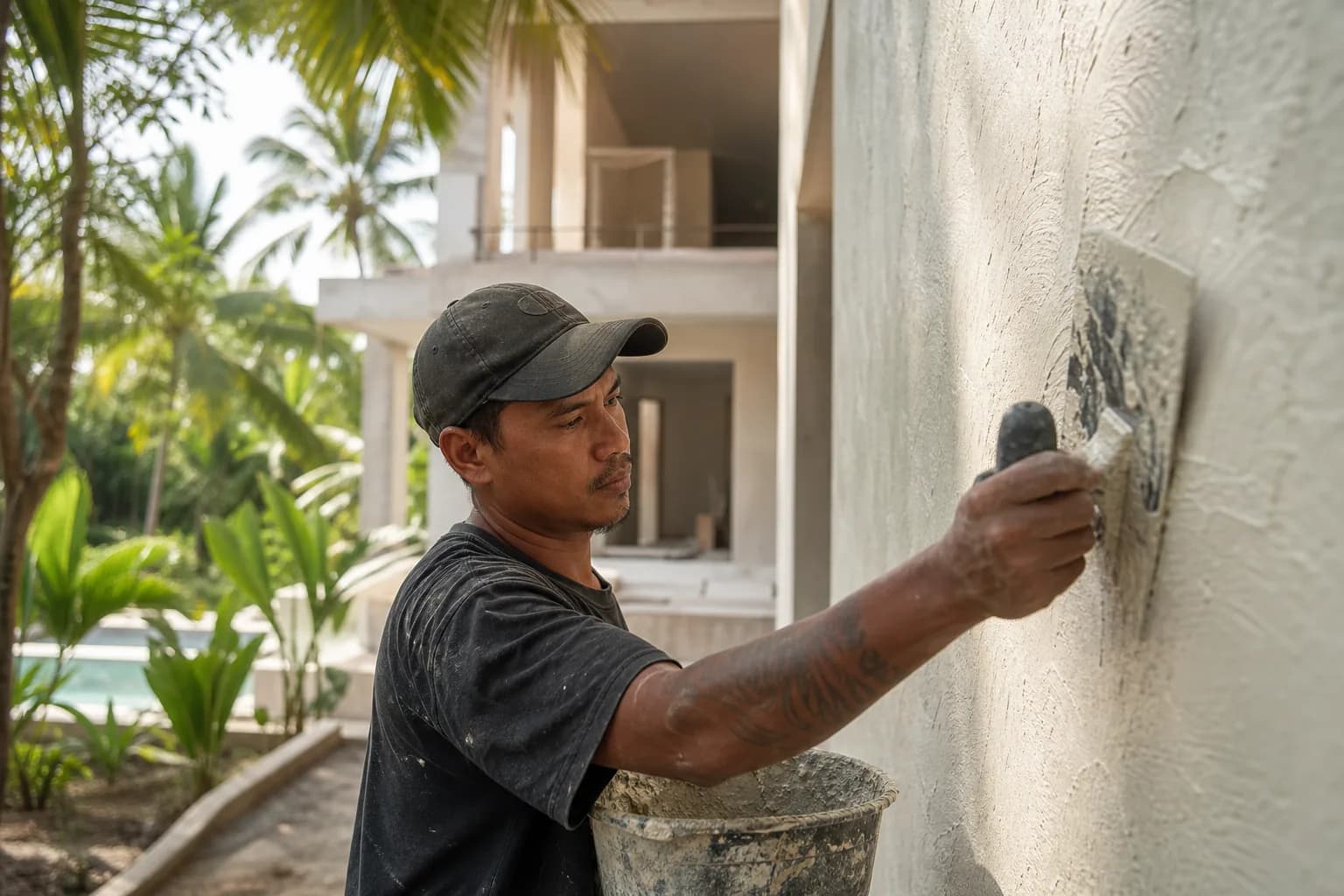
Resin-Infused Plaster Finishes: Anti-Salt Systems Bali
Expert technical guide: Resin-Infused Plaster Finishes: Anti-Salt Systems Bali
8 min read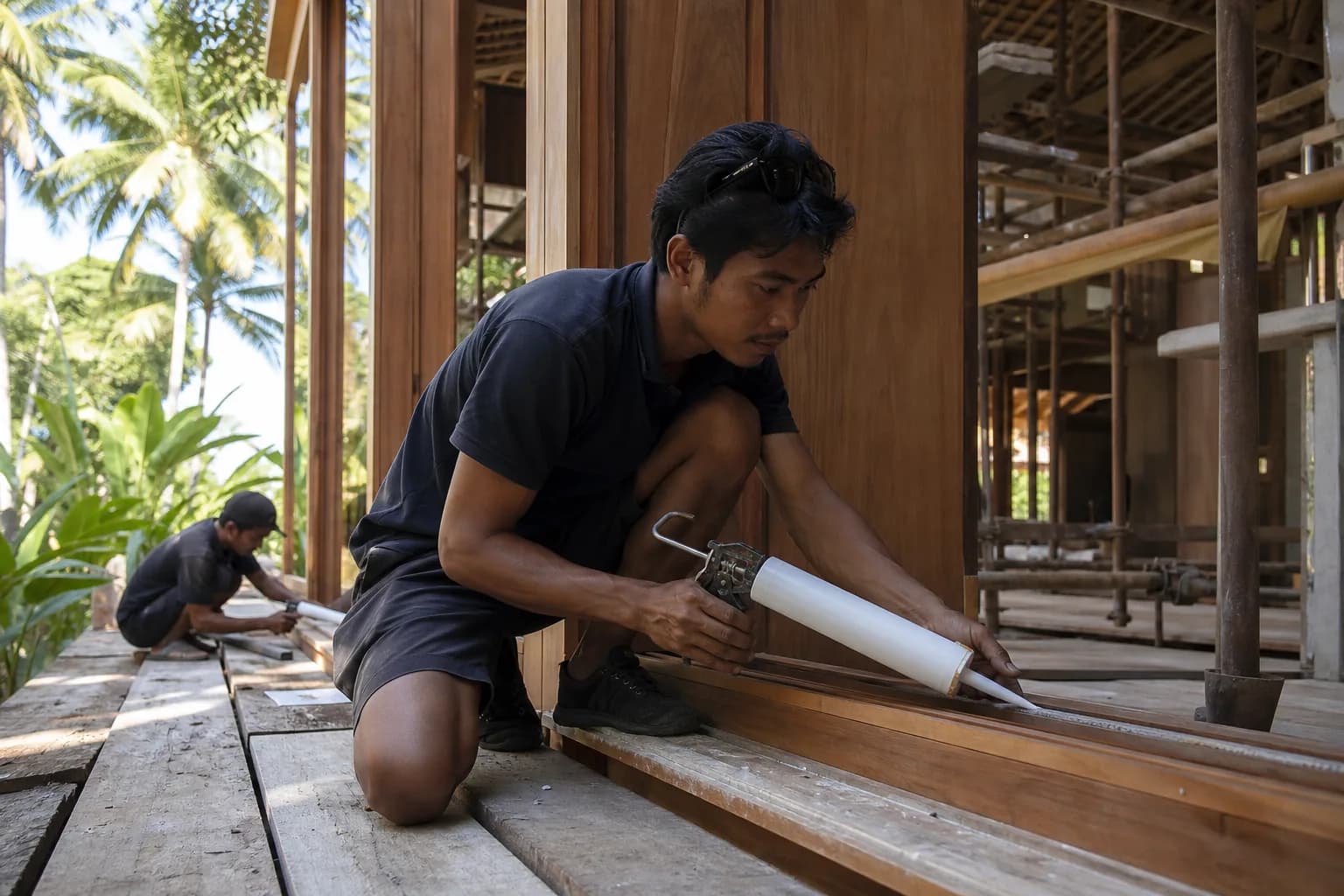
Prefinished Timber Joinery: Silicone Seals Fixings Bali
Professional prefinished timber joinery installation in Bali with silicone seals and fixings for durable weatherproof performance and a premium finish.
10 min read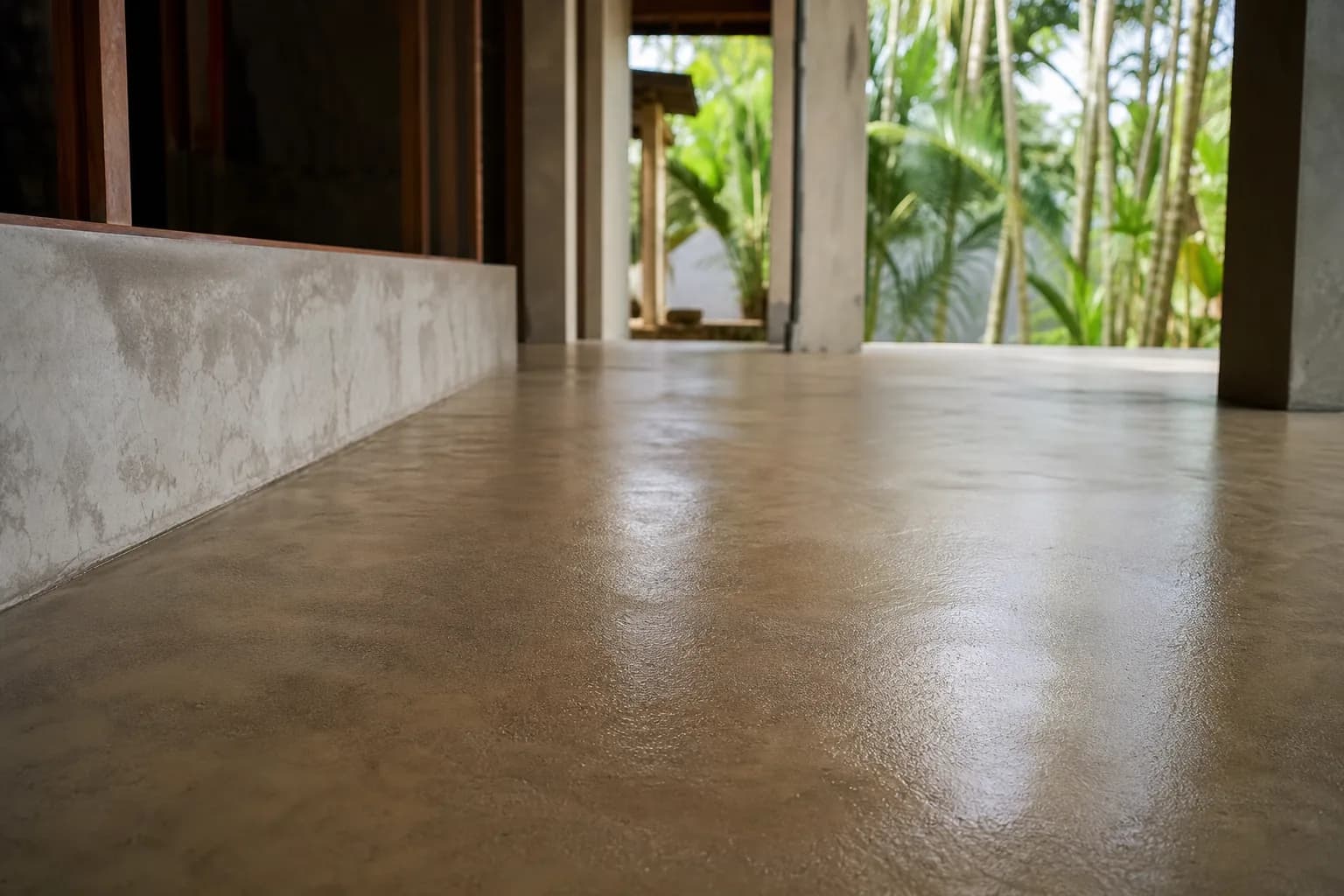
Polished Concrete Microtopping: Surface Prep Sealants Bali
Discover Bali s polished concrete microtopping: expert surface prep, durable sealants, and a flawless finish for modern floors with minimal maintenance.
9 min read