Amed Saltwater Corrosion: Steel Protection Costs Bali
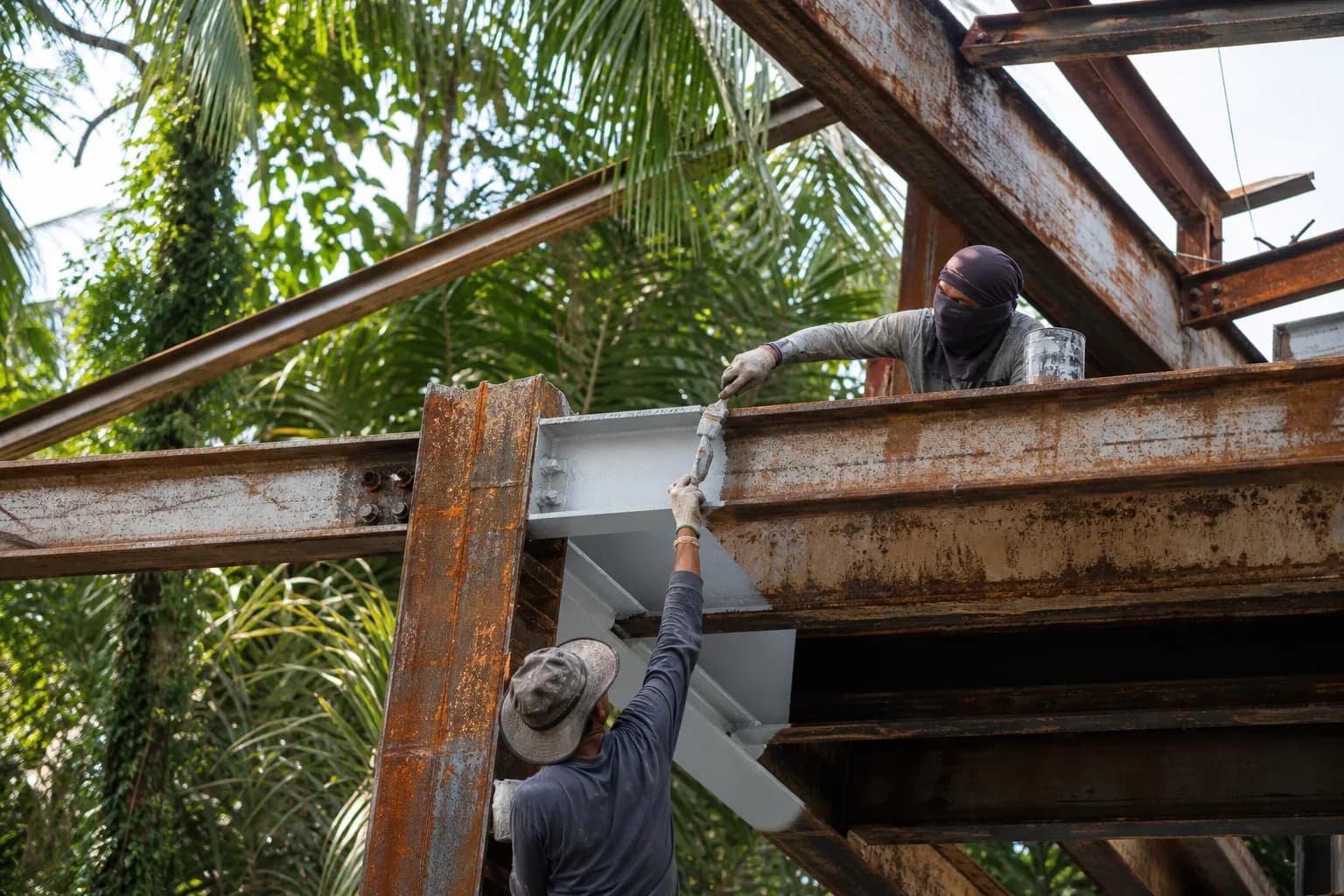
The Invisible Threat: Why Amed’s Coastal Environment Destroys Unprotected Steel Reinforcement
Amed’s dramatic coastline—where black volcanic sand meets turquoise water—creates one of Bali’s most corrosive construction environments. Property developers attracted to this northeastern coastal zone often underestimate a critical engineering challenge: saltwater-accelerated corrosion of steel reinforcement in concrete structures. Within 200 meters of Amed’s shoreline, chloride ion penetration can reduce unprotected rebar lifespan from 50+ years to under 15 years. The question isn’t whether corrosion will occur, but how quickly—and what protection systems justify their upfront cost against catastrophic structural failure. For villa construction in Amed, steel reinforcement protection isn’t optional engineering; it’s the difference between a durable asset and a crumbling liability.
Technical Deep Dive: Saltwater Corrosion Mechanisms in Amed’s Microclimate
Amed’s corrosion environment combines three accelerating factors: direct salt spray from consistent onshore winds, high relative humidity (75-85% year-round), and elevated temperatures that increase electrochemical reaction rates. When chloride ions penetrate concrete cover and reach steel reinforcement, they break down the protective oxide layer that normally prevents corrosion. The resulting iron oxide expansion creates internal pressures exceeding 15 MPa—enough to crack and spall concrete cover.
Chloride Penetration Rates in Amed Coastal Concrete
Research on tropical coastal concrete shows chloride penetration rates of 8-12mm per year in unprotected structures within 100 meters of breaking waves. Amed’s exposure classification falls into XS3 (tidal/splash zones) and XS1 (airborne salt) categories under international standards. At these rates, standard 40mm concrete cover reaches critical chloride threshold concentrations within 3-5 years—well before visible corrosion symptoms appear. By the time rust staining becomes visible on exterior surfaces, internal rebar cross-section may already be reduced by 15-25%.
The electrochemical process accelerates exponentially once initiated. A single corroding rebar acts as an anode, with surrounding passive steel becoming cathodes in a galvanic cell. Moisture and oxygen—abundant in Amed’s climate—complete the circuit. Corrosion current densities in unprotected coastal Bali structures have been measured at 0.5-2.0 μA/cm², rates that translate to steel loss of 5-20 microns annually per exposed surface.
Protection System Categories and Performance Data
Four primary protection strategies exist for Amed coastal construction, each with distinct cost-performance profiles:
- Increased concrete cover with low-permeability concrete: Minimum 50mm cover using concrete with water-cement ratio below 0.40 and minimum 400 kg/m³ cement content. Supplementary cementitious materials (SCMs) like fly ash or silica fume reduce permeability by 40-60%. Service life extension: 15-25 years beyond standard specification.
- Epoxy-coated reinforcement (ECR): Factory-applied fusion-bonded epoxy coating 175-300 microns thick creates physical barrier. Critical vulnerability: coating damage during handling and placement. Field studies show 0.5-2% coating defects even with careful installation, creating localized corrosion cells. Service life extension: 25-40 years when properly installed.
- Stainless steel reinforcement: Austenitic grades (304, 316) or duplex stainless steel provide inherent corrosion resistance through chromium oxide passive layer. Grade 316 with 2-3% molybdenum offers superior chloride resistance. Service life: 75-100+ years in XS3 exposure. Cost premium: 6-8x carbon steel pricing.
- Cathodic protection systems: Impressed current or sacrificial anode systems maintain steel at protective potential. Requires ongoing monitoring and maintenance. Typically specified for remediation rather than new construction due to complexity and lifecycle costs.
Amed-Specific Environmental Factors
Amed’s volcanic geology introduces additional variables. Black sand beaches contain higher iron content than white coral sand, potentially affecting local corrosion chemistry. The area’s limited freshwater resources mean many construction projects use well water with elevated chloride content (500-1500 ppm) for concrete mixing—introducing chlorides directly into the matrix before any external exposure. Proper water testing and treatment becomes critical; using seawater-contaminated mixing water can reduce time-to-corrosion-initiation by 60-70%.
Wind patterns matter significantly. Amed’s dry season (April-October) brings consistent southeast trades that carry salt spray 300+ meters inland. Properties on exposed ridgelines face higher deposition rates than sheltered valley locations, even at identical distances from shore. Site-specific microclimate assessment should inform protection specification—a villa on an exposed bluff requires more robust protection than one sheltered by existing vegetation or topography.
Hidden Risks: What Villa Buyers Miss in Amed Corrosion Planning
The most dangerous assumption in Amed construction is that “concrete is waterproof.” Standard concrete is porous, with capillary networks that actively wick saltwater through wetting-drying cycles. Buyers reviewing architectural renders rarely question rebar specification or concrete mix design—yet these invisible details determine 30-year structural performance.
The False Economy of Standard Specification
Many contractors quote projects using Indonesian standard SNI 2847 minimum requirements: 400mm concrete cover, standard carbon steel rebar, and basic concrete mixes. These specifications were developed for general Indonesian conditions, not Amed’s severe coastal exposure. The cost difference between standard and marine-grade specification might be 8-12% of structural budget—but remediation costs for corrosion damage typically exceed 200-300% of original construction cost. Spalling concrete repairs, rebar replacement, and structural strengthening require invasive demolition, temporary shoring, and extended timelines that make prevention appear remarkably cost-effective in hindsight.
Inspection and Maintenance Gaps
Even with proper initial protection, ongoing monitoring is essential. Chloride ingress is time-dependent and cumulative. Professional structural inspections should include concrete resistivity testing, half-cell potential mapping, and chloride content analysis at 5-year intervals for coastal Amed properties. These assessments cost $1,200-2,500 per inspection but detect deterioration years before visible damage, when intervention costs remain manageable. Most villa owners skip this monitoring entirely, discovering problems only when cosmetic damage appears—typically indicating advanced internal corrosion.
Design Details That Accelerate Corrosion
Architectural features common in Bali villa design can create corrosion hotspots: infinity pools with inadequate waterproofing allow chloride-rich water to saturate adjacent structural elements; decorative water features without proper drainage create permanent moisture exposure; horizontal surfaces without adequate slope retain standing water. Balcony cantilevers and roof overhangs experience severe wetting-drying cycles. These details require enhanced protection beyond general specification, but contractors rarely price them separately unless specifically required.
Step-by-Step Process: Implementing Corrosion Protection in Amed Projects
Phase 1: Site-Specific Exposure Assessment
Before finalizing structural design, conduct environmental exposure analysis. Document distance from shoreline, prevailing wind direction, topographic shielding, and local microclimate. Collect water samples from proposed construction water sources and test for chloride content, sulfates, and pH. This baseline data (cost: $400-800) informs appropriate protection specification. For Amed sites within 200m of shore or on exposed elevations, specify XS3 exposure class as minimum. Sites 200-500m from shore with partial shielding may use XS2 specification. Never use standard XC (carbonation only) exposure classes for any Amed coastal project.
Phase 2: Protection System Selection and Specification
Match protection strategy to project budget, timeline, and performance requirements. For most Amed villa construction, a hybrid approach offers optimal cost-performance: high-performance concrete (HPC) with SCMs as baseline protection, plus epoxy-coated rebar in critical elements (foundations, ground-floor columns, pool structures, exposed beams). Reserve stainless steel for highest-risk details: embedded connection plates, balcony support brackets, and elements where repair would be structurally complex or architecturally destructive.
Specify concrete performance requirements explicitly: minimum 28-day compressive strength 35 MPa, maximum water-cement ratio 0.40, minimum cement content 400 kg/m³, 10-15% fly ash or 5-8% silica fume replacement. Include chloride permeability testing (ASTM C1202) with maximum 2000 coulombs at 56 days. These specifications ensure concrete quality regardless of which local batch plant supplies material.
Phase 3: Quality Control During Construction
Corrosion protection fails most often through poor execution, not inadequate specification. Implement mandatory quality checkpoints: verify epoxy coating integrity before placement (visual inspection of all bars), confirm concrete cover using spacers at 600mm centers (not random placement), test concrete slump and air content at pour (reject non-conforming batches), ensure proper curing (wet curing minimum 7 days or curing compound application). Photographic documentation of rebar placement before concrete pour provides permanent record of as-built cover depths.
Concrete consolidation is critical—honeycomb voids create direct pathways for chloride ingress. Require experienced vibrator operators and supervise all pours personally or through qualified site engineers. In Amed’s heat, concrete can reach initial set within 90 minutes; plan pour sequences to avoid cold joints and ensure continuous placement.
Phase 4: Post-Construction Protection
Apply penetrating silane/siloxane sealers to all exposed concrete surfaces within 28 days of formwork removal. These hydrophobic treatments reduce water absorption by 70-85% without creating impermeable film that traps internal moisture. Reapplication every 5-7 years maintains effectiveness. Cost: $8-15 per square meter including labor. Establish maintenance schedule for joint sealants, waterproofing membranes, and drainage systems—failures in these secondary systems often initiate corrosion by creating localized moisture concentration.
Realistic Cost Analysis: Protection System Pricing for Amed Construction
Cost premiums for corrosion protection vary by system and project scale. For a typical 300m² villa in Amed (approximately 180m³ concrete volume, 18,000 kg reinforcement), protection upgrades add the following to base structural costs:
High-Performance Concrete Upgrade
Transition from standard 25 MPa mix to 35 MPa marine-grade with SCMs: +$25-35 per cubic meter. Total project impact: $4,500-6,300 (approximately 3-4% of structural budget). This baseline upgrade should be considered mandatory for any Amed coastal project.
Epoxy-Coated Reinforcement
ECR pricing runs $1,150-1,400 per ton versus $650-800 for standard carbon steel—a premium of $500-600 per ton. For 18-ton villa project: additional $9,000-10,800. Selective application to critical elements (40% of total rebar) reduces premium to $3,600-4,300 while protecting highest-risk areas.
Stainless Steel Reinforcement (Selective)
Grade 316 stainless at $4,800-5,500 per ton for critical connections and exposed elements. Budget 800-1,200 kg for typical villa: $3,800-6,600. Provides permanent protection for elements where future repair would be structurally complex.
Increased Concrete Cover
Upgrading from 40mm to 60mm cover increases concrete volume by 8-12% and requires larger formwork. Additional cost: $3,200-4,800 for typical villa. Benefit: significantly extends time-to-corrosion-initiation with no ongoing maintenance.
Total Protection Package
Comprehensive corrosion protection (HPC + selective ECR + critical stainless details + increased cover + surface treatment) adds $22,000-32,000 to a 300m² Amed villa—approximately 8-12% of total structural cost. Compare this to corrosion remediation costs of $85,000-150,000+ for major repairs after 12-18 years of unprotected exposure. The economic case for prevention is overwhelming, yet many projects skip these measures to meet initial budget targets.
Frequently Asked Questions: Amed Saltwater Corrosion Protection
How far from Amed’s coastline does saltwater corrosion remain a critical concern?
Airborne salt deposition remains significant up to 500 meters from breaking waves in Amed’s wind-exposed areas. Properties within 200m face severe exposure (XS3 classification) requiring maximum protection. Sites 200-500m experience moderate exposure (XS2) still demanding enhanced specification beyond standard Indonesian building codes. Even properties 500-1000m inland should use marine-grade concrete due to Amed’s consistent onshore winds and salt-laden air. Only sites beyond 1km with topographic shielding can consider reduced protection specifications, and even then, water source chloride content must be verified.
Can I add corrosion protection after construction if I initially built with standard specification?
Retrofitting corrosion protection is possible but expensive and limited in effectiveness. Options include cathodic protection systems ($180-280 per square meter of concrete surface), electrochemical chloride extraction (similar cost, temporary benefit), or concrete removal and replacement (often exceeding new construction cost). Surface treatments like sealers provide minimal benefit once chlorides have penetrated to rebar depth. The most cost-effective approach is always proper initial specification. If you’ve purchased an existing Amed property with unknown corrosion protection, commission a structural condition assessment ($2,200-3,800) including chloride profiling and half-cell potential testing to establish current condition and remaining service life.
Does using local Amed black sand in concrete affect corrosion rates?
Volcanic black sand con
 3173 m²6 month(s)from 125.000 USD
TALA FOUR
 3124 m²6 month(s)from 123.000 USD
TALA 8
 172 m²8 month(s)from 120.000 USD
Keshava
 2144 m²11 month(s)from 104.000 USD
Narayana
 164 m²7 month(s)from 79.000 USD
Private: Haridas Villas, Tegallalang
 3180 m²7 month(s)from 142.000 USD
Vasudeva
 3104 m²11 month(s)from 99.000 USD
TALA 100
 3127 m²9 month(s)from 177.000 USD
Mukunda
 4344 m²16 month(s)from 290.000 USD
Radha

Want to calculate?
 1from 198.000 USD
Private: Haridas Villas
164 m²7 month(s)from 79.000 USDTALA TWO
Start With Real Numbers, Not Guesses
Before buying land or finalizing a design, check the realistic build cost range for your project in Bali.
Our team reviews your inputs and gives a grounded estimate.
Available lands
 700 m²15 min$ 162500Bali, Tabanan
 1230 m²15 min$ 132543Bali, Tegallalang
 200 m²11 min$ 89286Bali, Tabanan
 2400 m²7 min$ 496552Bali, Canggu
 2500 m²5 min$ 609606Bali, Kedungu
 5028 m²10 min$ 361000Bali, Ubud
 1000 m²10 min$ 280788Bali, Pecatu
 615 m²15 min$ 113608Bali, Tabanan
 8313 m²15 min$ 716670Bali, Buduk
 3254 m²5 min$ 631800Bali, All
 13000 m²1 min$ 920567Bali, Pekutatan
 2000 m²15 min$ 110837Bali, Karangasem
 5000 m²8 min$ 424877Bali, Ungasan
 1362 m²15 min$ 335468Bali, Tumbak
 500 m²2 min$ 175862Bali, Cemagi
Essential Bali build & buy guides
- Bali villa construction cost per m² in 2026
- How much will your villa cost? Calculator
- Building a villa in Bali: the complete guide
- Buying land in Bali: step-by-step for foreigners
- Bali villa investment: yields, risks, returns
- Leasehold vs freehold: what foreigners can own
- Construction defect liability & 10-year warranty
- Bali building codes and construction standards
Related guides
Resin-Infused Plaster Finishes: Anti-Salt Systems Bali
Expert technical guide: Resin-Infused Plaster Finishes: Anti-Salt Systems Bali
8 min read
Prefinished Timber Joinery: Silicone Seals Fixings Bali
Professional prefinished timber joinery installation in Bali with silicone seals and fixings for durable weatherproof performance and a premium finish.
10 min read
Polished Concrete Microtopping: Surface Prep Sealants Bali
Discover Bali s polished concrete microtopping: expert surface prep, durable sealants, and a flawless finish for modern floors with minimal maintenance.
9 min read